
As an Amazon Associate I earn from qualifying purchases. All claims are strictly my personal opinion.
My top pick

A large silicone-free cloth with a light adhesive for the last wipe before stain, primer or an oil-based finish.

A tack cloth is a wiping cloth treated with a sticky resin so it lifts the fine dust, dirt and lint that sanding leaves behind, right before you stain, paint or clear coat. Use one after you’ve vacuumed, with a light touch, and check the pack for your finish type: some makers sell cloths that are compatible with water-based paints, and some resins can interfere with paint. When a damp cloth or a vacuum does the same job, you can skip it, and the finish makers below say so themselves.
This guide covers what a tack cloth is made of, when it’s worth using, when to leave it in the drawer, how to use one step by step, the alternatives, how to clean wood after sanding, and the tack cloths I’d buy.
⚡ Quick Answer
Buy: 3M Tack Cloth or Trimaco 10501 for general prep, Gerson Blend Prep when you want a synthetic cloth that won’t fray.
Skip it: when you’re finishing with water-based products and your cloth doesn’t say it’s compatible. A vacuum and a clean damp microfiber cloth are what General Finishes and Minwax describe.
Technique: vacuum first, then wipe lightly. Pressing hard is the mistake.
What Is a Tack Cloth?
A tack cloth is a cloth with a slightly tacky treatment on it. Wikipedia describes it as a wiping cloth treated with a tacky material that removes loose dust, dirt and lint from surfaces before painting, coating or finishing. The cloth itself is usually cotton gauze, with continuous-filament synthetic and nonwoven versions as alternatives. The tack is a resinous material, often a petroleum derivative, which can be solvent-based, water-based or hot-melt. The same page says “beeswax,” “varnish” and “lacquer” are common misnomers for it.
What Does It Have On It?
A resin, not wax, and the formula changes by brand. Trimaco says its Pro Blue cloth is 100% cotton mesh and wax and silicone free. Gerson’s Amazon listing describes its Blend Prep cloths as synthetic and medium tack, and 3M’s listing says its cloth is silicone free with a light adhesive. Makers don’t publish their resins on the pack, so if a finish is sensitive, the label and the manufacturer’s site are your only evidence.
Why It Works Where a Dry Rag Doesn’t
Fine sanding dust floats and then settles into the grain. A dry rag pushes it around; a tacky cloth picks it up. That’s the reason people reach for one before the last coat, when a single speck becomes a bump you can see and feel.
When to Use a Tack Cloth
Use one at the last step of surface prep, after the bulk of the dust is already gone:
- Before stain or paint on bare wood. The finish locks in whatever is on the surface. My guide to how to stain wood shows where the dust step sits, and pre-stain wood conditioner goes before the stain.
- Before oil-based or solvent-based finishes, where you’d rather not put water on the wood.
- Between coats, after scuff sanding. See sanding between coats of polyurethane and sanding between coats of paint.
- Before filler or repairs. 3M’s own data sheet for Bondo Wood Filler says to brush off the sanding dust and wipe the repair area with a Bondo tack cloth.
General Finishes’ instructions for its water-based topcoat Enduro-Var II say to remove dust, both before applying and between coats, with a vacuum, compressed air, an oil-free tack cloth or a water-dampened rag. That sentence is the whole decision in one line: a tack cloth is one of four accepted choices, and the finish maker names it with a qualifier.
When to Skip It
I’d leave the tack cloth out in these cases:
- The pack doesn’t say it works with your finish. Trimaco states that its Pro Blue cloth is compatible with water-based paints. Wikipedia notes that some tack treatments can leave residues from free oils or evaporating solvents and can interfere with paint. If I can’t confirm the cloth for a water-based finish, I’d use a vacuum and a damp cloth instead.
- You haven’t vacuumed yet. A tack cloth is a finishing step, not a dust collector. Loaded with heavy dust, it stops picking up and starts smearing.
- Softer woods are clogging it. Wikipedia says tack cloth must be changed frequently with softer woods. Swap for a fresh cloth or switch method.
- A damp cloth is already your finish maker’s instruction. Minwax’s wood preparation article offers a bristle-attachment vacuum or a damp cloth for sanding dust, and does not mention tack cloths on that page.
How to Use a Tack Cloth
Step 1: Vacuum First
Minwax’s preparation advice is to use a bristle attachment on a vacuum to capture the dust. Do the surface, the edges and the corners. If you need a vacuum for this, I compare them in best shop vac for dust collection.
Step 2: Unfold It
Open the cloth out and then loosely fold it into a pad. A loose pad gives you fresh, tacky surfaces to turn to.
Step 3: Wipe Lightly
Trimaco’s directions for its Pro Blue cloth: lightly wipe your surface prior to painting to remove any dust, dirt or loose particles, do not use too much pressure, and let the sticky resin do the work. It also recommends gloves, since it is a low-tack cloth.
Step 4: Refold as It Loads
When the face looks gray, turn to a clean fold. When the whole cloth is loaded, it’s done.
Step 5: Store or Replace It
Trimaco says that if a cloth can be reused, you can store it in a closed jar or plastic bag to keep it from drying out, and that after the base coat the surface should be completely dry before you reuse the cloth on the next coat. It gives no number of reuses, so I don’t either: replace the cloth when it stops picking up or leaves a film.
Tack Cloth Alternatives
| Method | Who describes it | Best use |
|---|---|---|
| Vacuum with bristle attachment | Minwax; General Finishes | First pass on every job |
| Damp cloth or water-dampened rag | Minwax; General Finishes | Water-based finishes, as long as the wood dries before you coat |
| Compressed air | General Finishes | Pores, carvings and corners, outdoors or with a mask |
| Oil-free tack cloth | General Finishes | Final wipe before the coat goes on |
| Mineral spirits on a rag | Not stated on the Minwax and General Finishes pages I read | Only if your finish’s label asks for it |
Damp Microfiber
A clean microfiber cloth wrung out until it’s barely damp covers the same ground as a water-dampened rag. Let the wood dry fully before staining or coating. General Finishes’ instruction for water-based topcoats uses exactly this wording: remove dust, then let the surface dry.
Air and Vacuum
These move or remove dust but leave nothing behind, which is what makes them the first step even when you plan to use a tack cloth after.
How to Clean Wood After Sanding
The order that holds up across the finish makers I read:
- Vacuum the surface and the edges with a bristle attachment (Minwax).
- Blow out pores and corners with compressed air if you have it (General Finishes).
- Wipe with an oil-free tack cloth or a water-dampened rag, whichever suits your finish (General Finishes).
- Let it dry if you used a damp cloth, then coat.
- Check at an angle. Hold a light low across the surface; dust shows up as a haze. This is my habit, not something from a maker.
For the sanding that comes before all this, my how to sand wood guide covers the grit sequence and the dust between grits. The “what to do after sanding wood” question is this checklist.
The Tack Cloths I’d Buy
3M Tack Cloth, 17 in x 36 in
Best General-Purpose Tack Cloth
The cloth I’d pick first for furniture, trim and cabinet doors you’re about to stain or finish with an oil-based product. The Amazon listing gives the size as 17 by 36 inches and describes a silicone-free cloth with a light adhesive, meant for metal, plastic, fiberglass or wood before priming and painting. I haven’t found a 3M statement on water-based compatibility, so for water-based finishes I’d use a damp cloth instead.
- ✅ Large cloth that folds into several fresh faces
- ✅ Silicone free, per the listing
- ❌ Water-based compatibility not stated by 3M that I could find
Best For: Stain and oil-based finishes on furniture and trim.
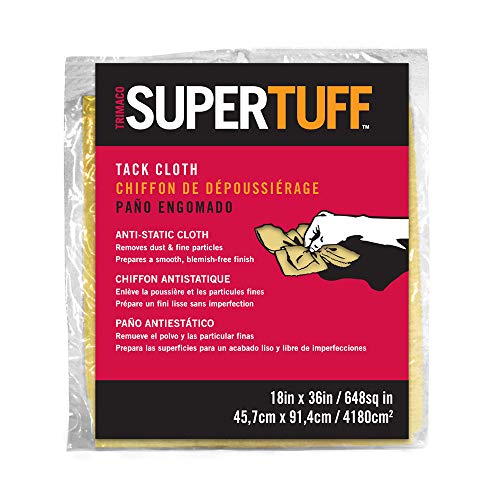
Trimaco 10501 Tack Cloth, 18 in x 36 in
Best Pick for Painters
Trimaco is a painter’s supply brand that publishes usage directions I can cite: wipe lightly, no heavy pressure, store in a closed jar or bag. The Amazon listing for the 10501 describes a resin-impregnated cloth for primers, sealers, urethane and other coatings, individually sealed, and reusable if it isn’t filled with dust, sealed in a bag between uses. The water-based compatibility claim I found on Trimaco’s site is for its separate Pro Blue cloth, so if that matters to you, check the pack.
- ✅ Maker publishes clear wipe and storage directions
- ✅ Individually sealed, so it keeps its tack on the shelf
- ❌ The water-based claim I found is for Pro Blue, not this cloth
Best For: Painters prepping trim, doors and cabinets.
Gerson Blend Prep Dry Tack Cloths, 12 Pack

Best Synthetic Option
The Amazon listing names these dry tack cloths and describes them as synthetic and medium tack, lint free with no fraying or loose strings, 9 by 18 inches with 16 usable surfaces. It says they are formulated for cleaning metal before painting, so they lean toward auto and metal work, and the 12 count suits a project with several coats. I couldn’t open a Gerson page of its own, so use the pack’s label for finish compatibility on wood.
- ✅ Synthetic cloth that won’t fray or leave strings
- ✅ 12 pack with 16 usable surfaces per cloth
- ❌ Listed for metal prep; no maker page found for wood finishes
Best For: Multi-coat finishing jobs where you want fresh cloths on hand.
Amazon Basics Microfiber Cleaning Cloths

Best Tack Cloth Alternative
For water-based finishes, General Finishes and Minwax both describe a damp cloth for sanding dust. A pack of clean microfiber cloths gives you that without any resin on the surface. Wring a cloth out until it’s barely damp, wipe, and let the wood dry before you coat.
- ✅ No tacky resin on the wood
- ✅ Washable and reusable
- ❌ Adds moisture, so the wood has to dry before you finish
Best For: Water-based stains, paints and topcoats.
🏆 My Verdict
Vacuum first, always. Then a light wipe with a tack cloth before stain or oil-based finishes, and a damp microfiber cloth for water-based ones unless your tack cloth’s pack says it’s compatible. Wipe lightly, store the cloth closed, and replace it when it stops picking up.
❓ Frequently Asked Questions
What does tack cloth have on it?+
What is an alternative to tack cloth?+
Can you paint right after using a tack cloth?+
Are you supposed to wet a tack cloth?+
How many times can you reuse a tack cloth?+
Conclusion
A tack cloth is the last wipe, not the first. Vacuum the dust, wipe lightly with a cloth your finish allows, and let a damp microfiber cloth cover the water-based jobs. For the sanding that comes before it, see how to sand wood.

