
As an Amazon Associate I earn from qualifying purchases. All claims are strictly my personal opinion.
Best biscuit joiner

A 6.5 A joiner with a rack-and-pinion fence that tilts 0 to 90 degrees and stays parallel to the blade.

A biscuit joiner (also called a plate joiner) cuts matching half-moon slots in two pieces of wood. You glue a compressed beech biscuit into the slots, the biscuit swells with the glue, and the boards line up flush and stay there while the clamps go on. The best biscuit joiner for most woodworkers is the DEWALT DW682K, because its rack-and-pinion fence keeps the blade parallel at any height. The Makita PJ7000 is the lighter corded alternative, the Makita XJP03Z is the best cordless joiner and the WEN JN8504 is the best budget pick.
Below are five biscuit joiners and one upgrade for when biscuits aren’t enough, a comparison table, reviews from the makers’ specifications, a buying guide and step-by-step instructions for your first biscuit joints.
Best Biscuit Joiners: Comparison
Specs come from the makers’ product pages; where a maker gives a detail only on its Amazon listing, it comes from that listing. I don’t print prices: each review gives a market tier, and the Amazon buttons show the live price.
| Product | ⭐ DEWALT DW682K 🏆 EDITOR’S CHOICE |
Makita PJ7000 | Makita XJP03Z | WEN JN8504 | WEN 20648 | Festool Domino DF 500 Q |
|---|---|---|---|---|---|---|
| Image | |
 |
 |
 |
 |
 |
| Power | Corded, 6.5 A | Corded, 5.6 A | 18V LXT (tool only) | Corded, 8.5 A | 20V Max, 4.0Ah kit | Corded |
| Speed | 10,000 RPM | 11,000 RPM | 12,000 RPM | 10,000 RPM | 8,500 RPM | Rotating and oscillating cutter |
| Blade | 4″ carbide | 4″ carbide | 4″ carbide | 4″ carbide | 4″ carbide, 6 teeth | 5 mm cutter installed |
| Fence | Tilts 0-90°, 45° notch | Stops at 0°, 45°, 90° | Stops at 0°, 45°, 90° | Adjustable height and angle | 0-90°, variable height | 0-90°, stops at 22.5°, 45°, 67.5° |
| Biscuit sizes | Preset stops, common sizes | #0, #10, #20 (6 depths) | #0, #10, #20 (6 depths) | #0, #10, #20 presets | #0, #10, #20 (6 stops) | Domino tenons, not biscuits |
| Warranty | 3 years | 1 year (listing) | 3 years | 2 years | 2 years | See Festool |
| Availability | Shop Now at Amazon | Shop Now at Amazon | Shop Now at Amazon | Shop Now at Amazon | Shop Now at Amazon | Shop Now at Amazon |
Best Biscuit Joiners: Reviews
Every pick could be ordered on Amazon when I checked it. Lamello, the Swiss company that invented the biscuit joint, makes the best-known premium joiners, but on Amazon they were only offered by third-party sellers in short supply, so I left them out. Porter-Cable’s 557 has disappeared from Amazon apart from spare parts.
Editor's ChoiceCorded biscuit joiner
DEWALT DW682K
DEWALT DW682K 6.5 Amp Plate Joiner Kit
A rack-and-pinion fence that tilts 0 to 90 degrees and stays parallel to the blade. The biscuit joiner to buy once.
Shop Now at AmazonSpecs: DEWALT
Best for
Accurate, repeatable slots for panels, tabletops and cabinets.
- Rack-and-pinion fence stays parallel
- Flush cuts without removing the fence
- Anti-slip pins, 3-year warranty
Skip it if
You want cordless: the Makita XJP03Z is the pro-grade battery option.
- Heavier than the budget joiners
- Dust bag fills fast without a vac
Read full review
Best Biscuit Joiner Overall
The DW682K is one of the longest-running biscuit joiners on the market, and the reason it has lasted is its fence. DEWALT uses an integral one-piece fence that tilts from 0 to 90 degrees and rides on a dual rack and pinion, so the blade and fence stay parallel as you raise or lower it. That’s what keeps slots in two mating boards at the same height, which is the whole job. You can make flush cuts at 0 degrees without removing the fence, and a 45-degree locating notch lets you index off the outside face of a mitered joint. The 6.5 A motor runs at 10,000 RPM with a carbide blade, preset depth stops cover the common biscuit sizes, and retractable anti-slip pins keep the joiner from creeping as you plunge. A non-marring aluminum shoe lets you clamp it upside down for stationary work on small parts. The kit includes a dust bag, vacuum adapter and kit bag, with DEWALT’s 3-year limited warranty. Mid price tier.
Corded plate joiner
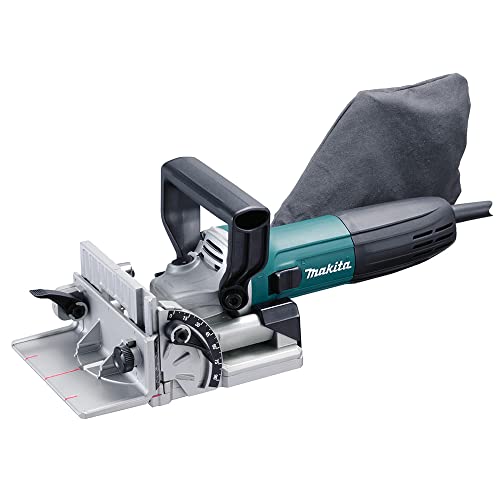
Makita PJ7000
Makita PJ7000 Plate Joiner
A lighter corded joiner with positive fence stops at 0, 45 and 90 degrees and six depth settings.
Shop Now at AmazonSpecs: Makita
Best for
A light corded joiner with positive angle stops.
- Positive stops at 0, 45 and 90 degrees
- Light at 5.5 lb
- Tool-free blade changes
Skip it if
You want the longest warranty: the DEWALT carries three years.
- 1-year warranty on the Amazon listing
- Lower-amp motor than the WEN corded
Read full review
Best Lightweight Corded Biscuit Joiner
The PJ7000 is the main rival to the DEWALT, and it’s lighter at 5.5 lb. Makita fits a cast aluminum pivot fence with three positive stops at 0, 45 and 90 degrees, so the common angles click into place instead of being set by eye, and a rack-and-pinion vertical fence system for height. The 5.6 A motor spins the 4″ carbide-tipped blade at 11,000 RPM, a little faster than the DEWALT, and the maximum cutting depth is 3/4″. Six depth settings with one-touch stops cover #0, #10 and #20 biscuits and other common sizes, and blade changes are tool-free thanks to the blade cover and a shaft lock. A dust port connects to a vacuum. The kit includes the blade, an angle guide, a dust bag and a tool case. Makita’s Amazon listing gives a 1-year warranty for this corded tool. Mid price tier.
Cordless plate joiner (18V)
Makita XJP03Z
Makita XJP03Z 18V LXT Cordless Plate Joiner
The PJ7000's fence and depth stops on Makita's 18V battery, at 12,000 RPM. Best if you already own LXT batteries.
Shop Now at AmazonSpecs: Makita
Best for
Cordless biscuit joining on a battery platform you already own.
- No cord to drag over panels
- 12,000 RPM, positive fence stops
- 3-year warranty
Skip it if
You don't own Makita batteries: the WEN 20648 kit includes one.
- Tool only, battery extra
- Heaviest joiner here with a battery
Read full review
Best Cordless Biscuit Joiner
A cordless biscuit joiner makes sense because the tool moves around a big panel or an assembled cabinet, and a cord catches on every edge. The XJP03Z is the cordless version of the PJ7000 on Makita’s 18V LXT platform, and it runs faster: 12,000 RPM with the same 4″ carbide-tipped blade and 3/4″ maximum depth. The cast aluminum pivot fence has positive stops at 0, 45 and 90 degrees and centers easily on 3/4″ stock, the vertical fence is rack-and-pinion, and six depth settings cover #0, #10, #20 and other common biscuits. It weighs 6.7 lb with a battery. This is the tool only: battery and charger are sold separately, so it’s best value if you already own Makita 18V tools. Makita gives it a 3-year limited warranty. Upper price tier.
Budget corded biscuit joiner
WEN JN8504
WEN JN8504 8.5 Amp Plate and Biscuit Joiner
An 8.5 A joiner with presets for the three standard biscuits and a bundle of #20s. The low-cost way to start.
Shop Now at AmazonSpecs: WEN
Best for
Occasional edge-gluing and DIY furniture on a budget.
- Low price with biscuits included
- Presets for #0, #10, #20
- Two-year warranty
Skip it if
You join miters and casework often: the DEWALT's fence is more precise.
- No rack-and-pinion fence or angle stops
- Check the fence for square before use
Read full review
Best Budget Biscuit Joiner
If you’ll cut biscuit slots a few times a year, mostly to align boards in a glued-up tabletop, the WEN JN8504 does that job for a fraction of the DEWALT’s price. WEN lists an 8.5 A motor turning a 4″ carbide-tipped blade at 10,000 RPM, an adjustable fence that sets slot height and angle, and preset stops for #0, #10 and #20 biscuits. The set comes with a dust bag, a molded case and 50 assorted biscuits, and this Amazon bundle adds a 100-pack of WEN #20 birch biscuits, the size you’ll use most. WEN backs it with a two-year warranty. The trade-off is in the fence: it lacks the DEWALT’s rack-and-pinion and the Makitas’ positive angle stops, so check that it’s square and parallel before each session. Budget price tier.
Budget cordless kit (20V)
WEN 20648
WEN 20648 20V Max Cordless Plate and Biscuit Joiner Kit
A complete cordless kit with battery and charger, six depth presets and a 0 to 90 degree fence, at a budget price.
Shop Now at AmazonSpecs: WEN
Best for
A cordless biscuit joiner with the battery in the box, on a budget.
- Battery and charger included
- Six depth presets
- Lighter than the Makita cordless
Skip it if
You already own Makita 18V tools: the XJP03Z is the better joiner.
- Slower 8,500 RPM motor
- WEN 20V platform is smaller than Makita's
Read full review
Best Budget Cordless Biscuit Joiner
The WEN 20648 is the cheapest complete cordless biscuit joiner here, because the kit includes the 20V Max 4.0Ah battery and a charger. The battery has an onboard charge gauge and fits WEN’s other 20V Max tools. WEN rates the motor at 8,500 RPM with a 4″ 6-tooth carbide-tipped blade, slower than the corded tools but enough for clean slots in hardwood at a steady feed. The fence sets 0 to 90 degrees with variable height, and six preset stops cover #0, #10 and #20 biscuits or can be set by hand for other sizes. The kit also has a dust bag, a dust chute adapter, a starter set of biscuits and a tool bag, with a two-year warranty. At about 5.9 lb, it’s lighter than the Makita cordless with its battery. Budget price tier.
Loose-tenon joiner
Festool Domino DF 500 Q
Festool Domino DF 500 Q Joiner
A loose-tenon joiner that cuts mortises for solid hardwood tenons: strength a biscuit can't give, at a premium price.
Shop Now at AmazonSpecs: the seller's Amazon listing
Best for
Furniture joints that need strength as well as alignment.
- Structural joints, not just alignment
- Indexing pins for fast layout
- Pivoting fence with angle stops
Skip it if
You mainly glue up panels and tabletops: a biscuit joiner does that for far less.
- Premium price, plus tenons and cutters
- Overkill for edge-glued panels
Read full review
Best Upgrade From a Biscuit Joiner
The Domino isn’t a biscuit joiner, and that’s why it’s here: it’s what many woodworkers buy when biscuits stop being enough. Instead of a curved slot for a compressed beech wafer, it cuts a mortise for a loose tenon, a solid hardwood Domino that adds real strength to frames, chairs and table aprons, not just alignment. Festool’s cutter rotates and oscillates at the same time to plunge a clean, flat-sided mortise. A dial adjusts mortise width so you can leave slack for alignment when joining panels, the pivoting fence sets 0 to 90 degrees with stops at 22.5, 45 and 67.5 degrees, and indexing pins register off the edge of the workpiece for fast, repeatable spacing. A hose port connects to an extractor. The DF 500 ships with a 5 mm cutter installed; other sizes and tenon assortments are extra. Premium price tier, several times a biscuit joiner.
How I Chose These Biscuit Joiners
I started from what a biscuit joiner is for: aligning edge-glued panels, locating parts in cabinet and box joints, and reinforcing miters. Then I looked at the joiners sold on Amazon today from established brands and picked the best all-rounder, a lighter corded model, a cordless joiner on a major battery platform, a budget corded and a budget cordless joiner, plus the loose-tenon joiner many woodworkers move up to. I compared motor, speed, blade, fence design, depth stops and warranty from the makers’ specifications. I don’t show customer ratings or prices. For how I pick products across the site, see how I choose.
How to Choose a Biscuit Joiner
The Fence Matters Most
A biscuit joint only works if the slot sits at exactly the same height in both boards, and the fence decides that. Look for a fence that stays parallel to the blade as you adjust it (the DEWALT’s dual rack and pinion, the Makitas’ rack-and-pinion vertical system), and positive stops at 0, 45 and 90 degrees if you’ll join miters. A fence that racks slightly out of parallel puts the slot at a different height at each end, and the boards won’t sit flush.
Depth Stops and Biscuit Sizes
Standard biscuits come in three sizes: #0 (about 47 mm long), #10 (about 53 mm) and #20 (about 56 mm). Use the biggest one that fits the joint: #20 for panels and casework in 3/4″ stock, #10 and #0 for narrower face frames and thinner parts. Every joiner here has preset depth stops for those three sizes; set the dial, and the joiner cuts a slot slightly deeper than half the biscuit, so it has room for glue. WEN sells #20 birch biscuits in 100-packs, and Trend has a 1,000-pack of #20 beech biscuits if you glue up a lot of panels.
Corded or Cordless
Biscuit slots are short, light cuts, so battery life isn’t a problem: a cordless joiner cuts dozens of slots per charge. The advantage is handling: the tool travels around a wide panel or into an assembled cabinet without a cord catching on edges and clamps. If you already own Makita 18V tools, the XJP03Z is the obvious choice. If you don’t, the WEN 20648 kit includes its battery and costs less than a Makita battery and charger alone. Corded joiners cost less for the same quality and never stop for a charge.
Dust Collection
A biscuit joiner throws chips out of a small port at high speed, usually straight at the bench. Every joiner here has a dust bag; connecting a shop vac through the adapter works much better and keeps the slot clear, which matters because chips left in a slot stop the biscuit from seating. A shop vac with a small hose fits most joiner ports with an adapter.
💡 Pro Tip: Keep Biscuits Away From the Final Edge
Biscuits swell with water-based glue. If a slot is too close to an edge you’ll cut or plane later, the biscuit can show, and a joint sanded too soon can “telegraph” a small bump over each biscuit as the swelling settles. Keep biscuits a couple of inches in from any edge you’ll trim, and let a glued panel dry overnight before you level it with a random orbital sander.
How to Use a Biscuit Joiner
These steps are for the most common job, edge-gluing boards into a panel or tabletop; casework and miters follow the same idea with the fence set to the angle.
- Lay out the boards in the order you’ll glue them, flip and swap until the grain looks right, and draw a large triangle across the whole panel so you can put them back in order.
- Mark slot centers across each joint with a pencil: one line across both boards, every 8″ to 10″ along the joint and about 2″ in from each end.
- Set the depth to the biscuit size, usually #20 for 3/4″ stock.
- Set the fence height so the blade is centered in the board’s thickness. Always reference from the same face, the top face of the panel, on every board, so any small error is the same on both sides of the joint and the faces still line up.
- Cut the slots: hold the joiner flat on the bench or fence on the face, line up the center mark with the mark on the joiner’s faceplate, start the motor and plunge smoothly, then let it spring back.
- Dry-fit first with biscuits in place and clamps on, to check the joints close and the faces sit flush.
- Glue and clamp: put glue in the slots and along the edges, insert the biscuits, close the joints and clamp across the panel with even pressure. Work quickly, because the biscuits start swelling as soon as they meet glue. My guide to woodworking clamps covers which clamps to use for panels.
How Deep Should the Biscuit Slot Be?
Slightly more than half the biscuit’s width in each piece, which is what the preset stops do. For a #20 biscuit, that’s a little over 1/2″ deep in each board. A slot cut too shallow leaves a gap in the joint that clamps can’t close; too deep and the biscuit sits loose and does nothing for alignment.
Biscuits vs Pocket Holes vs Dominoes
Biscuits are for alignment: they keep the faces of edge-glued boards flush and parts in register during glue-up, and they’re hidden. In long-grain edge joints, the glue line itself is stronger than the wood, so a biscuit adds alignment more than strength. Pocket holes add strength and clamp the joint with a screw, which is why they’re the faster choice for face frames and cabinet boxes; the trade-off is a visible pocket. My best pocket hole jig guide covers those. A Domino cuts a mortise for a solid tenon and adds real strength to frames, chairs and tables, at several times the price of a biscuit joiner. Many shops end up with a biscuit joiner for panels and a pocket hole jig for casework, and move to a Domino only for furniture joinery.
🏆 The Verdict
The best biscuit joiner for most woodworkers is the DEWALT DW682K: a rack-and-pinion fence that stays parallel at any height, flush cuts without removing the fence and a 3-year warranty. The Makita PJ7000 is lighter with positive angle stops, the Makita XJP03Z is the cordless pick for Makita 18V owners, and the WEN JN8504 and WEN 20648 are the budget corded and cordless options. When you want strength as well as alignment, the Festool Domino DF 500 Q is the step up.
❓ Frequently Asked Questions
What is a biscuit joiner for?+
Are biscuit joints stronger than screws?+
How deep should the biscuit slot be?+
What is better than a biscuit joiner?+
What is the best biscuit joiner for the money?+
What size biscuits should I use?+
Conclusion
Choose a biscuit joiner by how often you’ll use it and how much you trust the fence. For regular panel and casework glue-ups, the DEWALT DW682K is the one to own; the Makitas are the lighter and cordless alternatives; and the WEN joiners are a sensible low-cost start. Reference every slot from the same face, dry-fit before glue, and let the panel dry before you sand it flat. Questions about your project? Ask in the comments.
