As an Amazon Associate I earn from qualifying purchases. All claims are strictly my personal opinion.
Editor’s Choice
Short on time? Of the 7 sandpapers on this list for metal, this is the one I'd buy.

Dura-Gold Ceramic Variety Pack
50 film-backed ceramic discs for 5″ orbital sanders, five each of ten grits from 60 to 1000.
- Also recommended SHALL Zirconia Flap Discs
- Also recommended BAISDY Wet Dry Sandpaper

The best sandpaper for metal depends on the tool you sand with, more than on the metal. On a random orbital sander, use ceramic or mesh hook-and-loop discs; on an angle grinder, zirconia flap discs; by hand, aluminum oxide sheets or emery cloth; and for wet sanding and polishing, silicon carbide wet/dry paper. For most people, the best sandpaper for metal is the Dura-Gold ceramic disc variety pack: ten grits from 60 to 1000 in one box, on a film backing that doesn’t tear on sharp edges.
Below are my seven picks, one for each way of sanding metal, a comparison table, short reviews, and a buying guide on abrasives, grits and backings. If you are looking for the method rather than the paper, my guide on how to sand metal walks through it step by step.
Best Sandpaper for Metal: Comparison
Tiers compare today’s prices without printing them: $ is the lowest tier on the page and $$ the next one up. The Amazon buttons show the live price.
| Product | ⭐ Dura-Gold Ceramic Variety Pack 🏆 EDITOR’S CHOICE |
Mirka Abranet Assortment | SHALL Zirconia Flap Discs | BAISDY Wet Dry Sandpaper | 3M Aluminum Oxide 9005NA | Bates Emery Cloth Rolls | TPmax Strip Discs |
|---|---|---|---|---|---|---|---|
| Image | |
 |
 |
 |
 |
 |
 |
| Format | 5″ hook-and-loop discs, 8 holes | 5″ hook-and-loop mesh discs | 4-1/2″ x 7/8″ flap discs | 9″ x 3.6″ sheets | 9″ x 11″ sheets | 1″ x 20 ft rolls | 4-1/2″ x 7/8″ nonwoven discs |
| Abrasive | Ceramic fused with zirconia | Abrasive on open mesh | Zirconia alumina | Silicon carbide | Aluminum oxide | Emery cloth | Silicon carbide in nylon web |
| Grits | 60 to 1000 (10 grits) | 80 to 600 (7 grits) | 40, 60, 80, 120 | 400 to 3000 (9 grits) | 100, 150, 220 | 80 to 600 (6 grits) | One coarse grade |
| Best for | Rust, paint prep and finishing on an orbital sander | Dust-free sanding of paint and filler | Welds, scale, heavy rust | Wet sanding, polishing | Hand sanding, scuffing paint | Pipe, rods, small parts | Stripping paint and rust |
| Tier | $ | $$ | $$ | $ | $ | $ | $ |
| Availability | Check price on Amazon | Check price on Amazon | Check price on Amazon | Check price on Amazon | Check price on Amazon | Check price on Amazon | Check price on Amazon |
Best Sandpaper for Metal: Reviews
Each pick covers a different way of sanding metal, so most people need two of them: one for the coarse work and one for the finish. The specs below are the makers’ own, from each product’s listing.
Editor's Choice5" film discs, 50
Dura-Gold Ceramic Variety Pack
Dura-Gold 5″ Ceramic Sanding Discs, 50-Disc Variety Pack
Ten grits of film-backed ceramic discs for a 5" orbital sander: rust removal to pre-polish in one box.
Check price on AmazonSpecs: Dura-Gold's Amazon listing
Best for
Sanding metal with a 5" random orbital sander, from rusty patio furniture to car panels.
- Ten grits, from rust removal to pre-polish
- Ceramic and zirconia grain on a tear-resistant film
- Lowest price tier
Skip it if
You only sand by hand: sheets or emery cloth suit you better.
- Only five discs per grit
- 8-hole pattern: check your pad
Read full review
Best Sandpaper for Metal Overall
A random orbital sander does most metal sanding at home, and this box covers a full metal sequence on one: five discs each of 60, 80, 120, 180, 220, 320, 400, 600, 800 and 1000 grit. The grain is ceramic fused with zirconia alumina on a film backing with an 8-hole hook-and-loop back. Dura-Gold says the discs resist clogging and loading and run cooler, which is what you want on painted steel and thin panels.
Film is the backing to have on metal: paper discs tear on sharp edges and around holes, film doesn’t, and it stays flat for a more even scratch pattern. Dura-Gold markets the discs for auto body and paint shops, and sells every grit in boxes of 50 once you know which grits you go through fastest.
Best for dust-free sanding5" mesh discs, 35
Mirka Abranet Assortment
Mirka Abranet 5″ Mesh Sanding Discs, 35-Disc Assortment
Mesh discs that let a vacuum pull dust through the whole surface, so paint and filler clog them far less.
Check price on AmazonSpecs: Mirka's Amazon listing
Best for
Sanding paint, primer and filler on metal with a sander connected to a shop vac or extractor.
- Dust pulled through the whole disc
- Clogs far less on paint and filler
- No hole pattern to match
Skip it if
Your sander has no vacuum: most of the mesh advantage is lost.
- Needs a vacuum or extractor
- Higher tier than the Dura-Gold box
Read full review
Best for Dust-Free Sanding
Abranet is not paper: the abrasive sits on an open mesh, so a vacuum connected to the sander pulls dust straight through the whole disc instead of through a few holes. The box holds 35 discs in 80, 120, 180, 240, 320, 400 and 600 grit, and Mirka lists them for wood, putty, paint, plastic and metal. They fit any 5″ hook-and-loop orbital sander.
On metal, mesh pays off when you are sanding paint, primer and body filler, the materials that clog ordinary discs fastest, and when dust matters, such as inside a garage. Without a vacuum, most of its advantage is gone.
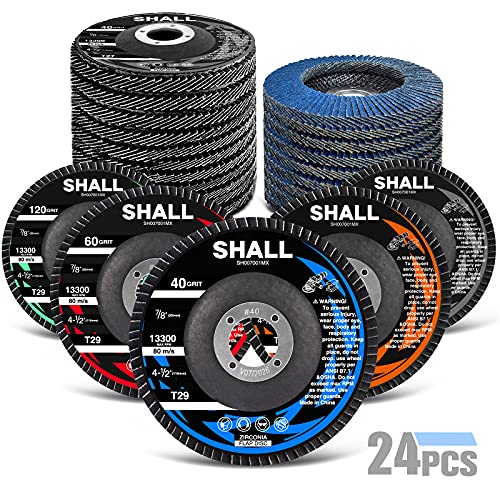
Best for angle grinders4-1/2" flap discs, 24
SHALL Zirconia Flap Discs
SHALL Zirconia Flap Discs, 4-1/2″, 24-Pack
Zirconia flap discs from 40 to 120 grit for welds, scale and heavy rust on a 4-1/2" grinder.
Check price on AmazonSpecs: SHALL's Amazon listing
Best for
Grinding welds and removing heavy rust and scale on trailers, gates and frames.
- Zirconia outlasts aluminum oxide on steel
- Both Type 29 and Type 27 shapes
- Grit etched on the metal ring
Skip it if
You work on thin car panels: a strip disc or orbital sander is safer.
- Only two 120 grit discs
- Too aggressive for thin sheet metal
Read full review
Best for Angle Grinders
When the job is welds, mill scale or thick rust, sandpaper on a sander is the slow way. A flap disc on a 4-1/2″ angle grinder is the fast one. This pack has 20 conical Type 29 discs (ten 40 grit, five 60, three 80 and two 120) and four flat Type 27 discs in 40 grit, all zirconia alumina on fiberglass backing plates, for grinders up to 13,300 RPM.
The mix is weighted toward 40 grit, the grade for the heaviest work, with 60 to 120 to blend afterwards. SHALL etches the grit number into the metal ring as well as printing it on the label, so you can still tell discs apart once the label has burned off.
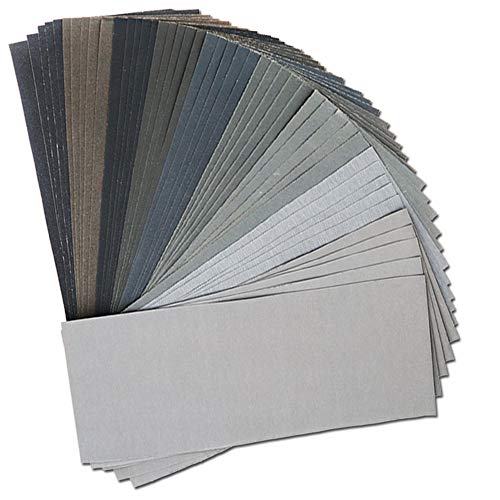
Best for wet sanding9" x 3.6" sheets, 45
BAISDY Wet Dry Sandpaper
BAISDY Wet Dry Sandpaper, 400 to 3000 Grit, 45 Sheets
Silicon carbide wet/dry sheets from 400 to 3000 grit for wet sanding primer and polishing bare metal.
Check price on AmazonSpecs: BAISDY's Amazon listing
Best for
Wet sanding primer and clear coat, and taking aluminum, brass or stainless to a polish.
- Nine fine grits, 400 to 3000
- Silicon carbide, the standard for wet sanding
- Lowest price tier
Skip it if
You still have rust or paint to remove: start with a coarser abrasive.
- Nothing coarser than 400
- Small sheets for large panels
Read full review
Best for Wet Sanding and Polishing
For a polished or mirror finish, the last steps are wet, and this is the paper for them: 45 silicon carbide sheets, five each of 400, 600, 800, 1000, 1200, 1500, 2000, 2500 and 3000 grit, on a waterproof backing that works wet or dry. The 9″ x 3.6″ sheets wrap around a block or fold into a corner, and the grit is printed on the back.
Use it after the coarse work is done: wet sanding primer at 400 to 600, clear coat at 1500 to 3000, or bare aluminum, brass and stainless through the grits before metal polish.
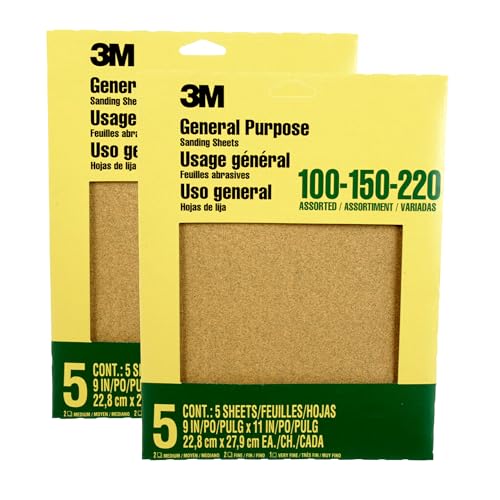
Best budget sheets9" x 11" sheets
3M Aluminum Oxide 9005NA
3M Aluminum Oxide Sandpaper 9005NA, 100-150-220
3M's general-purpose aluminum oxide paper in the three grits most paint prep on metal needs.
Check price on AmazonSpecs: 3M's Amazon listing
Best for
Scuffing and repainting metal furniture, railings, doors and appliances by hand.
- The three grits most paint prep needs
- Full 9" x 11" sheets
- From an abrasives maker
Skip it if
You need to remove heavy rust: use a flap disc or strip disc first.
- Paper tears on sharp edges
- Not for heavy rust or wet sanding
Read full review
Best Budget Sheets for Hand Sanding
For scuffing a painted railing, a mailbox or a metal door before repainting, you don’t need anything special. This is 3M’s general-purpose aluminum oxide paper, listed for paint, wood and metal, in 9″ x 11″ sheets of 100, 150 and 220 grit; this listing is two 5-sheet packs. Use it by hand, on a block, or cut to fit a sheet sander.
Those three grits are the paint-prep range for metal: 100 for light rust and flaking paint, 150 to smooth, 220 as the last pass before primer.
Best for pipe and rods1" x 20 ft rolls, 6
Bates Emery Cloth Rolls
Bates Emery Cloth Rolls, 1″ x 20 ft, 6 Grits
Six rolls of cloth-backed emery from 80 to 600 grit that wrap around pipe, rods and bolts.
Check price on AmazonSpecs: Bates' Amazon listing
Best for
Pipe, tubing, rods and bolts, and hand finishing small metal parts.
- Cloth backing wraps around round stock
- Six grits from 80 to 600
- Dispenser box, tear to length
Skip it if
You are sanding flat panels: discs or sheets cover the area faster.
- Slow on heavy rust
- Too narrow for flat panels
Read full review
Best for Pipe, Rods and Small Parts
Emery cloth is the traditional metalworking abrasive, and a cloth backing is what lets you wrap it around a pipe and pull it back and forth. This set has six 1″ x 20 ft rolls in 80, 150, 240, 320, 400 and 600 grit in a dispenser box, so you tear off what you need.
It is the right tool for copper pipe before soldering, rusty bolts and rods, handrails, and small parts that a sander can’t hold. Emery cuts more slowly than ceramic or zirconia, so it suits cleaning and finishing more than removal.
Best for rust and paint removal4-1/2" nonwoven discs, 5
TPmax Strip Discs
TPmax 4-1/2″ Strip Discs, 5-Pack
Nylon web discs with silicon carbide that strip paint and rust on a grinder without cutting into the metal.
Check price on AmazonSpecs: TPmax's Amazon listing
Best for
Stripping paint and surface rust from car panels, doors, trailers and machinery.
- Strips paint and rust without cutting the metal
- Safer than a flap disc on thin panels
- Resists clogging on paint
Skip it if
You need to grind a weld flat: that is a flap disc job.
- Doesn't level pitting or welds
- One grade: follow it with sandpaper
Read full review
Best for Rust and Paint Removal
A strip disc is not sandpaper but does the job people often buy coarse sandpaper for: getting rust and old paint off. It is an open nylon web loaded with silicon carbide that fits any 4-1/2″ angle grinder with a 7/8″ arbor. TPmax lists it for paint, rust, weld spatter, scale and oxidation, and says it won’t gouge or warp the workpiece.
That makes it the safer choice on thin sheet metal, car panels and anything you want to strip without removing metal. Follow it with 120 to 220 grit before primer.
How I Chose the Best Sandpaper for Metal
Metal is sanded with five kinds of tools (orbital sanders, angle grinders, sheet sanders, hand blocks and bare hands around round stock), and no single sandpaper fits all five. So I picked one abrasive for each, choosing the mineral that suits metal at that stage: ceramic and zirconia for removal, aluminum oxide for paint prep, silicon carbide for wet sanding, emery for hand work. I preferred makers that publish the grain, backing and grit list on the listing (Dura-Gold, Mirka, SHALL, 3M, Bates) and left out packs that didn’t say what the grain was. I don’t show customer ratings or prices, which change daily; more on how I choose the sanders I recommend.
How to Choose Sandpaper for Metal
Four things decide whether a sandpaper works on metal: the abrasive mineral, the grit, the backing and the format. Get the mineral and backing right and almost any grit sequence will work.
Abrasive Mineral
| Mineral | Use it for | Pick on this page |
|---|---|---|
| Ceramic | Fast removal of rust and paint on sanders and grinders; runs cool on stainless and thin panels | Dura-Gold |
| Zirconia alumina | Flap discs and coarse belts under heavy pressure | SHALL |
| Aluminum oxide | General sanding, scuffing and paint prep on steel | 3M 9005NA |
| Silicon carbide | Wet sanding, polishing, aluminum and brass | BAISDY, TPmax |
| Emery | Hand work on pipe, rods and small parts | Bates |
| Garnet | Wood only: dulls almost at once on steel | None |
Aluminum Oxide vs Silicon Carbide for Metal
These are the two minerals most sandpaper is made of, and on metal they split the job. Aluminum oxide is tougher: its grains hold up under pressure, so it is the better choice for dry sanding steel and iron at 80 to 320. Silicon carbide is harder and sharper but more brittle, so it cuts fast and leaves a fine, even scratch, then wears quickly under heavy pressure. That makes it the standard for wet sanding, for the fine grits above 400 and for softer non-ferrous metals. Buy aluminum oxide (or ceramic) for removal and prep, silicon carbide for finishing.
Grit
Metal follows the same grit scale as wood, but the jobs map to different numbers: 40 to 60 for welds and scale, 80 to 120 for rust and paint, 150 to 220 for smoothing, 220 to 320 as the last pass before primer, and 400 to 3000 wet for polishing. My how to sand metal guide has the full table by stage and by type of metal, and the sandpaper grit chart converts between CAMI and P grades.
Backing
- Paper: cheap and fine for scuffing, but it tears on sharp metal edges and softens in water unless it is wet/dry paper.
- Film: tough, flat and waterproof; the best backing for orbital sander discs on metal.
- Cloth: flexible and tear-resistant; emery cloth and belts use it.
- Mesh: lets a vacuum pull dust through the whole disc and resists clogging.
- Fiberglass plate: the rigid back of a flap disc.
Format: Match It to Your Tool
Hook-and-loop discs for random orbital sanders (check 5″ or 6″ and the hole pattern), flap discs and strip discs for angle grinders, 9″ x 11″ sheets for hand blocks and sheet sanders, rolls for round stock, and belts for belt sanders. If you sand wood too, my picks for the best sanding discs for random orbital sanders, the best sandpaper for wood and the best sanding blocks and sponges cover those.
Sandpaper for Metal by Job
Sandpaper for Rust
Light surface rust: 80 to 120 grit ceramic discs on an orbital sander, or aluminum oxide sheets by hand. Heavy, flaking rust: a strip disc or 40 to 60 grit zirconia flap disc on a grinder first, then 120 and 180. On pipe and bolts, emery cloth.
Sandpaper for Metal Before Paint
End at 220 to 320 grit, which leaves the surface dull and evenly scratched so primer can grip. Aluminum oxide sheets or ceramic discs both work; sand primer at 400 to 600 with wet/dry paper before the top coat. For car paint and clear coat, see my guide to what grit sandpaper for car paint.
Sandpaper for Polishing Metal
Silicon carbide wet/dry paper, used wet, from 400 up through 600, 800, 1000, 1500 and 2000 (and 3000 for a near-mirror finish), then metal polish. Change direction at each grit so you can see when the old scratches are gone.
Metal Roofs, Doors and Appliances
Painted steel roofing, garage doors, entry doors and appliances need a scuff, not a strip. Use 180 to 220 aluminum oxide or a gray scuff pad, and never sand through the galvanized or factory coating underneath.
💡 Pro Tip
Keep your metal abrasives separate from your wood ones. Steel particles left in a disc will scratch the next wood project and can rust under a clear finish, and sparks from metal work don’t belong near a bag of sawdust.
🏆 The Verdict
For an orbital sander, buy the Dura-Gold Ceramic Variety Pack: one box takes metal from rust to pre-polish. Add the SHALL zirconia flap discs if you own an angle grinder and have welds or heavy rust, and the BAISDY wet/dry sheets if you want a polished finish. For simple paint prep by hand, the 3M 9005NA sheets are all you need.
❓ Frequently Asked Questions
What is the best sandpaper for metal?+
What grade sandpaper for metal?+
Can I use sandpaper for metal?+
What sandpaper is best for removing rust from metal?+
Is aluminum oxide sandpaper good for metal?+
What are the downsides of silicon carbide sandpaper?+
Conclusion
There is no single best sandpaper for metal, only the best one for your tool and your stage: ceramic discs on an orbital sander, zirconia flap discs on a grinder, aluminum oxide by hand, emery around pipe, and silicon carbide wet for the finish. Start with the coarse abrasive that matches your worst rust and the fine one that matches the finish you want, and fill the middle from there. For the full method, see sanding metal step by step, and if you’re choosing the sander itself, the best random orbital sanders. Questions are welcome in the comments.
