


As an Amazon Associate I earn from qualifying purchases. All claims are strictly my personal opinion.
An orbital sander is the tool for sanding flat surfaces quickly and evenly; a detail sander is the tool for the corners, edges and narrow spaces an orbital sander can’t reach. If you can only buy one, buy the orbital sander, because it does most of the work on almost every project. Add a detail sander when your projects have inside corners, trim, louvers or small parts.
They are not competing tools as much as two halves of the same job. Below is a side-by-side comparison, what each is good and bad at, which gives the better finish, and two of each I’d buy.
Detail Sander vs Orbital Sander at a Glance
| Feature | Detail Sander (mouse or delta) | Random Orbital Sander (5″) |
|---|---|---|
| Pad shape | Pointed: iron or triangle | Round |
| Pad size | Small | 5″ or 6″ diameter |
| Motion | Small fixed orbit (some oscillate) | Orbit plus free rotation |
| Stock removal | Slow | Fast |
| Inside corners | ✅ Reaches right in | ❌ Leaves an unsanded arc |
| Large flat surfaces | ❌ Slow, uneven | ✅ Its main job |
| Weight | Light, one hand | Heavier, one or two hands |
| Abrasive | Shaped hook-and-loop sheets, specific to the tool | Standard 5″ or 6″ discs |
| Best for | Corners, trim, spindles, louvers, small parts | Tabletops, panels, doors, stripping, leveling |
| Typical price tier | $ to $$$ | $$ to $$$ |
Detail Sander (mouse or delta)
- Pad shape
- Pointed: iron or triangle
- Pad size
- Small
- Motion
- Small fixed orbit (some oscillate)
- Stock removal
- Slow
- Inside corners
- ✅ Reaches right in
- Large flat surfaces
- ❌ Slow, uneven
- Weight
- Light, one hand
- Abrasive
- Shaped hook-and-loop sheets, specific to the tool
- Best for
- Corners, trim, spindles, louvers, small parts
- Typical price tier
- $ to $$$
Random Orbital Sander (5″)
- Pad shape
- Round
- Pad size
- 5″ or 6″ diameter
- Motion
- Orbit plus free rotation
- Stock removal
- Fast
- Inside corners
- ❌ Leaves an unsanded arc
- Large flat surfaces
- ✅ Its main job
- Weight
- Heavier, one or two hands
- Abrasive
- Standard 5″ or 6″ discs
- Best for
- Tabletops, panels, doors, stripping, leveling
- Typical price tier
- $$ to $$$
⚡ Quick Answer
First sander for general woodworking or furniture? A 5″ random orbital like the Bosch ROS20VSC.
Already have an orbital and keep hand-sanding corners? Add a mouse sander like the BLACK+DECKER BDEMS600.
Doing trim, cabinets or overhead work with M12 batteries? The Milwaukee M12 FUEL detail sander.
What Is a Detail Sander?
A detail sander is a small, light sander with a pointed pad. The most common type is the “mouse” sander, with an iron-shaped pad that comes to a point; delta sanders use a triangle. The pad moves in a small, fast orbit, so the tip can be pushed right into a corner and still sand. Many come with finger attachments that stretch the tip into narrow molding profiles and between spindles.
What Is a Detail Sander Good For?
- Inside corners of cabinets, drawer boxes, bookcases and face frames.
- Window frames, trim and moldings.
- Stair spindles, chair rungs and furniture legs.
- Louvered doors and shutters.
- Small parts that a bigger pad would tip over on.
- Stripping the last bit of old finish from corners after the main surfaces are done.
Types of Detail Sander
Mouse sanders are the budget, all-round choice. Delta sanders have a larger triangular pad, somewhat faster on small flat areas. Oscillating detail sanders, like the Proxxon OZI, swing a small triangle back and forth instead of orbiting and are the most precise for tiny work. File sanders run a narrow belt for slots and louvers. I review all four types in my guide to the best detail sanders.
What Is an Orbital Sander?

When people compare an orbital sander with a detail sander, they almost always mean a random orbital sander: a round 5″ or 6″ pad that orbits and spins freely at the same time. That combination removes wood quickly and leaves a scratch pattern that is hard to see under a finish, so it is the most useful single sander for woodworking and refinishing.
What an Orbital Sander Is Good For
- Flattening and smoothing tabletops, panels, doors and cabinet sides.
- Removing old paint and finish from flat surfaces.
- Taking out planer and saw marks.
- Final sanding before stain on any open, flat surface.
What About Square-Pad “Orbital” Sanders?
Some tools sold as orbital sanders, or orbital finishing sanders, have a square pad that doesn’t spin: these are sheet sanders, or palm sanders in the 1/4-sheet size. Their square corners reach further into a corner than a round pad, but still not as far as a pointed detail pad. I compare them with random orbitals in sheet sander vs random orbital sander.
Head to Head
Speed
Winner: orbital sander, by a wide margin. A 5″ random orbital sander has far more pad area, more power and the added rotation. On a tabletop it does in minutes what a detail sander would take an hour to do, and less evenly.
Reach
Winner: detail sander, clearly. A round pad physically can’t sand the last inch of an inside corner. A pointed pad goes right into it. This is the entire reason detail sanders exist.
Finish Quality
Winner: orbital sander on flat surfaces. The random pattern hides scratches and the large flat pad keeps the surface level. A detail sander leaves a good finish in its small area, but used on a large surface it tends to leave an uneven, patchy result. In the corners, the detail sander wins by default, because the orbital sander leaves them unsanded.
Control and Comfort
Winner: detail sander for small and vertical work. It weighs little, fits in one hand and works overhead or inside a cabinet. The orbital sander is more comfortable for long sessions on large panels, especially one with a front handle.
Running Costs
Winner: orbital sander. 5″ discs are standard, sold everywhere and cheap in bulk. Detail sander sheets are shaped for each tool, and the tip of the sheet, where all the work happens, wears out first. Some pads let you rotate the sheet to use a fresh point.
What Type of Sander Gives the Best Finish?
For flat surfaces, a random orbital sander gives the best finish of any power sander, because its non-repeating scratch pattern is the hardest to see under stain and clear coat. Some finishers follow it with a very light pass by hand with the grain at the final grit. Detail sanders give a comparable finish in corners and small areas, and a belt sander, while fast, leaves the coarsest finish and needs an orbital sander after it. So the best-finish setup for a piece of furniture is an orbital sander on the flats and a detail sander in the corners, both taken to the same final grit.
Downsides of Each
Downsides of an Orbital Sander
It can’t reach inside corners, it is bulky on small parts and it leaves swirl marks if you press down or tilt it. For how to avoid those, see how to use an orbital sander.
Downsides of a Detail Sander
It is slow, it only suits small areas, the shaped sheets cost more per sanding area and wear fastest at the tip, and budget models vibrate and are loud for their size.
Are Detail Sanders Any Good?
Yes, for the job they are made for. As a second sander next to a random orbital, a detail sander saves a lot of hand-sanding in corners and on trim, and it is the only power sander that reaches those spots. Where people are disappointed is when they buy one as their only sander and try to sand a tabletop with it. It will do it, slowly and unevenly. Budget mouse sanders are fine for occasional use; if you sand trim or cabinets often, a better-built model with lower vibration is worth it.
Which One Should You Buy?
For Woodworking
Random orbital first. Most woodworking is flat panels and boards. Add a detail sander when you build boxes, cabinets or anything with inside corners.
For Furniture Refinishing and Cabinets
Both, ideally. The orbital sander strips and smooths the flat surfaces, the detail sander gets the corners, legs and molding. My guides to the best sanders for furniture and the best sanders for cabinets go into this in detail.
For Trim, Windows and Stairs
Detail sander first. These jobs are almost all narrow profiles and corners; a round pad has little to do.
For Decks, Floors and Large Panels
Orbital sander, or bigger. A detail sander has no role here beyond the odd corner.
The Best Detail Sanders to Buy
Two of the picks from my full detail sander reviews, one corded and one cordless.
BLACK+DECKER BDEMS600 Mouse Detail Sander
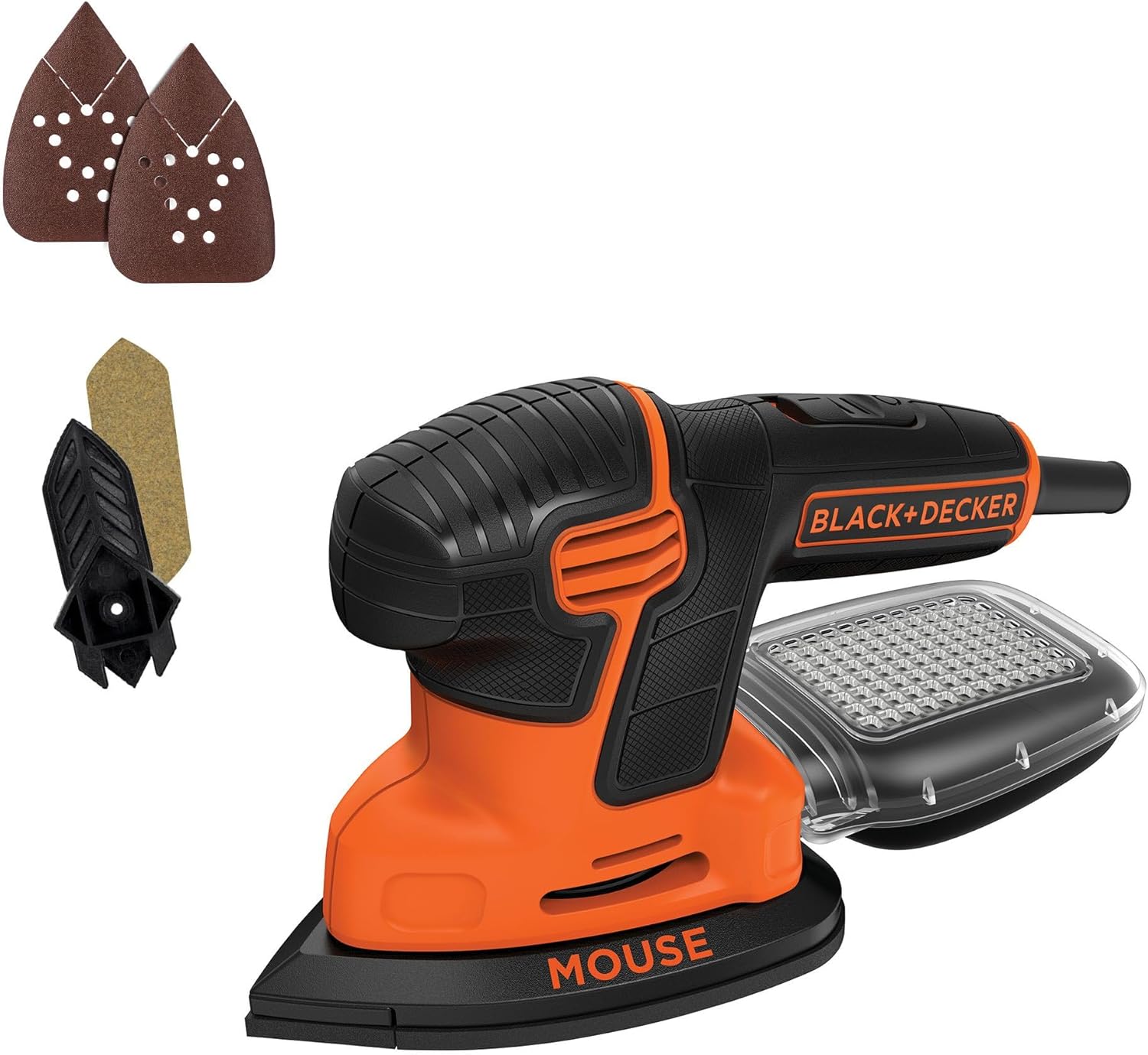
Best First Detail Sander
A 1.2 A mouse sander that Black+Decker rates at 14,000 to 16,000 orbits per minute (its own listings give both figures). The 3-position grip lets you hold it by the body, by the nose or at an angle, the finger attachment reaches into narrow profiles, and dust goes into a clip-on canister. 2.4 lb, 2-year limited warranty, and the lowest price tier.
- ✅ Finger attachment for moldings
- ✅ Three grip positions
- ✅ Lowest price tier
- ❌ Corded, and louder than premium models
Milwaukee M12 FUEL Orbital Detail Sander (2531-20)

Best Cordless Detail Sander
1.3 lb, four speed settings from 4,000 to 14,000 OPM plus a variable-speed trigger, and a small 1.5 mm orbit Milwaukee designed for a stain-grade finish. A sponge interface pad in the box lets the abrasive follow trim profiles. Sold as a bare tool with a 5-year limited warranty; you need an M12 battery.
- ✅ Very light, works overhead and inside cabinets
- ✅ Four speeds for delicate trim
- ✅ 5-year warranty
- ❌ Bare tool: battery and charger extra
The Best Orbital Sanders to Buy
Two 5″ corded random orbital sanders with variable speed. More options, including 6″ models, are in my random orbital sander reviews, and cordless ones in my cordless sander reviews.
Bosch ROS20VSC 5″ Random Orbital Sander

Best First Orbital Sander
A 2.5 A motor with a speed dial from 7,500 to 12,000 OPM, a pad dampening system Bosch designs to reduce swirl marks, and a micro-filter canister that twists off and shows how full it is.
- ✅ Variable speed
- ✅ Pad dampening against swirl marks
- ❌ Least powerful of the two
DEWALT DWE6423K 5″ Random Orbital Sander

More Power and Control
A 3 A motor at 8,000 to 12,000 OPM in a low-profile body that keeps your hand close to the work, a counterweight to cut vibration, a dust-sealed switch and a 3-year limited warranty.
- ✅ 3 A motor, variable speed
- ✅ Low height for control
- ❌ Higher price tier
🏆 The Verdict
Buy the orbital sander first: it does the bulk of the sanding on almost every project, faster and flatter. The Bosch ROS20VSC is a good place to start. Add a detail sander as soon as you find yourself hand-sanding corners, trim or spindles; the BLACK+DECKER BDEMS600 is the easy first one, and the Milwaukee M12 FUEL is the upgrade for regular trim and cabinet work. Together they cover everything from the tabletop to the last inch of the corner.
❓ Frequently Asked Questions
What is a detail sander good for?+
What are the downsides of using an orbital sander?+
What type of sander gives the best finish?+
Are detail sanders any good?+
Which is better, a detail sander or an orbital sander?+
Is a mouse sander the same as an orbital sander?+
Trying to decide for a specific project? Describe it in the comments and I’ll tell you which one I’d reach for.

