
As an Amazon Associate I earn from qualifying purchases. All claims are strictly my personal opinion.
Editor’s Choice
Short on time? Of the 3 oscillating edge sanders on this list, this is the one I'd buy.

A 1-3/4 HP oscillating edge sander on 115/230V with a 6″ x 89″ belt, a cast iron table and a 5-year warranty for home-shop use.
- Premium pick Shop Fox W1730
- Budget pick RIDGID EB4424

Edge sanders are some of the most useful machines in a woodworking shop, and after testing a wide variety of them across brands and price points, I can tell you that choosing the right one makes an enormous difference in the quality of your finished work. Whether you’re chasing perfectly square edges on glued-up panels, clean bevels, or smooth contour work on curved pieces, a good oscillating edge sander handles it on one machine. This roundup of the best edge sanders in 2026 covers full-size oscillating edge sanders for serious shops and a benchtop oscillating edge belt sander for smaller ones.
Full-size edge sanders run a long, wide belt horizontally past a work table, so you bring the edge of the workpiece to the belt and it stays square to the face. Most are heavy, floor-standing machines; the RIDGID below is the exception, a benchtop unit that combines a short oscillating belt with a spindle. I’ve updated this guide in 2026: one earlier pick is no longer sold on Amazon, and JET has replaced the model I originally reviewed with a new version, so the JET specs below are JET’s published figures for the current machine.
Best Edge Sanders Comparison
Here’s a side-by-side look at the edge sanders in this guide, covering the specs that matter most: motor, belt size and speed, oscillation, table, dust collection and warranty. All figures are the makers’ own.
| Product | ⭐ JET OES-689-BLK 🏆 EDITOR’S CHOICE |
Shop Fox W1730 | RIDGID EB4424 |
|---|---|---|---|
| Image | |
 |
 |
| Price | $$$ | $$$$ | $ |
| Type | Stationary, cabinet base | Stationary, industrial | Benchtop belt + spindle |
| Motor | 1-3/4 HP, 115/230V | 2 HP, 240V | 5 A |
| Belt Size | 6″ × 89″ | 6″ × 89″ | 4″ × 24″ |
| Belt Speed | 4,000 FPM | 3,150 FPM | Not published (1,725 RPM motor) |
| Oscillation | ✅ 106 per min, 1/4″ stroke | ✅ 52 per min, 3/4″ stroke | ✅ Yes (rate not published) |
| Work Table | Cast iron, 29-1/2″ × 10″, height-adjustable | Cast iron, 26-7/8″ × 12″ plus auxiliary table | Die-cast aluminum, bevels with 5 positive stops |
| Belt Tilt | 0–90° | 0–90° | Table bevels instead |
| Dust Port | 1 × 4″ | 2 × 4″ | - |
| Weight | 280 lb | 396 lb | 40 lb |
| Warranty | 5 years (2 years commercial use) | See Shop Fox | Lifetime service agreement (register within 90 days) |
| Availability | Check price on Amazon | Check price on Amazon | Check price on Amazon |
Key takeaways
- My top pick is the JET OES-689-BLK: fast 106-per-minute oscillation, a 6″ × 89″ belt at 4,000 FPM, dual-voltage wiring and a 5-year warranty for non-commercial use.
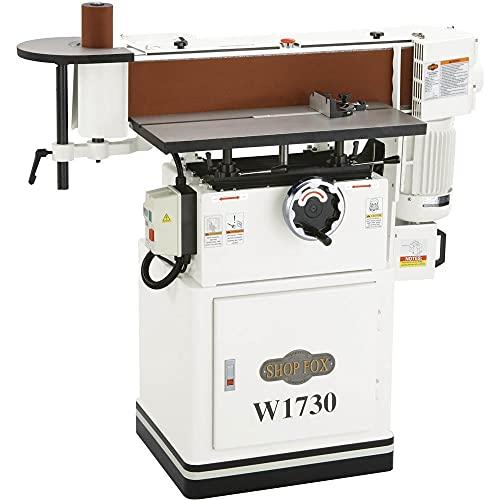
- Best for production shops: the Shop Fox W1730, 2 HP, a long 3/4″ oscillating stroke, two 4″ dust ports and spindle drums for curves.
- Best benchtop and best value: the RIDGID EB4424, oscillating edge belt and spindle sanding in one 40 lb machine.
💡 Pro Tip
Check your power before you shop. The Shop Fox W1730 needs a 240V circuit, while the JET ships prewired for 115V (JET recommends a 20 A circuit) and can be rewired for 230V. A full-size edge sander also needs a dust collector rated for its 4″ port, not just a shop vac.
What Is an Edge Sander?
An edge sander is a stationary sander built around a long abrasive belt that runs horizontally, with its sanding face held upright by a flat platen. You rest the workpiece on the table and push its edge against the belt, so the edge comes out flat, straight and square to the face. Oscillating models move the belt up and down as it runs, which spreads heat and wear across the full belt width and leaves a cleaner surface.
Who Needs One
Cabinet and furniture makers who square the edges of glued-up panels, doors, shelves and face frames every day get the most from an edge sander, along with anyone who makes a lot of curved parts, since the end drum or spindle handles outside and inside curves. For occasional edge work, a benchtop belt and disc sander is a cheaper, smaller alternative: see my best benchtop sanders. If most of your curves are inside curves, an oscillating spindle sander is the more specialized tool.
Oscillating Edge Sander Reviews
Below is a detailed review of each edge sander in the lineup: what each machine does well, where it falls short, its key specs, and exactly who I think it’s best suited for.
Editor's ChoiceOscillating edge sander
JET OES-689-BLK
JET OES-689-BLK 6″ x 89″ Oscillating Edge Sander, 1-3/4 HP
A full-size 6 x 89-inch oscillating edge sander that runs on 115V or 230V, on a cabinet base with a cast iron table.
Check price on AmazonSpecs: JET
Best for
Serious hobbyists and small pro shops without a 240V circuit.
- 115/230V dual voltage, no 240V circuit needed
- Height-adjustable cast iron table
- Enclosed cabinet with belt storage
Skip it if
You only have a shop vac, or you want to sand metal.
- Wood only: JET says not to sand metal
- Needs a 400 CFM dust collector
Read full review
JET’s edge sander was my top pick in earlier versions of this guide, and the OES-689-BLK is the model JET sells in its place today. On JET’s figures it is a step up: a 1-3/4 HP TEFC motor, prewired for 115V and rewirable for 230V, drives the 6″ × 89″ belt at 4,000 FPM, and the belt oscillates 106 times a minute with a 1/4″ stroke. The steel platen tilts from 0 to 90°, so you can sand with the belt horizontal or vertical.
The 29-1/2″ × 10″ cast iron table has a miter slot (a miter gauge is included) and raises and lowers 3-3/16″ on a handwheel, so you can move to a fresh band of the belt instead of wearing out one strip. An extension table at the drive drum handles contour sanding, a removable steel fence and backstop come in the box, and the machine sits on an enclosed cabinet with a door, a shelf and hooks for spare belts. There is one 4″ dust port; JET asks for at least 400 CFM of collection. JET’s warranty is 5 years for home-shop use and 2 years for commercial or industrial use, and the manual is clear that this is a wood-only machine: don’t use it on metal.
Best For: Serious hobbyists and small professional shops that want a full-size oscillating edge sander without running a 240V circuit.
ℹ️ Did You Know?
An edge sander squares the edges; the faces still need a finish sander. My guide to the best random orbital sanders covers the handheld tools that take the faces from planed to ready for finish.
Best for productionIndustrial edge sander
Woodstock Shop Fox W1730
Shop Fox W1730 Oscillating Edge Sander
A 2 HP, 396 lb edge sander with the longest stroke here and drums for curves.
Best for
Pro shops with 240V power doing long edges and curves in volume.
- 3/4" oscillation stroke for heat control
- Cast iron main and auxiliary tables
- Three drums for curves, two 4" dust ports
Skip it if
You have no 240V circuit or no room for a 396 lb machine.
- Needs a 240V circuit
- The most expensive and heaviest here
Read full review
The Shop Fox W1730 is a heavy-duty, industrial-class oscillating edge sander that weighs 396 lbs: this is a machine built for serious shop use. A 2 HP 240V motor runs the 6″ × 89″ belt at 3,150 FPM, with 3/4″ oscillation at 52 strokes per minute, the longest stroke here, providing excellent heat control and a premium surface finish. I was genuinely impressed by the fit and finish here: Shop Fox has clearly raised their quality bar, and the powder-coated finish throughout is a significant step up from their earlier offerings.
The graphite-coated platen tilts from 0 to 90°, and there are two cast iron tables: a 26-7/8″ × 12″ main table and a 10″ × 11-1/2″ auxiliary table. On the auxiliary table you can fit three sanding drums (1-1/2″, 2″ and 3″) for curves the main belt can’t reach; note that the drums spin but don’t oscillate. A 180-degree adjustable miter gauge, a removable fence and two 4″ dust ports complete a machine that delivers industrial versatility and a refined finish.
Best For: Professional woodworkers and serious shop owners with 240V power who need a heavy-duty oscillating edge sander for long, straight edges and curved work in volume.
Best benchtopBenchtop belt and spindle
RIDGID EB4424
RIDGID EB4424 Oscillating Edge Belt/Spindle Sander
A benchtop oscillating sander that switches between a 4 x 24-inch edge belt and a spindle, at about 40 lb.
Check price on AmazonSpecs: RIDGID
Best for
Hobbyists and small shops that want edge and spindle sanding in one compact machine.
- Edge belt and spindle in one machine
- Oscillates in both modes
- Lifetime Service Agreement when registered
Skip it if
You square long boards or glued-up panels, where a 6 x 89-inch belt is the tool.
- Short 4" x 24" belt, not for long boards
- Aluminum table, not cast iron
Read full review
The RIDGID EB4424 is a different kind of machine from the two above: a benchtop oscillating sander that converts between a 4″ × 24″ edge belt and a spindle, driven by a 5 A motor at 1,725 RPM. At about 40 lbs it lives on a bench or a shelf, and it costs a fraction of a full-size edge sander. For a small shop that squares short edges and sands curves now and then, it is the practical choice.
The oscillating action works in both modes, giving you the heat-reducing, finish-improving benefits of oscillation on flat edges alongside the curve-handling of a spindle sander, all without a second machine. The die-cast aluminum table bevels with five positive stops, and a lock-out switch prevents accidental starts. What really sets it apart is the warranty: register it within 90 days and RIDGID’s Lifetime Service Agreement gives you free parts and service for life.
Best For: Hobbyists and small shops that want oscillating edge and spindle sanding in one compact, affordable machine.
Honorable Mentions
Hand edge sander
FastCap Fastbreak
FastCap Fastbreak Dual Edge Sander | Sandpaper included

A hand tool that breaks both corners of an edge in one pass, for quick touch-ups on shelves and plywood edges.
Check price on AmazonSpecs: the seller's Amazon listing; no maker page found
Best for
Quick edge cleanup on shelves, cabinet parts and plywood edges.
- Breaks both corners uniformly in one pass
- 80 and 180 grit paper included
- Compact and portable
Skip it if
You need to flatten or square an edge: that takes a powered edge sander.
- Edge touch-ups only, not a replacement for a machine
Read full review
The FastCap Fastbreak Dual Edge Sander is a compact, hand-operated edge sanding tool that earns its spot as a shop companion for quick cleanup work. It comes with 80 and 180 grit paper, and its dual-edge design breaks both corners of an edge uniformly in one pass, which speeds up finish touch-ups on shelves, cabinet parts and plywood edges. It is a $ option for woodworkers who need a fast, portable solution alongside their stationary machines.
How to Choose the Best Edge Sander
With so few edge sanders on the market, the decision usually comes down to power, space and what you sand most. Here are the key factors I consider when evaluating any edge sander for my shop.
Oscillation: Do You Need It?
Oscillation is the single most important feature to look for in a finish-quality edge sander. An oscillating belt moves slightly up and down as it runs, which distributes heat across a wider area and reduces the risk of burning and of grit lines on the edge. Compare rate and stroke together: the JET oscillates fast with a short 1/4″ stroke, while the Shop Fox moves more slowly over a long 3/4″ stroke. For fine finish work, cabinet edges and decorative pieces, oscillation is absolutely worth it.
Power, Voltage and Dust Collection
A 6″ × 89″ belt needs real power, and power decides your wiring. The JET runs on a standard 115V circuit or on 230V; the Shop Fox needs 240V. Both need a dust collector on a 4″ port, and JET specifies at least 400 CFM, so budget for collection as part of the machine. The benchtop RIDGID, by contrast, runs on any standard household outlet.
Tables, Tilt and Curves
Look at how the table and belt move. On the JET the table rises and falls so you can use the full belt height, and the platen tilts for horizontal sanding; on the Shop Fox the platen tilts and an auxiliary table takes sanding drums. For curved work, the end drum of a full-size edge sander handles outside curves, but inside curves are better done on a spindle, which is why the RIDGID’s spindle mode and the Shop Fox’s drums matter.
Grit Sequence for Edges
For squaring rough edges, start at 80 grit, then move to 100 or 120 for a clean edge, and finish at 150 or 180 before stain or finish. Don’t jump from 80 straight to 180: the deeper scratches show up under finish. Keep the piece moving and use light, steady pressure, and clean the belt with a rubber belt cleaner when it starts to load up. For a full grit chart, see what grit sandpaper to use on wood.
Verdict: The Best Edge Sander for Most Woodworkers
For most woodworkers with a dedicated shop, the JET OES-689-BLK is my recommendation: a 1-3/4 HP dual-voltage motor, fast oscillation, a height-adjustable cast iron table and a 5-year home-shop warranty in a machine that doesn’t require a 240V circuit. If you run a production shop with 240V power, the Shop Fox W1730 gives you more motor, a longer oscillating stroke and drums for curves. And if you want oscillating edge and spindle sanding without the floor space or the cost, the benchtop RIDGID EB4424 is the one to buy.
❓ Frequently Asked Questions
Is an edge sander worth it?+
What are the differences between an edge sander and an orbital sander?+
What is the best sander for sanding edges?+
What are oscillating sanders good for?+
Is an oscillating tool a good sander?+
Thanks so much for reading: I hope this guide helps you find exactly the right edge sander for your shop and your projects. If you have questions, experiences to share, or a pick I missed, drop a comment below: I read and reply to every one. Happy sanding!

Great post! I’ve been looking for a new edge sander for my woodworking projects and this review is super helpful. Can you tell me more about the durability of the sanders? How long have you used them for and have you experienced any issues?
I really like the edge sanders for sale that you have listed. They all look like great options for the price.
I loved reading this, helped me way beyond my expectations. Fantastic work, from a craftsman to another!
Hey Thomas, thank you for the very kind words, I’m glad I could help!
How I love these, I’ve used friend’s edge sanders before but I’m getting my very own one right now! This helps so much, can’t thank you enough.
Just want to give a +1 for the JET, a truly beautiful machine. It’s also a wonder to me how I don’t see these in every shop, they’re the bomb!
I agree Anne, with both sentences. I guess it’s lack of hands-on experience, I bet that once someone has tried one of these they’ll quickly realize their potential and consider getting one. Thanks for the visit!
These are a Godsend for my type of work! Now that I’ve used it I can see why you recommended that JET James, it really is brilliant.
Indeed it is Kent, it offers incredible value. Thanks for stopping by!
I care a lot about performance and quality, but looks are a priority too for me and that Powermatic is gorgeous. It’ll fit right in, beautiful colors! Nicely done James
Well, I came for the best and I’ll get the best. The Powermatic it is, I know it’s pricey but I love Powermatic just as much as you do James. Time to have some fun!
You have a fine taste as well I see! You won’t regret it Louis, it’s incredible in every way. Enjoy!
I got the JET you recommended and boy what a BEAST! I couldn’t be happier and had to write this little thank you note. Thank you James!
No problem Benny, have fun!
Great work! Appreciate the detailed reviews you give of each machine, especially since edge sanders are quite an untouched topic out there. I appreciate it!
You’re right, not many people know about them, they’re one of the hidden treasures of woodworking. You’re welcome Holbrook, always happy to help!