
As an Amazon Associate I earn from qualifying purchases. All claims are strictly my personal opinion.
Editor’s Choice
Short on time? Of the 7 detail sanders on this list for tight spaces and corners, this is the one I'd buy.

A pointed pad and a detail finger for corners, trim and molding, with its own dust canister.
- Also recommended Milwaukee M12 FUEL Orbital Detail Sander
- Also recommended Proxxon OZI 115/E

Last updated: September 2026. Specs checked against each manufacturer’s own listing this month; products that stop being sold come off this page.
The best detail sander for most people is the BLACK+DECKER BDEMS600 Mouse: a pointed pad, a finger attachment for narrow profiles and built-in dust collection at a budget price. For cordless work in tight spaces and corners, the Milwaukee M12 FUEL 2531-20 is the upgrade.
A detail sander exists for one reason: a round or square pad cannot get into an inside corner, a louvered door or the recess of a raised panel, and a small pointed pad can. Below you’ll find seven detail sanders that each solve a different version of that problem, from a budget mouse sander to a 1.2 lb precision tool and a belt file for slots, plus the technique that gets clean corners without gouging the surface next to them.
Best Detail Sanders: Comparison
Seven tools, sorted by the kind of tight space they handle best. The first five are for home workshops and DIY; the two Festools are premium tools for daily professional finishing.
| Product | ⭐ BLACK+DECKER BDEMS600 🏆 EDITOR’S CHOICE |
Milwaukee M12 FUEL 2531-20 | SKIL SR232 | Proxxon OZI 115/E | WEN 6307 | Festool DTS 400 REQ-Plus | Festool RO 90 DX |
|---|---|---|---|---|---|---|---|
| Image | |
 |
 |
 |
 |
 |
 |
| Price | $ | $$$ | $ | $$$ | $ | $$$$ | $$$$ |
| Motion | Orbital | Orbital, 1.5 mm orbit | Orbital | Oscillating | Belt | Orbital, 2 mm stroke | Multi-mode (gear-driven) |
| Pad | Pointed pad + detail finger | Pointed pad + sponge interface | Pointed pad + 3 attachments | 2-1/2″ triangle (65 mm) | 1/2 x 18″ belt arm | 100 x 150 mm delta | 90 mm round + delta |
| Motor | 1.2 A | M12 brushless | 1.2 A | 100 W | 2 A | 250 W | 400 W |
| Speed | 14,000 to 16,000 OPM* | 4,000 to 14,000 OPM | 13,500 OPM | 3,000 to 10,000 osc/min | 1,080 to 1,800 ft/min | 6,000 to 12,000 RPM | 3,500 to 7,000 RPM (eccentric) |
| Variable Speed | ❌ | ✅ 4 settings + trigger | ❌ | ✅ | ✅ | ✅ | ✅ |
| Dust Collection | ✅ Canister | No bag in the box | ✅ Micro-filter box + 1-1/4″ port | Not specified | ✅ Dust port attachment | ✅ Bag + extractor port | ✅ Extractor port |
| Weight | 2.4 lb | 1.3 lb (bare) | 2.6 lb | 1.2 lb | 2.5 lb | 3.3 lb | 3.1 lb |
| Power | Corded | M12 battery (tool only) | Corded | Corded | Corded | Corded | Corded |
| Warranty | 2 years | 5 years | 1 year | Limited (see maker) | 2 years | 3 years | 3 years |
| Best For | Corners and trim at home | Cordless, on site | Value with attachments | Smallest spaces, models | Slots, louvers, gaps | Pro finish on frames | Strip, sand and polish |
| Availability | 🛒 Shop Now | 🛒 Shop Now | 🛒 Shop Now | 🛒 Shop Now | 🛒 Shop Now | 🛒 Shop Now | 🛒 Shop Now |
*Black+Decker’s own listings quote the BDEMS600 at both 14,000 and 16,000 orbits per minute. Price tiers: $ budget, $$ mid-range, $$$ upper mid-range, $$$$ premium.
Key takeaways
- For corners, trim and furniture at home, the BLACK+DECKER BDEMS600 covers the most jobs for the least money.
- Cordless on the M12 system: the Milwaukee M12 FUEL 2531-20, with four speeds and a 5-year warranty.
- For the very smallest spaces, the Proxxon OZI 115/E; for slots and louvers, a belt file like the WEN 6307.
- A detail sander is a second tool: use a palm or orbital sander on the open surfaces first.
Which Detail Sander Fits Tight Spaces and Corners?
“Tight space” means different things on different projects. Match the tool to the shape of the space before you compare motors.
Inside Corners and Raised Panels: a Pointed Pad
The classic mouse-style pad comes to a point, so it reaches into the corner where a panel meets its frame, the inside of a drawer box or the base of a stair baluster. The BLACK+DECKER, SKIL and Milwaukee tools here all work this way. A finger attachment extends the point into narrow molding profiles.
Window Frames and Trim: a Delta Pad
A larger triangle, like Festool’s 100 x 150 mm delta, covers more surface per pass while still reaching into a corner. It is the pad painters and finish carpenters use on window sashes, door frames and baseboards, where there is a lot of narrow surface to cover.
The Smallest Spaces: an Oscillating Micro Sander
When even a mouse pad is too big, a precision tool like the Proxxon with a 2-1/2 inch pad fits into model work, small boxes, instrument parts and fretwork. Its oscillating motion also lets it file into a spot rather than skate across it. If you also need to cut and scrape, an oscillating multi-tool with a sanding pad reaches the same corners.
Slots, Louvers and Gaps: a Belt File Sander
No pad fits between the slats of a louvered door or into a half-inch slot. A file sander runs a narrow belt around an arm, so it goes where the gap is, as long as the gap is wider than the belt.
Detail Sander or Orbital Sander?
Use an orbital or palm sander for anything flat and open, and the detail sander only where the bigger pad cannot reach. A detail sander on a whole tabletop is slow and leaves an uneven surface. My guide to the best palm sanders covers the square-pad tools that pair best with a detail sander, and my detail sander vs. orbital sander comparison goes deeper on which to buy first.
💡 Pro Tip
The point of a detail pad wears out long before the rest of the sheet. Rotate the sheet a third of a turn, or swap to a fresh one, the moment corner cutting slows down, instead of pressing harder.
Best Mouse Sander
The best mouse sander is the BLACK+DECKER BDEMS600, the model that gave the type its name. It sits in the budget tier, the pointed pad gets into corners and along trim, the finger attachment reaches molding profiles and the gaps between spindles, and the dust canister clips onto the back. Its limits are the ones every mouse shares: a single speed, and shaped sheets that only fit this pad.
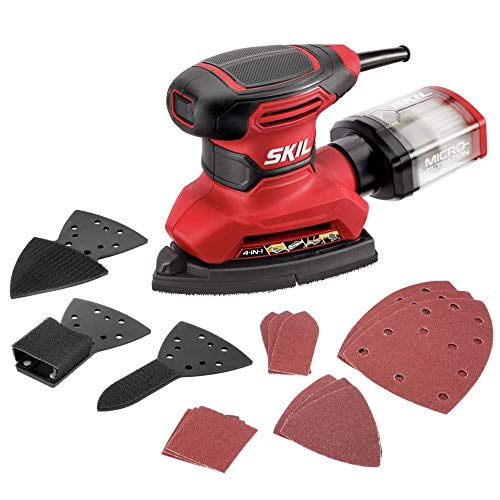
- More pad shapes for the money: the SKIL SR232 works on the same pointed-pad idea, adds three attachments for edges, contours and small flat areas, and has a 1-1/4 inch port for a shop vacuum hose.
- Cordless: the Milwaukee M12 FUEL 2531-20 weighs 1.3 lb and has four speeds, which suits overhead trim and the inside of cabinets. It is sold as a bare tool, so it makes most sense if you already run M12 batteries.
Mouse Sander vs Detail Sander
“Mouse” describes a body shape, not a different kind of tool: a rounded palm grip over an iron-shaped pad with a point at the front. That shape is built for inside corners, drawer fronts, cabinet doors and furniture detail. The other detail sanders on this page give it up for something more specific: the Proxxon’s 2-1/2 inch triangle for the smallest parts, the Festool DTS 400’s delta pad for frames and trim, and the WEN 6307’s narrow belt for slots and louvers. Buy a mouse for general corners and trim, and one of the others only when the space is smaller or narrower than a mouse pad can reach.
Detail Sander Reviews
Each review says what the tool does well in tight spaces, where it falls short and who should buy it. Specs are from each manufacturer’s own listing, checked in September 2026.
Editor's ChoiceMouse detail sander
BLACK+DECKER BDEMS600
BLACK+DECKER BDEMS600 Mouse Detail Sander
A pointed pad and a detail finger for corners, trim and molding, with its own dust canister.
Best for
Homeowners and DIYers sanding corners, trim, cabinets and furniture detail.
- Pointed pad plus detail finger attachment
- 3-position grip for awkward angles
- Dust canister and dust-sealed switch
Skip it if
You need a slower speed for veneer, paint or plastics.
- No variable speed
- Proprietary pad shape, so you buy shaped sheets
Read full review
Best Detail Sander Overall
The BLACK+DECKER BDEMS600 is the detail sander I recommend first, because it solves the most common tight-space problems for the least money. The pointed pad reaches inside corners and raised-panel edges, and the included detail finger attachment reaches into narrow molding profiles and between spindles.
The 1.2 A motor is rated by Black+Decker at 14,000 to 16,000 orbits per minute (its own listings quote both), enough to strip old finish in a corner, not just smooth it. A 3-position grip lets you hold it like a palm sander, by the nose, or at an angle for awkward reaches, and the dust canister clips to the back. The switch is dust-sealed, which matters on a tool that lives in a cloud of fine dust. It weighs 2.4 lb and carries a 2-year limited warranty.
Best cordlessCordless detail sander
Milwaukee M12 FUEL 2531-20
Milwaukee M12 FUEL Orbital Detail Sander (2531-20)
A 1.3 lb cordless detail sander with four speeds and a variable trigger, light enough for overhead and cabinet work.
Best for
Carpenters, remodelers and M12 owners sanding trim, cabinets and doors on site.
- 1.3 lb, easy in any orientation
- Four speeds plus a variable trigger
- Sponge interface pad for profiles
Skip it if
You don't own M12 batteries and sand at the bench, where a corded tool costs less.
- Battery and charger sold separately
- No dust bag included
Read full review
Best Cordless Detail Sander
The Milwaukee M12 FUEL Orbital Detail Sander is the cordless pick for tight spaces, and the one to buy if you already own M12 batteries. At 1.3 lb, with four speed settings from 4,000 to 14,000 OPM plus a variable-speed trigger, it is light enough to use overhead or inside a cabinet and controllable enough for delicate trim.
Milwaukee designed it around a small 1.5 mm orbit for a stain-grade finish, with a pad whose sharp straight edges reach into confined corners. A sponge interface pad comes in the box so the abrasive can follow complex trim profiles, along with a pad saver that protects the backing pad from heat and nine mesh sheets. The brushless motor, a counterweight to cut vibration, an LED light, a fuel gauge and a 5-year limited warranty round it out. It is sold as a bare tool, and there is no dust bag in the box, so budget for a battery if you are new to M12 and plan to connect a vacuum.
Multi-pad detail sander
SKIL SR232
SKIL SR232 Multi-Function Detail Sander
A 4-in-1 kit: a pointed detail pad plus three attachments for corners, contours and larger areas.
Check price on AmazonSpecs: SKIL
Best for
DIYers who want one inexpensive tool for corners, contours and small flat areas.
- Four pad shapes in one kit
- Dust box or 1-1/4" vacuum port
- Hook-and-loop sheets, 12 included
Skip it if
You need variable speed for veneer, paint or plastics.
- No variable speed
- 1-year warranty
Read full review
Best Value Detail Sander With Attachments
The SKIL SR232 is a 4-in-1 kit: a standard pointed detail pad plus three extra attachments for corners and edges, contoured surfaces and larger areas. If your tight spaces vary from project to project, the attachments give you more shapes for the money than any other tool here.
SKIL lists a 1.2 A motor at 13,500 orbits per minute, hook-and-loop sheet changes and a counterweight to reduce vibration. Dust handling is flexible: a micro-filtration dust box for quick jobs, or a 1-1/4 inch port for a shop vacuum hose. The switch is dust-sealed and the kit includes 12 sanding sheets. The warranty is one year, the shortest here, which fits its budget tier.
Oscillating micro sander
Proxxon OZI 115/E
Proxxon OZI 115/E Oscillating Delta Sander
The smallest tool here: a 2-1/2" oscillating triangle on a 1.2 lb body for models, small boxes and fretwork.
Check price on AmazonSpecs: Proxxon
Best for
Model makers, luthiers, crafters and restorers in spaces smaller than a mouse pad.
- 2-1/2" pad on a 1.2 lb body
- Variable 3,000-10,000 oscillations/min
- Oscillation also files into tight spots
Skip it if
You sand cabinet-size panels or want built-in dust collection.
- Slow on anything larger than a small panel
- No dust collection
Read full review
Smallest Detail Sander for the Tightest Spaces
The Proxxon OZI 115/E answers the “smallest detail sander” question. Its triangular pad measures 2-1/2 inches (65 mm) per side and the whole tool weighs 1.2 lb, so it fits into small boxes, model work, instrument parts and fretwork where a mouse sander is simply too big.
Instead of an orbit, the pad oscillates side to side, variable from 3,000 to 10,000 oscillations per minute on a 100 W DC motor. Proxxon says the motion runs quietly and also allows filing and plunge work, which is useful when you need to ease into a tight inside corner rather than skate across it. The head is die-cast zinc, pads are hook-and-loop, and it ships in a case with four sanding discs. There is no dust bag, so run it near a vacuum nozzle or dust hood.
Belt file sander
WEN 6307
WEN 6307 Detailing File Sander
A 1/2 x 18" belt on a slim pivoting arm that goes into slots, louvers and gaps no pad can enter.
Check price on AmazonSpecs: WEN
Best for
Louvered doors, shutters, slots and parts with narrow openings.
- Reaches slots and gaps no pad can enter
- Variable belt speed, pivoting arm
- Tool-free belt changes, auto-tracking
Skip it if
You mostly finish flat surfaces or thin veneer.
- Aggressive: easy to cut too deep on veneer
- Not a finishing sander for flat surfaces
Read full review
Best for Slots, Louvers and Narrow Gaps
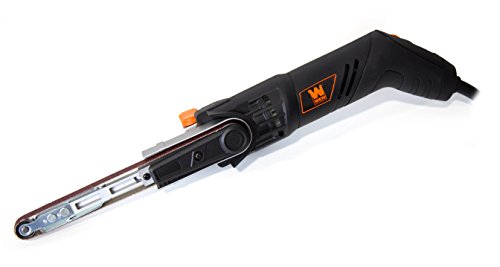
Some tight spaces are not corners at all: the gaps between louvered door slats, the inside of a slot, the underside of a chair rail. The WEN 6307 runs a 1/2 x 18 inch belt around a slim arm, so the abrasive goes wherever the arm fits.
WEN lists a variable speed dial from 1,080 to 1,800 feet per minute, an arm that pivots up to 55 degrees, auto-tracking so the belt needs no tensioning, and tool-free belt changes. It comes with three belts, a dust port attachment and a two-year warranty. A belt cuts faster and more aggressively than an orbital pad, so use a fine belt and a light touch on finished surfaces.
Premium delta sander
Festool DTS 400 REQ-Plus
Festool DTS 400 REQ-Plus Delta Sander
A 250 W delta sander that holds its speed under load, built for daily work on window frames, doors and trim.
Check price on AmazonSpecs: Festool
Best for
Painters, finish carpenters and cabinetmakers who sand frames, doors and trim every week.
- 250 W with speed held under load
- Large delta pad covers frames and trim fast
- Tool-free pad and abrasive changes
Skip it if
You only sand corners now and then: the price pays off with daily use.
- Premium tier
- Pad too large for the smallest spaces
Read full review
Best Premium Delta Sander
The Festool DTS 400 REQ-Plus is the professional finisher’s delta sander. Festool lists its main uses as vertical and overhead work, small surfaces, edges and tight corners, and stripping paint and varnish from window frames, which is exactly the work a big delta pad does best.
The 250 W motor runs from 6,000 to 12,000 RPM with a 2 mm stroke, and Festool’s MMC electronics hold the set speed under load so the pad does not slow down when it meets the surface. The 100 x 150 mm delta pad changes without tools, the machine weighs 3.3 lb, and it connects to Festool’s extractors or its own long-life dust bag. The warranty is three years. The price puts it out of reach for occasional use, but for daily trim and frame finishing it is the refined choice.
Compact multi-mode sander
Festool RO 90 DX
Festool ROTEX RO 90 DX FEQ-Plus Multi-Mode Sander
Round and delta pads plus gear-driven, random orbit and polishing modes: one small tool to strip, sand and polish.
Check price on AmazonSpecs: Festool
Best for
Professionals who want one compact tool to strip, sand and polish small parts and frames.
- Round and delta pads, swapped without tools
- Aggressive, finishing and polishing modes
- 400 W, 3-year warranty
Skip it if
You only need to reach corners: a mouse sander does that for far less.
- Premium tier
- Overkill for occasional corner sanding
Read full review
Best Premium Multi-Mode Option
The Festool ROTEX RO 90 DX is not a pure detail sander, and that is the point: it swaps between a 90 mm round pad and a delta pad without tools, and switches between a gear-driven aggressive mode, random orbital finishing and polishing.
Festool rates it at 400 W, with 260 to 520 RPM in rotary mode and 3,500 to 7,000 RPM in eccentric mode, a 3 mm stroke and a weight of 3.08 lb. The gear-driven mode strips stubborn finish from small parts and frames faster than any orbital detail sander, then the delta pad finishes the corners. It is the most expensive tool here and more than most corner work needs, which is why it sits at the end of the list, but if one small sander has to strip, finish and polish, this is it. Warranty: three years.
How I Chose These Detail Sanders
Reach First, Power Second
Every tool on this list earns its place by fitting a specific kind of tight space: pointed pad, delta pad, micro pad or belt arm. Raw wattage came after that.
Specs From the Maker
I checked each spec against the manufacturer’s own page or listing in September 2026. Two models that used to be on this page were no longer available, so they are gone.
Real Brands With Parts and Pads
Detail sanders eat pads and sheets. I kept to brands whose shaped sheets and replacement pads you can still buy years from now.
How to Choose a Detail Sander
Corded vs. Cordless
Corded tools give unlimited runtime and cost less for the same capability. Cordless is worth it when you move around a house or a job site, sand overhead, or already own the battery platform, which is why the Milwaukee makes most sense for existing M12 users.
Speed Control
Variable speed lets you slow down on veneer, paint and plastics, where heat and aggressive cutting cause damage. Among the seven, the Milwaukee, Proxxon, WEN and both Festools have it; the BLACK+DECKER and SKIL run at a single speed.
Dust Collection
Fine dust builds up fast in a corner with nowhere to go, clogs the sheet and hides the surface. A canister is fine for small jobs; for anything longer, connect a vacuum to the port and run an air filtration system in an enclosed shop.
Pad Shape and Attachments
A finger attachment or extra pads multiply what one tool can reach. Check that replacement sheets for the exact pad shape are easy to buy before you commit.
Weight and Grip
Detail work means holding the tool at odd angles for long stretches. Lighter tools like the Proxxon and Milwaukee reduce fatigue; multi-position grips like the BLACK+DECKER’s help control.
How to Sand in Really Tight Corners
- Sand the open surfaces first with a palm or orbital sander, stopping short of the corner.
- Switch to the detail sander at the same grit and work into the corner from each side, point first.
- Keep the pad flat. Tipping it onto the point gouges the corner and leaves a dip that shows under finish.
- Use light pressure and let the orbit cut. More pressure only slows the pad and heats the sheet.
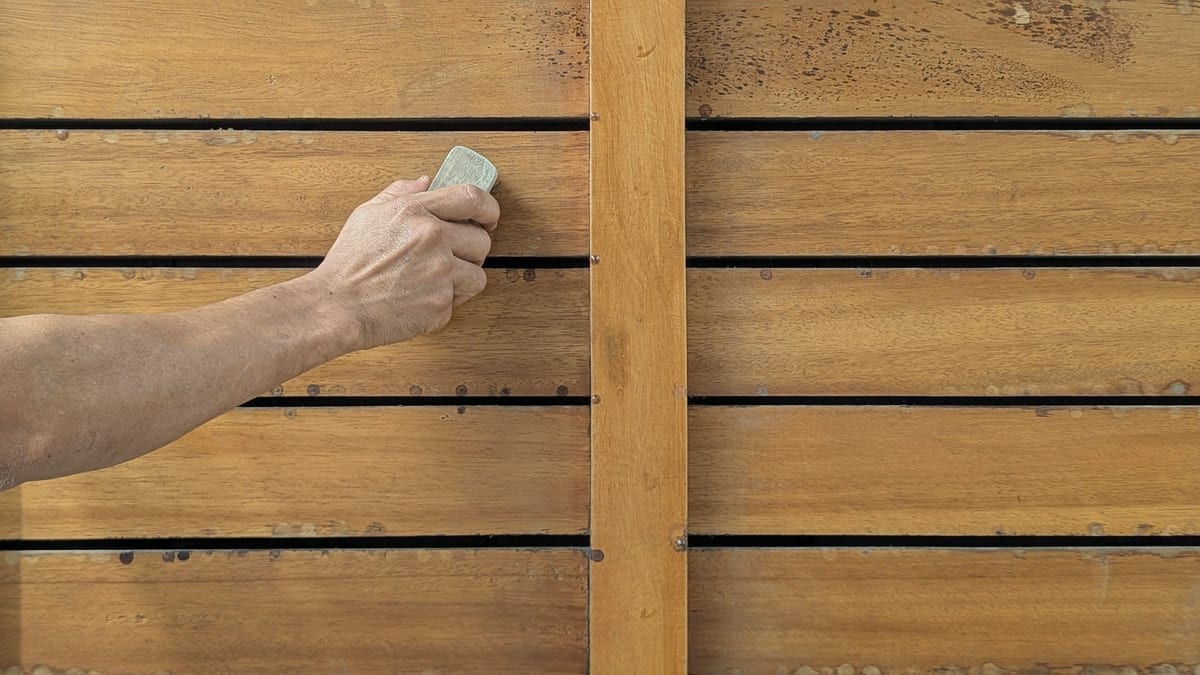
- Finish by hand in the last few millimeters with a folded sheet or a sanding sponge, following the grain.
⚠️ Important
Wear a dust mask or respirator and eye protection for detail sanding, even with collection running: the tool works close to your face and fine dust escapes in corners. If you are sanding old paint in a home built before 1978, the U.S. EPA says it is more likely to contain lead, so test it before sanding, or strip the paint instead of sanding it.
For cabinet doors, face frames and raised panels specifically, see my guide to the best sanders for cabinets, and for chairs, dressers and tables, the best sanders for furniture shows how a detail sander and a palm sander split the work.
🏆 The Verdict
For most people the BLACK+DECKER BDEMS600 is the right detail sander: it reaches corners and molding, collects its own dust and costs little. If you work cordless on M12, the Milwaukee M12 FUEL 2531-20 adds four speeds and a 5-year warranty at 1.3 lb. For the tightest work, the Proxxon OZI 115/E; for slots and louvers, the WEN 6307. Professionals finishing trim daily should look at the Festool DTS 400.
❓ Frequently Asked Questions
What is a good detail sander for small spaces?+
What is the best sander for sanding awkward places?+
How do you sand in really tight corners?+
Which is better, a detail sander or an orbital sander?+
What is the smallest detail sander?+
Is a mouse sander the same as a detail sander?+
Are mouse sanders any good?+
Conclusion
A detail sander does one job that no other sander can: it gets the abrasive into the corners, recesses and narrow spaces where old finish hides and new finish shows every miss. Pick the tool by the shape of your tight spaces, not by wattage: a pointed pad for corners and trim, a micro sander for the smallest parts, a belt file for slots. Pair it with a palm or orbital sander for the open surfaces and you have every part of a project covered. Questions about a specific piece? Leave a comment below and I’ll help you choose.

Great work! My wife asked me to get a mouse sander for her little shop and I just couldn’t decide which one to get, you saved my life haha. Thanks for the recommendation!
No problem Marcus, thanks for stopping by!
My old one broke so I went to read some reviews of newer models and found your article James. Got myself the Black & Decker Mouse like Steven down there and I couldn’t be happier, had to come back to thank you.
Thanks Richard, your satisfaction is exactly the reason I recommended it – felt the same thing. It’s a great machine and I’m glad I could help you!
I purchased the Skil Octo and love it. My only problem is finding the sanding pads in a store. The big box (Lowe’s &; Home Depot) don’t carry them which I find odd b/c they sell the sander.
Hey Alice, glad to hear it! You’re right about the pads, I’ve experienced the same. I have others that fit the machine (same size) but the suction holes are differently placed which makes them quite ineffective to use. The best solution is to order a bunch of Skil Octo sandpaper sets from Amazon. Thanks for stopping by!
Thanks for this James, the Black+Decker made my DIY projects a breeze!
You’re welcome Bill, that BD mouse sander is a great machine – have fun!
These are an absolute requirement for me, my work just doesn’t look the same without them. I’ve had an old B+D but I’m getting the new model you recommended now.
Thank you James, the effort you put in shows and it’s so so so useful. I’m going to refinish my stairs with the Hypertough!
Hey James, I went for the Skil and had to come here to say that it’s beyond awesome, just finished my first piece with it and the machine feels super sturdy and puts out amazing results. Thank you for the analysis, the way you write makes things clear and easy.
– C
Always glad to help Cameron, I do my best!
Well I just got myself the ol’ B&D Mouse, I’ve had it under my sight for a while and this made me take the step forward. Thanks for the great analysis, especially loved the useful comparison table!
No problem Steven, I’ve always thought that comparison tables were really helpful so I made sure to include them. The Mouse really is a great choice, you’ll love it!