


As an Amazon Associate I earn from qualifying purchases. All claims are strictly my personal opinion.
Editor’s Choice
Short on time? Of the 6 sanders I tested for furniture : palm and detail sander picks, this is the one I'd buy.
- Budget pick Makita BO4556K 1/4 Sheet Finishing Sander
- Also recommended BLACK+DECKER BDEMS600 Mouse

Last updated: September 2026. Every spec on this page was checked against the manufacturer’s own listing this month.
The best sander for furniture is a 1/4-sheet palm sander, because its square pad reaches right into the 90-degree corners that furniture is full of. Add a detail sander for carvings, spindles and recessed panels, and you can sand every surface of almost any piece.
I’ve spent years refinishing furniture, from simple tabletop restorations to ornate antique chests, and the tool question comes up on every project. Furniture is a different job from floors or decks: lots of small surfaces, inside corners, edges you must not round over, and veneer that forgives nothing. Below are my picks, a side-by-side table, and the exact sequence I follow to take a piece from old finish to ready-to-stain.
⚡ Quick Pick
Best overall: the DEWALT DWE6411K 1/4 Sheet Palm Sander, fast, comfortable one-handed and backed by a 3-year warranty.
Best value: the Makita BO4556K 1/4 Sheet Finishing Sander, the same 14,000 OPM in a slightly lighter body, with a tool case.
Best detail sander for furniture: the BLACK+DECKER BDEMS600 Mouse, whose pointed pad and detail finger reach carvings and corners no flat pad can touch.
Best Sanders for Furniture: Comparison
Six sanders, three jobs: square-pad palm sanders for the flat faces and corners, detail sanders for the carved and recessed areas, and one random orbital for big tabletops. Here is how they compare on the specs that matter for furniture.
| Product | ⭐ DEWALT DWE6411K 🏆 EDITOR’S CHOICE |
Makita BO4556K | BLACK+DECKER BDEMS600 | Bosch ROS20VSC | Milwaukee M12 FUEL 2531-20 | BLACK+DECKER BDEQS300 |
|---|---|---|---|---|---|---|
| Image | 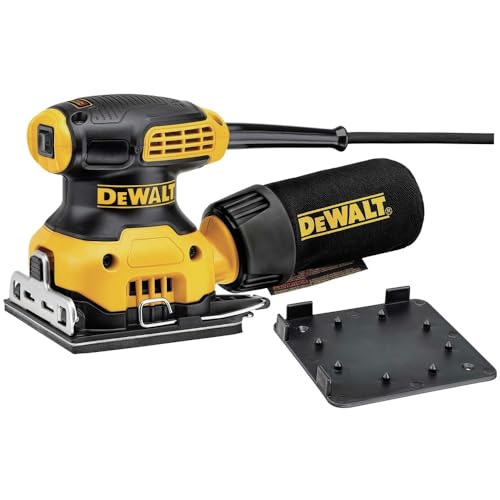 |
 |
 |
 |
 |
 |
| Price | $$ | $$ | $ | $$ | $$$ | $ |
| Sander Type | 1/4-sheet palm | 1/4-sheet palm | Detail (mouse) | 5″ random orbital | Cordless detail | 1/4-sheet palm |
| Motor | 2.3 A | 2.0 A | 1.2 A | 2.5 A | M12 brushless | 2.0 A |
| Speed (OPM) | 14,000 | 14,000 | 14,000 to 16,000* | 7,500 to 12,000 | 4,000 to 14,000 | 16,000 |
| Variable Speed | ❌ | ❌ | ❌ | ✅ Dial | ✅ 4 settings + trigger | ❌ |
| Dust Collection | ✅ Bag + locking vac port | ✅ Through-the-pad + port | ✅ Canister | ✅ Microfilter canister | No bag in the box | ✅ Bag |
| Power | Corded | Corded | Corded | Corded | M12 battery (tool only) | Corded |
| Warranty | 3 years | 1 year | 2 years | 1 year | 5 years | 2 years |
| Best For | All-round furniture work | Value, occasional refinishers | Carvings, corners, recesses | Tabletops, wide panels | Cordless detail on M12 | Tight budget |
| Availability | Shop Now | Shop Now | Shop Now | Shop Now | Shop Now | Shop Now |
⭐ DEWALT DWE6411K
🏆 EDITOR’S CHOICE
- Price
- $$
- Sander Type
- 1/4-sheet palm
- Motor
- 2.3 A
- Speed (OPM)
- 14,000
- Variable Speed
- ❌
- Dust Collection
- ✅ Bag + locking vac port
- Power
- Corded
- Warranty
- 3 years
- Best For
- All-round furniture work
Makita BO4556K
- Price
- $$
- Sander Type
- 1/4-sheet palm
- Motor
- 2.0 A
- Speed (OPM)
- 14,000
- Variable Speed
- ❌
- Dust Collection
- ✅ Through-the-pad + port
- Power
- Corded
- Warranty
- 1 year
- Best For
- Value, occasional refinishers
BLACK+DECKER BDEMS600
- Price
- $
- Sander Type
- Detail (mouse)
- Motor
- 1.2 A
- Speed (OPM)
- 14,000 to 16,000*
- Variable Speed
- ❌
- Dust Collection
- ✅ Canister
- Power
- Corded
- Warranty
- 2 years
- Best For
- Carvings, corners, recesses
Bosch ROS20VSC
- Price
- $$
- Sander Type
- 5″ random orbital
- Motor
- 2.5 A
- Speed (OPM)
- 7,500 to 12,000
- Variable Speed
- ✅ Dial
- Dust Collection
- ✅ Microfilter canister
- Power
- Corded
- Warranty
- 1 year
- Best For
- Tabletops, wide panels
Milwaukee M12 FUEL 2531-20
- Price
- $$$
- Sander Type
- Cordless detail
- Motor
- M12 brushless
- Speed (OPM)
- 4,000 to 14,000
- Variable Speed
- ✅ 4 settings + trigger
- Dust Collection
- No bag in the box
- Power
- M12 battery (tool only)
- Warranty
- 5 years
- Best For
- Cordless detail on M12
BLACK+DECKER BDEQS300
- Price
- $
- Sander Type
- 1/4-sheet palm
- Motor
- 2.0 A
- Speed (OPM)
- 16,000
- Variable Speed
- ❌
- Dust Collection
- ✅ Bag
- Power
- Corded
- Warranty
- 2 years
- Best For
- Tight budget
*Black+Decker’s own listings quote the BDEMS600 at both 14,000 and 16,000 orbits per minute. Price tiers: $ budget, $$ mid-range, $$$ upper mid-range, $$$$ premium.
⚡ Key Takeaways
- Square pads win on furniture: a DEWALT DWE6411K or Makita BO4556K reaches into every 90-degree corner a round pad misses.
- For carvings, spindles and raised panels, the BLACK+DECKER BDEMS600 is the detail sander to pair with it.
- Only big, flat tops call for a random orbital like the Bosch ROS20VSC: faster on open surfaces, useless in corners.
- On veneer, start at 120 grit and never park the sander in one spot.
Palm, Detail or Orbital: Which Sander Does Furniture Need?

Pad shape decides more than motor power on furniture. Before the reviews, here is how the three types divide the work on a typical dresser, table or chair.
The 1/4-Sheet Palm Sander Does 80% of the Work
A quarter-sheet palm sander has a flat, square pad of roughly 4-1/2 inches on a side. Its edges run parallel to the edges of a drawer front, an apron or a cabinet side, so you can sand right up to an inside corner without leaving a curved patch behind. It handles coarse stripping at 80 grit and final prep at 220 grit, and it uses ordinary sheets cut from a full sheet of sandpaper, which keeps running costs low. If you buy one sander for furniture, buy this type. My dedicated guide to the best palm sanders covers more models.
The Detail Sander Handles Carvings, Spindles and Recesses
A detail sander, often called a mouse sander, has a small pointed pad shaped like an iron. The point reaches into the corner of a raised panel, the junction between a turned leg and an apron, or the gap between chair slats. It is slow on open surfaces, so it is the second tool, not the first. The best detail sanders page compares every type, including finger attachments and file sanders for slots. For a straight head-to-head, see detail sander vs. orbital sander.
The Random Orbital Sander Is for Big Flat Tops
A random orbital sander spins and orbits a round 5-inch pad at the same time, which removes material faster and leaves fewer swirl marks on a wide tabletop than a palm sander. The catch is the round pad: it cannot reach into a corner, and it leaves an unsanded arc wherever two surfaces meet at 90 degrees. Use it on dining tables, desk tops and wide panels, then switch to a palm or detail sander for the edges. See my full list of random orbital sanders if tabletops are most of your work.
💡 Pro Tip
Before you plug anything in, hold each sander against the piece and walk through your sequence: tops, sides, fronts, then the tight spots. You will find the awkward corners before they find you, and you will not over-sand an exposed edge while chasing a corner next to it.
Best Sanders for Furniture: Reviews
Each review covers what the tool does well on furniture, where it falls short, and who should buy it. Specs are from the manufacturers’ own listings, checked in September 2026.
DEWALT DWE6411K 1/4 Sheet Palm Sander
Best Overall Sander for Furniture
The DEWALT DWE6411K is my top pick for furniture sanding, and it’s been my go-to for years. Its 2.3 A motor drives the 1/4-sheet pad at 14,000 OPM, which is what you feel on the first coarse pass over an old varnished top: it keeps cutting where weaker palm sanders bog down.
The details matter on furniture. The rubber overmold gives a secure one-handed grip while your other hand steadies the piece. The locking dust port holds a vacuum hose in place, so the hose does not pull loose every time you turn a drawer over. The foam pad keeps the sanding plane flat, the improved paper clamp holds the sheet tight through a full session, and the lower overall height brings your hand closer to the work for better control near edges. DEWALT includes a paper punch, a dust bag and a carrying bag.
- ✅ 2.3 A motor at 14,000 OPM keeps cutting on coarse stripping passes
- ✅ Locking dust port holds a vacuum hose securely
- ✅ Foam pad and separate counterweight for a flat, low-vibration finish
- ✅ Uses cut sheets of standard sandpaper, so consumables are cheap
- ✅ 3-year limited warranty
- ❌ No variable speed
- ❌ Slightly heavier than the Makita for long overhead sessions
Best For: Anyone who wants one sander that takes a piece from coarse stripping to final 220-grit prep, from hobbyists to serious refinishers.
Makita BO4556K 1/4 Sheet Finishing Sander
Best Value Sander for Furniture
The Makita BO4556K is where I point anyone who wants proper furniture sanding capability without paying for the DEWALT’s extra amperage. Its 2.0 A motor runs the same 14,000 OPM, so on a dresser or a set of chairs the difference in speed is small in practice.
Makita builds it on ball bearings to cut vibration and noise, gives it a contoured rubberized palm grip, and uses a large clamping lever that makes paper changes quick. Dust is pulled through the pad into a built-in port that connects to a vacuum. The body is slightly lighter than the DEWALT, which some people prefer for long one-handed sessions on a big wardrobe or dining set, and the K version comes with a hard tool case.
- ✅ 14,000 OPM from a 2.0 A motor
- ✅ Ball-bearing construction for lower vibration and noise
- ✅ Large clamping lever for fast paper changes
- ✅ Through-the-pad dust collection with a vacuum port
- ✅ Tool case included
- ❌ Less torque than the DEWALT on heavy coarse-grit stripping
- ❌ No variable speed; 1-year warranty
Best For: Hobbyists and occasional refinishers who want a well-built palm sander from a pro brand at a mid-range price.
BLACK+DECKER BDEMS600 Mouse Detail Sander
Best Detail Sander for Furniture
The BLACK+DECKER BDEMS600 is the best detail sander I’ve used, and on furniture it becomes indispensable the moment a piece has carved molding, spindle turnings or a recessed panel. Its pointed pad reaches places that would otherwise mean folded sandpaper and a lot of patience: chair back splats, the corner of a raised door panel, the junction between a turned leg and an apron.
The 1.2 A motor is small, but Black+Decker rates it at 14,000 to 16,000 orbits per minute (its own listings quote both figures), which is enough to remove old finish in tight spots rather than just polish it. The detail finger attachment extends the reach into the narrowest profiles, the 3-position grip lets you hold it like a palm sander or by the nose, and a dust canister clips on the back. Pair it with either palm sander above and you have a two-tool kit that covers every surface on almost any piece of furniture.
- ✅ Pointed pad reaches corners and carvings no square pad can
- ✅ Detail finger attachment for the tightest profiles
- ✅ 3-position grip for control in awkward spots
- ✅ Dust canister and dust-sealed switch
- ✅ Budget price, easy to own alongside a palm sander
- ❌ Slow on open, flat areas
- ❌ Uses shaped sheets, not cut-down standard paper
Best For: Anyone refinishing furniture with carved detail, molding profiles or recessed panels. It is the companion to a palm sander, not a replacement.
Bosch ROS20VSC 5″ Random Orbital Sander
Best Orbital Sander for Refinishing Furniture Tops
When the job is a dining table, a desk top or a wide cabinet side, a random orbital sander is simply faster than a palm sander. The Bosch ROS20VSC earns its place here because of two features that matter on furniture: a variable speed dial from 7,500 to 12,000 OPM, so you can slow down on veneer, and a pad dampening system designed to limit swirl marks on flat and contoured surfaces.
The 2.5 A motor drives a 5-inch hook-and-loop pad, and Bosch’s microfilter canister is rated to catch particles down to 1/2 micron, with a clear body that shows when it needs emptying. That matters when you are sanding between finish coats and every speck of dust shows up in the next coat. Remember the limit of any round pad: it will not reach into the corner where a tabletop meets a raised edge or a breadboard end, so keep a palm or detail sander for those spots.
- ✅ Variable speed, 7,500 to 12,000 OPM
- ✅ Pad dampening to reduce swirl marks
- ✅ Microfilter canister rated to 1/2 micron
- ✅ Faster than any palm sander on wide, open surfaces
- ❌ Round pad cannot reach inside corners
- ❌ Too big for chairs, spindles and small drawers
Best For: Refinishing tabletops, desks and large flat panels, as a second sander next to a palm sander.
Milwaukee M12 FUEL Orbital Detail Sander (2531-20)
Best Cordless Detail Sander for Furniture
If you already run Milwaukee M12 batteries, the M12 FUEL Orbital Detail Sander is the cordless way to handle furniture detail work, with no cord to drag over a freshly sanded surface or snag on a chair leg. Milwaukee specs it with a 1.5 mm orbit, four speed settings from 4,000 to 14,000 OPM and a variable-speed trigger, at 1.3 lb.
The small orbit is aimed at a stain-grade finish rather than fast stock removal, which suits furniture, where blotchy stain over coarse scratches is the usual failure. The pad has sharp straight edges for corners, and a sponge interface pad in the box lets the abrasive follow molding profiles. There is also an LED light for the inside of cabinets and a 5-year limited warranty. Two caveats: it is sold as a bare tool, so the battery and charger are extra if you are not on M12 yet, and there is no dust bag in the box, so plan on a vacuum.
- ✅ Cordless, 1.3 lb, easy to use in any orientation
- ✅ Four speeds from 4,000 to 14,000 OPM plus a variable trigger
- ✅ Sponge interface pad for curved profiles
- ✅ LED light and 5-year warranty
- ❌ Tool only: battery and charger sold separately
- ❌ No dust bag included
Best For: M12 owners who refinish furniture on site or away from an outlet.
BLACK+DECKER BDEQS300 1/4 Sheet Sander
Best Budget Sheet Sander for Furniture
For a first refinishing project, or a single thrift-store dresser, the BLACK+DECKER BDEQS300 gets you the right pad shape for the least money. It has a 2.0 A motor at 16,000 OPM and a pad designed for flush sanding on three sides, with 270 degrees of clearance, so it gets close to inside corners.
The paddle switch sits on top of the body and locks on for one-handed use, paper clamps take standard cut sheets, and a tri-layer dust bag catches most of the dust. It is a lighter-duty tool than the DEWALT or Makita, so it suits occasional projects better than weekly use, but the 2-year warranty is longer than Makita’s.
- ✅ Square pad with flush sanding on three sides
- ✅ 16,000 OPM from a 2.0 A motor
- ✅ Lock-on paddle switch for one-handed work
- ✅ 2-year limited warranty
- ❌ Built for occasional use, not daily shop work
- ❌ Dust bag only, no locking vacuum port
Best For: First-time refinishers and one-off projects where the right pad shape matters more than a pro-grade motor.
How I Chose These Sanders
Furniture is a narrow use, so I judged each tool on four questions rather than raw power.
Can It Reach a 90-Degree Inside Corner?
This rules the list. Square and pointed pads made it in; round pads made it only as the tabletop specialist, clearly labeled as such.
Can It Finish, Not Just Strip?
Most furniture ends up stained or clear-coated, where scratches show. I favored tools whose orbit, speed and pad design support a clean 180 to 220-grit finish.
Is It From a Brand With Parts and a Real Warranty?
Every pick carries a manufacturer warranty from one to five years, and all come from brands whose pads and accessories you can still buy years later.
Is It Actually Available?
I checked every model’s specs against the manufacturer’s listing and confirmed each one was in stock on Amazon in September 2026. When a model stops being sold, it comes off this page.
How to Sand Furniture for Refinishing: Step by Step
The right sequence matters as much as the right tool. This is the method I use on every piece, whether it is a paint-caked dresser or a light refresh on a dining table.
Step 1: Take It Apart Where You Can
Remove drawers, doors and hardware. A table with its legs off becomes a top and four sticks, each easy to sand flat. Label mating parts with painter’s tape before you separate them so everything goes back in the same place. If the piece is caked in several coats of paint, a gel paint stripper takes most of it off before you sand.
Step 2: Follow the Grit Progression
- 80 grit: strip old paint, varnish or stain on solid wood only.
- 120 grit: remove the 80-grit scratches and level the surface. Start here on veneer.
- 180 grit: smooth the surface for finishing.
- 220 grit: final pass before finish, or lightly between coats.
Never skip more than one grit, or the coarser scratches will show through stain. If the piece is going to be painted rather than stained, my guide on how to sand furniture to paint covers the shorter sequence.
Step 3: Sand the Flat Faces First
Use the palm sander, or the random orbital on big tops, on every main surface. Move with the grain, keep the sander moving, overlap each pass by about half a pad and let the tool’s weight do the work. Pressing harder slows the orbit and digs hollows into soft woods like pine.
Step 4: Work Edges and Inside Corners
Bring the square pad right into each inside corner from both sides so the two sanded faces meet cleanly. On outside edges, keep the pad flat on the face and let it run just off the edge; tilting it rounds the edge over, and a rounded edge looks soft under finish.
Step 5: Detail Work in Carvings and Grooves
Now switch to the detail sander for carvings, molding and raised-panel corners. Old finish hides in exactly these places and new stain will show every spot you missed. For grooves too narrow for any pad, wrap sandpaper around a dowel or a sanding sponge and work it by hand.
💡 Pro Tip
For turned legs and spindles, cut a 1-inch strip of cloth-backed sandpaper and use it like a shoe-shine cloth: one end in each hand, wrapped around the spindle, pulled back and forth. It follows the curve far better than any flat pad.
Step 6: Final Hand Sand and Clean Up
Finish with a light pass by hand at 220 grit, always with the grain, to remove any remaining machine marks. Then vacuum and wipe the whole piece with a tack cloth. Dust left in the pores becomes grit in the topcoat.
Dust, Veneer and Safety

Why a Vacuum Attachment Is Worth It on Furniture
Sanding dust hides the surface you are trying to judge, clogs the paper and settles into wet finish. All the corded sanders above have a dust port or canister; connecting a shop vacuum to the port is the single biggest upgrade you can make, and it keeps fine dust out of the air you breathe. For the cleanest setup, choose a sander that connects to a vacuum without adapters.
Veneer Needs a Lighter Hand
⚠️ Important
Veneer on older pieces and flat-pack furniture can be very thin, and it is easy to sand through on edges and high spots. Skip 80 grit entirely, start at 120 or finer, check often, and hand sand the edges.
Old Paint Can Contain Lead
If the piece was painted before 1978, the U.S. EPA says the paint is more likely to contain lead. Test it before you sand, and if it is positive, do not dry sand it: use wet methods and a HEPA vacuum, or have a lead-safe certified contractor do it.
🏆 The Verdict
For most furniture projects the DEWALT DWE6411K is still my first recommendation: square pad, strong motor, locking vacuum port and a 3-year warranty. Pair it with the BLACK+DECKER BDEMS600 for carvings and corners and you can sand any piece. On a tighter budget, the Makita BO4556K gives the same 14,000 OPM for less. Add the Bosch ROS20VSC only if big tabletops are a regular job.
❓ Frequently Asked Questions
What is the best type of sander for furniture?+
What is the best detail sander for furniture?+
How do you sand intricate details on furniture?+
What is the best tool for intricate sanding?+
Can you use an orbital sander to refinish furniture?+
Do I need a sander with a vacuum attachment for furniture?+
Conclusion
Furniture rewards the right pad shape more than raw power. A square-pad palm sander for the flat work, a detail sander for the carved and recessed areas, and a methodical grit sequence will bring almost any piece back. If your project is kitchen or bathroom cabinetry rather than freestanding furniture, my guide to the best sanders for cabinets covers the differences, and the detail sander comparison goes deeper on tight spaces and corners. Questions about a specific piece? Leave a comment below and I’ll help you pick the right tool.

Thank you very much for all of the information! I’ve just started to learn about redoing furniture and I’m having fun with it.! Enjoy your day!
You’re more than welcome Hayley, thanks for the kind words and enjoy your woodworking journey. Have a wonderful weekend!
Thanks a lot for this write up James, got the DeWalt coupled with the Black+Decker and they’re an unbeatable duo! I’ve been enjoying using them on a bunch of old furniture I’ve had on hold since the winter, these beauties make it an easy and actually relaxing task. Again, thank you.
I’m glad to hear it Manny, they’re awesome little beasts indeed. Good luck with the refinishing and enjoy the Summer!
Hey James, I’m in a little woodworking group where we mostly deal with furniture. We have a lot of “newbies” so this guide will be outstanding for them to read. You’re clearly very experienced and our doors are always open to have you as a teacher! Thanks again James.
Hey Jesse, that sounds great. Be sure to send me an email and I’ll do my best to help out, I can send you a package of tools you can give to the new members too – I’ve got a lot laying around!