
As an Amazon Associate I earn from qualifying purchases. All claims are strictly my personal opinion.
Editor’s Choice
Short on time? Of the 6 sheet sanders on this list, this is the one I'd buy.

The most powerful, best-controlled half-sheet sander I’ve ever used, with Bosch’s industry-leading suspension system for all-day comfort.
- Mid-range pick Makita BO4900VA genuine half-sheet powerhouse with variable speed at a more accessible price point.
- Also recommended Makita BO4556Outstanding finish quality and Makita build reliability at a price that’s hard to beat.

Sheet sanders are the workhorses of finish sanding: consistent, predictable, and easy to use with universally available sandpaper. I’ve spent years working with these tools on furniture builds, cabinet refacing, and trim work, and I’ve tested every model on this list under real shop conditions. Whether you’re a weekend DIYer smoothing out a tabletop or a pro doing production finish work, there’s a sheet sander here for you. Below you’ll find quarter-sheet (1/4), third-sheet and half-sheet (1/2) models, a plain-English guide to which size you need, and three cordless sheet sanders for anyone already on a battery platform.
What I love most about sheet sanders is their simplicity. They present the sandpaper flat below the machine and work with either a vibrating or orbital motion: that flat contact surface is exactly why they’re so good on rectangular workpieces like benches, planks, and cabinet doors. They barely leave any scratches when used properly, and unlike belt sanders you physically can’t tilt them at an angle and gouge a flat surface. I picked up my first one as a kid, and they’ve been a staple of my shop ever since. I only picked models for this list that keep vibration well-managed: the cheap ones that shake your arms apart aren’t worth your time or your joints.
Best Sheet Sanders Comparison
Here’s a side-by-side look at every sheet sander I tested, covering sheet size, motor output, speed range, dust collection, and value tier. Use this table to zero in on the right tool before diving into the full reviews below.
| Product | ⭐ Bosch OS50VC 🏆 EDITOR’S CHOICE |
BLACK+DECKER BDEQS300 | DEWALT DWE6411 | Makita BO4556 | Makita BO3710 | Makita BO4900V |
|---|---|---|---|---|---|---|
| Image | |
 |
 |
 |
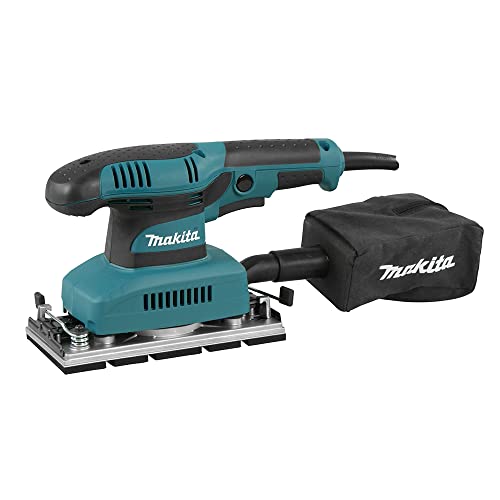 |
 |
| Price | $$$$ | $ | $$ | $$ | $$ | $$$ |
| Sheet Size | 1/2 Sheet | 1/4 Sheet | 1/4 Sheet | 1/4 Sheet | 1/3 Sheet | 1/2 Sheet |
| Motor | 3.4A | 2.0A | 2.3A | 2.0A | 1.7A | 2.9A |
| OPM Range | 8,000–11,000 | 16,000 | 14,000 | 14,000 | 11,000 | 4,000–10,000 |
| Variable Speed | ✅ | ❌ | ❌ | ❌ | ❌ | ✅ |
| Dust Collection | Canister / Vac Port | Bag | Bag / Vac Port | Bag | Bag | Bag / Vac Port |
| Warranty | 1 year | 2 years | 3 years | 1 year | 1 year | 1 year |
| Availability | Shop Now at Amazon | Shop Now at Amazon | Shop Now at Amazon | Shop Now at Amazon | Shop Now at Amazon | Shop Now at Amazon |
Key takeaways
- My top pick is the Bosch OS50VC: the most powerful half-sheet sander in the category with best-in-class vibration control and premium variable speed.
- Runner-up: the Makita BO4900V, a superb variable-speed half-sheet sander at a more accessible price point, great for large surfaces.
- Best compact workhorse: the Makita BO4556, outstanding finish quality and rock-solid build from one of the most trusted names in power tools.
- Best entry-level pick: the DEWALT DWE6411, rubber overmold grip, improved paper clamping, and a locking dust port make this the most practical affordable option I’ve tested.
- Best 1/3-sheet option: the Makita BO3710, the ideal middle ground between compact maneuverability and serious surface coverage.
Sheet Sander Reviews
Below are my in-depth reviews of every sheet sander I tested, covering real performance, standout features, and exactly who each tool is best suited for. I’ve organized them from compact quarter-sheet models up to the full-size half-sheet tools, so you can compare across size classes at a glance.
💡 Pro Tip
One of the biggest advantages sheet sanders have over random orbital sander tools is that you can use standard sandpaper cut to size, no proprietary hook-and-loop discs required. A single 9″×11″ sheet cuts cleanly into four 1/4-sheet pieces, three 1/3-sheet pieces, or two 1/2-sheet pieces. Buy in bulk and you’ll spend a fraction of what disc-based sanders cost to run. These are the sandpaper brands I’d buy for a sheet sander.
1/4-sheet orbital sander
BLACK+DECKER BDEQS300
BLACK+DECKER BDEQS300 1/4-Sheet Orbital Sander
A light, simple 1/4-sheet sander with a 16,000 OPM motor and a dust bag, made for occasional finish sanding.
Best for
First-time buyers and weekend DIYers doing occasional touch-ups and trim prep.
- 2.0 A motor at 16,000 OPM
- Light and easy to control one-handed
- Simple clamp, nothing to break
Skip it if
You sand for long sessions: it isn't built for continuous work.
- Not built for heavy or continuous use
- More vibration than premium models
Read full review
Black+Decker delivers once again with a solid entry-level machine that won’t ask much of your wallet. The BDEQS300 is small, light, and dead simple to use: exactly what you want when you’re just getting started with sheet sanding. The 2.0A motor puts out 16,000 OPM, which handles everyday finishing tasks without complaint: smoothing bare wood before staining, knocking down grain raised by a primer coat, prepping trim before painting.
It won’t win performance trophies against the heavier tools further down this list, but for occasional home use and light finishing tasks, it delivers real results. The built-in dust collector does an acceptable job and the clamp-style paper retention is simple and reliable: nothing fancy, nothing to break. Where it shows its budget nature is in extended use: the materials aren’t built for hours of continuous operation, and you’ll feel more vibration transfer than on pricier tools.
Key Features:
Entry-level pick1/4-sheet palm sander
DEWALT DWE6411
DEWALT Electric Sander, 1/4 Sheet, 14,000 OPM (DWE6411)
A 1/4-sheet sander with a 2.3 A motor, a rubber overmold grip and a dust port that locks onto a vacuum hose.
Shop Now at AmazonSpecs: DEWALT
Best for
Serious DIYers and occasional contractors who want a durable 1/4 sheet.
- Locking dust port for a vacuum hose
- Rubber overmold grip
- Improved paper clamp
Skip it if
You want variable speed to slow down for finish coats.
- Single speed only
- Dust bag could be larger
Read full review
The DWE6411 raises the bar for inexpensive 1/4 sheet sander tools in a meaningful way. The 2.3A motor sanding at 14,000 OPM doesn’t bog down under load the way cheaper tools do, and you feel that extra headroom when you’re working against hardwood grain. The rubber overmold texture is the real comfort story here: it provides smooth and comfortable control during long sanding sessions while keeping the tool firmly in hand.
DEWALT also engineered improved paper clamp features for better paper retention and a locking dust-port system that allows you to lock a vacuum hose directly to the sander: a small design decision that pays big dividends when you’re working in a clean-air-critical environment. The reduced overall height gets you closer to your work for improved control and visibility. If you’re a serious DIYer or occasional contractor who wants a 1/4-sheet tool that will keep up, this is the one to buy.
Key Features:
Best compact1/4-sheet finishing sander
Makita BO4556
Makita BO4556 2 Amp Finishing Sander
One of my all-time favorite 1/4-sheet sanders: 14,000 OPM tuned for a clean scratch pattern rather than raw speed.
Shop Now at AmazonSpecs: Makita
Best for
Final passes on furniture, cabinets and fine trim before topcoating.
- Refined orbital action for a clean finish
- Light and nimble, low fatigue
- Thorough dust collection
Skip it if
You need fast stock removal: it puts finish quality ahead of speed.
- No variable speed
- Slower than the 16,000 OPM models
Read full review
Probably the best bang-for-your-buck option on this entire list, and one of my all-time favorite 1/4-sheet sanders. Makita’s BO4556 is an impressively capable machine, until you pick it up and realize Makita just builds things better. The 2.0A motor at 14,000 OPM produces a refined orbital action tuned for finish quality, and the scratch pattern it leaves is noticeably cleaner than faster tools. Makita prioritizes finish consistency over raw speed, and on furniture work that’s exactly the right call.
The clamping system is solid and reliable, the dust collection is effective, and the overall build quality is the kind that holds up under years of regular use. Lightweight and nimble, with sound and vibration well-controlled. This is the tool I’d recommend to any woodworker looking to get into Best Sanders for Furniture 2026 projects without overspending on their first dedicated sheet sander.
Key Features:
Best 1/3 sheet1/3-sheet finishing sander
Makita BO3710
Makita BO3710 Finishing Sander
A 1/3-sheet sander that covers panels faster than a 1/4 sheet but stays easy to handle, with a lock-on switch.
Shop Now at AmazonSpecs: Makita
Best for
Medium panels, cabinet doors and furniture that need more coverage than a 1/4 sheet.
- 1/3-sheet pad, a middle ground for coverage
- Lock-on switch for long sessions
- Counterbalance keeps vibration down
Skip it if
You want precut paper in every grit: you will often cut 1/3 sheets yourself.
- No variable speed
- Fewer grits sold precut in 1/3 size
Read full review
The 1/3-sheet format doesn’t get the attention it deserves, and the BO3710 is a perfect example of why that’s a shame. It covers furniture panels and door faces noticeably faster than the compact 1/4-sheet tools, yet it’s still manageable enough for tighter work. If you regularly move between large flat surfaces and detailed areas, this middle-ground size is genuinely the sweet spot, and Makita nails the execution here.
With a 1.7A motor delivering 11,000 OPM, the BO3710 produces a smooth, consistent finish. The ergonomic grip pairs with a built-in counterbalance system that keeps vibration under control, and the lock-on power button is something I appreciate more with every long sanding session: it lets you fully relax your grip without losing power. Its dust collection system keeps the working environment clean, and sourcing 1/3-sheet paper has gotten much easier in recent years. A highly underrated tool at a very accessible price.
Key Features:
Makita BO3710 Review: Specs at a Glance
The short version of my Makita BO3710 review: it is the 1/3-sheet sander to buy if you want more pad than a palm sander without the weight of a half-sheet machine. Makita’s spec sheet lists a 1.7-amp motor at 11,000 OPM, a 3-5/8″ x 7-1/4″ pad that takes 3-5/8″ x 9″ paper (a standard sheet cut in three), 3.5 lb and a vibration rating of 3.5 m/s², helped by the built-in counterbalance. The paper goes in under a large rubberized clamping lever, the two-finger trigger has a lock-on button, the base is cast aluminum, and dust goes through the pad into a cloth bag. Makita covers it for 1 year.
Where it falls short is speed control: it runs at one speed, so on veneer or a last pass before stain you manage aggressiveness with the grit. For a variable-speed alternative, the half-sheet Makita BO4900V below adds a dial at the cost of size and weight. See the Makita BO3710 on Amazon.
Runner-up1/2-sheet finishing sander
Makita BO4900V
Makita BO4900V 2.9 Amp Variable Speed 1/2 Sheet Sander
Makita's half-sheet sander: a big pad and variable speed for tabletops and wide panels, a tier below the Bosch.
Shop Now at AmazonSpecs: Makita
Best for
Tabletops, wide panels and other large flat surfaces, from stock removal to fine finishing.
- 1/2-sheet pad covers large surfaces fast
- Variable speed, 4,000 to 10,000 OPM
- Vacuum-ready dust port
Skip it if
You sand inside drawer boxes or tight spaces, where a 1/4 sheet fits better.
- Heavier and less nimble than 1/4-sheet tools
Read full review
The BO4900V is Makita’s half-sheet sander and it’s a quality machine at a strong price. The big 1/2-sheet pad is ready for larger tasks (tabletops, cabinet carcasses, wide floor patches) and the 2.9A motor with variable speed from 4,000 to 10,000 OPM gives you real versatility. Dial it back for fine finishing on veneered surfaces, open it up for fast material removal on solid stock.
Even at high speeds, vibration control is very good and the ergonomic handles keep fatigue at bay. The built-in dust collector does its job well, and connecting a vacuum hose is straightforward for near-dust-free operation on bigger pieces. If you’re working on any of the types of projects covered in my guide to Best Sanders for Wood 2026, this half-sheet format will save you serious time on flat stock.
Key Features:
Editor's Choice1/2-sheet finishing sander
Bosch OS50VC
Bosch OS50VC 3.4-Amp Variable Speed 1/2-Sheet Orbital Finishing Sander with Vibration Control
The best sheet sander I've used: a 3.4 A half-sheet with variable speed and a suspension that tames vibration.
Shop Now at AmazonSpecs: Bosch
Best for
Pros and serious furniture builders who spend long hours finish-sanding.
- Best vibration control on the list
- Variable speed, 8,000 to 11,000 OPM
- SheetLoc clamp also takes stick-on paper
Skip it if
You only sand now and then, or mostly work in tight spots a half-sheet pad can't reach.
- Premium price
- Overkill if you only sand occasionally
Read full review
If you’re looking for the best half-sheet orbital sander on the market, the Bosch OS50VC is the one I reach for when the work matters most. Of all the half-sheet sander reviews I’ve written, this one shines the brightest. The roaring 3.4A motor with variable speed from 8,000 to 11,000 OPM will take on anything you throw at it and can run continuously without failing. The ergonomic design includes multiple hand positions so the tool adapts to you, not the other way around.
The Bosch-exclusive suspension system is, without question, the best vibration control I’ve ever experienced in a sheet sander. Most tools transfer orbital motion directly into your hand; the OS50VC’s suspension isolates the pad mechanism from the housing in a way that makes multi-hour sessions genuinely comfortable. The SheetLoc Supreme Paper Clamping System delivers a perfect paper fit every time, and it also accepts stick-on paper if you prefer. I know I sound enthusiastic: this machine earns it. Easily the best sheet sander I’ve ever used.
Key Features:
1/4 Sheet vs 1/2 Sheet Sanders: Which Size Do You Need?
Sheet sanders are named after how much of a standard 9″ x 11″ sheet of sandpaper they take. The size decides almost everything else about the tool: how many hands you need, how fast it covers a panel, where it fits and what the paper costs you. Here is how the three sizes on this page compare, using the makers’ own paper sizes.
| Size | Paper size | Pieces per 9″ x 11″ sheet | Handling | Models on this page |
|---|---|---|---|---|
| 1/4 sheet (quarter) | 4-1/2″ x 5-1/2″ | 4 | One hand, palm grip | BLACK+DECKER BDEQS300, DEWALT DWE6411, Makita BO4556 |
| 1/3 sheet (third) | 3-5/8″ x 9″ | 3 | One or two hands | Makita BO3710 |
| 1/2 sheet (half) | 4-1/2″ x 11″ | 2 | Two hands | Makita BO4900V, Bosch OS50VC |
When a Quarter-Sheet Sander Is the Right Call
A 1/4 sheet sander is the one most people should buy first. It fits in one hand, so you can sand a cabinet side, a door stile or a stair riser without a second hand to steady it, and its square pad reaches right into the inside corners of face frames, drawer boxes and window trim. It is also the size for painted work: scuffing between coats, feathering a patch, knocking down raised grain after the first coat of primer. If your projects are furniture, cabinets and trim, a quarter-sheet covers nearly all of it. For more compact one-handed options, see my palm sander reviews.
When a Half-Sheet Sander Earns Its Size
A 1/2 sheet sander puts twice the paper on the surface, which matters when the job is a tabletop, a run of cabinet sides or a stack of shelves. The larger pad also bridges small dips rather than following them, so it keeps a wide panel flatter than a small pad does. The trade-offs are weight and reach: you steer it with two hands, it is tiring on vertical surfaces, and it won’t fit inside a drawer box. Buy a half-sheet as a second sander, or as a first one only if most of your work is large and flat.
Where the 1/3 Sheet Fits
The third-sheet format sits between the two: a longer, narrower pad that still works one-handed for short spells but covers panels faster than a quarter-sheet. It suits people who move between doors and panels in the same session. The one drawback is paper: fewer grits come precut in 1/3 size, so you will usually cut full sheets yourself.
Paper: Clamps, Hook-and-Loop and Dust Holes
Every sheet sander on this page clamps ordinary sandpaper, so you can cut any grit from full 9″ x 11″ sheets. Some pads also take hook-and-loop or adhesive-backed sheets, which change faster but cost more. With plain paper, use the punch plate that comes with most models (or buy pre-punched sheets) so the dust collection can pull through the pad; unpunched paper leaves the dust on the surface, where it clogs the grit. For corners tighter than 90 degrees, a sheet sander won’t get in at all, and that is where one of the best detail sanders earns its place next to it.
Cordless Sheet Sanders
If you already own batteries from one of the big platforms, a cordless 1/4 sheet sander is worth a look: no cord to drag across a finished surface, and nothing to plug in when you sand trim in place or work on a ladder. What you give up is runtime on long sessions and a little balance, since the battery adds weight above the pad. These are the three bare-tool models I’d consider. They are newer additions, chosen from the makers’ published specs rather than from the long-term use behind the corded reviews above, and each is sold without battery or charger. For every battery-powered sander type, see my best cordless sander roundup.
Cordless 1/4-sheet sander
DEWALT DCW200B
DEWALT 20V MAX XR 1/4 Sheet Sander (DCW200B)

The most versatile cordless 1/4 sheet here on paper: brushless, with variable speed from 8,000 to 14,000 OPM.
Shop Now at AmazonSpecs: DEWALT
Best for
DEWALT 20V owners who want variable speed on a cordless quarter-sheet sander.
- Brushless motor with variable speed
- Standard 1/4-sheet paper, punch included
- Locking dust bag and extractor port
Skip it if
You would buy DEWALT batteries just for this: a corded model is better value.
- Tool only: no battery or charger
Read full review
The DCW200B is the cordless version of the quarter-sheet format with the most to offer on paper: a brushless motor with variable speed from 8,000 to 14,000 OPM, so you can slow it down for finish coats and run it flat out on bare wood. DEWALT lists it at 2.1 lb for the bare tool, and it takes standard 4-1/2″ x 5-1/2″ paper. A locking dust bag, a hole punch and a port for DEWALT’s dust extractors come in the box, and it carries DEWALT’s 3-year limited warranty.
Cordless 1/4-sheet sander
Makita XOB02Z
Makita 18V LXT 1/4 Sheet Finishing Sander (XOB02Z)

Makita's cordless 1/4 sheet with two speeds and, per Makita, up to 30% less vibration than the corded BO4556.
Shop Now at AmazonSpecs: Makita
Best for
Makita 18V LXT owners doing trim and cabinet work.
- Two speeds: 11,000 and 14,000 OPM
- Less vibration than the BO4556, per Makita
- Dust bag, punch plate and paper included
Skip it if
You want standard quarter sheets without trimming them.
- Non-standard 4-1/2 x 4 in paper
- Tool only: no battery or charger
Read full review
Makita’s XOB02Z is the cordless relative of the BO4556 reviewed above, and Makita says it runs with up to 30% less vibration than that corded model. It has two speeds, 11,000 and 14,000 OPM, a 1/16″ orbit and a brushed motor, and weighs 3.8 lb with a battery fitted. Note the paper: Makita specifies a 4-1/2″ x 4″ piece rather than the usual 4-1/2″ x 5-1/2″. A dust bag, punch plate and three sheets are included, backed by Makita’s 3-year limited warranty.
Cordless 1/4-sheet sander
Milwaukee 2649-20
Milwaukee M18 1/4 Sheet Orbital Sander (2649-20)

The lightest cordless 1/4 sheet here with a battery fitted, backed by a 5-year warranty.
Shop Now at AmazonSpecs: Milwaukee
Best for
M18 owners sanding trim, walls and overhead who want the lightest cordless option.
- About 2.6 lbs with battery
- Variable speed, 11,000 to 13,000 OPM
- Dust bag plus universal vacuum adapter
Skip it if
You don't already own M18 batteries.
- Narrower speed range than the DEWALT
- Tool only: no battery or charger
Read full review
The Milwaukee 2649-20 is the lightest of the three on Milwaukee’s figures, at about 2.6 lb with a battery, which makes it the easiest to hold on walls and overhead. It runs at a variable 11,000 to 13,000 OPM with a 1.6 mm orbit, clamps paper with a two-step clamp, and comes with a dust bag and a universal vacuum adapter. Milwaukee backs it with a 5-year limited warranty, the longest here.
Corded or Cordless: Which Sheet Sander Should You Buy?
Buy corded if you sand in a shop for long stretches: a corded quarter-sheet costs less, weighs less than a cordless tool with its battery, and never stops halfway through a tabletop. Buy cordless if you already own the batteries and do a lot of sanding in place, on trim, doors, stairs and furniture around the house, where the cord is the biggest nuisance. If you would have to buy into a battery platform just for a sander, the corded models above are the better value.
How to Choose the Best Sheet Sander
With so many options across sizes and price points, picking the right sheet sander comes down to a handful of key decisions. Here’s what I always think through before recommending one tool over another.
Start with the size question in the quarter-sheet vs half-sheet section above; once you know the size, these are the specs that separate a good sander from a frustrating one.
Motor Power and OPM
For general woodworking, 12,000–16,000 OPM covers the full range of useful applications. Higher OPM removes material faster but produces a slightly coarser scratch pattern. Lower OPM is better for fine finish passes where surface quality is the priority. Tools with variable speed give you the best of both worlds: fast for material removal, dialed back for final passes before finishing.
💡 Pro Tip
If you’re also doing rough stock removal or working on decks and outdoor structures, a sheet sander alone won’t be enough. Check out my guide to the Best Sanders for Deck 2026 and consider pairing your sheet sander with a belt sander for the heavy lifting. You can find my best belt sander picks there as well.
Vibration Control
This is the spec that separates a comfortable all-day tool from one that leaves your hands numb. Budget tools transfer orbital motion directly into the grip. Premium tools, especially the Bosch OS50VC, use active suspension systems that isolate the pad mechanism from the housing. If you sand for more than 30 minutes at a stretch, this is worth paying for.
Dust Collection
More important than most people appreciate until they’ve spent real time in a dusty shop. Fine wood dust (especially from MDF, walnut, and exotic hardwoods) is a genuine long-term health hazard. A quality dust collection system, or hooking your sander to a shop vac via the dust port, dramatically reduces airborne particles. For occasional use in a ventilated space, the built-in bag is acceptable. For regular indoor use I strongly recommend a shop vac connection, or a dust extractor built for sanders, and a dust mask at minimum.
⚠️ Important
MDF dust is particularly hazardous because of the formaldehyde-based binders in the material. Always wear an N95 or better respirator when sanding MDF or particle board, regardless of how good your dust collection system is. A basic dust bag is not sufficient protection for this application.
Sheet Sander vs. Random Orbital Sander
Both are finish sanders but they work differently. A random orbital sander uses a random elliptical pattern that prevents swirl marks and is very versatile across grain directions. A sheet sander uses a consistent orbital or vibrating pattern that excels at sanding with the grain for a clean, directional surface: many woodworkers prefer it for final furniture finishing for exactly this reason. I go deeper on the trade-offs in my sheet sander vs. random orbital comparison.
If you can only own one, a random orbital is more versatile. If you do a lot of fine furniture work, a sheet sander produces a grain-aligned surface that’s hard to beat before a topcoat. Many serious woodworkers keep both types in their shop and use them in sequence. For a broader view of the category, my Best Sanders for Wood 2026 guide covers all the major types side by side.
🏆 The Verdict
After testing every model on this list under real shop conditions, the Bosch OS50VC stands in a class of its own: its combination of raw 3.4A power, best-in-class vibration suspension, and precision variable speed make it the sheet sander I reach for on every project where the finish quality actually matters. If you want the best, this is it. For a more accessible entry into half-sheet territory, the Makita BO4900V is a superb runner-up, and for compact precision work the Makita BO4556 remains one of the best value tools in any woodworking shop.
Verdict: The Best Sheet Sander for Woodworkers
After putting every contender through real shop conditions, the Bosch OS50VC is the clear winner and the best sheet sander for anyone who takes finish quality seriously. Its class-leading 3.4A motor, active vibration suspension, variable speed control, and SheetLoc Supreme Paper Clamping System make it the tool most woodworkers should buy if budget allows. For those who want strong half-sheet performance at a friendlier price, the Makita BO4900V is an excellent runner-up that won’t disappoint. If your work leans toward detail-oriented or compact tasks, the Makita BO4556 delivers outstanding value and remains one of the sharpest buys in the category. Whichever you choose, all three are tools you’ll reach for project after project.
❓ Frequently Asked Questions
Are sheet sanders any good?+
What is a quarter sheet sander used for?+
What sandpaper does a 1/4 sheet sander use?+
What’s better, 1/4 sheet sander or orbital sander?+
What’s the difference between a sheet sander and a detail sander?+
What’s the difference between a sheet sander and a belt sander?+
What is the best orbital sheet sander?+
I hope this guide helps you find exactly the right sheet sander for your shop and your projects, whether you’re just getting started with a first tool or upgrading to a professional-grade machine. If you have questions about any of the models reviewed here, or want to share your own experience with a sheet sander you love, drop a comment below: I read every one. Thanks for spending time here, and happy sanding!

One thing that I always wish folks would include in reviews like this, is noise level comparisons. I live in a condo, and do wood working in the garage, but noise is always a concern, I am still grateful for the information provided here though, just made my decision that much harder. I’m just starting to build up wood working tools, so right now I have a basic random orbit, and just got a 1/3 sheet craftsman, which to me is insanely loud, compared to the Bosch orbital.
Hello Robert, thanks for the comment. I agree, noise comparisons are indeed very useful but sometimes it doesn’t cross my mind because I work in a shop most of the time. Sheet sanders tend to be louder than round orbitals due to the design and motion behind them although some – like the Bosch OS50VC or the Makita BO4900V seen above – keep it to an impressively low level due to their excellent vibration control. Never tried the Craftsman sheet sander myself but I’d highly recommend those two if you want a quiet operation. Hope that helped and thank you for stopping by Robert – have a great weekend!
James I have always used Makita 1/4 sanders for my commercial painting business and personal use. I purchased one recently and found that the paper holder clips had changed. I found this new clip system to be subpar for Makita. I am not opposed to change but this system is lightweight for what I expected from Makita. The wire clip bent while I attempted to place the pre cut paper on it. I bent it back and it worked, but I hardly expect that this system will last. The wire needs to be heavier gauge or spring steel. Just my opinion. I will look for another sander. Too bad everything else is quality.
Hey Robert! Can you tell me which model it was? I personally have never run into this issue but I’d love to know which machine it was so I could check it out. I hold Makita with the same regard as you do and they’re one of my favorite brands so it’s quite unexpected. Thanks in advance!
I’ll have to say that you are doing a very great job in writing articles like this, it was needed in the woodworking community! I got the 1/4 sheet Makita and couldn’t be happier, it’s a beast of a machine. Thank you James.
It’s my pleasure to help Ron and thank you for the kind words. That little Makita sure packs a punch, have fun with it!
Thanks for your marvelous post James! I quite enjoyed reading it, you’re a great writer and it absolutely made my mind up on getting the Bosch OS50VC. As soon as it came 2 days ago I used it to sand a big old bench that belonged to my wife’s grandfather and it looks as good as new. The machine was just as excellent as you said in both performance and quality, can’t thank you enough. Keep it up!
Hey Michael, thanks for the kind words. I’m really glad you liked the Bosch, it’s an incredible machine. I’m also sure that the bench looks beyond great, enjoy!
If you only knew how easier you just made my life James. Going to be dealing with a bunch of wooden decks so I went with the Bosch. I really appreciate the help, can’t wait to make them decks as good as new!
Excellent choice Hopper, those decks won’t stand a chance. Have fun and have a Happy New Year!
I can’t believe these aren’t more popular, I love them! They are easy to use and give me lovely results. I’m upgrading to the 1/2 sheet Makita, it’ll make refinishing my furniture a walk in the park!
Just want to give you a big thank you for the analysis, it was time to get a new one but it’s hard to pick with so much out there. That is until I looked at your table – got myself the Bosch OS50VC. Thanks again!
I’m glad to have helped Edgard, that’s exactly why I made the tables – I know how useful they were for me. Also, wonderful choice! The Bosch OS50VC is the best 1/2 sheet sander I’ve ever used.