


As an Amazon Associate I earn from qualifying purchases. All claims are strictly my personal opinion.
Editor’s Choice
Short on time? Of the 9 benchtop belt sanders I tested, this is the one I'd buy.

A 1.5 HP dual-voltage powerhouse with a 6×48″ belt and 12″ disc that handles any professional workload without breaking a sweat.

If you’ve ever tried to hold a workpiece steady with one hand while guiding a handheld belt sander with the other, you already know why benchtop belt sanders exist. A quality benchtop machine flips the equation — you bring the wood to the sander, not the other way around, and suddenly you have two hands free, far better control, and results that are genuinely consistent piece after piece. Whether you’re a dedicated hobbyist producing real volume or a professional who needs repeatable accuracy every day, a benchtop belt sander is one of the most productive machines you can add to your shop. I’ve spent a lot of time working through these as part of my broader research on Best Benchtop Sanders — and the nine machines below represent the full range from entry-level two-in-one combos right up to serious 1.5 HP professional workhorses. If you’re sticking with a handheld machine for now, my guide on how to use a belt sander covers the technique.
I’ve personally tested and worked with every one of them. What follows are my honest assessments — what each machine does best, where it has limits, and exactly who it’s suited for. Let’s get into it.
⚡ Quick Pick
In a hurry? My top choice is the JET JSG-6DC — a 1.5 HP dual-voltage powerhouse with a 6×48″ belt and 12″ disc that handles any professional workload without breaking a sweat.
For a budget-friendly alternative, go with the WEN 6502T — it has a cast iron base that punches well above its affordable price tag, making it a smart entry-level pick.
For a unique upgrade that handles curves and contours, consider the WEN 6524 — the only machine here that combines a belt sander with a full oscillating spindle sander in one unit.
Best Benchtop Belt Sanders Comparison
Here’s a quick side-by-side overview of every benchtop belt sander reviewed below, covering the specs that matter most when you’re choosing between machines.
| Product | ⭐ JET JSG-6DC 🏆 EDITOR’S CHOICE |
WEN 6515T | JET JSG-96 | RIKON 50-120 | JET J-41002 | BUCKTOOL BD4801-M | BUCKTOOL BD4801 | WEN 6524 | WEN 6502T |
|---|---|---|---|---|---|---|---|---|---|
| Image | |
 |
 |
 |
 |
 |
 |
 |
 |
| Price | $$$$ | $$ | $$$$ | $$$$ | $$$$ | $$$$ | $$$ | $$$ | $$$ |
| Motor | 1.5 HP | 2.3A | 3/4 HP | 3/4 HP | 3/4 HP | 1 HP | 3/4 HP | 3.5A | 4.3A (1/2 HP) |
| Belt Size | 6×48″ | 1×30″ | 6×48″ | 6×48″ | 2×42″ | 4×36″ | 4×36″ | 4×24″ + spindles | 4×36″ |
| Disc Size | 12″ | 5″ | 9″ | 10″ | 8″ | 8″ | 8″ | Spindle only | 6″ |
| Belt Speed | 2,500 SFPM | 3,160 FPM | — | 2,030 SFPM | — | 2,161 FPM | 3,450 RPM | 1,575 FPM | 3,600 RPM |
| Best For | Heavy pro use | Budget belt/disc combo | Mid-range all-rounder | Portable pro | Intricate shapes | Metal & knife sharpening | Budget direct-drive | Curves & contours | Entry level |
| Warranty | 2 yr | 2 yr | 2 yr | 2 yr | 2 yr | 2 yr | 2 yr | 2 yr | 2 yr |
| Availability | Shop Now at Amazon | Shop Now at Amazon | Shop Now at Amazon | Shop Now at Amazon | Shop Now at Amazon | Shop Now at Amazon | Shop Now at Amazon | Shop Now at Amazon | Shop Now at Amazon |
⭐ JET JSG-6DC
🏆 EDITOR’S CHOICE
- Price
- $$$$
- Motor
- 1.5 HP
- Belt Size
- 6×48″
- Disc Size
- 12″
- Belt Speed
- 2,500 SFPM
- Best For
- Heavy pro use
- Warranty
- 2 yr
WEN 6515T
- Price
- $$
- Motor
- 2.3A
- Belt Size
- 1×30″
- Disc Size
- 5″
- Belt Speed
- 3,160 FPM
- Best For
- Budget belt/disc combo
- Warranty
- 2 yr
JET JSG-96
- Price
- $$$$
- Motor
- 3/4 HP
- Belt Size
- 6×48″
- Disc Size
- 9″
- Belt Speed
- —
- Best For
- Mid-range all-rounder
- Warranty
- 2 yr
RIKON 50-120
- Price
- $$$$
- Motor
- 3/4 HP
- Belt Size
- 6×48″
- Disc Size
- 10″
- Belt Speed
- 2,030 SFPM
- Best For
- Portable pro
- Warranty
- 2 yr
JET J-41002
- Price
- $$$$
- Motor
- 3/4 HP
- Belt Size
- 2×42″
- Disc Size
- 8″
- Belt Speed
- —
- Best For
- Intricate shapes
- Warranty
- 2 yr
BUCKTOOL BD4801-M
- Price
- $$$$
- Motor
- 1 HP
- Belt Size
- 4×36″
- Disc Size
- 8″
- Belt Speed
- 2,161 FPM
- Best For
- Metal & knife sharpening
- Warranty
- 2 yr
BUCKTOOL BD4801
- Price
- $$$
- Motor
- 3/4 HP
- Belt Size
- 4×36″
- Disc Size
- 8″
- Belt Speed
- 3,450 RPM
- Best For
- Budget direct-drive
- Warranty
- 2 yr
WEN 6524
- Price
- $$$
- Motor
- 3.5A
- Belt Size
- 4×24″ + spindles
- Disc Size
- Spindle only
- Belt Speed
- 1,575 FPM
- Best For
- Curves & contours
- Warranty
- 2 yr
WEN 6502T
- Price
- $$$
- Motor
- 4.3A (1/2 HP)
- Belt Size
- 4×36″
- Disc Size
- 6″
- Belt Speed
- 3,600 RPM
- Best For
- Entry level
- Warranty
- 2 yr
⚡ Key Takeaways
- My top pick is the JET JSG-6DC — the most powerful benchtop belt sander available, with a 1.5 HP dual-voltage motor, massive 6×48″ belt, and 12″ disc built for sustained professional use.
- Runner-up for most hobbyists: the JET JSG-96 — refined JET build quality in a more bench-friendly package, with a graphite platen and integrated blast gate that set it apart from the competition.
- Best on a budget: the WEN 6502T — a cast iron base at an entry-level price makes this the most honest starter benchtop belt sander on the list.
- Best for curves and contours: the WEN 6524 — pairs a belt sander with an oscillating spindle for unbeatable two-in-one value for scroll saw and bandsaw woodworkers.
- Best portable 6×48″: the RIKON 50-120 — carry handles and pre-drilled mounting holes make this the go-to if you need to move your machine between locations.
Best Benchtop Belt Sander Reviews
Below are my in-depth reviews of every machine in the comparison table above. I cover the strengths, the real-world limitations, and who each one is right for — so you can match the machine to your actual work, not just the spec sheet.
💡 Pro Tip
When comparing benchtop belt sanders, belt width is often more telling than motor size. A 6×48-inch belt moves a massive abrasive surface at high speed and handles wide, heavy stock with ease. A 4×36-inch belt suits most hobby tasks in a compact footprint. Narrow belts like the 2×42-inch on the JET J-41002 are purpose-built for intricate shaping. Match the belt size to your typical workpiece width first — then look at horsepower.
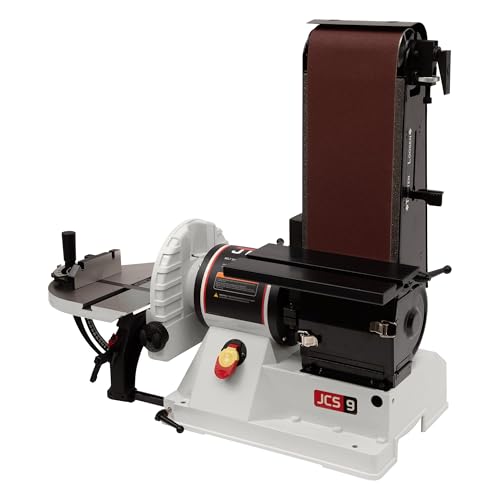
JET Benchtop 6″ x 48″ Belt & 12″ Disc Sander, 1-1/2 HP, 115/230V 1Ph (JSG-6DC)
The JET JSG-6DC is the machine you buy when you’ve outgrown mid-range belt sanders and need something that can genuinely keep up with a professional workload. The 1.5 HP motor — the most powerful in this category — drives the 6×48-inch belt at 2,500 SFPM and the 12-inch disc at 1,725 SFPM without flinching, even on dense hardwoods or heavy stock removal sessions. The dual-voltage 115/230V design is a smart long-term investment: run it from a standard outlet today, and if you ever upgrade to a 230V circuit, this machine is already ready for it.
The belt and table system is exactly what I want from a machine at this level. Exclusive dual thumbscrews lock the belt at any angle from horizontal to vertical with confidence — it doesn’t creep or shift under load, which is more than I can say for lesser machines. The precision-ground cast iron table is flat, large, and features miter-gauge slots with positive stops at both 90 and 45 degrees. Industrial push-button controls add a professional feel and a genuine safety advantage in a busy shop. The single 4-inch dust port on the back of the base collects dust efficiently from both the belt and disc stations simultaneously.
- ✅ Most powerful benchtop belt sander available — 1.5 HP
- ✅ Dual-voltage 115/230V — future-proof for shop upgrades
- ✅ 6×48″ belt + 12″ disc — maximum capacity combination
- ✅ Graphite-covered steel platen runs cooler, extending belt life
- ✅ Dual thumbscrew belt tracking locks tight — no creep under load
- ✅ Precision-ground cast iron tables with 90° and 45° positive stops
- ✅ Industrial push-button controls
- ✅ Single 4″ dust port covers both belt and disc
- ❌ Stand sold separately
- ❌ Premium investment — overkill for light hobby use
WEN Benchtop Belt and Disc Sander with 1 x 30 in. Belt and 5 in. Sanding Disc (6515T)
WEN has earned a strong reputation among hobbyists for packing genuine capability into compact, affordable machines — and the 6515T is a fine example. The 2.3A motor delivers up to 3,160 FPM on the 1×30-inch belt and 3,450 RPM on the 5-inch disc, making it a capable two-in-one for anyone who needs both belt and disc sanding in a single small footprint. For smaller shops where bench space is tight, this machine is an efficient, budget-friendly solution.
The sturdy heavy-duty base prevents walking and wobbling under load — a detail that matters more than it sounds, since a machine that creeps across the bench mid-cut is a genuine frustration. Two separate dust ports maximize vacuuming efficiency by keeping suction focused at each working surface independently. The included miter gauge handles angle work at both stations, and the package includes an 80-grit sanding disc, a 100-grit sanding belt, and a 2-year warranty straight out of the box. For hobbyists looking for a reliable entry-level belt/disc combo that covers the basics without demanding a large investment, this is my pick.
- ✅ Two-in-one belt and disc sanding in a compact footprint
- ✅ 2.3A motor — up to 3,160 FPM belt / 3,450 RPM disc
- ✅ Heavy-duty base prevents walking and wobbling under load
- ✅ Two separate dust ports for maximum vacuuming efficiency
- ✅ Includes miter gauge, 80-grit disc, and 100-grit belt
- ✅ 2-year warranty
- ❌ 1×30″ belt is narrower than most competitors on this list
- ❌ 5″ disc is the smallest on this list
- ❌ Not suited for wide flat surface or high-volume work
JET Benchtop 6″ x 48″ Belt & 9″ Disc Sander, 3/4 HP, 115V 1Ph (JSG-96)
The JET JSG-96 sits in the middle of JET’s benchtop range and hits a balance point that makes it the most broadly useful machine in this lineup for the majority of woodworkers. The 3/4 HP motor is paired with a 6×48-inch belt and a 9-inch disc — a setup that’s significantly more maneuverable than the larger JSG-6DC and easier to fit into a busy bench without a dedicated stand. What this machine lacks in raw capacity it makes up for in refinement and thoughtful engineering.
The graphite-covered steel platen keeps the belt running cool and extends belt life — a detail I haven’t seen consistently executed on competitors at this level. The large cast iron table has preset stops at 90° and 45° and lets you run the belt vertically, horizontally, or anywhere in between. The tracking adjustment knob with quick-lock handle keeps the belt on track during use without constant fiddling. For woodworkers who want professional JET build quality and reliability without stepping all the way up to the JSG-6DC, the JSG-96 is the smart buy — and it’s the one I’d recommend to most serious hobbyists.
- ✅ Full 6×48″ belt in a more workbench-friendly package than the JSG-6DC
- ✅ Graphite-covered steel platen runs cooler, extending belt life
- ✅ Large cast iron table with 90° and 45° preset stops
- ✅ Quick-lock tracking adjustment handle keeps belt on track
- ✅ Specially designed belt guard allows full use of the 6″ belt width
- ✅ JET build quality and 2-year warranty
- ❌ 9″ disc smaller than the 10″ and 12″ on bigger machines
- ❌ No variable speed
RIKON 50-120 6-by-48-Inch Belt 10-Inch Disc Sander
The RIKON 50-120 gives you a full 6×48-inch belt paired with a 10-inch disc in a package designed with portability genuinely in mind. The carry handles and pre-drilled bench-mounting holes are a practical combination — move this machine to where the work is, or bolt it down permanently when you’ve found your spot. The fully enclosed 3/4 HP motor with integrated fan cooling runs notably cooler under sustained load than many open-frame competitors, which contributes directly to longer motor life.
Belt speed at 2,030 SFPM is a step below the JET machines at the same belt size, but the disc delivers 1,720 RPM with good torque for flat face sanding. The solid steel and cast iron construction gives this machine a rigidity you can feel — it doesn’t flex or chatter under load. The disc table measures 4×8 inches, and the quick-release belt tension lever makes changeovers clean and fast. For a woodworker who wants a capable 6×48-inch machine with the flexibility to relocate it, the RIKON 50-120 makes a compelling case that I think is genuinely underrated in this category.
- ✅ 6×48″ belt + 10″ disc at a mid-range investment level
- ✅ Carry handles + pre-drilled mounting holes — genuinely portable
- ✅ Fully enclosed, fan-cooled motor for longer life
- ✅ Solid steel and cast iron construction — rigid and stable
- ✅ Disc table tilts for versatile stock positioning
- ✅ Quick-release belt tension lever
- ✅ 2-year warranty
- ❌ Belt speed (2,030 SFPM) lower than JET machines at the same belt size
- ❌ 10″ disc smaller than the 12″ on the JET JSG-6DC
JET 2″ x 42″ Belt and 8″ Disc Sander, 3/4 HP, 1Ph 115V (Model J-41002)
The JET J-41002 is the smallest of the three JET machines on this list, and the one I’d specifically recommend to woodworkers whose shop work is dominated by intricate shaping rather than broad flat surface sanding. The 2×42-inch belt is narrow — it works almost like a file or coping saw in the way it gets into small openings, around odd angles, and along curved profiles without bridging over them the way a wider belt would. The 3/4 HP JET motor still delivers real power through this narrower format, and the cast iron tilting table ensures the rigidity needed for repeatable precision work.
The deluxe miter gauge turns and locks at 45 degrees both left and right, the steel rubber-footed base keeps the machine planted firmly, and the adjustable dust deflector and chute handle waste competently. The removable platen is a particularly useful feature — pull it out and you can sand, grind, or finish outside curves and odd-shaped workpieces right on the belt itself. One important note: if you regularly need to sand wide boards or large flat panels, step up to the JSG-96 — the J-41002 isn’t designed for that work, and using it that way will frustrate you.
- ✅ Narrow 2×42″ belt — excellent for inside curves, odd shapes, tight openings
- ✅ Full 3/4 HP JET power in a compact footprint
- ✅ Cast iron construction and heavy-duty steel base
- ✅ Removable platen enables sanding of outside curves and odd shapes
- ✅ Deluxe miter gauge with 45° left/right lock
- ✅ Adjustable dust deflector and chute
- ✅ 2-year warranty
- ❌ Narrow belt not suited for wide flat surface work
- ❌ Smaller 8″ disc compared to larger machines on this list
BUCKTOOL Pro 1HP Bench Belt Sander for Metal Working, 4 x 36 in Belt and 8 in Disc Sander (BD4801-M)
⚠️ Important
The BD4801-M is purpose-built for metalworking and knife grinding — if you’re doing purely casual woodworking on a tight budget, a lighter-duty machine may suit you better. But if metal polishing, sharpening, or serious benchtop work is on your agenda, this is where I’d spend my money at this tier.
What immediately sets the BUCKTOOL BD4801-M apart from most belt-and-disc sanders in this segment is that it’s genuinely engineered with metal in mind. The 1HP direct-drive induction motor is 25% more efficient than traditional belt-drive designs, and BUCKTOOL makes it clear this is a step up in power from their own BD4603 and BD4801 woodworking machines. Running the 4×36-inch belt at 2,161 FPM and the disc at 3,450 RPM, the machine delivers consistent, sustained performance — and the aluminum belt dust outlet is specifically designed to prevent melting when you’re grinding metal, a detail that really matters if you’ve ever ruined a belt on a lesser machine.
I particularly appreciate the thoughtful layout here. The switch box sits on top of the machine for easy, intuitive access mid-operation. The included knife grinding jig mounts directly to the belt plate and removes cleanly when you don’t need it — a genuinely useful inclusion rather than a gimmick. The removable dust port doubles as a way to open up the work area for polishing longer stock. Belt tension is adjustable, the belt tracking control is quick to dial in, and the sturdy cast aluminum base with rubber feet keeps vibration impressively low. The 8-inch sanding disc uses hook-and-loop paper for fast swaps, and the disc table adjusts 0–45 degrees while the belt table covers the full 0–90-degree range for both horizontal and vertical sanding.
- ✅ 1HP direct-drive motor — more powerful than standard woodworking-grade machines
- ✅ 25% more efficient than traditional belt-drive designs
- ✅ Aluminum belt dust outlet prevents melting during metal grinding
- ✅ Knife grinding jig included — mounts and removes cleanly
- ✅ Removable dust port enlarges work area for long stock
- ✅ Belt table tilts 0–90°; disc table tilts 0–45°
- ✅ Hook-and-loop disc paper for easy replacing
- ✅ Top-mounted switch box for convenient operation
- ✅ Cast aluminum base with rubber feet minimises vibration
- ✅ Quick belt change with track control function
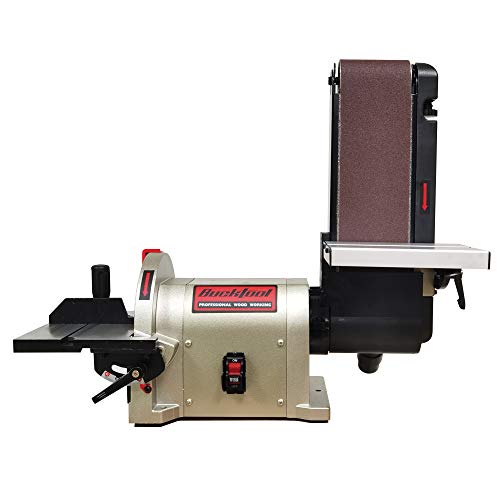
BUCKTOOL Direct Drive Bench Belt Sander, 4×36 in Belt and 8 in Disc Sander, 3/4HP
The BUCKTOOL BD4801 earns its place on this list by doing something the Porter-Cable at a similar investment level cannot: delivering 3/4 HP through a direct-drive motor with no intermediary drive belt to wear out, slip, or reduce efficiency. BUCKTOOL’s direct-drive design connects the motor shaft straight to the belt and disc, which translates to genuinely better power delivery than a belt-driven machine of the same rating — the machine feels more responsive under load, and there’s one fewer wearing part to maintain over its lifetime. I find this makes a meaningful real-world difference in daily use.
The 4×36-inch belt operates at both 0 and 90 degrees, and the curved drum design enables sanding of convex and concave profiles — particularly useful for chair legs, curved furniture components, and decorative stock. The disc runs at 3,450 RPM on an 8-inch platter, and the miter gauge serves both belt and disc stations. Two dust ports give you flexibility in how you connect to your dust collection setup. The cast aluminum base with rubber feet keeps the machine stable without the weight penalty of full cast iron. For hobbyists looking for a capable, low-maintenance belt/disc combo that outperforms its price tag, the BD4801 is the one I’d reach for first.
- ✅ Direct-drive motor — no drive belt, better efficiency and reliability
- ✅ 3/4 HP feels stronger than rated thanks to direct-drive design
- ✅ Belt works at 0° and 90°; curved drum enables convex/concave sanding
- ✅ Disc speed 3,450 RPM on 8″ disc
- ✅ Miter gauge serves both belt and disc stations
- ✅ Dual dust ports for flexible collection setup
- ✅ Low-maintenance design — nothing to adjust in the drive system
- ✅ 2-year warranty
- ❌ Cast aluminum base (not cast iron) — lighter but less vibration dampening
- ❌ Smaller 8″ disc vs. larger machines on this list
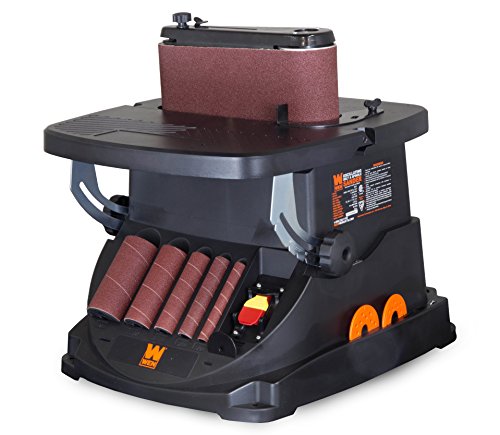
WEN 6524 Oscillating Belt and Spindle Sander
The WEN 6524 earns special recognition because it’s genuinely different from everything else on this list. Rather than pairing a belt with a flat disc, it combines a 4×24-inch belt sander with a full oscillating spindle sander — giving you curved exterior sanding via the belt and curved interior sanding via the spindle in one compact machine. This is the machine I’d recommend to any woodworker who does scroll saw, bandsaw, or jigsaw work and needs to sand the resulting shapes quickly and cleanly. If you’ve been looking at an oscillating spindle sander alongside a belt sander, this two-in-one solves that dilemma in a single purchase.
The 3.5A motor oscillates both the spindle and belt at 58 times per minute with a 5/8-inch stroke — the key detail here is the oscillation itself, which distributes abrasive wear across the full sleeve height rather than concentrating it at one point, dramatically extending sleeve life and reducing heat. Five spindle drum sizes (1/2″, 3/4″, 1″, 1.5″, and 2″) plus the belt attachment cover an enormous range of profiles and arcs. Belt speed tops out at 1,575 FPM and spindle at 2,000 RPM. The package includes six full abrasive sets, five throat plates, a bevelling work table, and onboard storage for all accessories. At this price, the two-in-one value is exceptional — this is one of my favorite picks on this entire list for the right type of woodworker.
- ✅ Belt + oscillating spindle in one machine — unique combination on this list
- ✅ Five spindle sizes cover almost any curved interior profile
- ✅ Oscillating action extends sleeve life and reduces heat buildup
- ✅ Includes six abrasive sets, five throat plates, bevelling table, onboard storage
- ✅ Excellent two-in-one value
- ✅ 2-year warranty
- ❌ 4×24″ belt is shorter than most competitors — less suited to large flat stock
- ❌ 3.5A motor is the least powerful on this list
- ❌ Not ideal as a primary flat-surface sander
WEN Benchtop Belt and Disc Sander with 4 x 36 in. Belt, 6 in. Disc and Cast Iron Base (6502T)
The WEN 6502T rounds out this list as the most affordable option — and it earns its spot not by cutting corners on what matters most, but by making smart trade-offs. The cast iron base is the headline feature: at this price, most machines use aluminum or pressed steel, which vibrates noticeably under load. Cast iron absorbs vibration naturally, producing a calmer, more controlled sanding experience that genuinely improves result quality. This one detail alone separates the WEN 6502T from similarly priced competitors.
The 4.3A motor runs the 4×36-inch belt at 3,600 RPM — adequate power for everyday hobby tasks on typical stock. The belt tilts 0–90 degrees for flexibility when working curved stock. The 6-inch disc is the smallest on this list, which limits what you can do on the disc side for larger panels, but for the occasional sanding work this machine is designed for, it rarely becomes a hard constraint. Belt changes are quick via the tension release lever, and the included miter gauge handles angle work accurately. If you’re just getting started with benchtop belt sanding — or you need a secondary machine for a secondary workspace — this is exactly the right tool. You might also find it useful to check out some belt sander reviews to understand how benchtop models compare to their handheld counterparts.
- ✅ Cast iron base — exceptional vibration control for an entry-level price
- ✅ 4.3A motor at 3,600 RPM — capable of everyday hobby sanding tasks
- ✅ Belt tilts 0–90° for curved piece sanding
- ✅ Tension release lever for fast, easy belt changes
- ✅ Cast aluminum disc table with miter gauge
- ✅ Two-in-one belt and disc in a compact footprint
- ✅ 2-year warranty
- ❌ Smallest disc on this list at 6″
- ❌ Lower HP limits heavy-duty capability
- ❌ 2.5″ dust port — best used with a shop vac
How to Choose the Best Benchtop Belt Sander for Your Shop
With nine machines covering a wide range of belt sizes, motor outputs, and use cases, picking the right one comes down to understanding exactly what your shop work demands. Here are the factors I’d prioritize.
Belt Size and Width
Belt size is the single most important specification to match to your work. A 6×48-inch belt — as found on the JET JSG-6DC, JET JSG-96, and RIKON 50-120 — covers wide boards and handles heavy stock removal with ease. A 4×36-inch belt suits most hobby woodworking tasks and fits comfortably on a crowded bench. Narrow belts like the 2×42-inch on the JET J-41002 are purpose-built for intricate shaping. Choose based on your typical workpiece width, not just horsepower.
ℹ️ Did You Know?
A wider belt doesn’t just sand more surface area — it also distributes heat more effectively across a larger abrasive surface, which means belts last longer and the platen stays cooler during extended sessions. This is one reason why the 6×48″ machines on this list are noticeably more suitable for sustained production work than their narrower counterparts.
Belt/Disc Combo vs. Belt/Spindle Combo
For most woodworkers, a belt and disc combination delivers the most versatility for a single bench footprint. The belt handles long-grain flattening, edge work, and shaping, while the disc excels at end-grain faces, bevels, and precise flat sanding right up to a layout line. If your work is dominated by curves — scroll saw, bandsaw, jigsaw shapes — the WEN 6524’s belt-plus-spindle configuration is a smarter choice than any belt/disc combo. Think about the actual shapes you sand most often before deciding.
Motor Type: Direct-Drive vs. Belt-Driven
In a belt-driven design, the motor connects to the sanding belt via an intermediary drive belt — introducing a component that stretches, slips, and eventually needs replacement. A direct-drive design, like the one in the BUCKTOOL BD4801, connects the motor shaft straight to the abrasive with no intermediary, resulting in more efficient power transfer and lower long-term maintenance. For hobbyists who prefer a set-it-and-forget-it approach, direct-drive is worth seeking out. For more context on how different sander types compare in real woodworking scenarios, my guide to belt sander reviews goes deeper on this.
Construction Quality and Vibration Control
Cast iron bases and tables absorb vibration better than aluminum or pressed steel. This isn’t just a comfort issue — excessive vibration translates directly into less precise sanding and premature wear on both the machine and the workpiece. Even on an entry-level machine like the WEN 6502T, the cast iron base makes a meaningful difference in day-to-day use. If you’re comparing two machines at a similar investment level, always prefer the one with more cast iron in the construction.
Dust Collection
Every machine on this list includes at least one dust port. Machines with two dust ports — like the WEN 6515T and BUCKTOOL BD4801 — are genuinely more effective at keeping dust under control when both the belt and disc surfaces are in use simultaneously. A 4-inch dust port connects directly to most standard shop dust collectors; smaller ports typically work best with a shop vac. For extensive sanding projects, good dust management isn’t optional — it protects your health, keeps the shop clean, and prevents clogging that reduces abrasive performance. If you’re working on larger projects like furniture refinishing, I’d also suggest reading about the Best Sanders for Furniture 2026 to round out your shop setup.
Matching the Machine to Your Project Type
Think about your most common project types before committing to a size. If you regularly work on doors, large panels, or wide boards, you need a 6×48-inch belt. If you build furniture with shaped components, curved legs, or decorative profiles, a narrower belt or the WEN 6524’s spindle capability will serve you better. For deck work or stair refinishing, it’s also worth checking out my guides on Best Sanders for Deck 2026 and Best Sanders for Stairs 2026 to see where a benchtop machine fits into the broader picture.
💡 Pro Tip
Start with the coarsest grit appropriate to the task and work progressively finer. For heavy stock removal, begin with 60- or 80-grit. For general smoothing of already-dimensioned stock, 100- or 120-grit is a sensible starting point. Finish passes at 150- or 180-grit prepare most species well for finishing. Never skip more than one grit step — jumping from 80 to 180 leaves deep scratches that only become visible after finish is applied.
Sandpaper and Maintenance
Regular maintenance keeps performance consistent and extends machine life. Clean the dust ports and collection bag after every session — clogged dust management increases heat and can become a fire hazard with fine dust accumulation. Check belt tracking before each use, and inspect belts and discs for glazing — a shiny, smooth surface means the abrasive is spent and needs replacing. For furniture refinishing work, keeping a range of grits on hand will save you time and produce noticeably better results. For sheet sanding tasks where a benchtop machine isn’t the right fit, my Best Sheet Sanders 2026 guide covers the alternatives well.
🏆 The Verdict
After working through every machine on this list, the JET JSG-6DC is the clear overall winner — its 1.5 HP dual-voltage motor, massive 6×48-inch belt, and 12-inch disc make it the most capable benchtop belt sander available, and the precision cast iron table, industrial push-button controls, and rock-solid dual-thumbscrew belt locking system deliver professional results day after day. It’s the right call for any serious hobbyist or working professional who wants a machine they’ll never outgrow. For those who want the same JET quality in a more bench-friendly, mid-range package, the JET JSG-96 is the best all-rounder for most woodworkers. On a tighter budget, the WEN 6502T is a genuinely honest entry-level pick — that cast iron base punches well above its price. And if curves and contours are your specialty, nothing on this list matches the WEN 6524 for two-in-one value.
❓ Frequently Asked Questions
What belt size should I choose for a benchtop belt sander?+
Is a belt/disc combo better than a belt-only benchtop sander?+
How does a direct-drive motor differ from a belt-driven motor on a benchtop sander?+
What grit sandpaper should I start with on a benchtop belt sander?+
How do I maintain a benchtop belt sander to keep it performing well?+
Thanks so much for reading — I hope this breakdown helps you find exactly the right benchtop belt sander for your shop and the work you love doing. If you have questions about any of the machines reviewed here, or want to share your own experience with one of them, drop a comment below — I read and reply to every one. Happy sanding!
