
As an Amazon Associate I earn from qualifying purchases. All claims are strictly my personal opinion.
Recommended tool for this job

SKIL 5" Random Orbital Sander with Cyclonic Dust Box
The best power tool option for larger flat glass surfaces like tabletops and glass shelves.

To sand glass, use silicon carbide wet/dry paper or diamond pads, keep the glass wet the whole time, and work up through the grits: 120 to 220 for edges and chips, 400 to 800 to refine, 1000 to 3000 to clear the haze, then polish with cerium oxide on a felt pad to bring the clarity back. Sanding glass is a genuinely useful skill, and more achievable than most people expect. Whether I need to remove deep scratches from a glass tabletop, smooth a sharp edge on a cut piece, repair a chip in a glass door, or restore clarity to frosted or etched glass, the same fundamental process applies: always wet, always through fine grits, and always finished with a polishing compound, not sandpaper alone.
⚡ Quick Answer
Abrasive: silicon carbide wet/dry paper, such as the CooBigo 120 to 3000 assortment, or diamond hand pads for edges.
Grits: 120 to 220 to shape, 400 to 800 to refine, 1000 to 3000 to clear the haze.
Finish: cerium oxide paste on a felt pad. Spend longer polishing than sanding.
Tempered glass: light scratch polishing only. Never sand or grind the edges.
This guide covers the full process, the right tools and paper for different glass jobs, the grit sequence, what you can and can’t do to tempered glass, and the polishing stage that turns a milky, sanded surface back into clear glass. If your job is a sharp cut edge, go straight to how to sand glass edges. Once you understand the rhythm of wet sanding and grit progression, it becomes almost meditative work.
⚠️ Safety Is Non-Negotiable With Glass
Fine glass particles get into the air as soon as you start, and freshly sanded edges are razor sharp. Wear sealed safety goggles (not just safety glasses), a P100 dust mask or respirator (FFP3 in Europe), and nitrile gloves. Keeping the glass wet holds most of the dust down in the slurry, which is why every method below is a wet one.
Can You Sand Glass?
Yes. Glass is hard, but abrasives made from silicon carbide or industrial diamond are harder still, so they cut it cleanly. Mirka, which makes abrasives for refinishing vehicle and building glass, puts it simply in its glass sanding guide: to remove scratches from glass, you sand it and then polish it. Bus, train and car side windows are routinely reconditioned that way instead of being replaced.
What sanding can’t do is make glass clear on its own. Every grit leaves a pattern of fine scratches, and those scatter light, so sanded glass always looks frosted until the polishing compound goes on. That’s the part most first attempts skip.
Choose the Right Tool for Your Glass Job
The tool I recommend depends on the size and type of the glass job. Matching the tool to the task saves time and gives better results.
| Glass job | Best tool | Start grit | Finish with |
|---|---|---|---|
| Sharp cut edge | Diamond hand pad or wet/dry paper on a block | 120 to 150 | 400 for a safe edge, 2000 and cerium for a polished one |
| Chip in an edge | Diamond pad, or a rotary tool for small pieces | 60 to 80 | Grits up to 1000 or more, then cerium |
| Scratch on a tabletop or shelf | Random orbital sander, damp, or paper on a block | 220 to 320 | 2000 to 3000, then cerium on a felt pad |
| Faint scratch you can’t feel | No sanding: polisher or drill with a felt pad | None | Cerium oxide only |
| Frosted or etched glass | Wet/dry paper on a block | 400 | 2000, then cerium |
| Bottles, beads, small pieces | Dremel or other rotary tool | 120 | Felt wheel and cerium |
Hand Sanding With Wet/Dry Paper
The right choice for small, precise jobs: smoothing a sharp edge on a cut glass tile, spot-repairing a scratch, working on a small decorative piece, or anything where control matters more than speed. Wrap the paper around a flat block, not your fingers, so the pressure stays even. Silicon carbide wet/dry paper handles water without falling apart and cuts glass cleanly.
Diamond Hand Pads for Edges
Flexible diamond pads, the kind sold for tile and stone, are the fastest way to take the sharp corner off a cut edge. They last far longer than paper on glass, rinse clean, and come in sets from 60 to 3000 grit, so one set takes an edge from rough to polished. Keep the pad and the edge wet.
Random Orbital Sander for Flat Panels
The best power tool option for larger flat glass surfaces like tabletops and shelves. The random orbit avoids the straight, directional scratches a sheet sander leaves. Use silicon carbide discs, and keep the glass damp from a spray bottle rather than flooded: most orbital sanders are electric and not built to be wet. Keep water away from the motor vents and the cord, and plug into a GFCI outlet. For a sander to do it with, see the best random orbital sanders. Never use a belt sander on glass: it’s too aggressive and builds heat fast.
Dremel or Rotary Tool for Small Pieces
Ideal when the pieces are too small for an orbital sander but you still want power: watch crystals, glass beads, bottle rims, and small chips in glass edges. Use silicon carbide or diamond bits at low to medium speed, keep the glass wet, and switch to a felt wheel with cerium oxide for the polish. Rotary tools are inexpensive and versatile enough to justify having one for occasional glass work.
💡 Pro Tip
Buy wet/dry paper, not woodworking paper. Sandpaper sold for wood usually has a paper backing that softens and tears once it’s soaked, and it’s rarely sold past 400 grit. The black wet/dry sheets sold for automotive finishing are silicon carbide on a waterproof backing and run from 80 to 3000 or finer, which is exactly the range glass needs.
What Sandpaper to Use on Glass
The sandpaper to use on glass is silicon carbide wet/dry paper, the black waterproof sheets sold for auto body finishing, used wet in grits from 120 to 3000. For edges, diamond hand pads do the same job faster. Those are the two abrasives that work on glass. Ordinary sandpaper for wood isn’t one of them, mainly because of its backing and its grit range; my guide to the types of sandpaper explains the backings and abrasives in more detail.
Silicon Carbide Wet/Dry Paper
Silicon carbide is the abrasive in most wet/dry paper. It’s very hard, its grains fracture into sharp new edges as they wear, and it’s sold on waterproof backings in every grit you need. A mixed pack from 120 to 3000 covers almost any glass job, and you can cut the 9″ x 3.6″ sheets into strips for edges. Mirka makes a stearate-free silicon carbide net abrasive, Abranet SIC NS, developed mainly for glass sanding, which tells you how the professionals approach it.
Diamond Pads and Bits
Diamond cuts glass faster and wears far more slowly than paper. For a one-off edge, paper is cheaper; if you smooth glass edges often (tiles, mosaics, shelves, bottle crafts), a set of diamond hand pads pays for itself.
Which Glass Sandpaper for Your Job
| Your situation | Use | Why |
|---|---|---|
| One sharp edge to smooth |  Silicon carbide wet/dry paper on a block |
Cheaper than diamond for a one-off edge |
| Edges often: tiles, mosaics, shelves, bottle crafts | 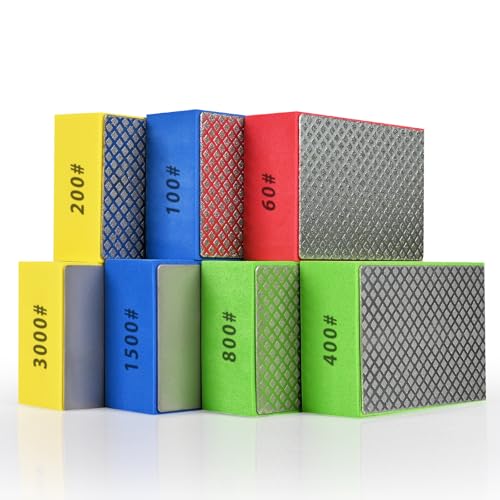 Diamond hand pads |
Cut faster, wear far more slowly and rinse clean |
| Scratch on a tabletop or shelf | Silicon carbide discs on a random orbital sander, glass kept damp |
The random orbit avoids straight, directional scratches |
| Bottle rims, beads, small chips |  Silicon carbide or diamond bits in a rotary tool, low to medium speed |
Too small for a sander, but you still want power |
| Only wood sandpaper on hand | Don’t use it on glass | The paper backing softens and tears when soaked, and it rarely goes past 400 grit |
What Grit Sandpaper for Glass
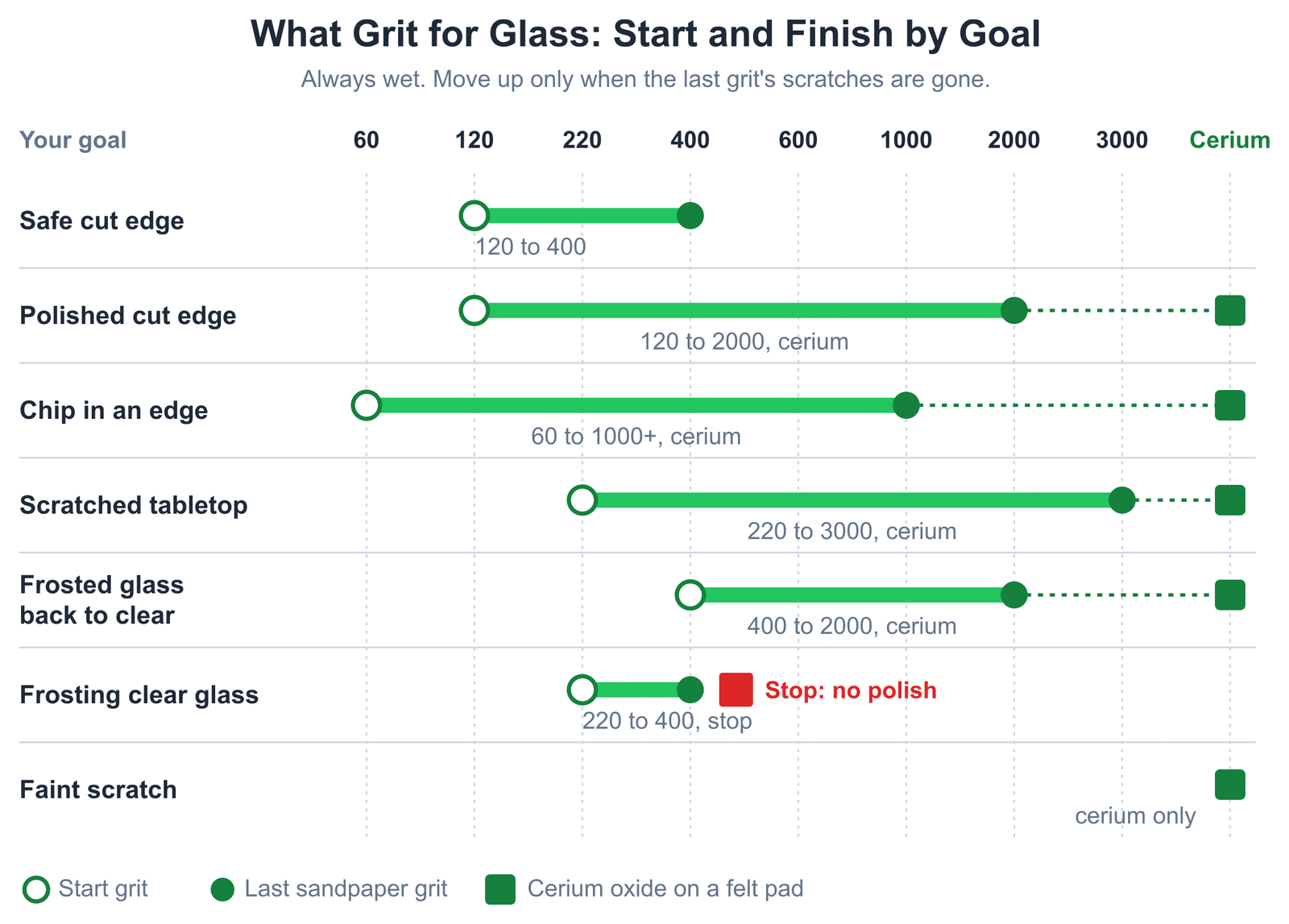
Glass needs a longer run of grits than wood, because the finish you want is optical, not just smooth. A practical sequence for most jobs is below; for how these numbers compare across grading systems, see the sandpaper grit chart.
| Grit | What it does on glass | What the glass looks like after |
|---|---|---|
| 60 to 120 | Heavy removal: chips, sharp corners, deep scratches | Coarse, grey, visibly scratched |
| 220 to 400 | Removes the coarse scratch, levels the area | Smooth to the touch, evenly frosted |
| 600 to 800 | Fine smoothing | Uniformly milky |
| 1000 to 1500 | Pre-polish | The haze starts to lighten |
| 2000 to 3000 | Final sanding before polish | Satin, partly see-through |
| Cerium oxide | Polishes out the last micro-scratches | Clear |
The same grits, arranged by what you’re trying to do: where to start, where to stop sanding, and whether cerium oxide follows.
How to Sand Glass: The Complete Process
The process I follow is the same whether I’m repairing a single scratch or restoring an entire tabletop surface. The key is consistency: wet sanding, fine grit progression, and patience with the polishing stage.
Step 1: Check the Glass and Set Up
Look for a small etched mark in one corner before anything else. Glass in shower doors, glass tables and many furniture panels is usually tempered, and that changes what you’re allowed to do (see tempered glass below). Then clean the glass, lay it on a rubber mat or folded towel on a flat surface so it can’t rock, and set a spray bottle of clean water next to you.
Step 2: Wet the Surface and Begin With Coarse Grit
Wet the glass thoroughly before the first stroke and keep it wet at all times. Dry sanding glass puts fine particles in the air and builds heat; water suppresses both and carries the slurry away so the paper keeps cutting.
Starting grit depends on what I’m addressing:
- Chip repair or edge grinding: start at 60 to 80 grit
- Deep scratches requiring significant material removal: start at 80 to 120 grit
- Sharp cut edge needing smoothing: start at 120 to 150 grit
- Moderate surface scratches: start at 220 to 320 grit
Sand with consistent, even strokes: circular motion works well on flat surfaces, along-the-edge strokes for glass edges. Apply firm but not excessive pressure and keep the motion continuous. Sand for about 60 to 90 seconds at each grit stage before evaluating and moving on. Rinse or wipe the glass between stages to clear the residue: dried glass slurry makes it hard to judge progress.
Step 3: Progress Through the Grit Sequence
After the coarse pass, move up through the grits in the table above. At each stage the rule is the same: don’t move to the next grit until the scratch marks from the previous grit are completely gone. Wipe the surface clean and inspect it in good light: any remaining coarser scratches will be obvious. If they’re still there, keep going at the current stage. Changing the direction of your strokes with each grit makes the old scratches easier to spot.
Mirka’s advice on its own glass process is to use as few steps as the job allows and to give each one the time it needs, because uneven sanding can distort the way light passes through the glass. On a flat panel that means keeping the paper on a block and sanding a wider area than the scratch itself, so you don’t dig a dip.
⚠️ Important
The milky stage is normal: don’t stop here. After the coarse and medium grit passes, the glass will look cloudy and milky rather than clear. This is exactly what it should look like at this stage: the fine scratches from the sandpaper scatter light in all directions rather than transmitting it. The glass only clarifies fully during the polishing stage. First-timers often stop at 400 to 600 grit and assume the process has failed. It hasn’t: keep going through the fine grits and into the polishing compound stage. The transformation happens at the very end.

Step 4: Polish to Crystal Clarity
After the finest grit, sandpaper alone can’t restore full optical clarity: the surface still has a fine haze from the micro-scratches of even 2000 to 3000 grit paper. The polishing stage is what completes the transformation and is where I see the most satisfying results. Mirka’s rule for glass is to spend more time polishing than sanding.
Switch from sandpaper to a polishing pad, either a felt pad on a drill, polisher or Dremel, or a soft cloth for hand polishing. If you’re working from a drill, my drill sanding attachment guide covers the attachment types and how to use them. Apply one of these compounds:
- Cerium oxide powder: the standard glass polishing compound. Mix it with water to a thin paste and work it with a felt pad. Specialist suppliers sell it for scratches you can barely feel with a fingernail; anything deeper has to be sanded first.
- Jeweller’s rouge: a softer compound for light finishing. Not as aggressive as cerium oxide on heavily scratched glass, but effective for the final clarity stage after a thorough grit progression.
- Plastic or headlight polish: a practical stand-in if you can’t get a glass compound. It’s slower on glass than cerium oxide, so expect more time on this stage.
Polish in firm circular motions for several minutes, longer than you think is needed, and keep the paste damp: a felt pad running dry on glass gets hot quickly. Rinse the compound off with clean water and assess the result. If full clarity hasn’t returned, apply more compound and keep polishing. Once you’re satisfied, clean the glass with glass cleaner and a microfibre cloth.
ℹ️ Did You Know?
Cerium oxide is a rare earth compound that polishes glass by a combination of very fine abrasion and a mild chemical reaction with the glass surface. That dual action produces a clearer result than sandpaper alone can reach, which is why optical and glass restoration work has relied on it for decades.
How to Sand Glass Edges: Step by Step
Can you sand glass edges? Yes, on ordinary annealed glass, and smoothing a freshly cut edge is the most common glass sanding job there is. After cutting or breaking annealed glass, the edges are razor sharp. The one exception is tempered glass: never sand or grind its edges (see tempered glass below).
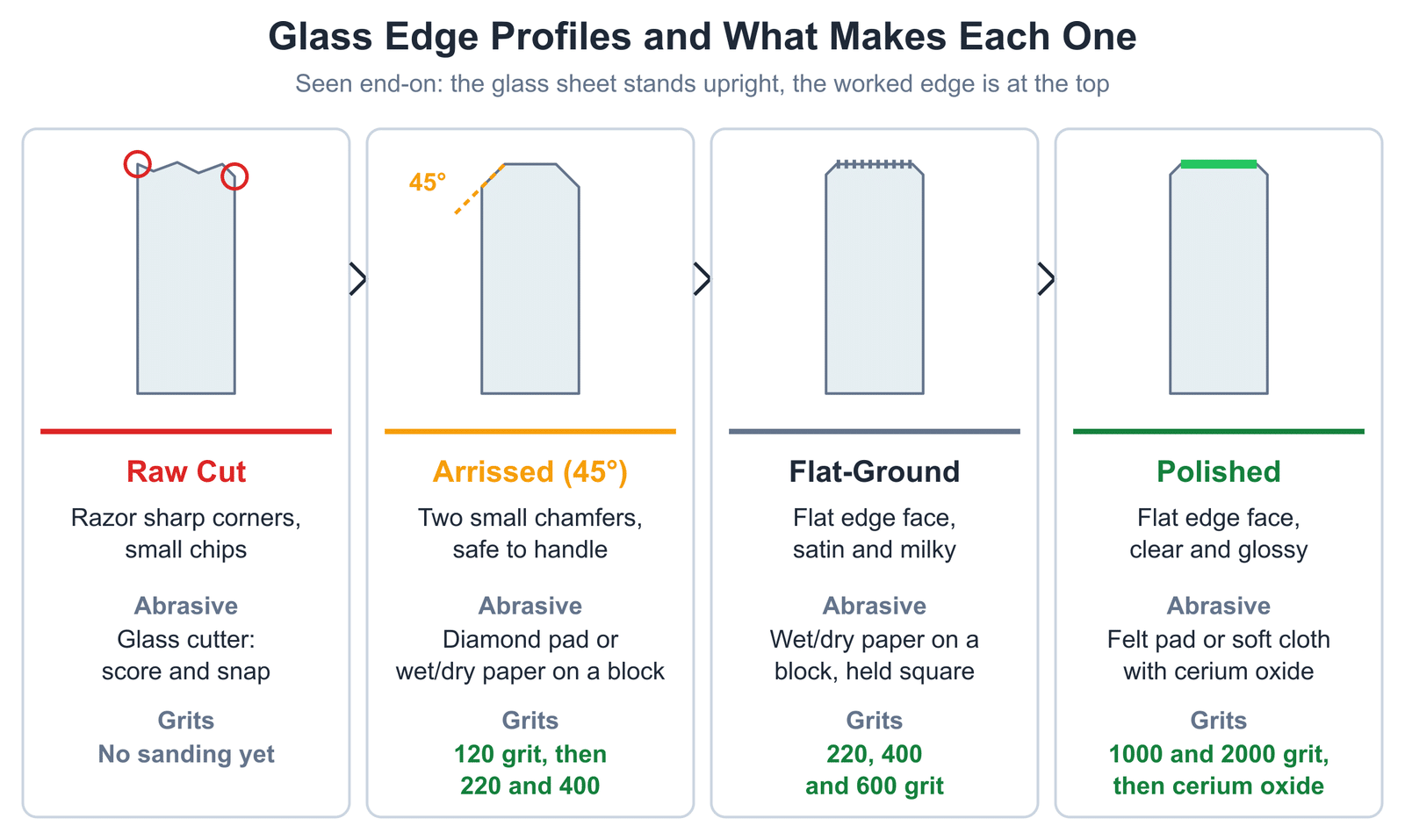
Glass fabricators describe edges by profile. A 2024 paper in Glass Structures & Engineering by Bukieda, Meyer, Engelmann and Weller, published on Glassonweb, describes an arrissed edge as one where the sharp margins of the as-cut edge are removed by small chamfers at about 45 degrees, a smooth ground edge as milky, and a polished edge as transparent. The diagram shows which abrasive and which grits get you to each one by hand.
Step 1: Secure the Glass and Take Off the Sharp Corners
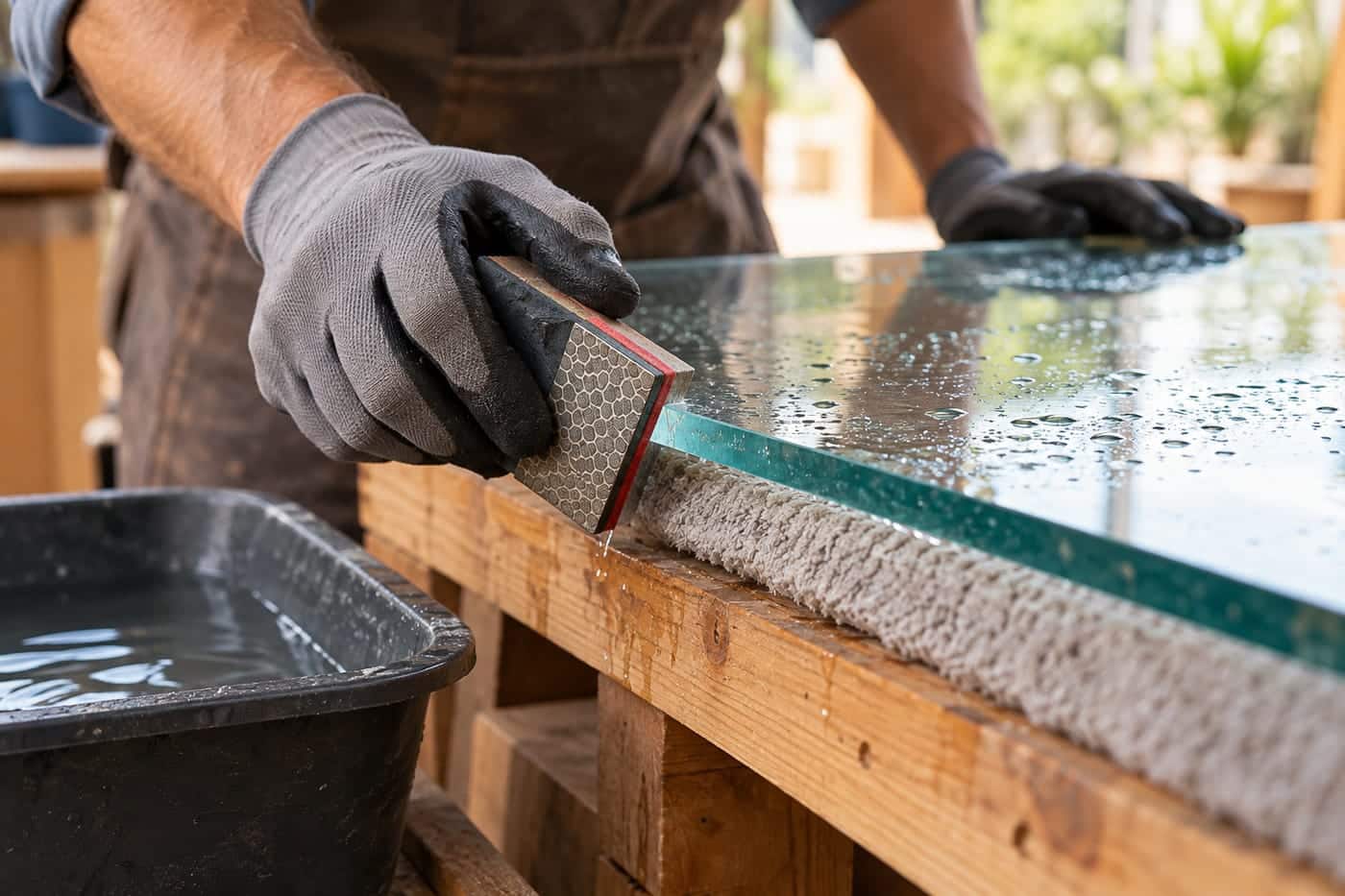
Secure the glass flat on a work surface with the edge overhanging slightly, on a rubber mat or folded towel so it can’t rock, and wet the edge. Starting at 120 grit, on a diamond pad or paper wrapped on a block, sand along the edge at a 45-degree angle in one direction: this creates a small chamfer (bevel) that removes the sharpest corner quickly and safely. Do both corners of the edge. On a diamond pad set, the 100 or 200 pad does this in a few strokes.
Step 2: Smooth the Edge Through 220, 400 and 600 Grit
Once the sharp corner is gone, progress through 220, 400 and 600 grit, keeping the abrasive wet and working along the edge in short, controlled strokes. To even out the edge face itself, hold the block square to it so the paper sits flat on the edge, which gives the satin, flat-ground look. A firm block matters here; my guide to the best sanding blocks covers how to choose one. If all you need is a safe edge, you can stop at 400 grit, as the tool table above shows.
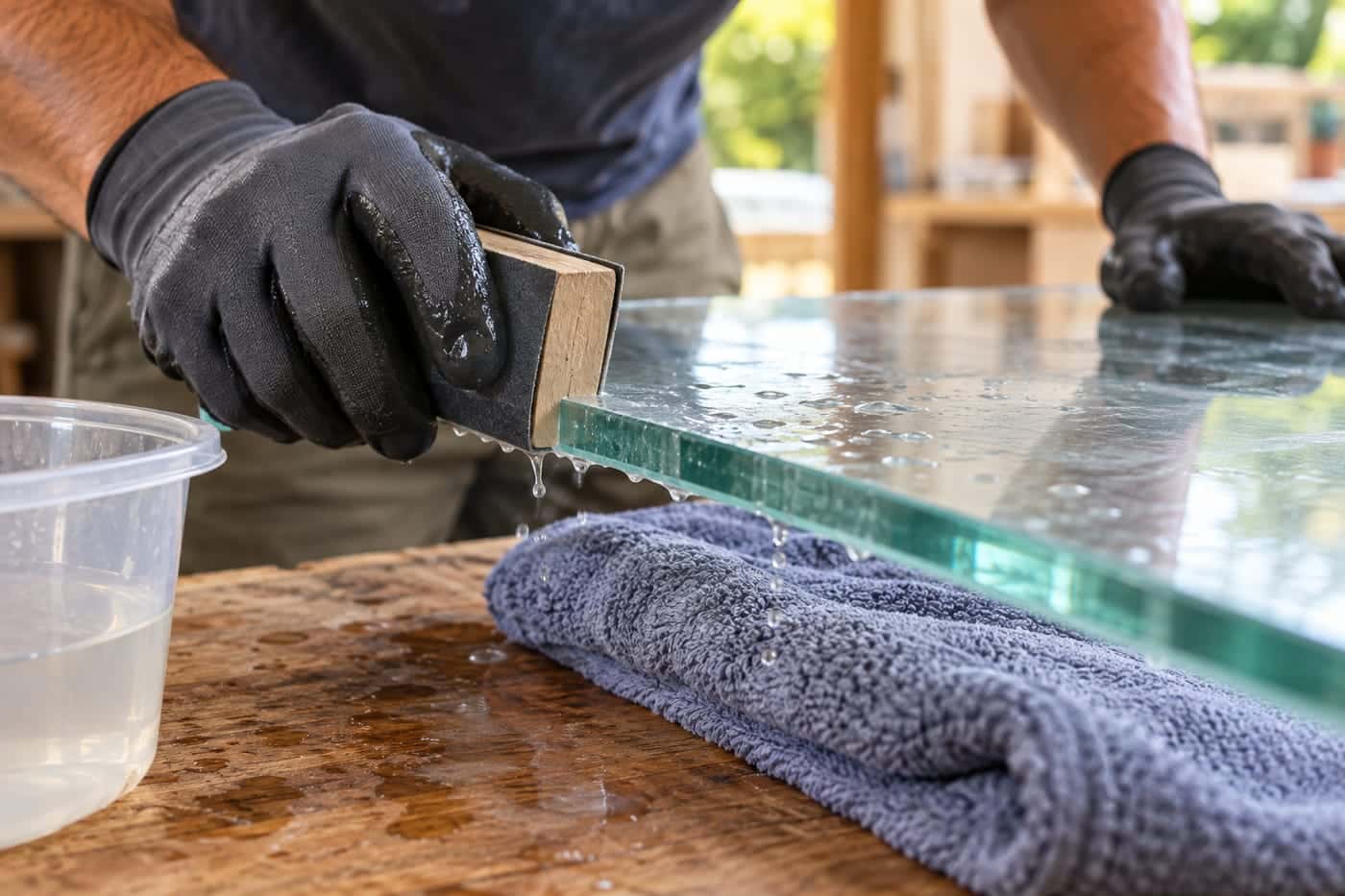
Step 3: Check the Edge Between Grits
Rinse the edge and look at it in good light before every change of grit. It should go from chipped and grey, to evenly frosted, to a little clearer at each stage; any coarser scratches still showing mean more time at the current grit. Never run your bare finger along a freshly sanded glass edge to test it: use the back of your hand or a cloth. Micro-sharp edges are easy to miss by feel and cut surprisingly deep.
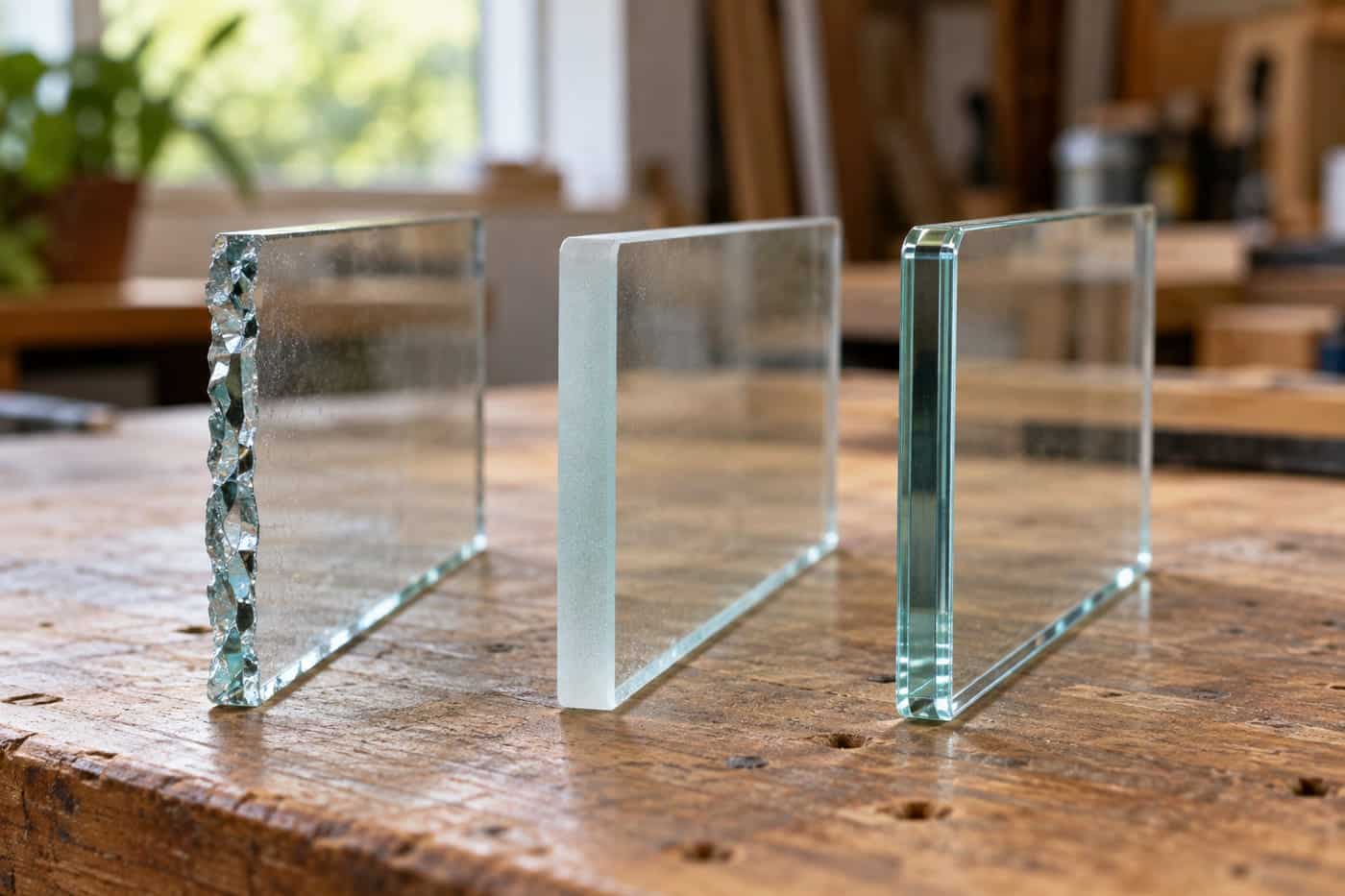
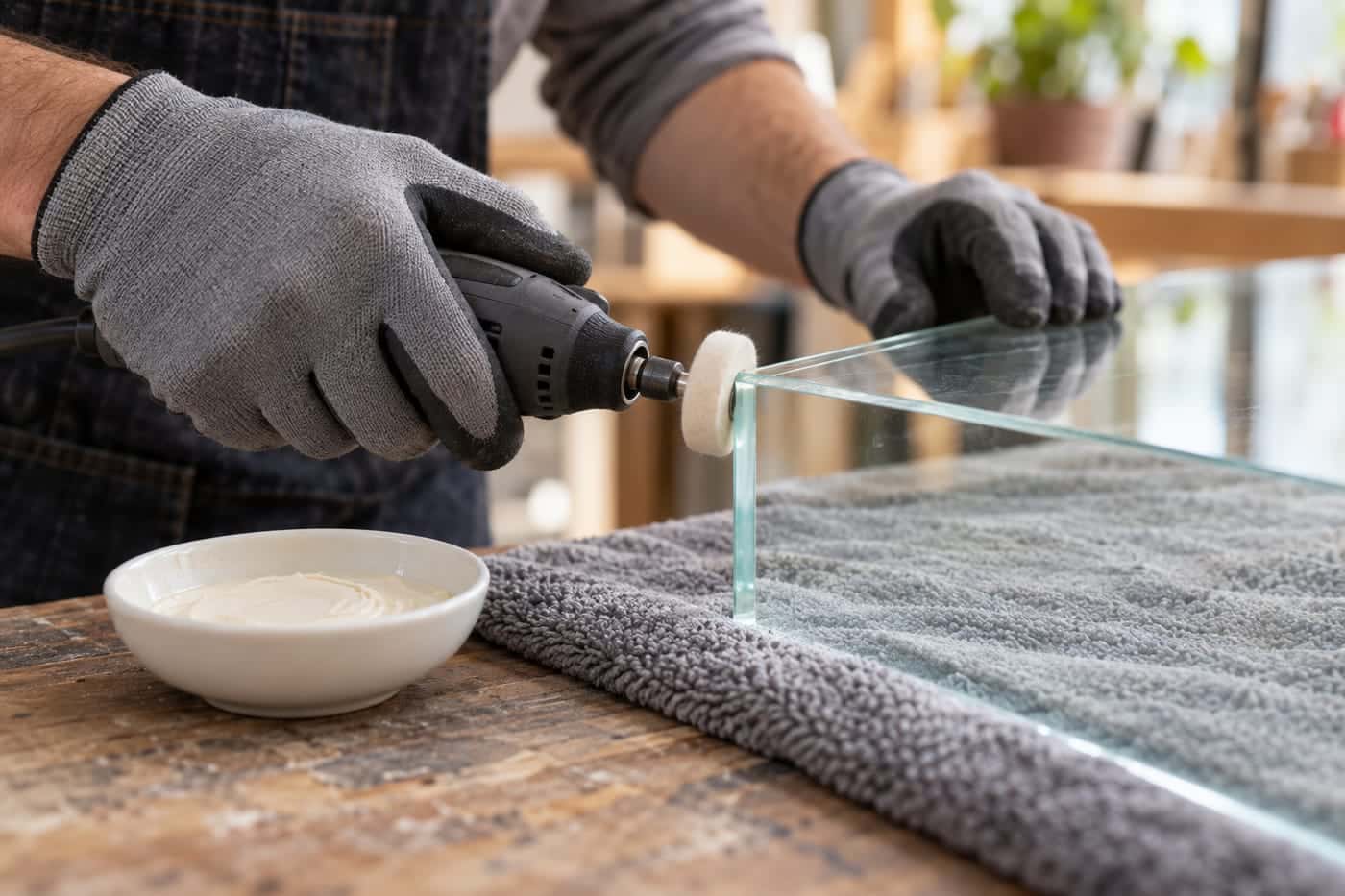
Step 4: Polish the Edge Clear
For a polished edge, continue to 1000 and 2000 grit, then apply cerium oxide with a soft cloth or felt for a final buff. On a long edge, a felt pad on a rotary tool is quicker than a cloth; keep the paste damp so the pad doesn’t run dry and heat the glass. The entire process takes 10 to 15 minutes for a straight edge.
The difference between where you started and where you finish is easy to see side by side:
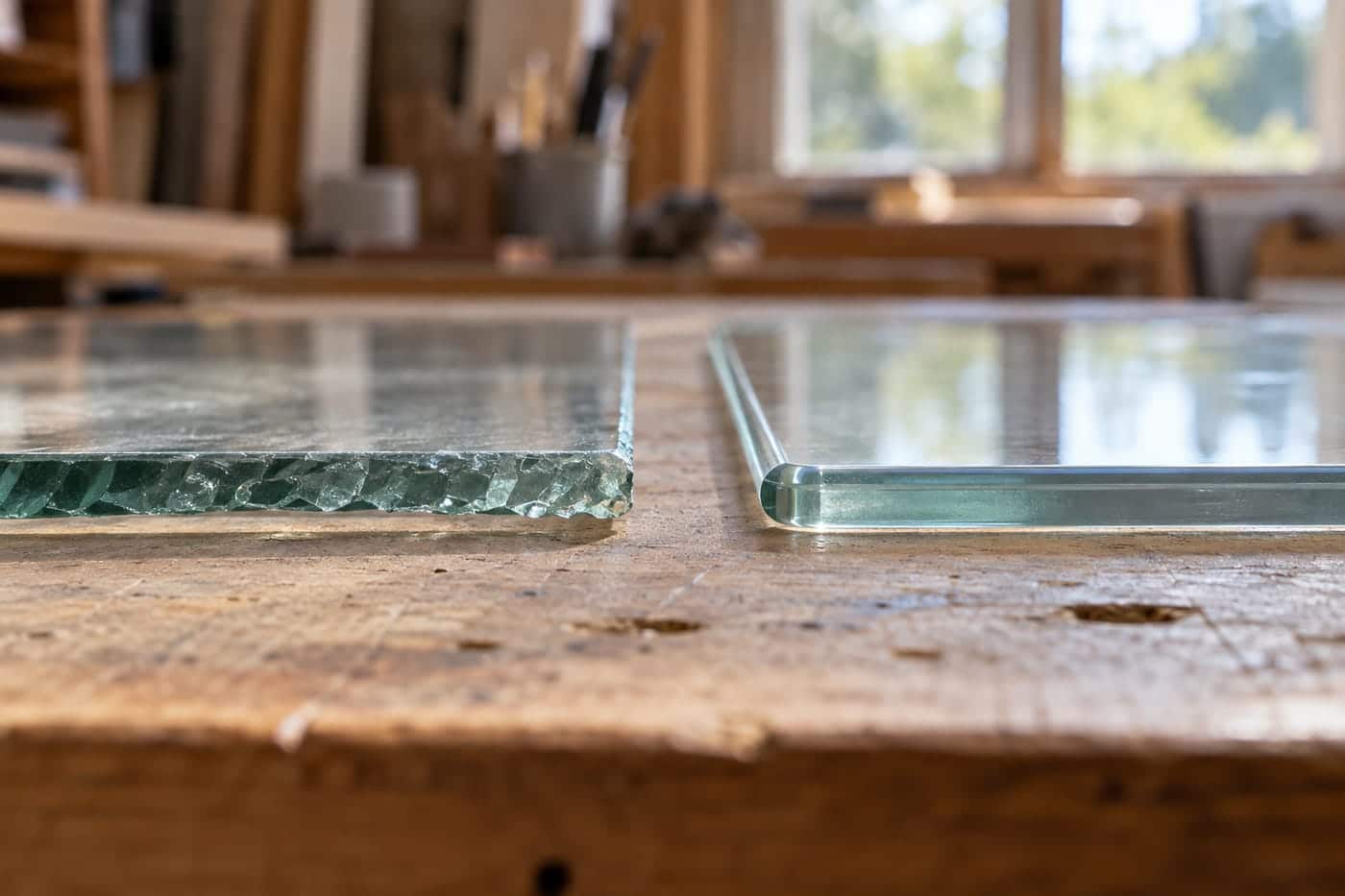
Should You Sand Glass Wet or Dry?
Wet, every time. Water does three jobs on glass: it holds the fine glass dust in a slurry instead of letting it into the air, it keeps the surface cool, and it floats the loosened particles away so they don’t roll under the paper and scratch the glass deeper. Dry sanding glass also clogs fine paper within seconds.
Is Plain Water Enough?
Yes. Clean water is all the lubricant glass needs. A drop of dish soap in the spray bottle helps the paper glide on large flat panels, but it’s optional. Avoid oils and polishes during sanding; they smear the slurry and hide the scratches you’re trying to see. Change the water if it fills with grit from a coarser stage, because those particles will scratch the next, finer one.
Damp, Not Flooded, With Power Tools
With an electric sander or rotary tool, mist the glass instead of running water over it. A damp surface still gives you the dust control, and it keeps water out of a tool that isn’t designed for it.
Can You Sand Tempered Glass?
Partly. You can polish light scratches out of the face of tempered glass, but you can’t cut, drill, grind or sand its edges, and deep scratches in it are better left alone. That’s the honest answer, and it’s more useful than the blanket “never” you’ll often read.
Why the Edges Are Off Limits
Tempered (toughened) glass is heated and then cooled quickly, which leaves the outer surfaces in compression and the core in tension. That’s what makes it strong, and it’s why it breaks into small pebble-like pieces instead of shards. Glass fabricators cut, drill and finish the edges before tempering, never after, because grinding into the edge breaks through the compressed layer and the whole sheet can shatter at once.
Polishing Scratches Out of Tempered Glass
The face is different. Mirka states on its glass sanding page that scratched tempered glass can be sanded and polished to remove marks, and its own process is used on vehicle side windows, which are tempered. Cerium oxide makers likewise list tempered glass, shower screens and glass tables among the surfaces their powder is for. Keep it to fine grits and polish only: a scratch you can barely catch with a fingernail is a polishing job, while a deep gouge in tempered glass is a reason to replace the panel, not to sand into it.
How to Tell If Glass Is Tempered
Look in each corner for a small etched or sandblasted mark: safety glazing in doors, showers and many tables carries one naming the standard it meets. No mark doesn’t prove the glass is plain annealed glass, so treat shower doors, glass tabletops, oven doors and frameless panels as tempered unless you know otherwise.
When Not to Sand Glass
There are a few scenarios where sanding isn’t the right answer, and knowing them upfront saves frustration and risk.
The edges of tempered glass are the biggest one, as above: no grinding, no edge sanding, no trimming to size.
Windshields. Car windshields are laminated, with a plastic layer between two sheets of glass, and they’re the glass you look through at speed. Mirka specifically doesn’t recommend its glass sanding process on front windshields because of the risk of optical distortion. Wiper marks and light haze can be polished; anything you’d need to sand is a job for an auto glass shop.
Very thin glass, anything under 2mm, can crack from the pressure of sanding, even when wet. Thin decorative panes are better left alone or replaced if damaged.
Extremely deep gouges often aren’t worth the effort. Removing enough material to get below a deep gouge can leave a visible dip that distorts what you see through the glass, which looks worse than the original scratch.
Mirrors from the back. The reflective coating is on the rear face, and sanding there removes it. Work only on the front glass.
Common Glass Sanding Applications
Beyond cut edges (covered step by step above), a few glass jobs come up again and again, and each has a slightly different approach.
Removing Surface Scratches from Tabletops
A glass tabletop that has picked up scratches can be restored if you’re patient with the grit sequence. Most glass tables are tempered, so check for the mark first and stay with the finer grits on the face. For moderate surface scratches:
- Start at 220 or 320 grit depending on scratch depth: if your fingernail catches easily, start at 220.
- Use a random orbital sander with silicon carbide discs or paper on a block, keeping the surface damp. Work in overlapping passes over an area wider than the scratch, for 2 to 3 minutes at each grit.
- Progress through 400, 600, 800 and 1000 grit, spending more time at the finer grits. The surface will look increasingly milky: this is correct.
- Move to 1500 and 2000 grit to approach the final clarity stage.
- Once the area is uniformly hazy with no scratches left, switch to cerium oxide and a felt polishing pad. Spend 5 to 10 minutes on this stage, or longer.
- Rinse thoroughly and clean with glass cleaner and a microfibre cloth.
This process takes 45 minutes to an hour per tabletop: not fast, but the result is genuinely impressive.
Restoring Frosted or Etched Glass
Frosted glass is just a fine surface texture, so the same sanding and polishing sequence that removes scratches also removes frosting. If you want to restore clarity:
- Start at 400 grit, since frosting is usually a fine texture, not a deep one.
- Progress through 800, 1200, 1500 and 2000 grit, checking often to avoid over-sanding.
- Apply cerium oxide and polish to full clarity.
Be aware that this erases any etched design permanently. Acid-etched designs can also have uneven depth, so work carefully and check frequently.
Frosting Glass With Sandpaper
The reverse job works too. To frost a panel or a jar, mask off the clear areas with vinyl or tape, then sand the exposed glass wet with 220 to 400 grit in small overlapping circles until the finish is even. Stop there: going finer makes the frost smoother and more see-through, and polishing would undo it. A coarser grit gives a rougher, more opaque frost.
Chipped Glassware and Bottle Rims
A small nick in the rim of a glass or a cut bottle can be smoothed the same way as an edge: wet 220 to 400 grit until the chip is rounded over, then up to 1000 or more and a polish. Hold the piece over a towel. If there’s a crack running from the chip, though, sanding won’t fix it, and a cracked drinking glass belongs in the recycling.
Can You Sand Glass to Make It Smaller?
Only by a hair. Sanding removes glass very slowly, so it’s for smoothing an edge or taking off a fraction of a millimetre to fit, not for changing size. To make annealed glass smaller, score and snap it with a glass cutter, then sand the new edge. Tempered glass can’t be resized at all after tempering; order a new panel cut to size.
Glass Safety & Protective Gear
Glass work creates specific hazards worth respecting. The fine particles and sharp edges need proper protective equipment, not just because guidelines say so, but because the injuries are genuinely nasty.
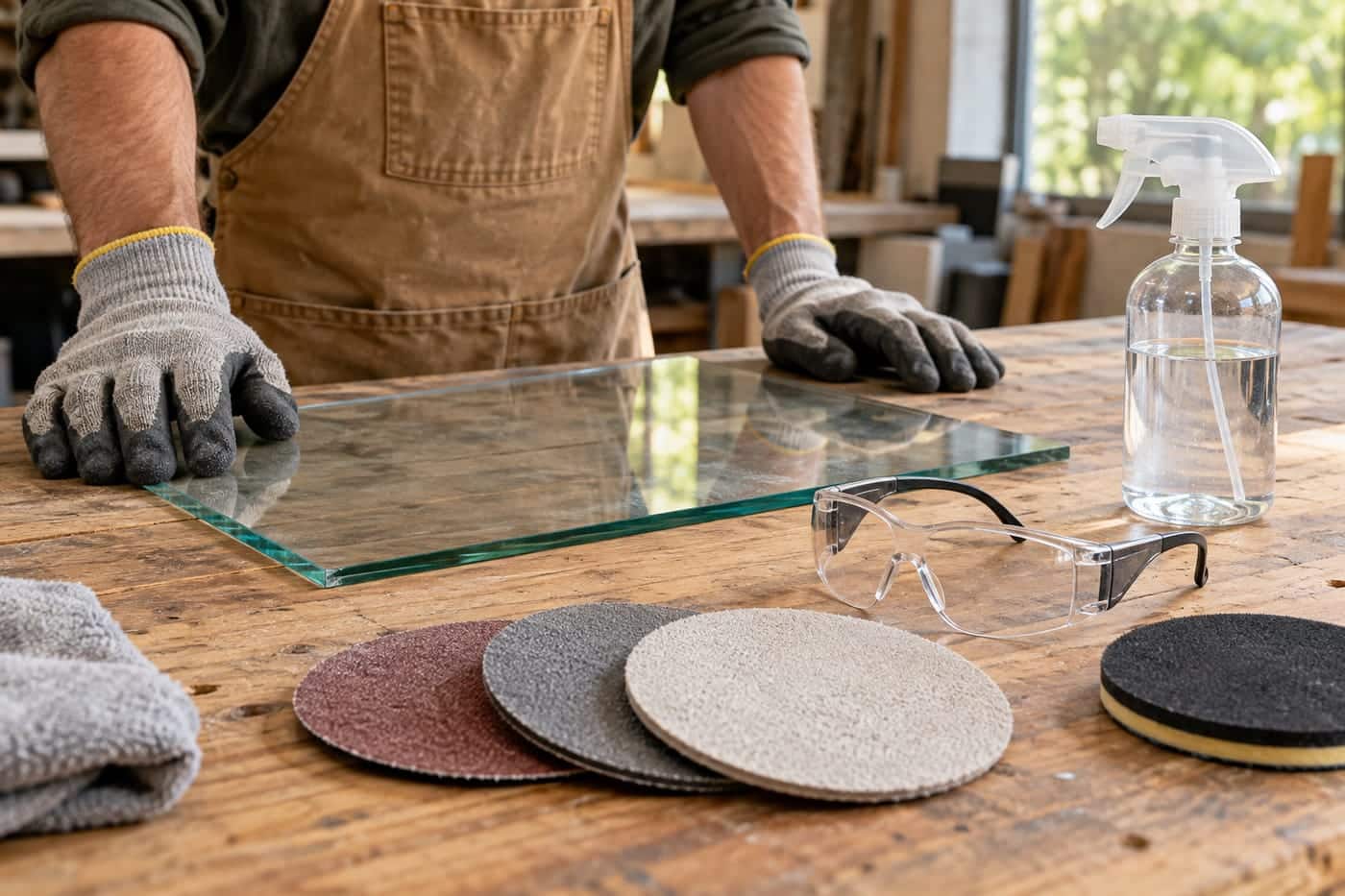
Beyond the basic safety warning earlier, here’s the gear I recommend:
- Safety goggles: full-seal goggles that wrap around your eyes, not regular glasses. Glass particles fly sideways and upward, not just straight ahead.
- Dust mask: P100, or FFP3 in Europe. Glass is made from silica sand, but melted into a non-crystalline solid; OSHA’s silica rules are about crystalline silica in materials like sand, stone, concrete and mortar. That doesn’t make glass dust safe to breathe: it’s sharp and irritating, and Mirka tells its own glass customers to always wear a dust mask. For regular glass work, see my picks for the best respirator for sanding. If you sand glass often in an enclosed workshop, a shop air filtration system helps clear the fine airborne dust between sessions.
- Gloves: nitrile or rubber gloves around 8-mil thick protect against both the abrasive slurry and sharp edges. I keep multiple pairs because wet gloves reduce grip and I change them frequently.
- Work surface protection: glass slurry stains and dulls wood. Lay plastic or rubber matting under the glass before you start. If a wooden frame or table does get marked, my guide to the best sanders for furniture refinishing covers the tools for bringing it back.
What You Need
None of this is expensive. For most jobs it’s a pack of wet/dry paper, a block, cerium oxide and a felt pad; the power tools only earn their place if you have large panels or lots of small pieces. Specs below are from the makers’ listings.
CooBigo Wet/Dry Sandpaper Assortment, 120 to 3000 Grit
Best Paper for Sanding Glass
24 silicon carbide sheets, 9″ x 3.6″, two each of 120, 150, 180, 240, 320, 400, 600, 800, 1000, 1500, 2500 and 3000 grit, for wet or dry use. That’s the whole glass sequence in one pack, and the sheets cut down easily into strips for edges or squares for a block.
- ✅ Covers coarse shaping to pre-polish
- ✅ Silicon carbide on a waterproof backing
- ❌ Only two sheets per grit
- ❌ No 2000 grit in the set
Best For: Edges, scratches and frosting by hand.
GLASS POLISH PRO Cerium Oxide Powder, 8.8 oz

Best Glass Polishing Compound
A 250 g jar of 3.5-micron cerium oxide from Glass Polish, a company that sells glass scratch repair supplies. You mix it with water and apply it with a felt pad on a rotary tool, drill or polisher, or by hand with a cloth. The maker lists it for mirrors, shower screens, glass tables and tempered glass, and is clear that the powder alone is for fine scratches; deeper ones need sanding first.
- ✅ The compound that actually restores clarity
- ✅ Enough for several tabletops
- ❌ Won’t remove scratches you can feel on its own
Best For: The final polish after 2000 to 3000 grit.
GLASS POLISH PRO Rayon Felt Polishing Pads, 3″

Best Pads for Cerium Oxide
Five 3-inch felt pads in a thermally bonded rayon blend with a hook-and-loop back, made for polishing glass with cerium oxide. You need a 3″ hook-and-loop backing pad for your drill or polisher; the same maker sells 6″ pads for larger machines.
- ✅ Made for glass and cerium
- ✅ Small enough to control on a drill
- ❌ Backing pad not included
Best For: Polishing scratches on tables, shelves and windows.
EGOFIX Diamond Hand Polishing Pads, 7-Piece
Best for Smoothing Glass Edges
Seven sponge-backed diamond pads in 60, 100, 200, 400, 800, 1500 and 3000 grit, for wet or dry use on glass, tile and stone. On a cut edge, the 100 or 200 knocks off the sharp corner in a few strokes, and the finer pads take it to a smooth, polished bevel.
- ✅ Coarse to polish in one set
- ✅ Rinse clean and outlast paper on glass
- ❌ Too small for flat panels
Best For: Cut edges, tiles, mosaic pieces and chips.
SKIL 5″ Random Orbital Sander SR211601
Budget Sander for Flat Glass
A 2.8-amp, 5″ random orbital sander with variable speed and up to 13,000 orbits per minute. Variable speed matters on glass, where you want to work slowly; run it on silicon carbide discs on damp, not wet, glass. It’s a budget tool, so if you also sand wood, compare it with the picks in my random orbital sander guide.
- ✅ Variable speed
- ✅ Even scratch pattern on large panels
- ❌ Electric: keep the glass damp, not wet
Best For: Tabletops and shelves.
Dremel 4000-1/25 Rotary Tool Kit
Best for Bottles and Small Glass Pieces
A corded 1.6-amp rotary tool with electronic speed control from 5,000 to 35,000 rpm, one attachment and 25 accessories. Glass wants the low end of that range: add silicon carbide or diamond bits for shaping and a felt wheel with cerium oxide for the polish.
- ✅ Slow speeds for glass
- ✅ Useful for far more than glass
- ❌ Glass bits and felt wheels sold separately
Best For: Bottle rims, beads, watch crystals and small chips.
NEOTRIL 8 Mil Nitrile Gloves

Gloves for Wet Glass Work
Disposable 8-mil nitrile gloves, latex and powder free, with a raised diamond texture that keeps your grip on wet glass and paper. They’re thick enough to take the abrasive slurry and stand up to brushing past a sanded edge, and you’ll want to change them often once they’re wet.
- ✅ Grip when wet
- ✅ Latex free
- ❌ Not cut-resistant gloves: handle broken glass with care
Best For: Every wet sanding job.
✨ The Bottom Line
Glass sanding is entirely achievable once you understand the core principles: wet sanding throughout, grit progression to the finest available paper, and a dedicated polishing compound at the end to restore clarity. The most common mistake is stopping too early and assuming the milky appearance means failure: it doesn’t. Push through to the polishing stage, leave the edges of tempered glass alone, and start with a small practice piece or a single sharp edge if you’re new to the process.
❓ Frequently Asked Questions
Can glass be sanded down?+
What sandpaper do you use to sand glass?+
Can you sand glass edges?+
Will sandpaper damage glass?+
Should you sand glass wet or dry?+
Can you sand tempered glass?+
Can sanding remove deep scratches from glass completely?+
What’s the best Dremel attachment for sanding glass?+
Start with Confidence
Glass sanding is satisfying work when you understand the process: watching a scratched, cloudy surface progressively clarify through the grit stages and finally come clear under the polishing compound is genuinely rewarding. The most important factor isn’t having expensive equipment; it’s understanding why each step matters and not rushing the polishing stage where the real transformation happens.
Take the safety precautions seriously (goggles, gloves, wet sanding throughout), keep away from the edges of tempered glass, and don’t skip the polishing compound at the end. If you’re new to glass sanding, start with a small practice piece: a sharp edge that needs smoothing is the perfect first project. If you also work on other hard materials, the same grit logic carries over to sanding metal.
For more on sanding techniques and projects, browse the blog for other detailed guides. And if you hit a snag with a specific glass project, leave a comment below: I’m happy to troubleshoot.

Nice article. Please if possible add videos that we may Watch too. Thank you sir
A suggestion of sandpaper grades/grits would be helpful as well.
Recommend you add info on what type of sandpapr to use. Some abrasives (diamond etc.) cut glass far better than others.
Hey Robert – thanks for the helpful comment and I completely agree with you! As soon as I’ve got some time I’ll update and expand the article with a section dedicated to choosing the ideal sandpaper types for sanding glass. Have a great one!
I second this. Will be a great article, once it has this. Without it, I’m missing the one step to get started.
I really like the simple step-by-step, though. Makes easy to follow without all the extra fluff.