
As an Amazon Associate I earn from qualifying purchases. All claims are strictly my personal opinion.
Editor’s Choice
Short on time? Of the 7 cheap dust collectors on this list, this is the one I'd buy.

A 1-1/2 HP collector for a standard 110V outlet, with a 12″ steel impeller, 1,280 CFM, a 2.5-micron bag and a Y-fitting for two machines.
- Also recommended WEN DC1300
- Budget pick WEN DC3401

A cheap dust collector is worth buying when it moves enough air for your biggest machine, filters fine enough for sanding dust, and plugs into the outlet you already have. For most shops, the best cheap dust collector is the Shop Fox W1685: 1-1/2 HP on a standard 110V outlet, 1,280 CFM through a 12″ steel impeller, a 2.5-micron bag and a Y-fitting for two machines. The WEN DC1300 moves slightly more air for less money, with a coarser 5-micron bag, and the WEN DC3401 is the cheapest real dust collector worth owning.
A dusty workshop isn’t just unpleasant: fine wood dust in the air is a health hazard, and it settles onto your freshly finished surfaces in the most maddening way. The good news is that you don’t need to spend a fortune to fix it. I’ve personally tested and compared the Shop Fox and JET collectors on this list, and the WEN and POWERTEC picks were chosen from their makers’ published specifications. Below you’ll find a comparison table, quick picks, short reviews, the cheapest route of all (a shop vac with a separator), and a buying guide. If you want to see how these budget units stack up against the 3 HP cyclones, my main dust collector reviews cover the premium tier, and the small shop dust collectors guide covers 115V machines chosen for tight floors.
Cheap Dust Collectors Comparison
Here’s a side-by-side look at all seven units so you can compare the key specs at a glance before the reviews. Airflow is the maker’s rating at the open inlet; real airflow at the end of a hose is lower on every machine.
| Product | ⭐ Shop Fox W1685 🏆 EDITOR’S CHOICE |
WEN DC1300 | POWERTEC DC1081 | Shop Fox W1826 | WEN DC3474 | WEN DC3401 | JET DC-1200VX-CK1 |
|---|---|---|---|---|---|---|---|
| Image | |
 |
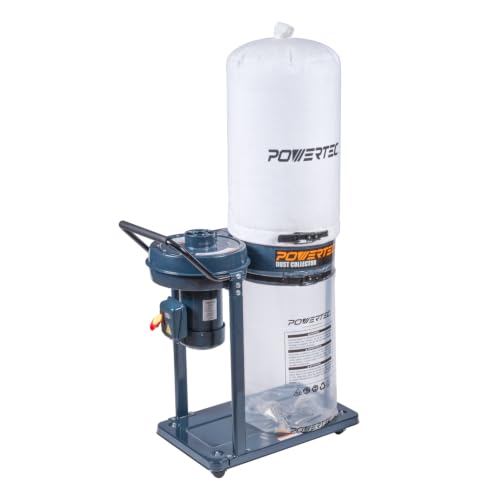 |
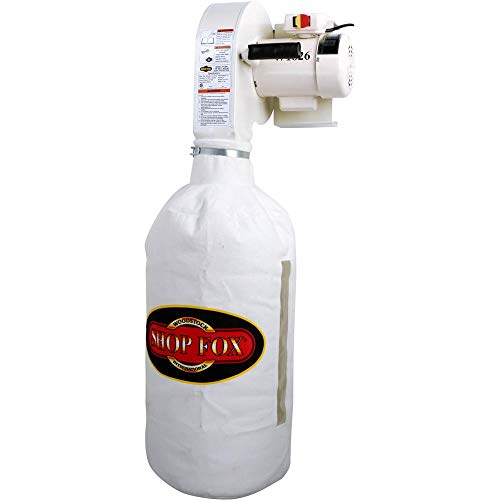 |
 |
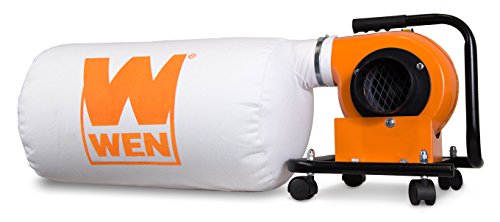 |
 |
| Motor | 1-1/2 HP, 110V | 14 A, 120V | 1 HP, 120/240V | 1 HP, 120V | 7.4 A induction | 5.7 A brushed | 2 HP, 230V |
| Airflow (maker) | 1,280 CFM | 1,300 CFM | 800 CFM | 537 CFM | 600 CFM | 660 CFM | 1,200 CFM |
| Filter | 2.5 micron bag | 5 micron bag | 1 micron bag | 2.5 micron bag | 5 micron bag | 5 micron bag | 2 micron canister |
| Intakes | 6″ or 2 × 4″ | 2 × 4″ | 1 × 4″ | 1 × 4″ | 1 × 4″ | 1 × 4″ | 6″ or 2 × 4″ |
| Mounting | Mobile | Mobile | Mobile | Wall | Mobile or wall | Mobile or wall | Mobile |
| Warranty | 2 years | 2 years | Not published | 2 years | 2 years | 2 years | 5 years |
| Best for | Best overall | Most air on 120V | Finest bag | Wall-mount | Floor or wall | Lowest cost | Best filtration |
| Tier | $$ | $$ | $$ | $$ | $ | $ | $$$ |
| Availability | Check price on Amazon | Check price on Amazon | Check price on Amazon | Check price on Amazon | Check price on Amazon | Check price on Amazon | Check price on Amazon |
Key takeaways
- My top pick is the Shop Fox W1685: a 12″ steel impeller, 1,280 CFM and a 2.5-micron bag on a standard 110V outlet, with a Y-fitting for two machines.
- Most airflow on a household outlet: the WEN DC1300, 1,300 CFM from a 14-amp motor and two 4″ inlets.
- Finest filtration in a budget bag: the POWERTEC DC1081, with a 1-micron bag where most cheap collectors use 2.5 or 5 microns.
- No floor space: the Shop Fox W1826 hangs on the wall. Lowest cost: the WEN DC3401.
- Below these, a shop vac with a cyclone separator is the cheapest dust collection that works, for one small tool at a time.
💡 Pro Tip
Even on a tight budget, don’t compromise on filtration. A 2.5-micron bag is the minimum I’d recommend for regular woodworking; the 5-micron bags on the WEN collectors let more of the fine sanding dust back into your shop air. A cheap way out: buy the collector that fits your outlet and airflow, then swap the stock bag for a 1-micron replacement bag sized to its ring.
Cheap Dust Collector Reviews
I’ve spent real time with the Shop Fox and JET machines here in working shop conditions, from suction consistency to bag capacity and maintenance. The WEN and POWERTEC collectors joined the list later, and for those I’ve stuck to what their makers publish. Here’s what each one does well and where it makes trade-offs.
Editor's Choice1-1/2 HP bag collector
Shop Fox W1685
Shop Fox W1685 1-1/2 HP 1280 CFM Dust Collector
My pick for most budget shops: 1,280 CFM from a 12" steel impeller on a standard 110V outlet, with a Y-fitting for two machines.
Best for
Budget shops on 110V that want two machines connected and a finer bag.
- 12" steel impeller on household power
- Two 4" intakes via Y-fitting
- 2.5-micron bag
Skip it if
You want the most airflow per dollar: the WEN DC1300 moves a little more for less.
- Needs a 20 A circuit of its own
Read full review
Best Cheap Dust Collector Overall
The Shop Fox W1685 is the 1-1/2 HP, 110V version of Shop Fox’s single-stage bag collector, and it’s the one I’d point most budget shops to, because it plugs into an ordinary outlet. Shop Fox rates it at 1,280 CFM and 10.1 inches of static pressure, from a motor that turns a 12″ radial-fin steel impeller, not cast aluminum or nylon.
The 6″ main inlet comes with a Y adapter for two 4″ hoses, so you can keep two machines connected. The 2.5-micron upper bag filters finer than the WEN DC1300’s 5-micron bag, and the plastic lower bag holds 5.4 cubic feet of chips. It rolls on a steel base with casters and carries a 2-year warranty. The one thing to plan for: Shop Fox rates it at 16 A full load and calls for a 20 A circuit, so give it a circuit of its own rather than sharing one with your saw.
Most air on 120V120V bag collector
WEN DC1300
WEN DC1300 1,300 CFM Dust Collector
1,300 CFM on a 120V outlet, with two 4" inlets and a 50-gallon bag.
Check price on AmazonSpecs: WEN
Best for
Garage shops without a 220V outlet.
- Most airflow on a 120V outlet
- Two 4" inlets, steel impeller
Skip it if
Fine sanding dust worries you most.
- 5-micron stock bag
Read full review
Most Airflow on a 120V Outlet
If your shop has only household outlets, the WEN DC1300 is the budget collector that comes closest to a 2 HP machine. WEN rates it at 1,300 CFM from a 14-amp, 120V motor turning a 10-inch steel impeller at 3,450 RPM. The inlet splits into two 4″ ports, so a table saw and a planer can stay connected, and the vertical bag holds 50 gallons, which means fewer trips to empty it. It rolls on a mobile base with four swivel casters, and WEN covers it for 2 years.
The trade-off is filtration. The stock bag is rated at 5 microns, coarser than the Shop Fox bags, so the finest sanding dust gets through. WEN sells a 1-micron canister cartridge for this machine (model DC1300-AF1), which turns it into a much better fine-dust collector later. The manual asks for a grounded 120V outlet on a circuit of at least 15 amps; with a 14-amp motor, I’d give it a circuit of its own rather than share it with your saw. At 86 lb assembled and over 6 feet tall, it is a floor machine, not one to hang on the wall.
Finest bag1 HP bag collector
POWERTEC DC1081
POWERTEC DC1081 1 HP Dust Collector
800 CFM and 1-micron bags, the finest stock bag here, on 120V or 240V.
Best for
Shops that sand a lot on a budget.
- 1-micron bags
- Runs on 120V or 240V
Skip it if
You want two machines connected at once.
- Single 4" intake
Read full review
Finest Filtration in a Budget Bag
The POWERTEC DC1081 is the budget collector for people who sand. POWERTEC fits it with 1-micron filter bags, the finest bag on this list, so it holds back more of the dust that a random orbital or a drum sander throws off. The 1 HP motor runs at 3,450 RPM, POWERTEC rates it at 800 CFM, and it can be wired for 120V or 240V, so you can start on a household outlet and move it to a 240V circuit later. It sits on a steel base with low-profile casters (15-1/4″ x 25-1/2″), with a single 4″ intake.
At 800 CFM it sits between the single-tool WENs and the bigger machines: enough for one stationary tool on a short hose, not for a ducted shop. POWERTEC’s product page doesn’t publish the warranty, the impeller or the bag volume, so I can’t compare those, and I’d check the warranty with the seller before buying.
Wall-mount pickWall-mount collector
Shop Fox W1826
Shop Fox W1826 Wall Dust Collector
The most compact pick: 537 CFM on the wall, for one machine at a time.
Best for
Small shops that need the floor space.
- Wall mount saves floor space
- Dust-level window, bottom zipper
Skip it if
You run two machines or a big planer.
- One machine at a time
Read full review
Best Cheap Wall-Mount Dust Collector
The Shop Fox W1826 is the most compact collector on this list, and for small shops or hobbyists running a single machine, it’s a genuinely impressive performer for the price. Its 1 HP motor generates up to 537 CFM through a single 4″ intake, enough to handle one tool at a time. What I really appreciate about the W1826 is how thoughtfully it’s designed: there’s a dust-level window so you can see when the bag needs emptying, a bottom zipper for bag removal, and a paddle switch with a removable lock-out key. The wall bracket with a locking screw makes installation quick, and the padded handle means you can lift it on and off the wall solo.
The 2.5-micron bag stores up to 2 cubic feet of debris: smaller than the freestanding units, but adequate for a single-machine setup. Fine Woodworking named the W1826 the best value in its test of wall-mounted dust collectors, and after using it myself I’d say that reputation is well-deserved. It comes with a 2-year warranty. If your shop is small, your budget is firm, or you simply want to reclaim floor space, the W1826 is the right call.
Rolling or wall-mount
WEN DC3474
WEN DC3474 Rolling Dust Collector With Induction Motor
600 CFM from an induction motor, on casters or on the wall.
Check price on AmazonSpecs: WEN
Best for
One machine, on the floor or the wall.
- Floor unit or wall-mounted
- Induction motor, no brushes
Skip it if
Fine sanding dust worries you most.
- 5-micron bag
Read full review
Best Cheap Collector for Floor or Wall
The WEN DC3474 steps up from the DC3401 in a meaningful way: a 7.4-amp induction motor paired with a 9-inch impeller moves up to 600 CFM through a 4″ port. An induction motor has no brushes to wear out, which is the main reason to pay more for it over the DC3401. It ships with a mobile base on swivel casters, but it can also be wall-mounted when floor space is at a premium, and that dual-purpose design is rare at this price.
The 15-gallon zippered bag filters to 5 microns: fine for chips and the bulk of sawdust, less so for fine sanding dust. An onboard carrying handle makes it easy to move solo, and at 41.1 lb it’s one of the lighter machines here. WEN backs it with a 2-year warranty.
Budget pickCompact rolling collector
WEN DC3401
WEN DC3401 5.7-Amp Rolling Dust Collector
The cheapest real dust collector here: 660 CFM, 17 lb, on casters or the wall.
Check price on AmazonSpecs: WEN
Best for
Weekend chip collection on the lowest budget.
- Lowest tier on this list
- Light, mobile, wall-mountable
Skip it if
You'll run it every day.
- Nylon impeller, brushed motor
Read full review
Lowest-Cost Real Dust Collector
The WEN DC3401 is the cheapest machine here that is a true dust collector rather than a vacuum: a 5.7-amp motor and a 6-inch impeller move up to 660 CFM through a 4″ port, into a 12-gallon, 5-micron zippered bag. It weighs 17 lb, rolls on four lockable casters, comes with an optional wall mount, and has a carry handle, so it can follow you from the planer to the miter saw. WEN’s warranty is 2 years.
The savings show in the parts: the impeller is nylon, not steel, so keep screws and offcuts out of the hose, and the motor is brushed, with easy-access brush caps for when they wear. For a planer or a benchtop jointer used on weekends, it is the right amount of machine. For daily use, the induction-motor DC3474 is worth the step up.
Best filtrationVortex Cone collector
JET DC-1200VX-CK1
JET DC-1200VX-CK1 Vortex Cone Dust Collector
The step-up: a 2-micron canister and a Vortex Cone that keeps chips off it.
Check price on AmazonSpecs: the seller's Amazon listing; no maker page found
Best for
Fine-dust filtration first.
- Finest filtration on this list
- Longest warranty here
Skip it if
You have no 230V outlet.
- 230V only, highest tier here
Read full review
Worth Stretching For: Best Filtration
The JET DC-1200VX-CK1 is the premium choice of this group, and the one to stretch for if fine dust is your main worry. The 2 HP motor delivers 1,200 CFM through a main 6″ intake with a Y-piece that splits into two 4″ inlets, so like the W1685 you can keep two machines connected. The impeller is all steel.
Where the DC-1200VX-CK1 pulls away from every other unit here is filtration. The 2-micron canister filter is a step up from bags, and JET’s Vortex Cone separates heavy chips before they reach the filter, so the canister clogs far less and keeps its airflow between cleanings. In practical terms, the machine runs cleaner for longer, which you’ll notice during long sanding sessions. Construction is everything you’d expect from JET, and it carries a 5-year warranty, the longest on this list. It needs a 230V circuit, and it sits a full tier above the rest, so it only makes sense if your budget can reach it. If it can, this is a machine you’ll never outgrow.
The Cheapest Dust Collection That Works: A Shop Vac and a Separator
If even the WEN DC3401 is more than you want to spend, or your dust comes from handheld tools, a dust collector may be the wrong machine. A shop vac with a cyclone separator on a bucket is the cheapest dust collection that actually works, for one tool at a time.
When a Shop Vac Is Enough
Sanders, routers, track saws and small benchtop tools have narrow ports, 1-1/4″ to 2-1/2″. They need high suction through a small hose, which is what a vacuum makes and what a dust collector doesn’t. For a random orbital sander, a shop vac with a fine-dust filter (or a dust extractor) beats any budget collector. My guide to dust extractor vs shop vac vs dust collector explains the difference in suction and airflow, and which machine fits which tool.
Add a Cyclone Separator
A cyclone dust separator on a 5-gallon bucket catches most of the chips before they reach the vac, so the filter stays clean and the suction holds. It is the cheapest upgrade in dust collection. The best shop vacs for dust collection guide covers the vacs that pair well with one.
When You’ve Outgrown the Shop Vac
A table saw, a planer or a jointer throws more chips than a vac can move through its hose, and the separator bucket fills in minutes. That is the point to buy a collector from the list above. My guide to dust collection for woodworking tools shows which machine each tool needs, from the table saw to the sander.
How I Chose These Cheap Dust Collectors
I looked only at collectors in the budget tiers that are sold on Amazon today and whose makers publish their specifications. The criteria, in order:
- Airflow for the money, taken from the maker’s spec sheet or manual. Every figure is an open-inlet maximum; I compare them with each other, not with what you’ll get at the end of a 10-foot hose.
- Your outlet: six picks run on a standard 120V outlet, and only the 2 HP JET needs 230V. The table says which is which.
- Filtration: the micron rating of the stock bag or canister, because that is what decides how much sanding dust goes back into the air.
- Build: steel or nylon impeller, induction or brushed motor, and warranty as tie-breakers.
I don’t show star ratings or prices: prices change daily, so each pick carries a tier ($ to $$$) and the Amazon button shows the live price. The larger 3 HP to 5 HP cyclones are in my main dust collector reviews.
How to Choose a Cheap Dust Collector

Not all budget dust collectors are created equal. Before you buy, here are the factors that matter most, and what to look for at each level of the budget range.
Airflow (CFM): The Most Important Number
CFM (cubic feet per minute) is the single most important spec on a dust collector. More CFM means the collector keeps chips moving through longer hoses and can serve more than one machine. As a rule of thumb, a 600 to 800 CFM rating handles one machine at a time on a short hose (like the W1826, the WENs under 1,000 CFM or the POWERTEC), while 1,200 CFM or more is what you want for two tools connected at once or a small ducted system. Remember that the rating is measured at the open inlet: hose, fittings and a dirty bag all cut into it.
120V or 220V: Check Your Outlet First
This is where most cheap dust collector purchases go wrong. The 2 HP machine here, the JET DC-1200VX-CK1 (230V), needs a dedicated 230V circuit. If your shop only has standard outlets, the WEN DC1300 (1,300 CFM) and the Shop Fox W1685 (1,280 CFM) are the most airflow you can get on 120V, and the POWERTEC DC1081 can be wired either way. Shop Fox calls for a 20 A circuit for the W1685, and a 14-amp motor like the DC1300’s will trip a 15-amp circuit that is also feeding your saw, so plan for a circuit of its own, and ask a licensed electrician if you are adding one.
⚠️ Important
Only the JET DC-1200VX-CK1 runs on 230V and needs a dedicated 230V circuit. If your shop only has 120V outlets, choose from the Shop Fox W1685, WEN DC1300, POWERTEC DC1081, Shop Fox W1826, WEN DC3474 and WEN DC3401.
Filtration Rating: Protect Your Lungs
Filtration is where cheap dust collectors vary the most, and it’s the spec I always tell people not to overlook. The bags on budget collectors run from 5 microns (the three WENs) to 2.5 microns (both Shop Fox models) and 1 micron (POWERTEC). The finer the rating, the more of the fine sanding dust stays in the bag instead of the air. If you do a lot of finishing work or sanding, consider the JET’s 2-micron canister, or upgrade a cheaper machine with a finer bag or canister. A collector at the machine doesn’t catch the dust already in the air, so pair it with a shop air filtration system and a respirator for heavy sanding days.
Portable Bag vs. Wall-Mount vs. Canister
The three designs in this price range suit different shops. Wall-mount units (like the W1826) free up the floor entirely. The WEN DC3474 and DC3401 work as either a floor unit on casters or a wall-mounted collector. Portable bag collectors (like the W1685, DC1300 and DC1081) sit on casters and move to the machine you are using. Canister units (like the JET) filter best and are the easiest to clean between sessions.
Single Machine vs. Dual Machine Capacity
If you only ever connect one tool at a time, any unit here will work. If you want a table saw and a jointer permanently connected, you need two 4″ intakes: the W1685, the JET and the WEN DC1300 have them; the others have a single 4″ port.
Impeller and Motor: Where Budget Collectors Cut Corners
The impeller is the spinning fan at the heart of your dust collector. Steel impellers (W1685, JET, DC1300) are the most durable and shrug off small debris. Cast aluminum (W1826) works fine in normal use. The nylon impeller on the DC3401 is the clearest cost-cutting on this list: keep screws and offcuts out of its hose. Motors differ too: the DC3474’s induction motor has no brushes to wear, while the DC3401’s brushed motor will need new brushes in time. For heavy daily use, steel and induction are preferable.
Upgrades That Make a Cheap Collector Better
The best money you can spend after the collector itself is on filtration. A 1-micron replacement bag, such as the POWERTEC 70333 1-micron dust collector bag, costs a fraction of a canister; measure the ring on your collector before ordering, because bags are sized to it. For the WEN DC1300, WEN’s own DC1300-AF1 1-micron canister replaces the 5-micron top bag. Cleaning the filter you have is the other cheap win: shake out or tap-clean the bag or canister after heavy sessions, because a caked filter costs more airflow than a long hose.
Warranty Coverage
Warranty length is a good proxy for a maker’s confidence. On this list, coverage ranges from 2 years (Shop Fox, WEN) to 5 years (JET); POWERTEC doesn’t publish one on its product page. Longer coverage isn’t just a nice-to-have: it tells you the brand expects the machine to hold up.
🏆 The Verdict
The Shop Fox W1685 is the best cheap dust collector for most woodworkers: a 12″ steel impeller, 1,280 CFM and a 2.5-micron bag on a standard 110V outlet. The WEN DC1300 moves slightly more air for less money, with a coarser bag; if you sand a lot, the POWERTEC DC1081 has the finest bag. If floor space is the priority, the W1826 is a brilliant wall-mount alternative, and on the tightest budget the WEN DC3401 still collects real chips. And if filtration is your top concern and your budget can stretch, the JET DC-1200VX-CK1 is in a league of its own.
❓ Frequently Asked Questions
What is the best budget dust collector?+
What is the best and most affordable dust collector?+
What can I use instead of a dust collector?+
How do you make a homemade dust collector?+
Do I need a 220V outlet for a dust collector?+
How can I save money on dust collector filters?+
Is a 5-micron bag good enough for sanding dust?+
Conclusion
Clean air and a clean shop on a budget: that’s what every machine on this list can deliver. A good dust collector doesn’t just make your workshop tidier; it protects your health, extends the life of your tools, and gives better finishes by keeping fine particles off your workpiece.
If I had to pick just one, it’s the Shop Fox W1685: a 12″ steel impeller, 1,280 CFM and a 2.5-micron bag from a motor that plugs into an ordinary outlet. For the most air per dollar, the WEN DC1300 is the one to beat; for fine sanding dust, the POWERTEC DC1081; for tight spaces, the W1826; and for the smallest budgets, the WEN DC3401, or a shop vac with a separator until you outgrow it.
Thanks for reading: if you have questions about any of these units or want help matching a dust collector to your setup, drop a comment below. I read every single one and I’m always happy to help. See you on the next one!
