
As an Amazon Associate I earn from qualifying purchases. All claims are strictly my personal opinion.
Best woodworking vise

A 7" cast-iron front vise with a rapid-action lever, an 8" opening and a built-in bench dog.

A woodworking vise holds a board still while you plane an edge, cut dovetails, chop a mortise or sand a part, and it’s the first thing that turns a table into a workbench. The best woodworking vise for most benches is the Yost M7WW: a 7″ cast-iron front vise with a rapid-action lever, an 8″ opening and a built-in bench dog. The Eclipse EWWQR7 is the quick-release alternative, the Pony Jorgensen 27091 is the best value, and the Groz 39006 is the clamp-on pick for benches you can’t bolt a vise to.
Below are eight picks: six woodworking vises from a light 6-1/2″ model to a 10″ front vise, and two engineer’s bench vises for metal and general shop work. You’ll also find a comparison table, short reviews from the makers’ specifications, a buying guide and how to mount a vise so it actually works.
Best Woodworking Vises: Comparison
Specs come from the makers’ listings. Opening is how wide the jaws open; throat depth is how far down from the top of the jaws they grip. “Not listed” means the maker doesn’t publish that figure. I don’t print prices: each review gives a market tier, and the Amazon buttons show the live price.
| Product | ⭐ Yost M7WW 🏆 EDITOR’S CHOICE |
Eclipse EWWQR7 | Pony Jorgensen 27091 | Yost F10WW | IRWIN 226361 | Groz 39006 | Wilton WVA6 | Yost LV-4 |
|---|---|---|---|---|---|---|---|---|
| Image | |
 |
 |
 |
 |
 |
 |
 |
| Jaw width | 7″ | 7″ | 7″ | 10-1/4″ | 6-1/2″ | 6″ | 6″ | 4-1/2″ |
| Opening | 8″ | 7.87″ | 9″ | Not listed | 4-1/2″ | 4-1/2″ | 6″ | 3″ |
| Throat depth | 3″ | 3″ | Not listed | Not listed | Not listed | Not listed | 3.75″ | 2.6″ |
| Mount | Under bench edge | Under bench edge | Bench face | Under bench edge | Under bench edge | Clamp-on or bolt-down | Bolt-down, bench top | Bolt-down, swivel |
| Quick release | Yes | Yes | No | No | No | No | No | No |
| Extras | Bench dog | Adjustable dog | Steel dog | 15-1/2″ screw | Toe-in jaws | Portable | Pipe jaws, anvil | Anvil, pipe jaws |
| Availability | Shop Now at Amazon | Shop Now at Amazon | Shop Now at Amazon | Shop Now at Amazon | Shop Now at Amazon | Shop Now at Amazon | Shop Now at Amazon | Shop Now at Amazon |
Best Woodworking Vises: Reviews
Every pick could be ordered on Amazon when I checked it. Benchcrafted, Lake Erie Toolworks and Veritas make superb leg vises and wagon vises, but they’re sold through their own stores and suit a bench built around them; the vises below bolt to the bench you already have.
Editor's Choice7" quick-release woodworking vise
Yost M7WW
Yost M7WW 7-Inch Rapid Action Woodworking Vise
A 7" cast-iron front vise with a rapid-action lever, an 8" opening and a bench dog.
Shop Now at AmazonSpecs: Yost listing on Amazon
Best for
A first quick-release front vise on a wooden workbench.
- Quick-release lever
- 7" jaws, 8" opening, 3" throat
- Built-in bench dog
Skip it if
Your bench is a folding or metal-top bench: a clamp-on vise like the Groz fits better.
- Needs wood jaw faces added
- 1-year warranty
Read full review
Best Woodworking Vise Overall
The M7WW is the front vise most home workbenches should get: big enough for drawer sides and table aprons, quick to adjust, and from a vise maker that has been in business since 1908. Yost lists 7″ jaws, an 8″ maximum opening and 3″ of throat depth, in a 30,000 PSI cast-iron body with steel guide rails and a chrome-plated sliding T-bar handle. The feature that sets it apart from the plain-screw vises below is the rapid-action lever: move it toward the handle and the nut disengages, so you can slide the jaw open or shut in one motion and then give the handle a final turn to clamp. It also has a bench dog in the front jaw, raised with a finger bolt, which works with a dog in the benchtop to hold a board flat for planing or sanding. It weighs about 21 lb, mounts under the bench edge and carries a 1-year limited warranty. Add wood faces to the jaws before first use. Mid price tier.
7" quick-release woodworking vise
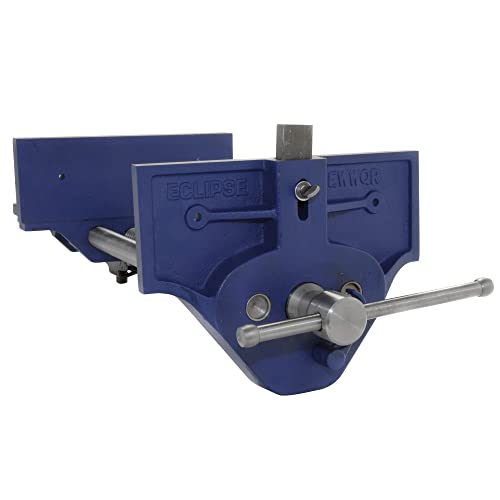
Eclipse EWWQR7
Eclipse EWWQR7 7-Inch Quick Release Woodworking Vise
A 7" grey cast-iron quick-release vise with an adjustable dog and a 7.87" opening.
Shop Now at AmazonSpecs: Eclipse listing on Amazon
Best for
A quick-release front vise that doubles as a tail vise with a bench stop.
- Quick-release trigger
- Adjustable front dog
- Tommy bar protects the casting
Skip it if
You need more than 8" of capacity: the Pony 27091 opens to 9".
- Mounting screws not included
- Opening just under 8"
Read full review
Best Quick-Release Alternative
The Eclipse EWWQR7 is the other quick-release 7″ vise worth comparing, a pattern woodworkers have used for decades. Eclipse lists 7″ x 3″ jaw faces, a 7.87″ maximum opening and 3/4″ guide rods and main screw, with a grey cast-iron body and sliding jaw chosen for shock absorption. A front-mounted trigger disengages the screw for fast opening and closing. Its adjustable front stop (dog) works with a bench stop, which turns the vise into a tail vise as well as a face vise. The tommy bar is designed to bend before the vise is over-stressed, a small safety detail that protects the casting. The jaws are predrilled for wooden cushions, and there are two predrilled holes and two cast tabs for mounting screws (not included). It weighs about 20.7 lb. It’s close to the Yost on paper; buy whichever is easier to get. Mid price tier.
medium-duty woodworker's vise
Pony Jorgensen 27091
Pony Jorgensen 27091 Medium Duty Woodworker’s Vise
A medium-duty 7" face vise with a 9" opening, Acme screw and a steel dog, for a budget price.
Shop Now at AmazonSpecs: Pony listing on Amazon
Best for
The most opening for the money in a woodworking face vise.
- 9" maximum opening
- Acme screw, twin guide bars
- Steel dog in the front jaw
Skip it if
You open and close the vise all day: a quick-release model saves a lot of cranking.
- No quick release
- Wood facings not included
Read full review
Best Value Woodworking Vise
The Pony 27091 has been the go-to budget face vise for years, and it’s still the best value here. Pony describes it as a medium-duty vise for home, shop or professional use, with a 7″ jaw width and a 9″ maximum opening, the largest opening among the 7″ vises on this page. It mounts to the face of a wooden workbench with the jaw tops flush with the benchtop; some benches need the face mortised or shimmed to get there. The main screw has Acme threads and runs between twin plated-steel guide bars, and a solid steel dog in the front jaw works with a bench stop to hold oversize work. The jaws are drilled for wood facings (not included). There’s no quick release, so opening it wide means turning the handle. At under 12 lb it’s lighter than the Yost and Eclipse. Budget price tier.
10" front vise
Yost F10WW
Yost F10WW 10-Inch Woodworker’s Front Vise
A 10" cast-iron front vise with a 1-3/16" screw and 3/4" guide rods for wide panels.
Shop Now at AmazonSpecs: Yost listing on Amazon
Best for
Wide panels and cabinet parts on a heavy workbench.
- 10" wide jaws
- 1-3/16" screw, 3/4" guide rods
- Long screw for wide work
Skip it if
Your bench top is thin or light: a 7" vise suits it better.
- No quick release
- Opening not listed
Read full review
Best Large Front Vise
If you build cabinets, doors or anything with wide panels, a 10″ vise grips more of the board and holds it straighter. The F10WW is Yost’s 10″ cabinetmaker’s vise: the body measures 10-1/4″ wide by 19-1/4″ long, with a 1-3/16″ solid steel main screw 15-1/2″ long and 3/4″ guide rods. The long screw gives it a much deeper reach than the 7″ vises, though Yost doesn’t list the exact opening on the listing. Yost suggests it for cabinet work, such as holding two pieces together while you drill or saw. It has a cast-iron body, a plain screw without a quick release, and a 1-year limited warranty. Like any face vise, it works best with hardwood jaw faces at least as wide as the iron jaws, and a 10″ vise needs a thick, solid benchtop and apron to mount to. Budget-to-mid price tier.
6-1/2" light-duty woodworker's vise
IRWIN 226361
IRWIN 226361 6-1/2-Inch Woodworker’s Vise
A light-duty 6-1/2" vise with toe-in jaws and a 4-1/2" capacity for small work.
Shop Now at AmazonSpecs: IRWIN listing on Amazon
Best for
Small parts, carving and light benches.
- Toe-in jaws grip at the top
- Square body, easy under-bench mount
- Takes wood cheeks
Skip it if
You plane or saw full-size boards: get a 7" vise with a bigger opening.
- 4-1/2" capacity
- Light duty only
Read full review
Best Cheap Woodworking Vise
The IRWIN 226361 is the smallest and cheapest under-bench vise here, and for hobby work it’s enough. IRWIN lists 6-1/2″ jaws with a 4-1/2″ jaw capacity, made for light woodworking. The jaws toe in toward the top, so they close at the top edge first and grip the workpiece firmly where you’re working. A square body makes it simple to mount under a bench, and the jaws have provision for wooden cheeks to protect the work. It’s small enough to fit a light or homemade bench, but don’t expect it to hold a door edge for heavy planing: 4-1/2″ is the limit, and there’s no dog or quick release. For carving, small boxes, sharpening and holding parts for sanding, it’s a good start. Budget price tier.
6" portable clamp-on vise
Groz 39006
Groz 39006 6-Inch Portable Woodworking Vise
A 6" cast-iron vise that clamps to a bench edge or bolts down, with toe-in jaws.
Shop Now at AmazonSpecs: Groz listing on Amazon
Best for
Benches that can't take a bolted vise, and carving or sharpening on the go.
- Clamps on or bolts down
- Toe-in cast-iron jaws
- Chrome-plated screw and rods
Skip it if
You'll plane long edges: a face vise flush with the bench is steadier.
- Clamp fits benches up to 2-5/32"
- Sits above the benchtop
Read full review
Best Portable Clamp-On Vise
Not every bench can take a bolted-on vise: folding benches, metal-top benches and kitchen tables can’t. The Groz 39006 handles both cases. You can bolt it down through its cast slots, or use the built-in screw clamp, which grips a bench edge up to 2-5/32″ (55 mm) thick and sets up in seconds. Groz lists 6″ jaws with a 4-1/2″ opening, a close-grained cast-iron body, toe-in jaws that meet at the top first, and a chrome-plated steel screw, twin guide rods and tommy bar. The body and sliding jaw are predrilled for wooden liners. It weighs about 7 lb. Because it sits on top of the bench rather than flush with it, it’s less suited to planing long edges than a face vise, but it’s ideal for carving, sharpening, sawing small parts and taking the vise to the job. Mid price tier.
Best Bench Vise for Metal and General Shop Work
People searching for the best bench vise often mean a different tool: an engineer’s vise that sits on top of the bench, with hardened serrated jaws, an anvil and usually a swivel base. It’s the right vise for metal, pipe, sharpening mower blades and general repairs, and the wrong one for wood, because the jaws dent boards and the vise isn’t flush with the bench. Many shops have one of each. These are the two I’d pick.
6" bench vise for metal
Wilton WVA6
Wilton WVA6 6-Inch Apprentice Bench Vise
A 6" ductile-iron engineer's vise with a 6" opening, pipe jaws and an anvil.
Shop Now at AmazonSpecs: Wilton listing on Amazon
Best for
Metal, pipe and general repair work.
- 72,000 PSI ductile iron
- 6" jaws, 6" opening, 3.75" throat
- Pipe jaws and anvil
Skip it if
You only work wood: a woodworking vise holds boards better.
- Serrated jaws mark wood
- Sits on top of the bench
Read full review
Best Bench Vise for Metal and General Shop Work
For metal, pipe and general garage work, you want an engineer’s (machinist) bench vise instead: serrated steel jaws, an anvil and a swivel base. The WVA6 is Wilton’s 6″ Apprentice vise, made of 72,000 PSI ductile iron, which Wilton says is twice as strong as ordinary cast iron without extra weight. It has 6″ jaws, a 6″ opening, 3.75″ of throat depth and pipe jaws for 1/4″ to 3″ pipe, plus a large anvil surface for hammering and forming. Wilton is the best-known name in bench vises, and the Apprentice line is its lower-cost range. Keep it for metal: the serrated jaws dent wood unless you add soft jaw covers. Mid price tier.
4-1/2" homeowner's bench vise
Yost LV-4
Yost LV-4 4-1/2-Inch Homeowner’s Vise
A small 4-1/2" swivel vise with an anvil and pipe jaws for light repairs.
Shop Now at AmazonSpecs: Yost listing on Amazon
Best for
Occasional home repairs on a small bench.
- 240-degree swivel head
- Anvil and pipe jaws
- Compact
Skip it if
You do real metalwork: the Wilton WVA6 is far stronger.
- 3" opening
- Mounting bolts not included
Read full review
Best Cheap Bench Vise
For light repairs around the house, a small swivel bench vise is all most people need. The LV-4 has 4-1/2″ jaws, a 3″ opening and 2.6″ of throat depth, in 30,000 PSI gray iron. The head rotates 240 degrees on its swivel base, there’s a 3-1/2″ x 2-7/10″ anvil, and the jaws take pipe from about 0.6″ to 1.85″. Mounting hardware isn’t included, so buy bolts long enough for your benchtop. It’s light duty: fine for holding a part to file, saw or glue, not for heavy hammering. Budget price tier.
How I Chose These Vises
I started from what a woodworking vise has to do: hold a board firmly on its edge for planing, upright for sawing, and flat with a bench dog for sanding or scraping, without marking the wood. That puts the weight on jaw width, opening, throat depth and how the vise mounts. Then I looked at the vises sold on Amazon today from established makers and picked one for each kind of bench and budget: two quick-release 7″ vises, a value face vise, a 10″ front vise, a light-duty vise, a clamp-on portable vise and two engineer’s vises for metal. Within each group I favored the models more buyers have owned for longer. I compared specs from the makers’ listings and don’t show customer ratings or prices. For how I pick products across the site, see how I choose.
Types of Woodworking Vises
Front (Face) Vise
A front vise mounts under the front edge of the bench, usually at the left end for a right-handed worker, with the fixed jaw flush with the bench face. It’s the everyday vise for edge planing, sawing and holding parts upright, and every woodworking vise in the main list is one, except the clamp-on Groz.
Quick-Release Vise
A quick-release (rapid-action) vise is a front vise with a half nut you can disengage, so the jaw slides open or shut instead of being cranked. The Yost M7WW and Eclipse EWWQR7 have it. If you clamp and unclamp often, it’s the feature worth paying for.
Tail Vise and Bench Dogs
A tail vise sits at the end of the bench and pushes a board against a dog in the benchtop, so you can hold it flat. A front vise with a dog in its jaw does the same job on a smaller scale: raise the dog, put a stop in a bench dog hole, and clamp the board between them.
Leg Vise
A leg vise is a tall wooden chop on a screw, mounted on a bench leg. It has huge capacity and holds long boards on edge well, but you build it into the bench, usually from screw hardware sold for the purpose. It’s a project, not a bolt-on.
Clamp-On and Portable Vises
A portable vise clamps to a bench edge or a table, so it suits folding benches, shared spaces and carving. The Groz 39006 can also be bolted down. They’re handy but sit above the benchtop, which makes them less steady for planing long edges.
How to Choose a Woodworking Vise
Jaw Width and Opening
7″ jaws with an 8″ to 9″ opening suit most home benches: they hold a drawer side, a table leg or a 2×4 on edge. 10″ jaws support wide panels and doors better. Under 7″, the vise is for small parts and light work.
Throat Depth and Guide Rods
Throat depth, about 3″ on the 7″ vises here, sets how much of a board the jaws grip below the top edge. Guide rods keep the moving jaw parallel; twin rods of 3/4″ diameter resist racking when you clamp something at one end of the jaws.
Your Bench
Measure the benchtop thickness and the front apron before you buy. Most under-bench vises need a solid top, often up to about 3″ thick, and room below it for the vise body. A thin or hollow top needs a spacer block, and a metal or folding bench needs a clamp-on vise instead. My guides to the best workbench and the best portable workbench cover benches that take a vise well.
How to Install a Woodworking Vise
- Pick the spot: near the left front corner for a right-handed worker, clear of a bench leg so long boards can hang down.
- Set the height: the top of the jaws should sit flush with, or just below, the benchtop. Add a spacer block under the bench if the top is thin.
- Set the fixed jaw flush with the bench face, mortising the apron if needed, so a long board clamped in the vise also bears on the bench edge.
- Fasten it with lag screws or bolts through the mounting holes into solid wood. Bolts through the top are the strongest.
- Add hardwood jaw faces at least as wide as the iron jaws and slightly taller, screwed through the holes in the jaws with countersunk screws.
💡 Pro Tip: Line the Jaws for Sanding
Glue thin cork or leather to the wooden jaw faces. It grips finished and curved parts without marking them, which is what you want when you sand chair parts, legs and turned work held in the vise, and it stops the part from creeping when a sander vibrates against it.
🏆 The Verdict
The best woodworking vise for most benches is the Yost M7WW: 7″ jaws, an 8″ opening, a quick-release lever and a bench dog. The Eclipse EWWQR7 is the quick-release alternative, the Pony Jorgensen 27091 the best value, the Yost F10WW the large front vise, the IRWIN 226361 the cheapest and the Groz 39006 the clamp-on pick. For metal, add a Wilton WVA6, or a Yost LV-4 for light repairs.
❓ Frequently Asked Questions
What is the best vise for woodworking?+
What is the difference between a woodworking vise and a bench vise?+
What are the four main types of vices?+
Which heavy-duty bench vise is best?+
Are Harbor Freight vices of good quality?+
Is a quick release woodworking vise worth it?+
Conclusion
Choose a vise by your bench and what you hold in it. For a wooden workbench, a 7″ quick-release front vise like the Yost M7WW is the most useful single upgrade you can make; add a 10″ vise for wide panels, a clamp-on vise for a folding bench, and an engineer’s vise if you work metal. Mount it flush, add wooden faces, and it will hold work for decades. Questions about your bench? Ask in the comments.
