
As an Amazon Associate I earn from qualifying purchases. All claims are strictly my personal opinion.
Is a Mirka DEROS worth it? For anyone who sands for hours at a time, usually yes: it is one of the lightest 5″ and 6″ random orbital sanders you can buy, it runs quietly and with low vibration, and it is built around dust-free sanding. For occasional DIY sanding, no: a good mid-priced random orbital does the same basic job for a fraction of the cost.
Below I go through what the DEROS is, how the new DEROS II differs from the original, how it compares with Festool, and who should spend the money. Every number on this page comes from Mirka’s or Festool’s own published specs.

⚡ Quick Verdict
Buying a DEROS today? Get the current Mirka DEROS II 550X: 5″ pad, 5 mm orbit, 2.2 lb, LED speed indicators and a separate on/off switch.
Want the bigger 6″ pad with a case in the box? The original DEROS 650CV is still sold.
Only sanding a few weekends a year? Save the money: a Bosch ROS20VSC is the sensible buy.
Mirka DEROS at a Glance
| Spec (from Mirka) | DEROS II 550X | DEROS 650CV |
|---|---|---|
| Generation | Current (DEROS II) | Original DEROS |
| Pad diameter | 5″ | 6″ |
| Orbit | 5.0 mm | 5.0 mm |
| Speed | 4,000-10,000 rpm, lever with LED indicators | Variable, lever control |
| Power input | 350 W, brushless | 350 W, brushless |
| Weight | 2.2 lb | 2.36 lb |
| Noise | 71.0 dB | 71.0 dB |
| Vibration | 3.2 m/s² | 3.4 m/s² |
| Dust system | Central vacuum ready | Central vacuum ready, central air inlet pad |
| Bluetooth | ✅ myMirka app | Not listed by Mirka |
| Warranty | 2 years, plus 1 year free when registered within 30 days | |
| Price tier | $$$$ | $$$$ |
What Is the Mirka DEROS?
The DEROS is Mirka’s electric random orbital sander. Mirka is a Finnish abrasives company, and the DEROS was designed as the power tool for its dust-free sanding system: net abrasives such as Abranet, a sander that pulls air through the whole pad, and a dust extractor on the other end of the hose. That origin explains most of its design choices.
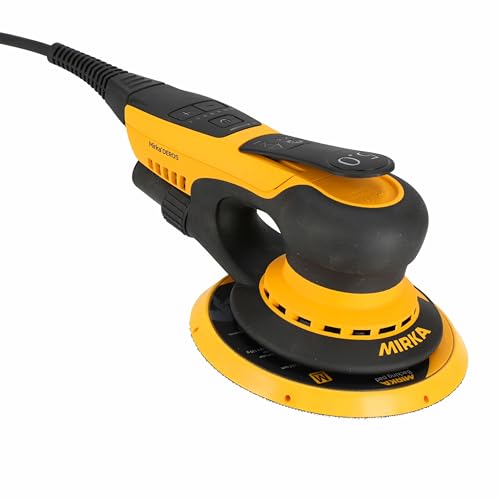
The first thing you notice in any photo is the shape. The DEROS has no tall motor housing sticking up from the pad. The brushless motor sits low, and the body is barely bigger than your palm, so your hand is very close to the work. Mirka’s own page describes it as compact, low-profile and balanced, and says it can be used for long periods without fatigue thanks to its low noise and vibration. The design has won a Red Dot industrial design award, according to Mirka.
What Is the Mirka DEROS Used For?
Mirka lists it for general-purpose sanding of wood, drywall, solid surfaces and paint removal, and the 5 mm orbit is its middle-of-the-road setting: aggressive enough to level and strip, fine enough to finish. In practice you see it in three places:
- Woodworking and cabinet shops, where one sander runs most of the day on an extractor.
- Painting and drywall contractors, where dust-free sanding in an occupied home is the selling point.
- Automotive and marine refinishing, where Mirka’s abrasives are a standard, and the DEROS pairs with them.
Mirka DEROS Reviews
Mirka DEROS II 550X 5″
The One to Buy Today
The DEROS II 550X is the current generation: a 5″ pad with a 5.0 mm orbit, a 350 W brushless motor and a speed range of 4,000 to 10,000 rpm. Mirka rates it at 2.2 lb, 71.0 dB and 3.2 m/s² of vibration. The practical upgrades over the original are about control: the speed lever now has clearly visible LED indicators, the on/off switch is separate from the speed setting, and Bluetooth links it to the myMirka app for vibration monitoring. The Amazon listing is tool only and includes an Abranet sample pack.
- ✅ 2.2 lb, among the lightest 5″ random orbitals
- ✅ LED speed indicators and a separate on/off switch
- ✅ Low published vibration, 3.2 m/s²
- ✅ 2 + 1 years of warranty when registered
- ❌ Premium price tier
- ❌ Needs an extractor to show what it can do
Best For: Anyone who sands for long stretches and already has, or will buy, a dust extractor.
Mirka DEROS 650CV 6″

The Original, With a 6″ Pad
The DEROS 650CV is the sander that built the DEROS name: a 6″ pad, 5 mm orbit, 350 W brushless motor, 2.36 lb, with soft start and an electronic motor brake. Mirka says its performance is comparable to a conventional 500 W electric sander, and that it keeps a constant speed under load. Its backing pad has a central air inlet to pull dust out from the middle of the pad, and the symmetrical body works in either hand, with a longer shape that allows a two-handed grip. This listing includes the case.
- ✅ 6″ pad covers large panels and tabletops faster
- ✅ Soft start and motor brake
- ✅ Case included
- ❌ Older generation: no LED speed indicators or Bluetooth listed
- ❌ Premium price tier
Best For: Big flat surfaces, cabinet sides and drywall, where a 6″ pad saves passes.
What We Like About the DEROS
Weight and Height
At 2.2 lb for the 5″ DEROS II and 2.36 lb for the 6″ 650CV, a DEROS weighs about as much as a quarter-sheet palm sander. For vertical work, overhead work and long sessions, that matters more than any other spec. The low body also keeps your hand close to the pad, which makes it easier to keep the pad flat, and a flat pad is what prevents gouges and swirl marks.
Noise and Vibration
Mirka publishes both: 71.0 dB for both models, and 3.2 m/s² (DEROS II 550X) or 3.4 m/s² (650CV) of vibration. Few mainstream sander makers put those two numbers on the product page. Vibration is the reason your hand goes numb after an hour of sanding, and Mirka built the DEROS II’s app connection around monitoring it.
Brushless Motor
Both models use a brushless motor. Mirka’s case for it is the usual one: low maintenance, long life, and a speed that stays constant under load instead of bogging down when you lean on the tool.
Built for Dust-Free Sanding
The DEROS is designed to run connected to an extractor, pulling dust through a multi-hole pad and net abrasives. Used that way, far less dust ends up in the room and on the surface, which also means the abrasive cuts longer before it loads up. If you don’t own an extractor yet, my guide to the best dust extractors covers the machines that pair well with a sander like this.
Drawbacks to Know Before You Buy
- Price. A DEROS sits in the same premium tier as Festool, several times the price of a good mid-range random orbital.
- It wants an extractor. The DEROS works without one, but the dust-free benefit, and a good part of the value, depends on the hose.
- Corded only. The DEROS models on this page are 120 V corded tools.
- Tool-only listing. The DEROS II 550X listing is the tool without a case; the 650CV listing includes one.
DEROS II vs the Original DEROS
This is the “DEROS 2 vs 1” question. Both generations share the same concept, the same 5 mm orbit option, the same 350 W brushless motor rating and the same 71.0 dB noise figure. The DEROS II changes the controls and adds connectivity:
- Speed control you can see. The DEROS II has LED indicators next to the speed lever, plus a separate on/off switch, so you can set a speed and return to it.
- Bluetooth. The DEROS II pairs with the myMirka app for vibration monitoring.
- A lighter 5″ model. The 550X is listed at 2.2 lb, against 2.36 lb for the 6″ 650CV.
If you find the original at a clearly lower price, it is still a very capable sander. If prices are close, buy the DEROS II.
5″ or 6″, and Which Orbit?
The model number tells you both: in “550X”, the first two digits are the pad (5″) and the third is the orbit (5 mm); in “650”, a 6″ pad and 5 mm orbit. A 5″ pad is lighter and easier to control on edges and smaller parts, and 5″ discs are the most common size in hardware stores. A 6″ pad covers more area per pass, which pays off on big panels. The 5 mm orbit is the all-rounder. Mirka also makes 2.5 mm orbit versions, such as the 625X, for fine finishing between coats, but that is a second sander for most people, not a first one.
Mirka vs Festool
The DEROS’s real competitor is Festool’s brushless random orbital, the ETS EC 150/5, and for a compact 5″ sander, the ETS 125 REQ. For the whole lineup on both sides, including sheet, delta and drywall sanders and the extractors, see my Festool vs Mirka comparison; if you’re leaning Festool, my guide to Festool sanders explains which model fits which job.
| Published spec | Mirka DEROS 650CV | Festool ETS EC 150/5 |
|---|---|---|
| Pad / stroke | 6″ / 5 mm | 150 mm (about 6″) / 5 mm |
| Motor | Brushless, 350 W | Brushless (EC) |
| Weight | 2.36 lb | 2.5 lb |
| Pad brake | Electronic motor brake | Sanding pad brake |
| Warranty | 2 years, +1 with registration | 3 years |
| Price tier | $$$$ | $$$$ |
On paper they are very close: same stroke, brushless motors, similar weight, both with a brake. The differences are in the systems around them. Festool sells its sanders into an ecosystem of extractors, hoses and Systainer cases, with a 3-year warranty on this model. Mirka comes from the abrasives side, and the DEROS is designed around its net abrasives and dust-free sanding. If you already own a Festool extractor, a Festool sander plugs straight in; if you already use Mirka abrasives, the DEROS is the natural fit. Neither choice is a mistake.
Festool ETS EC 150/5 EQ-Plus

The Festool Alternative
The ETS EC 150/5 has a brushless EC motor with stepless speed pre-selection and constant speed under load, a 5 mm stroke, and a weight of 2.5 lb. Festool adds a sanding pad brake with a carbide tip and its Vibration Control System, and the listing states a 3-year warranty. It ships with a Multi-Jetstream 2 pad and a Systainer³ case.
- ✅ Brushless, constant speed under load
- ✅ 3-year warranty, Systainer case
- ❌ Premium price tier, like the DEROS
Best For: Shops already running Festool extractors and cases.
Festool ETS 125 REQ-Plus
A Compact 5″ Festool
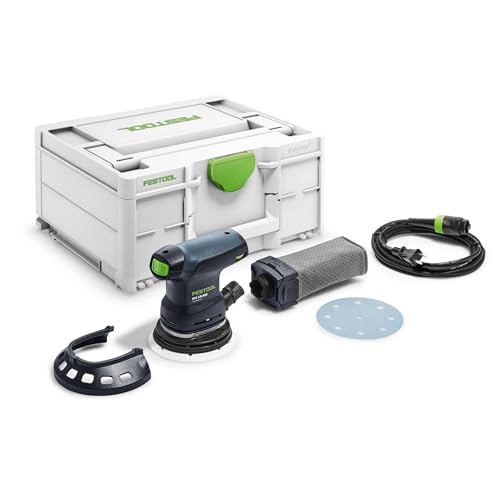
The ETS 125 REQ is Festool’s compact 5″ random orbital, shaped to fit any size hand and light enough, Festool says, for extended vertical and overhead use. It has step-less variable speed, a balanced vibration-stop design and Jetstream dust extraction, and it comes in a SysGen3 Systainer. It is the lower-cost way into Festool, but still in the premium tier.
- ✅ Compact, made for vertical and overhead work
- ✅ Variable speed, Jetstream extraction
- ❌ Brushed motor, unlike the DEROS
Best For: Finish work on cabinets and furniture in a Festool shop.
Is a Mirka Sander Worth It for You?
The honest answer depends on hours, not skill level.
- Yes, if you sand most days, or for hours at a time: professional finishing, cabinet making, drywall and paint prep. Lower weight, noise and vibration add up over a working week, and the brushless motor is built for that duty.
- Yes, if dust is the problem. Sanding in a lived-in house, or with fine drywall or paint dust, is where a DEROS on an extractor earns its price.
- No, if you sand a few weekends a year. A mid-priced random orbital does the same basic job. You’ll get more from spending the difference on a vacuum or extractor and good abrasives.
The Sensible Alternative: Bosch ROS20VSC

The Bosch ROS20VSC is a 2.5 A, 5″ random orbital with a speed dial from 7,500 to 12,000 OPM, a pad dampening system that Bosch designs to minimize swirl marks, and a twist-off micro-filter dust canister. It is heavier and louder than a DEROS and has a brushed motor, but for occasional sanding it gets you a good finish in the mid-range price tier. More options at every price are in my best random orbital sanders guide.
How to Get the Most From a DEROS
- Connect an extractor. Match the hose to the sander’s port and use a tool-activated outlet so extraction starts with the sander. For a budget route, a shop vac with the right hose works too; see my shop vac for dust collection guide.
- Use net or multi-hole abrasives. Mirka’s DEROS is designed for them, and they let the extractor pull dust through the whole pad instead of a few holes.
- Let the tool do the work. Light pressure, pad flat, slow overlapping passes. Pressing down slows the pad’s rotation and turns random scratches into swirls, with any random orbital.
- Use the speed range. Lower speeds for veneer, edges and between coats; full speed for leveling.
💡 Pro Tip
Register the tool with Mirka within 30 days of purchase. It adds a free third year to the standard two-year warranty, which on a sander in this price tier is worth the two minutes.
How I Reviewed It
This review is built from the published specifications of Mirka and Festool (weight, orbit, speed, power, noise, vibration, warranty) and from each product’s current Amazon listing, checked on the day of writing. Where a listing contradicted the maker, I used the maker’s figure. I don’t show star ratings or prices: prices change daily, so each product carries a price tier and the Amazon button shows the live price.
🏆 The Verdict
The Mirka DEROS is worth it for people who sand for a living or for hours at a stretch: it is light, quiet, low in vibration and built for dust-free work. Buy the current DEROS II 550X unless you specifically want a 6″ pad, in which case the DEROS 650CV is still a strong tool. If you’re in a Festool shop, the ETS EC 150/5 is the equal alternative. And if you sand occasionally, a Bosch ROS20VSC plus a good vacuum is the smarter spend.
❓ Frequently Asked Questions
Are Mirka sanders better than Festool?+
What sanders do professional painters use?+
What is the Mirka DEROS used for?+
Is a Mirka sander worth it?+
What’s the difference between the DEROS II and the original DEROS?+
Should I get the 5-inch DEROS 550X or the 6-inch 650?+
Conclusion
The Mirka DEROS earned its reputation by being light, low and quiet, and the DEROS II adds the controls it was missing. It is a professional tool priced like one, and it is at its best on the end of an extractor hose. If that describes how you work, it is one of the best random orbital sanders you can buy. If not, a good mid-range sander and a better vacuum will serve you well.
Sanding drywall with it? My guide to the best sanders for walls and drywall covers the rest of the setup. Questions about the DEROS or its Festool rival? Ask in the comments below.

