


As an Amazon Associate I earn from qualifying purchases. All claims are strictly my personal opinion.
A belt sander is for removing a lot of wood fast on flat surfaces; an orbital (random orbital) sander is for smoothing and finishing. If you are leveling rough boards, taking a door down to size or stripping thick old paint, a belt sander does it in a fraction of the time. For almost everything else, including every final pass before stain or paint, a random orbital is the better and safer tool.
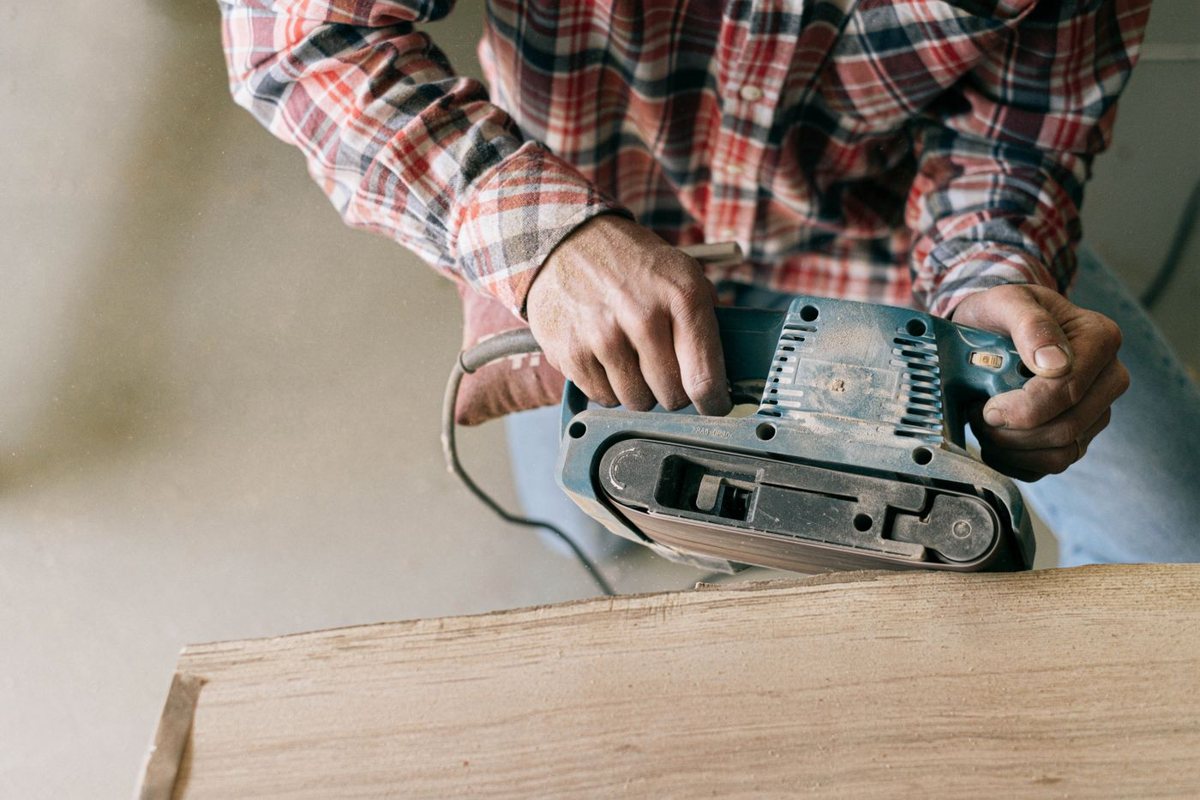
Many shops use both, one after the other. Below is a side-by-side comparison, the projects where each one wins, the mistakes to avoid, and three sanders I’d buy of each type.
Belt Sander vs Orbital Sander at a Glance
| Feature | Belt Sander | Random Orbital Sander |
|---|---|---|
| Motion | Continuous loop, straight line | Orbit plus free rotation |
| Stock removal | Very fast | Moderate |
| Finish quality | Coarse, needs follow-up sanding | Ready for finish at 180-220 grit |
| Direction | Must follow the grain | Any direction |
| Learning curve | Steep: easy to gouge | Gentle, beginner friendly |
| Weight and size | Heavier, two hands | Light, one or two hands |
| Abrasive | Belts (3″ x 18″ or 3″ x 21″ most common) | 5″ or 6″ hook-and-loop discs |
| Best for | Leveling, scribing, stripping flat stock | Smoothing, finishing, furniture |
| Typical price tier | $ to $$$ (premium $$$$) | $ to $$$ |
Belt Sander
- Motion
- Continuous loop, straight line
- Stock removal
- Very fast
- Finish quality
- Coarse, needs follow-up sanding
- Direction
- Must follow the grain
- Learning curve
- Steep: easy to gouge
- Weight and size
- Heavier, two hands
- Abrasive
- Belts (3″ x 18″ or 3″ x 21″ most common)
- Best for
- Leveling, scribing, stripping flat stock
- Typical price tier
- $ to $$$ (premium $$$$)
Random Orbital Sander
- Motion
- Orbit plus free rotation
- Stock removal
- Moderate
- Finish quality
- Ready for finish at 180-220 grit
- Direction
- Any direction
- Learning curve
- Gentle, beginner friendly
- Weight and size
- Light, one or two hands
- Abrasive
- 5″ or 6″ hook-and-loop discs
- Best for
- Smoothing, finishing, furniture
- Typical price tier
- $ to $$$
⚡ Quick Answer
Your first or only sander? A random orbital such as the Bosch ROS20VSC.
Leveling rough lumber, fitting doors or stripping flat surfaces? Add a belt sander such as the Metabo HPT SB8V2.
First belt sander on a budget? The SKIL 7510-01 warns you when you press too hard.
How Each One Works
Belt Sander
A belt sander drives a continuous loop of abrasive around two drums, so the whole flat platen under the belt cuts in one direction, fast. It removes material aggressively, which is its strength and its danger: tilt it or stop moving and it digs a groove in seconds. Because it cuts in straight lines, you always sand with the grain. Handheld models are sized by the belt, and 3″ x 18″ and 3″ x 21″ are the common sizes for home shops; my belt sander reviews cover larger 4″ x 24″ machines too.
Random Orbital Sander
A random orbital sander moves its round pad in a small orbit while the pad also spins freely. No grain of abrasive follows the same path twice, so the scratches are small and random and disappear under a finish. It removes wood much more slowly than a belt sander but is far more forgiving, and it works in any direction on any surface. It is the sander most people should buy first; the full lineup is in my best random orbital sanders guide.
Where Each One Wins
Belt Sander: Heavy Removal on Flat Stock
- Leveling glued-up panels and rough boards before finer sanding.
- Taking doors and shelves down to size, and scribing cabinet sides to a wavy wall.
- Stripping thick paint or varnish from large flat surfaces like deck boards and tabletops. For the full comparison, see the best sanders to remove paint.
- Shaping and rounding edges and ends, with the sander turned over and clamped (only on models designed for it).
Random Orbital: Smoothing and Finishing
- Every final pass before stain, paint or clear coat.
- Furniture and cabinets, where one gouge ruins the piece.
- Veneer and plywood, which a belt sander can cut through in seconds.
- Curved and uneven surfaces, where a flat belt platen can’t follow the shape.
Belt Sander vs Orbital Sander by Project
Floors
A handheld belt sander is not the tool for a whole floor: it is too narrow, and on a large area it leaves dips and waves. Full floors are done with rental drum or large orbital floor sanders, plus an edger at the walls. A handheld belt sander can help level a small raised board or a patch. See my guides to the best sanders for floors, sanding wood floors yourself and sanding hardwood floors with an orbital sander.
Decks
A belt sander is fast on flat deck boards with thick, peeling finish, as long as you keep it moving with the grain and set nail heads first. Railings, balusters and the final pass are random orbital work. My guide to the best sanders for deck refinishing and how to sand a deck go step by step.
Tabletops and Glue-Ups
Belt sander first, at 80 grit, to flatten the joints; then the random orbital from 120 up to 180 or 220 to remove the belt’s straight scratches and prepare for finish.
Furniture Refinishing
Random orbital almost always. A belt sander on a veneered dresser is the classic way to ruin it.
⚠️ Important
Sanding paint in a home built before 1978 can release lead dust. Test before you sand, contain the area and use a vacuum with a HEPA filter. A belt sander makes dust faster than any other handheld sander.
Common Mistakes
Belt Sander Mistakes
- Sanding across the grain. The straight scratches are deep and show through any finish.
- Stopping in one spot. Keep it moving, or it cuts a hollow.
- Tipping at the edges. Let the platen hang no more than a third of the way off the edge, or you round it over.
- Pressing down. The weight of the sander is enough.
- Starting on the wood. Start the belt before it touches the surface, and lift it off before you switch it off.
Random Orbital Mistakes
- Pressing too hard, which stops the pad spinning and causes swirls.
- Tilting the pad onto its edge.
- Skipping grits after a belt sander: go 80 (belt) to 120 to 150 or 180, not straight to 220.
The Best Belt Sanders to Buy
All three are handheld 3″ belt sanders. For 4″ x 24″ machines and cordless models, see my full belt sander reviews.
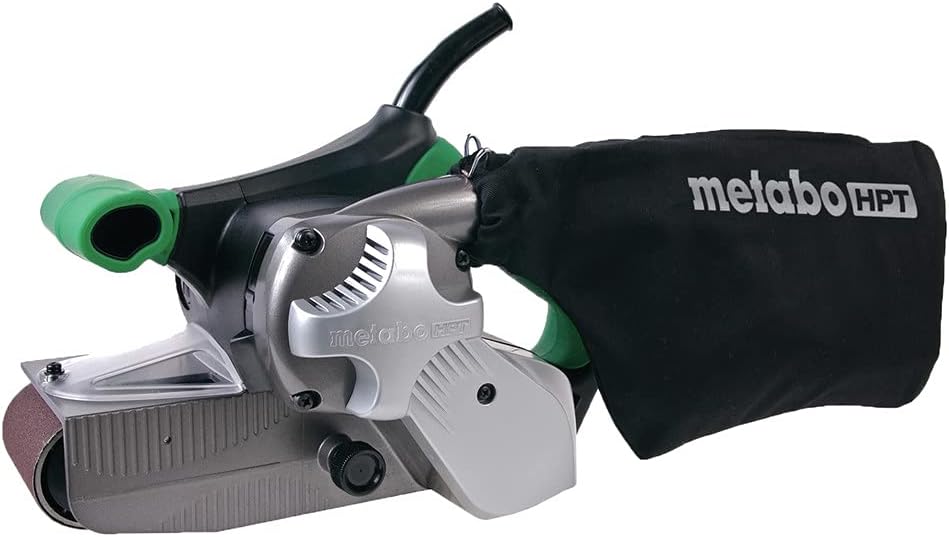
Metabo HPT SB8V2 3″ x 21″ Belt Sander
Best Belt Sander Overall
The SB8V2 pairs a 9 A, 1,020 W motor with a variable speed dial at the base of the handle, so you can slow the belt for softwoods and paint and run it fast for leveling. The clear front cover lets you see the belt’s edge when you sand up to a wall, and the dust bag sits on the left side so it stays out of the way in corners. Metabo HPT backs it with a 5-year limited warranty.
- ✅ 9 A with variable speed
- ✅ Clear front cover for sanding to a line
- ✅ 5-year warranty
- ❌ Heavier than the 3″ x 18″ class
Best For: Leveling, door fitting and stripping on a home-shop budget.
SKIL 7510-01 3″ x 18″ Belt Sander

Best Budget Belt Sander for Beginners
The SKIL 7510-01 is a 6 A, 3″ x 18″ belt sander with the one feature a first-time belt sander user needs: pressure control technology that warns you when you press too hard, the most common cause of gouges. The belt tracks itself, the micro-filtration dust box catches fine dust, it fits standard 1-1/4″ vacuum hoses, and it sands flush up to an edge.
- ✅ Pressure warning for beginners
- ✅ Auto-tracking belt, vacuum-ready
- ✅ Lowest price tier
- ❌ Less power than 3″ x 21″ machines
Best For: Occasional stripping and leveling, and learning to use a belt sander safely.
Makita 9903 3″ x 21″ Belt Sander

Best Premium Belt Sander
The Makita 9903 is built for control: an 8.8 A motor that Makita rates at 85 dB, a variable speed dial from 690 to 1,440 ft/min, and an auto-tracking belt that stays centered without adjustment. Its nose and side are designed to sand flush to a wall, and the front grip gives a comfortable two-handed hold on long passes.
- ✅ Wide variable speed range
- ✅ Auto-tracking belt
- ✅ Sands flush to walls
- ❌ Premium price tier
Best For: Frequent use, finish carpentry and anyone who wants the most control from a belt sander.
The Best Orbital Sanders to Buy
All three are 5″ random orbital sanders with variable speed, useful for following a belt sander with finer grits.
Bosch ROS20VSC 5″ Random Orbital Sander

Best Random Orbital for Beginners
The Bosch ROS20VSC has a 2.5 A motor with a speed dial from 7,500 to 12,000 OPM, a pad dampening system Bosch designs to minimize swirl marks, and a hook-and-loop pad with more than 35,000 hooks to hold discs firmly. The micro-filter dust canister, which Bosch rates for particles as small as 1/2 micron, twists off and shows when it’s full.
- ✅ Variable speed
- ✅ Pad dampening against swirls
- ❌ 2.5 A, the least power of the three
Best For: A first sander for furniture and general woodworking.
Makita BO5041K 5″ Random Orbit Sander

Best for Following a Belt Sander
The Makita BO5041K has a 3 A motor and the widest speed range here, 4,000 to 12,000 OPM, with a rubberized palm grip and a second handle for two-handed control. That combination suits the job right after a belt sander: full speed to erase belt scratches at 120 grit, low speed for delicate finishing. The K kit includes a case.
- ✅ 4,000-12,000 OPM
- ✅ Two-handed control
- ✅ Case included
- ❌ Bigger than a palm-grip random orbital
Best For: Tabletops, doors and panels after heavy sanding.
DEWALT DCW210D1 20V MAX Cordless 5″ Random Orbital Sander

Best Cordless Random Orbital
The DCW210D1 is a brushless 5″ random orbital with variable speed from 8,000 to 12,000 OPM and a low-profile body. Its 8-hole hook-and-loop pad is replaceable, the switch is dust-sealed, and this kit includes a 2.0 Ah battery, charger and storage bag. No cord makes it the easy choice for decks, railings and work away from an outlet. More options are in my cordless sander reviews.
- ✅ Cordless, brushless, variable speed
- ✅ Battery and charger included
- ✅ Replaceable pad
- ❌ A 2.0 Ah battery limits long sessions
Best For: Decks, railings and outdoor projects.
Other Comparisons
- Square pad or round pad? See palm sander vs orbital sander and sheet sander vs random orbital sander.
- New to random orbitals? My guide on how to use an orbital sander covers the technique.
🏆 The Verdict
Buy a random orbital sander first: it handles most projects and is hard to ruin work with. The Bosch ROS20VSC is my pick to start. Add a belt sander when you start leveling glue-ups, fitting doors or stripping big flat surfaces; the Metabo HPT SB8V2 gives you variable speed and a 5-year warranty. Used together, belt first and orbital second, they cover almost every sanding job in a home shop.
❓ Frequently Asked Questions
What are the 5 most common mistakes people make with a random orbital sander?+
What are the disadvantages of using a belt sander?+
Which sander is best for beginners?+
Can I sand my wood floor with a belt sander?+
Should I use a belt sander or an orbital sander on a deck?+
Should I use a belt sander or a planer?+
Still unsure which one your project needs? Describe it in the comments and I’ll help you choose.

