
As an Amazon Associate I earn from qualifying purchases. All claims are strictly my personal opinion.
Best router bit set to start with
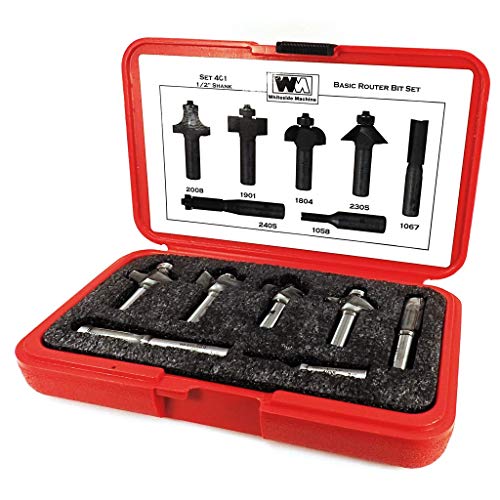
The seven most-used bits, carbide-tipped on 1/2″ shanks, in a hard case.
- Premium Freud 91-100
- Budget YONICO 17150

Router bits fall into four groups: edge-forming bits (roundover, chamfer, cove, ogee, beading) that shape an edge, usually guided by a bearing; grooving and joinery bits (straight, spiral, dovetail, rabbet, slot cutter, V-groove, core box) that cut into the wood; trimming bits (flush trim and pattern) that copy a template or edge; and specialty bits for doors, panels and keyholes. Most woodworkers use seven of them most of the time: two straight bits, a flush trim, a roundover, a cove, a rabbet and a chamfer.
This guide shows the cut each type of router bit makes, how to read a bit (shank, carbide, flutes and bearing), what to buy first, and five router bit sets worth considering. If you’re new to the tool, start with how to use a router; if you still need the router itself, see my best router for woodworking picks.
⚡ Quick Pick
Best router bit set: the Whiteside 401 – the seven most-used bits, carbide-tipped on 1/2″ shanks.
Premium: the Freud 91-100. Best value on 1/4″ shanks: the Bosch RBS015MBS.
Budget: the YONICO 17150. For a trim router: the Bosch RBS006TES.
Types of Router Bits: the Cut Each One Makes
The chart shows the end of a board after one pass with ten common bits. The red line is the profile the bit leaves.

Edge-Forming Bits
Edge-forming bits shape the edge of a board. Most have a ball-bearing pilot on the tip that rides along the edge, so you can rout without a fence or guide, and you control how much of the profile you cut with the depth setting.
- Roundover: rounds a square edge to a radius, from 1/8″ for a softened edge to 1/2″ or more for a bullnose. With the bit set slightly deeper, it leaves a small step called a fillet. The most-used bit in most shops.
- Chamfer: cuts a flat bevel, usually 45°. Also used to join the sides of boxes and columns at an angle.
- Cove: cuts a concave quarter circle, the opposite of a roundover. Common on table edges and molding.
- Ogee and Roman ogee: a concave-and-convex S-curve, the classic profile on furniture tops and frames.
- Beading: a roundover with a small step on both sides, leaving a rounded bead on the edge.
- Edge-forming combination bits: larger profiles that combine several of these for crown and base molding, best used in a router table.
Grooving and Joinery Bits
These bits cut into the face or end of a board. Most have no bearing, so you guide the router with an edge guide, a straightedge, a jig or the router table fence.
- Straight bits: flat-bottomed grooves, dadoes, rabbets, mortises and hollowing. Buy them in the widths you need: 1/4″ and 1/2″ first, then 3/4″. Undersized “plywood” bits match plywood that is thinner than its nominal size.
- Spiral bits: straight bits with helical flutes. Upcut spirals lift chips out of mortises; downcut spirals leave a clean top edge in veneer and plywood; compression spirals do both.
- Rabbeting bits: a cutter with a bearing that cuts an L-shaped step along an edge for cabinet backs, frames and box bottoms. Sets often come with several bearings for different rabbet widths.
- Dovetail bits: angled cutters for dovetail joints with a jig, and for sliding dovetail slots. The angle (commonly 7° to 14°) must match the jig.
- Slot cutters: a horizontal cutter with a bearing for slots along an edge, for splines, biscuits and T-molding.
- V-groove bits: V-shaped grooves for lettering, decorative lines and panel details.
- Core box bits: round-bottomed grooves for flutes, finger pulls and drainage grooves.
- Tongue-and-groove and rail-and-stile sets: matched pairs for edge joints and cabinet door frames, used in a router table.
Trimming and Pattern Bits
- Flush trim bits have the bearing on the tip and the same diameter as the cutter, so the bit trims one surface flush with another: laminate, edging, veneer, or a part routed to a template fixed underneath.
- Pattern (top-bearing) bits have the bearing at the shank, for templates fixed on top of the work. Many woodworkers own both so they can always rout downhill with the grain.
Template routing is covered step by step in how to use a router.
Specialty Bits
- Raised panel bits: large horizontal or vertical cutters for cabinet door panels. Router table only, at low speed.
- Keyhole bits: cut a keyhole slot for hanging frames and shelves on a screw.
- Mortising bits: straight bits made to plunge and cut at the tip, for mortises and hinge recesses.
- Surfacing (spoilboard) bits: wide, flat cutters for flattening slabs on a router sled.
How to Read a Router Bit
Shank: 1/4″ or 1/2″
The shank is the smooth part that goes into the collet. A 1/2″ shank has four times the cross-section of a 1/4″ shank, so it’s stiffer, vibrates less and is the safe choice for large profiles and long straight bits. Use 1/4″ shanks in trim and palm routers, which only take 1/4″, and for small profiles. A full-size router takes both, so buy 1/2″ bits for it whenever the profile is available.
Carbide-Tipped, Solid Carbide or High-Speed Steel
Almost all woodworking bits today are carbide-tipped: carbide cutting edges brazed to a steel body. Carbide stays sharp many times longer than high-speed steel (HSS) in hardwood, plywood and MDF, whose glue dulls steel fast. Solid carbide is used for small spiral bits. HSS bits are cheap and very sharp at first but dull quickly; they’re mostly found in budget sets.
Flutes, Bearings and Diameter
Most bits have two flutes (cutting edges). A bearing guides the bit along an edge or template and should spin freely; replace a gritty bearing, because a seized one burns the edge. Diameter matters for speed: the larger the bit, the slower it should run. Check the maximum RPM on the bit or the packaging, and slow the router down for bits over about 1-1/2″ across.
Which Router Bits to Buy First
Start with the bits you’ll use this month, not a box of 50. A good first kit: a 1/4″ and a 1/2″ straight bit, a flush trim bit, a 3/8″ roundover, a 45° chamfer, a rabbeting bit and a cove. That’s almost exactly the Whiteside 401 below. Add a dovetail bit when you buy a dovetail jig, a pattern bit for templates, and door and panel sets once you have a router table.
💡 Pro Tip: Clean Bits Cut Longer
Burn marks and a rough cut are often pitch, not a dull edge. Soak the bit in a resin cleaner and scrub it with a brass brush, keeping the bearing out of the cleaner or removing it first. Store bits in a case or a drilled block so the carbide edges never touch each other.
Best Router Bit Sets
Five sets for different routers and budgets. All could be ordered on Amazon when I checked them, and the contents come from the makers’ listings. I don’t print prices; each review gives a market tier.
Whiteside 401 Basic 7-Piece Router Bit Set (1/2″ Shank)
Best Router Bit Set Overall
Whiteside sells the 401 as a set of “only the most popular woodworking bits”, and the list proves it: a 1/4″ straight (1058), a 1/2″ straight (1067), a 1/2″ flush trim (2405), a 3/8″ radius roundover (2008), a 3/8″ radius cove (1804), a 3/8″ x 1/2″ rabbet (1901) and a 45° chamfer (2305). All seven are carbide-tipped on 1/2″ shanks, in a hard plastic case, for hand-held routers and router tables. Seven good bits cover more real work than a 50-piece box of profiles you’ll never use. It sits in the upper mid-range tier; Whiteside’s 402 is the basic set for 1/4″ collets.
- ✅ The seven bits most projects use
- ✅ Carbide-tipped, 1/2″ shanks
- ✅ Each bit sold singly to replace later
- ❌ Only seven bits for the money
- ❌ Needs a router with a 1/2″ collet
Best For: A first set of quality bits for a mid-size router.
Freud 91-100 13-Piece Super Bit Set (1/2″ Shank)

Best Premium Router Bit Set
Freud’s Super Bit Set adds joinery and decorative bits to the basics. The 13 bits, all on 1/2″ shanks, are three double-flute straight bits (1/4″, 1/2″ and 3/4″), a 1/2″ mortising bit, a 1/4″ round nose, a V-groove, a 1/2″ 14° dovetail, a cove, a rabbeting bit, a roundover, a Roman ogee, a chamfer and a 1/2″ flush trim bit. Freud says they cut hardwood, softwood, plywood and composites in hand-held and table-mounted routers, and the set comes in a shadow-box case that hangs on the wall. It’s a premium-tier set.
- ✅ 13 bits including dovetail and mortising
- ✅ Three straight bits for common dado widths
- ✅ Wall-hanging shadow-box case
- ❌ Premium price tier
- ❌ 1/2″ shanks only
Best For: Furniture makers who want joinery bits from one maker in one case.
Bosch RBS015MBS 15-Piece Carbide-Tipped Router Bit Set (1/4″ Shank)

Best Value Set (1/4″ Shank)
Bosch’s 15-piece set suits routers with only a 1/4″ collet and buyers who want a wide spread of profiles from a known brand. On 1/4″ shanks, it has three double-flute straight bits (1/4″, 1/2″ and 5/8″), two roundovers (1/8″ and 1/4″), two chamfers (45° and 25°), a cove, a Roman ogee, a rabbeting bit, a 12° dovetail, a 60° V-groove, a slotting cutter, a top-bearing straight trim bit and a flush laminate trim bit. The tips are micrograin carbide with an anti-friction coating, in a plastic case. It sits in the mid-range tier.
- ✅ 15 profiles, including slotting and pattern bits
- ✅ Fits trim routers and full-size routers
- ✅ Anti-friction coating
- ❌ 1/4″ shanks chatter on big cuts
- ❌ Larger profiles are better on 1/2″ shanks
Best For: Owners of trim and palm routers, and buyers who want variety from a known brand.
YONICO 17150 15-Bit Router Bit Set (1/2″ Shank)

Best Budget Router Bit Set
For trying profiles before you buy premium versions of the ones you use, Yonico’s 17150 set is the low-cost option on 1/2″ shanks. It includes four straight bits (1/4″, 3/8″, 1/2″ and 3/4″), a flush trim, a 1/2″ 10° dovetail, a 90° V-groove, a 1/4″ radius core box, a 45° chamfer, two coves (1/4″ and 1/2″ radius), a Roman ogee, two roundovers (1/4″ and 1/2″ radius) and a rabbet/slotting bit. Yonico lists C3 micro-grain carbide, a Teflon coating and silver-brazed tips, in a storage case. It’s in the budget tier.
- ✅ 15 bits on 1/2″ shanks for little money
- ✅ Four straight bit widths
- ✅ Coated, in a case
- ❌ Less proven edge life than Whiteside or Freud
- ❌ Expect to replace favorites with premium bits
Best For: Beginners who want to find out which profiles they actually use.
Bosch RBS006TES 6-Piece Trim and Edging Router Bit Set (1/4″ Shank)

Best Set for a Trim Router
A trim router mostly does edges, so a small edging set is all it needs. Bosch’s RBS006TES has two roundovers (1/8″ and 1/4″ radius), two chamfers (45° and 25°), a 1/2″ top-bearing straight trim bit for pattern work and a 5/8″ double-flute flush laminate trim bit, all on 1/4″ shanks with micrograin carbide tips, an anti-friction coating and a plastic case. It’s in the budget tier.
- ✅ Exactly the bits a trim router uses
- ✅ Pattern and flush trim bits included
- ✅ Budget tier
- ❌ No grooving or joinery bits
Best For: A first set for a compact or palm router.
Are Expensive Router Bits Worth It?
For the bits you use every week, yes. Premium bits from makers like Whiteside and Freud use thicker carbide, which you can have resharpened more times, sharper grinds and better bearings, so they cut cleaner and last longer in hardwood and plywood. Cheap sets are fine for learning which profiles you like and for occasional jobs. A sensible plan is a budget set to start, then buy a premium version of each bit as the cheap one dulls.
❓ Frequently Asked Questions
What are the different bits for a router?+
Will any router bit work on any router?+
Are cheap router bits worth it?+
Are Whiteside router bits high quality?+
How often should router bits be replaced?+
What is the best material for router bits?+
Conclusion
You don’t need every type of router bit. Start with straight bits, a flush trim bit and three or four edge profiles on 1/2″ shanks, learn them well, and add joinery and table bits as your projects call for them. Run large bits slower, keep them clean, and feed against the rotation. Questions about a profile? Ask in the comments.

