


As an Amazon Associate I earn from qualifying purchases. All claims are strictly my personal opinion.
Editor’s Choice
Short on time? Of all the sanding blocks and sponges I tested for hand sanding, this is the one I'd buy.
- Also recommended 3M SandBlaster Dual Angle sponge
- Budget pick Milescraft Sand-It

A sanding block does one simple job: it keeps the sandpaper flat, so your fingers don’t press grooves into the wood. A sanding sponge does the opposite: it bends, so the abrasive follows curves, corners and moldings. Most people need one of each. For hand sanding flat wood, the best sanding block is the Preppin’ Weapon, which holds plain quarter sheets without glue or hook-and-loop. For profiles, edges and corners, the best sanding sponge is 3M’s SandBlaster Dual Angle, whose angled sides get into the details.

Below are my six picks, a comparison table, short reviews, and a guide to choosing between a block and a sponge, and between plain paper, hook-and-loop and a dust-extracting block.
⚡ Quick Pick
Flat surfaces with plain sandpaper: Preppin’ Weapon Sanding Block.
Moldings, edges and corners: 3M SandBlaster Dual Angle sponge.
Curves, flats and corners with one tool, on a budget: Milescraft Sand-It.
Best Sanding Blocks and Sponges: Comparison
Tiers compare today’s prices without printing them: $ is the lowest tier on the page and $$ the next one up. The Amazon buttons show the live price.
| Pick | Type | Abrasive | Size | Best for | Tier |
|---|---|---|---|---|---|
| Preppin’ Weapon | Rigid block, clip-on | Plain 1/4 sheet or 2-3/4″ file paper | 1/4 sheet | Flat wood and panels | $ |
| 3M SandBlaster Dual Angle | Foam sponge, angled sides | Mineral grit, 150 | Hand size | Moldings, edges, corners | $ |
| 3M Pro Grade 3-in-1 | Foam sponge, 3 profiles | 180 grit | 2 sponges | Mixed shapes | $ |
| 3M Sponge 12-Pack | Foam block | Medium grit | 12 blocks, 3-3/4″ x 2-5/8″ | Bulk jobs, drywall, paint | $ |
| Mirka Hand Block | Rigid block, hook-and-loop | Mirka net strips | 2.75″ x 8″ | Dust-free hand sanding | $$ |
| Milescraft Sand-It | Rigid block, 4 profiles | Any 1/4 sheet (150 grit included) | 1/4 sheet | Curves and tight spots | $ |
Type
- Preppin’ Weapon
- Rigid block, clip-on
- 3M SandBlaster Dual Angle
- Foam sponge, angled sides
- 3M Pro Grade 3-in-1
- Foam sponge, 3 profiles
- 3M Sponge 12-Pack
- Foam block
- Mirka Hand Block
- Rigid block, hook-and-loop
- Milescraft Sand-It
- Rigid block, 4 profiles
Abrasive
- Preppin’ Weapon
- Plain 1/4 sheet or 2-3/4″ file paper
- 3M SandBlaster Dual Angle
- Mineral grit, 150
- 3M Pro Grade 3-in-1
- 180 grit
- 3M Sponge 12-Pack
- Medium grit
- Mirka Hand Block
- Mirka net strips
- Milescraft Sand-It
- Any 1/4 sheet (150 grit included)
Size
- Preppin’ Weapon
- 1/4 sheet
- 3M SandBlaster Dual Angle
- Hand size
- 3M Pro Grade 3-in-1
- 2 sponges
- 3M Sponge 12-Pack
- 12 blocks, 3-3/4″ x 2-5/8″
- Mirka Hand Block
- 2.75″ x 8″
- Milescraft Sand-It
- 1/4 sheet
Best for
- Preppin’ Weapon
- Flat wood and panels
- 3M SandBlaster Dual Angle
- Moldings, edges, corners
- 3M Pro Grade 3-in-1
- Mixed shapes
- 3M Sponge 12-Pack
- Bulk jobs, drywall, paint
- Mirka Hand Block
- Dust-free hand sanding
- Milescraft Sand-It
- Curves and tight spots
Tier
- Preppin’ Weapon
- $
- 3M SandBlaster Dual Angle
- $
- 3M Pro Grade 3-in-1
- $
- 3M Sponge 12-Pack
- $
- Mirka Hand Block
- $$
- Milescraft Sand-It
- $
Best Sanding Blocks and Sponges: Reviews
The specs below are the makers’ own, from each product’s listing. Every pick was in stock on Amazon when I checked it.
Preppin’ Weapon Sanding Block

Best Sanding Block Overall
The Preppin’ Weapon solves the two things that make cheap blocks annoying: paper that slips and paper you throw away half used. It’s sized for a standard quarter sheet of plain-backed 9″ x 11″ sandpaper, or 2-3/4″ file paper, and spring-loaded end clips hold it with minimal overlap. The maker says that cuts sandpaper waste by 36% compared with a standard rubber block, and since it takes plain paper you’re not paying extra for adhesive or hook-and-loop sheets.
You can stack up to four sheets and tear the top one off when it wears out, which keeps you sanding instead of reloading. The clips and springs are stainless steel, the body is high-impact ABS, and the contoured shape is made for long sessions. It comes in four colors, so you can keep one per grit.
- ✅ Takes cheap plain sandpaper, no adhesive or hook-and-loop
- ✅ Holds up to four sheets at once
- ✅ Stainless steel clips, won’t rust
- ✅ Comfortable for long sessions
- ❌ Rigid: not for curves
- ❌ Pricier than a basic rubber block
Best For: Tabletops, doors, panels and any flat wood you sand by hand between machine passes.
3M SandBlaster Dual Angle Sanding Sponge
Best Sanding Sponge for Wood
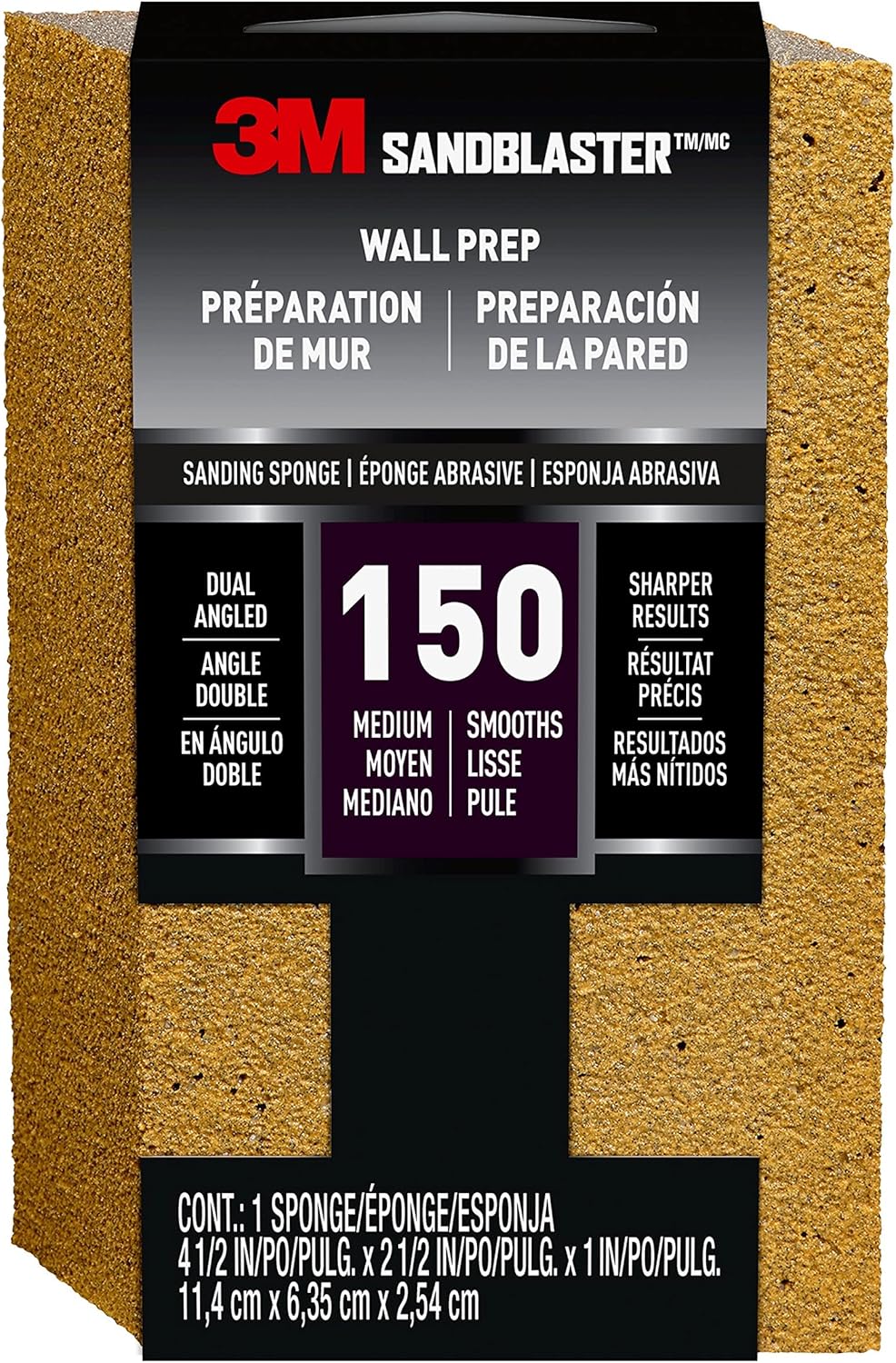
3M’s SandBlaster Dual Angle is a sponge made for bare wood, with angled sides that reach into the corners of raised panels, the flats of a molding and the inside edges of a frame. 3M uses a professional-grade foam that keeps its shape, so the edges stay crisp longer than on a soft generic sponge, and it works wet or dry.
This one is 150 grit, the right grit for smoothing bare wood after a coarser pass and before a finish; the same sponge is sold in other grits. 3M also says it won’t discolor the surface you’re sanding, which matters on light woods like maple.
- ✅ Angled sides for detail and corners
- ✅ Firm foam keeps its shape
- ✅ Wet or dry
- ✅ Won’t discolor light woods (3M)
- ❌ Single grit per sponge
- ❌ Too soft to keep a wide surface flat
Best For: Cabinet doors, trim, chair parts and the details a sander can’t reach.
3M Pro Grade Precision 3-in-1 Sanding Sponge

Best Sponge for Curves, Corners and Flats
The Pro Grade Precision 3-in-1 sponge puts three shapes on one piece of foam: a contoured side for curves, an angled edge for corners and a flat side for larger areas. That makes it the sponge to grab when one piece has all three, like a turned leg that meets a flat apron.
This pack is two sponges in 180 grit, a medium grit for smoothing and removing light imperfections on wood, metal, drywall and painted surfaces. You can rinse it clean and reuse it, and 3M says it keeps its grit and shape over several projects.
- ✅ Contoured, angled and flat sides
- ✅ Two sponges per pack
- ✅ Washable and reusable
- ✅ Works on wood, paint and drywall
- ❌ 180 grit only in this pack
- ❌ Not firm enough for leveling
Best For: Furniture with curves and corners, spindles, and prep between coats of paint.
3M Sanding Sponge Block, 12-Pack, Medium

Best Value Sanding Sponges
If you go through sponges quickly, on a room of trim, a set of kitchen cabinets or drywall patches, buy them by the dozen. This 3M 12-pack of medium-grit sponge blocks is for general-purpose sanding on most surfaces. Each block is 3-3/4″ x 2-5/8″ x 1″, conforms to the surface, resists clogging, and can be used wet or dry, then rinsed and reused.
- ✅ Twelve blocks per pack
- ✅ Resists clogging
- ✅ Wet or dry, rinse and reuse
- ✅ Conforms to uneven surfaces
- ❌ Medium grit only in this pack
- ❌ Plain blocks, no angled edges
Best For: Painting prep, drywall repairs and big trim jobs where you’ll wear through several sponges.
Mirka Hand Sanding Block, Vacuum-Ready, 2.75″ x 8″

Best Dust-Free Sanding Block
Hand sanding makes as much fine dust as a sander, and it goes straight into the air you breathe. Mirka’s vacuum-ready hand block connects to a dust extractor through a hose, and it’s designed to work with Mirka’s net sanding strips, whose open mesh lets the dust pass through the abrasive and out of the block. It takes 2.75″ x 8″ hook-and-loop sheets and has a low, ergonomic profile.
It’s the pick if you already have a shop vac or extractor for your sander, and it’s common in auto body shops for the same reason. The hose isn’t included. See my guides to the best shop vac for dust collection and the best dust extractor if you need one.
- ✅ Connects to a vacuum for clean sanding
- ✅ Long 8″ pad for leveling
- ✅ Quick hook-and-loop sheet changes
- ✅ Light, low-profile body
- ❌ Needs hook-and-loop strips, not plain paper
- ❌ Hose sold separately
- ❌ Higher tier than the other blocks
Best For: Long hand-sanding sessions indoors, fillers and body work, and anyone sanding in a finished room.
Milescraft 1622 Sand-It Multi-Surface Sanding Block

Best Budget Block for Curves and Tight Spots
The Sand-It is a rigid block with four profiles: flat, convex, concave and a tight edge. That covers the inside of a cove, the outside of a round-over and the flat face in one tool, which a plain rubber block can’t do. A quick-snap lock holds any quarter sheet of sandpaper, so changing from coarse to fine takes seconds, and 150 grit paper comes in the box.
- ✅ Flat, convex, concave and edge profiles
- ✅ Uses any quarter sheet
- ✅ Quick-snap paper lock
- ✅ Lowest tier on the page
- ❌ Small: slow on big flat panels
- ❌ Plastic body, not as comfortable as the Preppin’ Weapon
Best For: Molding profiles, round-overs, chair rungs and repairs in tight spots.
How I Chose These Sanding Blocks and Sponges
I looked at blocks and sponges on sale on Amazon today from makers that state clearly what their product does, and picked one for each way people hand sand: flat surfaces with plain paper, detail and corners, mixed shapes, bulk jobs, dust-free sanding and tight profiles. I compared the shape, how the abrasive attaches, the grit and whether it can be washed. I don’t show customer ratings or prices: prices change daily, so each pick carries a tier and the Amazon button shows the live price.
How to Choose a Sanding Block or Sponge

Block or Sponge?
Use a rigid block when the surface must stay flat: tabletops, panels, edges you want crisp, and filler you’re leveling with the wood around it. A block bridges the low spots and cuts the high ones, which is exactly what flattening means. Use a sponge when the surface isn’t flat: moldings, turnings, curved chair parts, and between coats of finish, where you want to scuff evenly without cutting through on the edges.
Plain Paper, Hook-and-Loop or Built-In Abrasive
- Plain paper blocks (Preppin’ Weapon, Milescraft, the classic 3M rubber sanding block) take the cheapest abrasive there is: sheets torn from a 9″ x 11″ pack. See my picks for the best sandpaper for wood.
- Hook-and-loop blocks change grits in a second and pair with mesh abrasives for dust extraction, but the sheets cost more.
- Sponges have the abrasive bonded to the foam. There’s nothing to load, but when the grit is worn, the sponge is done.
Grit
Blocks follow the same grit sequence as a sander: 80 to 100 to level, 120 to 150 to smooth, 180 to 220 before a finish, and 320 or finer between coats. Sponges are usually graded by name (coarse, medium, fine, superfine) as well as by number, so check the number before you buy. My sandpaper grit chart has the right sequence job by job, and there’s a separate guide on sanding between coats of polyurethane.
Wet or Dry
Most foam sponges can be used wet, which keeps dust down on drywall and paint and stops the abrasive from clogging. On bare wood, sand dry: water raises the grain and swells the fibers.
Your Hands
If you sand for hours, the shape matters. A tall, contoured block like the Preppin’ Weapon lets you push with the palm instead of pinching with the fingers, which is what causes cramps.
💡 Pro Tip
Draw light pencil lines across the surface before you sand with a block. When the lines are gone everywhere, the surface is flat and you’re ready for the next grit. If they stay in one spot, that’s a low area: keep the block flat and keep going, don’t press harder there.
Sanding Blocks and Sponges by Job
- Wood furniture: a rigid block on the flat tops and sides, a sponge on legs and moldings. My guide on how to sand furniture to paint walks through the whole routine.
- Cabinets: the Dual Angle sponge for the inside corners of shaker doors, a block on the stiles and rails. For the bigger surfaces, see the best sanders for cabinets.
- Walls and drywall: sponges, used slightly damp, keep the dust down on patches. My drywall grit guide covers the grit for each coat.
- Corners a sander can’t reach: a sponge or the Sand-It’s tight edge, or a detail sander if there are many of them.
- Auto body: long, rigid blocks keep panels straight. For machine work on cars, see the best sander for auto body.
🏆 The Verdict
For flat wood, get the Preppin’ Weapon and load it with plain quarter sheets. For moldings, edges and corners, keep a 3M SandBlaster Dual Angle sponge in the grit you use most. Add the 3M 12-pack for big painting and drywall jobs, the Mirka block if you sand indoors with a vacuum, and the Milescraft Sand-It for profiles.
❓ Frequently Asked Questions
What is a good quality sanding block?+
Are sanding blocks better than sandpaper?+
Which brand of sander is considered the best?+
What is the golden rule of sanding?+
Is a sanding sponge better than sandpaper?+
What is the best sanding block for wood?+
Conclusion
A block for the flats and a sponge for everything else will cover almost any hand-sanding job. Buy the block once and choose it for comfort and how it holds the paper; buy sponges in the grits you actually use. Most of the work is still done with a sander: start with how to sand wood or my picks for the best random orbital sanders, and use the block for what the machine can’t reach. Questions? Ask in the comments.
