
As an Amazon Associate I earn from qualifying purchases. All claims are strictly my personal opinion.
Editor’s Choice
Short on time? Of the 6 dust collectors on this list for a small shop, this is the one I'd buy.

A 1.5 HP single-stage collector that runs on a standard 115V outlet, with a 2-micron canister filter and a Vortex Cone that keeps chips off it.
- Also recommended JET JCDC-1.5
- Also recommended POWERTEC DC5371

In a small shop, the best dust collector is the one that fits three limits at once: your floor space, your outlet, and the one machine you run at a time. For most garage and basement shops, the best dust collector for a small shop is the JET DC-1100VX-CK: 1.5 HP on a standard 115V outlet, a 2-micron canister filter, a Vortex Cone that keeps chips off that filter, four casters and a 5-year warranty.
Below are six collectors chosen for small shops, from a 17 lb wall-mountable WEN to a 115V cyclone, plus a comparison table, short reviews, and a guide to the numbers that matter when space and power are tight: real airflow, circuit size, footprint, filtration and noise. If your shop has room and a 240V circuit for a 3 HP cyclone, my main dust collector reviews cover the bigger machines.
Best Dust Collectors for a Small Shop: Comparison
| Product | ⭐ JET DC-1100VX-CK 🏆 EDITOR’S CHOICE |
JET JCDC-1.5 | Laguna C|Flux:1 | POWERTEC DC5371 | RIKON 60-100 | WEN DC3401 |
|---|---|---|---|---|---|---|
| Image | |
 |
 |
 |
 |
 |
| Motor | 1.5 HP, 115/230V | 1.5 HP, 115V | 1.5 HP, 110/220V | 1 HP, 120/240V | 1 HP, 115V | 5.7 A |
| Airflow (maker) | 1,100 CFM | 763 CFM with filter | 900 CFM shop setting | 560 CFM | 624 CFM | 660 CFM |
| Filter | 2 micron canister | MERV 13 canister | 1 micron canister | 1 micron bag | 5 micron bag | 5 micron bag |
| Type | Single-stage, mobile | Cyclone, mobile | Cyclone, mobile | Wall-mount | Single-stage, mobile | Mobile or wall |
| Best for | Best overall | 115V cyclone | Premium cyclone | Wall-mount | 5-year warranty | Budget pick |
| Tier | $$$ | $$$ | $$$$ | $$ | $$ | $ |
| Availability | Shop Now at Amazon | Shop Now at Amazon | Shop Now at Amazon | Shop Now at Amazon | Shop Now at Amazon | Shop Now at Amazon |
Do You Need a Dust Collector in a Small Shop?
Before choosing a model, check that a dust collector is the right machine at all. Small-shop dust problems come in three kinds, and each has its own tool.
Handheld Tools Only: Get an Extractor
If your dust comes from sanders, routers and track saws, a dust collector is the wrong tool. Those tools have small ports, 1-1/4″ to 1-1/2″, and need high suction through a narrow hose, which is what a HEPA dust extractor does and a collector can’t. See my guide to the best dust extractor for those.
One Benchtop Machine Now and Then: A Shop Vac and a Separator
A benchtop planer or a contractor saw used a few hours a month can live with a shop vac fronted by a cyclone separator. The separator drops chips into a bucket before they reach the vac’s filter. Read my guides to the best dust separator and the best shop vac for dust collection; just know that a planer can fill a 5-gallon bucket fast.
Stationary Machines with 4″ Ports: You Need a Collector
Table saws, jointers, planers, bandsaws and drum sanders throw chips by the bucket through a 4″ port. They need volume, not suction, and that is a dust collector’s job. Every collector on this page is sized to run one such machine at a time, which is how most small shops work: one hose, moved from machine to machine, or a short run of duct with blast gates. For hoods, guards and fittings machine by machine, see my guide to dust collection for woodworking tools.
Best Dust Collectors for a Small Shop: Reviews
Editor's ChoiceSingle-stage collector
JET DC-1100VX-CK
JET DC-1100VX-CK Vortex Cone Dust Collector
1.5 HP on a standard 115V outlet, a 2-micron canister and a Vortex Cone that keeps chips off the filter.
Shop Now at AmazonSpecs: JET
Best for
One-car garage and basement shops running a table saw, jointer or planer one at a time.
- Runs on 115V, rewires to 230V
- 2-micron canister with Vortex Cone
- 5-year warranty
Skip it if
Your shop has no floor space left: the POWERTEC hangs on the wall.
- Single-stage: fine dust still reaches the filter
- 1,100 CFM is a maximum, not airflow at a hose end
Read full review
Best Dust Collector for a Small Shop Overall
The JET DC-1100VX-CK is a single-stage collector with two features that matter in a small shop. Its 1.5 HP motor runs on 115V or 230V, so you can start on a standard outlet and rewire later. And the Vortex Cone inside the drum separates chips from fine dust, so the chips settle into the bag instead of packing against the 2-micron canister filter, which keeps airflow up between cleanings. JET rates it at 1,100 CFM, the motor is totally enclosed and fan-cooled for continuous duty, and it rolls on four casters, so you can park it against a wall and wheel it to the machine you are using. JET’s warranty is 5 years.
Best 115V cyclone115V cyclone
JET JCDC-1.5
JET JCDC-1.5 Cyclone Dust Collector
A two-stage cyclone on 115V, rated 763 CFM with its filter installed, with a 20-gallon drum and a remote.
Shop Now at AmazonSpecs: JET
Best for
Small shops that sand and plane a lot and want a cyclone without a 240V line.
- Cyclone separation on a 115V circuit
- Airflow published with filter installed
- Remote control and 5-year warranty
Skip it if
Your outlet shares a 15 A circuit: JET asks for a dedicated 20 A one.
- Needs a dedicated 20 A circuit
- Bigger and heavier than a bag collector
Read full review
Best 115V Cyclone
The JET JCDC-1.5 is a true two-stage cyclone that runs on 115V. Heavy chips spin out into a 20-gallon steel drum before the air reaches the filter, so suction stays steadier as the drum fills than on a bag collector. JET quotes 763 CFM with the filter installed, a more honest figure than the open-inlet ratings most makers print.The canister filter is MERV 13, mounts straight to the housing and has paddles for cleaning; an RF remote works from up to 50 feet. It takes a single 6″ port or two 4″ ports, sits on a 47″ x 22″ footprint, weighs 143 lb and carries JET’s 5-year warranty for home-shop use. JET specifies a dedicated 115V, 20 A circuit for its 14 A motor.
Premium cyclonePremium cyclone
Laguna C|Flux:1
Laguna C|Flux:1 1.5 HP Cyclone Dust Collector
The strongest here: 900 CFM at its shop setting, a 1-micron canister and a 25-gallon drum, on the right circuit.
Shop Now at AmazonSpecs: Laguna
Best for
Serious small shops with the right circuit that want big-shop filtration in a mobile cyclone.
- Highest airflow and static pressure here
- 1-micron canister, 48.4 sq ft of filter
- 25-gallon drum with fill indicator
Skip it if
Your garage only has standard 15 or 20 A outlets.
- Needs a 25 A circuit at 110V, or 220V
- Highest price tier on this page
Read full review
Premium Small-Shop Cyclone
The Laguna C|Flux:1 is the strongest machine on this page. Laguna rates its 1.5 HP dual-voltage motor at 900 CFM at its shop setting (1,314 CFM maximum) with 10.1 inches of static pressure, and its 1-micron canister has 48.4 square feet of filter area, cleaned with a dual-paddle handle. Chips drop into a 25-gallon drum with a fill-level indicator. Read the power requirements before you buy: Laguna’s manual lists 18.8 A at 110V and a 25 A minimum circuit, which most garage outlets are not. At 220V the draw halves to 9.4 A on a 15 A circuit. It weighs 232 lb and Laguna lists 82 dB at 9.8 feet.
Best wall-mountWall-mount collector
POWERTEC DC5371
POWERTEC DC5371 Wall Mount Dust Collector
A 1 HP wall-mount unit with a 1-micron bag that frees up floor space in a small shop.
Shop Now at AmazonSpecs: POWERTEC
Best for
Shops where the car still has to fit, with one machine near the wall.
- Takes no floor space
- 1-micron bag with window and zipper
- Runs on 120V or 240V
Skip it if
You run a planer or long hose runs, where more airflow helps.
- 560 CFM, one machine at a time
- Inlet grate needs regular checks
Read full review
Best Wall-Mount Collector
The POWERTEC DC5371 gets the collector off the floor entirely. It hangs on a bracket, weighs 35.5 lb, and moves 560 CFM with a 1 HP induction motor that runs on 120V at 12 A or 240V at 6 A. The 1-micron bag has a window to check the dust level and a zipper to empty it, and a single 4″ inlet takes a hose straight from the machine. A grate behind the inlet protects the impeller from large offcuts; POWERTEC advises checking it regularly, because debris that collects there cuts airflow.
Best 1 HP1 HP collector
RIKON 60-100
RIKON 60-100 1 HP Dust Collector
A compact 1 HP collector with static pressure and noise published and a 5-year warranty.
Shop Now at AmazonSpecs: RIKON
Best for
A first collector for a bandsaw, jointer or router table in a tight space.
- 5-year warranty
- Static pressure and noise published
- Small 32-1/4" x 15" footprint
Skip it if
Fine sanding dust is your main concern: the bag filters to 5 microns.
- 5-micron bag: add a finer bag for sanding dust
Read full review
Best 1 HP Collector
The RIKON 60-100 is a compact 1 HP collector with the published numbers to back it up: 624 CFM at its 4″ inlet, 3.25 inches of static pressure, a 9″ steel blower wheel and a 7 A, 115V TEFC motor that keeps dust out of the windings. Its footprint is 32-1/4″ x 15″, it stands 60″ tall and weighs 60 lb, and RIKON rates it under 78 dB at 3 feet. The bag filters to 5 microns and holds 2.1 cubic feet. A locking toggle switch prevents accidental starts, and RIKON’s 5-year warranty is unusual at this price tier.
Budget pickRolling or wall-mount
WEN DC3401
WEN DC3401 Rolling Dust Collector
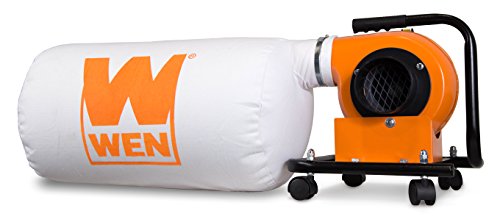
The lightest and least expensive here: 660 CFM in a 17 lb unit that rolls or hangs on the wall.
Shop Now at AmazonSpecs: WEN
Best for
Hobbyists with a benchtop planer or miter saw who want more than a shop vac on a small budget.
- 17 lb, rolls or hangs on the wall
- Lowest price tier here
Skip it if
You run a full-size table saw or jointer every week.
- Brushed motor with brushes to replace
- 5-micron bag and small 6" impeller
Read full review
Budget Pick
The WEN DC3401 is the lightest and least expensive collector here. A 5.7 A brushed motor and 6″ impeller move up to 660 CFM through a 4″ port, into a 12-gallon, 5-micron zippered bag. It measures 34.25″ x 13″ x 14.2″ and weighs 17 lb, with a carry handle, four locking casters and a built-in wall mount, so it can live on a shelf bracket and come down when needed. Carbon brush caps are easy to reach for maintenance, and WEN covers it for 2 years.
How I Chose These Small-Shop Dust Collectors
I looked only at collectors that a small shop can actually power and park, from makers that publish specifications, and that are on sale on Amazon today. The criteria, in order:
- Runs on 115V or 120V, because most garages and basements don’t have a 240V circuit. The Laguna is the one exception I kept: it runs on 110V, but only on a 25 A circuit.
- Fits a small floor: mobile on casters or wall-mounted, with a footprint you can park against a wall.
- Published airflow, taken from the maker’s spec sheet or manual. Where makers measure differently, I say so: JET quotes the JCDC-1.5 with its filter installed, Laguna gives both a shop setting and a maximum.
- Filtration and warranty as tie-breakers.
The larger 2 HP to 7.5 HP collectors and the 220V-only budget models are in my main dust collector reviews and the cheap dust collectors guide. I don’t show star ratings or prices: prices change daily, so each pick carries a price tier and the Amazon button shows the live price.
How to Choose a Dust Collector for a Small Shop
Real Airflow, Not the Box Number
The CFM on the box is usually measured at an open inlet with no hose and no filter. Every foot of hose, every bend and a dirty filter lower it. That is why the JCDC-1.5’s 763 CFM “with filter installed” and the Laguna’s 900 CFM “shop setting” are more useful than a bare maximum. In a small shop the hose run is short, which works in your favor: keep the collector close to the machine it serves.
Your Circuit
Check the amp draw against your breaker before you buy. The WEN draws 5.7 A and the RIKON 7 A, comfortable on a shared 15 A circuit. The POWERTEC draws 12 A at 120V. JET asks for a dedicated 20 A circuit for the JCDC-1.5, and the Laguna needs 25 A at 110V. A collector that trips the breaker every time the table saw starts is a collector you stop using.
Footprint and Height
Measure the floor and the ceiling. Bag collectors are narrow but tall once the bags are fitted; the RIKON stands 60″. Cyclones take a bigger footprint, 47″ x 22″ for the JCDC-1.5, and a basement with low joists may not clear one. Wall-mount units like the POWERTEC and WEN take no floor space at all.
Filtration: 1, 2 or 5 Microns
The micron rating is the size of particle the filter is rated to stop, and the finest dust is what stays in the air you breathe. A 5-micron bag catches chips and coarse dust; a 1- or 2-micron bag or canister catches much more of the fine dust that sanding makes. If you buy a 5-micron collector, plan on a finer replacement bag, and pair any collector with an air filtration unit for what escapes.
Single-Stage or Cyclone
A single-stage collector sends everything through the impeller into the bag, so the filter clogs faster and suction drops as it fills. A cyclone spins chips out into a drum first, so the filter sees mostly fine dust and suction holds up longer. Cyclones cost more and take more room; in a small shop a single-stage with a cone or separator, like the JET DC-1100VX-CK, is the usual compromise.
Noise
In an attached garage or a basement, noise reaches the house. Compare published figures, but check the distance each maker measured at: RIKON rates the 60-100 under 78 dB at 3 feet, while Laguna rates the C|Flux:1 at 82 dB at 9.8 feet. The WEN is the only one of the six that lists a brushed motor.
💡 Pro Tip
In a small shop, skip the ductwork at first. Park the collector in a corner on its casters, use one 10-foot hose with quick-change fittings, and move it from machine to machine. Short hose runs keep more of the rated airflow, and you can add a wall-mounted run with blast gates later if the layout settles.
🏆 The Verdict
For most small shops the JET DC-1100VX-CK is the dust collector to buy: 1.5 HP on a 115V outlet, a 2-micron canister and a 5-year warranty on casters. If you sand and plane a lot and want a cyclone without a 240V line, the JET JCDC-1.5 runs on 115V. If floor space is gone, the POWERTEC DC5371 hangs on the wall.
❓ Frequently Asked Questions
What is the best dust collector for a small shop?+
How do I know what size dust collector I need?+
Is a shop vac good enough for dust collection?+
What’s the difference between a shop vac and a dust collector?+
Can you turn a shop vac into a dust collector?+
What is the best DIY dust collection system for a small shop?+
Conclusion
A small shop doesn’t need a big collector; it needs the right-sized one on the right circuit. Run one machine at a time, keep the hose short, and choose filtration fine enough for the dust you make. The JET DC-1100VX-CK is the best fit for most garages and basements, the JET JCDC-1.5 brings cyclone separation to 115V, and the POWERTEC DC5371 saves the floor.
Mostly sanding with handheld tools? A HEPA dust extractor is the better buy. Protecting your lungs while you work? See my guide to the best respirator for woodworking. Questions about your shop? Ask in the comments.
