
As an Amazon Associate I earn from qualifying purchases. All claims are strictly my personal opinion.

To sand a car for paint: wash and degrease it, mask it, then either scuff the old paint or strip it, shape any filler with 80 grit, feather the edges with 180, finish bare areas with 320 before primer, block sand the primer with 400 to 600 using a guide coat, and go over everything with 600 before the base coat. Wet sanding at 1500 to 3000 grit is a separate job done on cured clear coat after the car is painted, not part of the prep.
⚡ Quick Answer
Stripping or filler: 80 grit on a DA sander or long block, then 180 to feather the edges.
Before primer: 320. On primer, before base coat: 400 to 600, with a guide coat. 600 is the safe default.
Sound old paint: scuff it instead of stripping it, 320 if it gets primer, 600 if base goes straight on.
Discs: a mixed 80 to 600 pack like the Mirka Abranet assortment covers every prep stage.
Sanding a car is the single most important phase of any respray or restoration job, and it’s also the one most people underestimate. Get the sanding right and the paint adheres properly, looks smooth and lasts. Get it wrong and every flaw, scratch and uneven patch shows right through the finished colour, no matter how good your paint is. The sanding stage is literally the foundation that everything else builds on.
The good news is that with the right tools, the right grit sequence and a methodical approach, this is absolutely something I’ve done to professional standard myself, and you can too. It takes time and patience (there’s no shortcutting through the grit sequence) but the process is straightforward. Whether you’re restoring a classic, fixing accident damage, or treating rust on a specific panel, the technique remains the same. Here’s exactly how to do it.
- DA (random orbital) sander: electric or air, 5″ or 6″
- Hook-and-loop discs: 80, 180, 320, 400 and 600 grit
- Long and short sanding blocks for filler and primer
- Dry guide coat to show low spots and scratches
- Body filler for dents deeper than surface scratches
- Wax and grease remover, masking tape and masking film
- P100 respirator and safety goggles
ℹ️ Electric vs Air Sander for Automotive Work
Both work. Air (pneumatic) DA sanders are light and simple, which is why body shops with big compressors run them all day, but a 6″ air sander needs a compressor that can keep up with it, and a small home unit usually can’t. Electric DA sanders plug into the wall and many have dust extraction built in, which makes them the easier choice in a home garage. Whichever you use, keep it moving and let the disc do the cutting. I compare both kinds in my guide to the best DA sanders for auto body work.
Strip to Bare Metal or Scuff the Old Paint?
Decide this before you buy a single disc, because it changes the job from a weekend to a project. Grassroots Motorsports, painting a project car at home, stripped theirs to metal because the old paint was peeling and rippled, and noted that stripping alone takes 10 to 20 hours on top of the bodywork it usually uncovers.
When You Can Sand Over the Old Paint
If the existing paint is sound (well bonded, no cracking, no peeling, no bubbles or rust underneath) you don’t need to remove it. You scuff it so the new primer or paint has something to grip: 320 if it’s going under primer, 600 if the base coat goes straight on. Chips and scratches get feathered out locally, and only damaged areas go down to metal.
When It Has to Come Off
Cracked, crazed or peeling paint, rust bubbling under the surface, or layer after layer of old resprays has to go. New paint applied over a failing finish will fail in the same pattern. Strip those panels to metal with 80 grit, or use a chemical stripper on large flat areas and keep it out of seams.
How to Sand a Car for Paint in 6 Steps
I’ll walk you through the complete sanding process, from surface prep to the last pass before base coat. Each stage builds on the previous one, and skipping steps or rushing through grits is where most DIY attempts go wrong.
Step 1: Thoroughly Clean and Mask All Surfaces
Before any sandpaper touches the car, it needs to be completely clean. Wash the entire car and degrease every surface that will be sanded: road grime, wax and silicone from detailing products get dragged into the scratches by the paper and stop paint from bonding later. A wipe-down with wax and grease remover after washing removes what washing alone misses.
Next, remove everything you can: mirrors, badges, light surrounds, door handles, trim strips, any fixture that sits proud of the panel. Sanding around them produces uneven results and risks scratching them. What can’t be removed gets masked with automotive masking tape and film. Cover glass, rubber seals and anything else you don’t want abrasive or overspray reaching. Taking 30 minutes to mask properly saves hours of cleanup and rework later.
Step 2: Assess and Repair Existing Damage
Work over the entire car in good light and identify every area of damage before you start sanding. Mark them with chalk or masking tape. There are two categories of damage that need different treatment:
- Superficial damage: light scratches, minor scuffs, chips, oxidation. These are feathered out with 180 and then 320, with no filler needed.
- Structural damage: dents, deep gouges, rust-through, deformed metal. Grind the area to clean bare metal, apply body filler slightly proud of the surface, let it cure as the can directs, then shape it with 80 grit on a long block before blending it into the panel with 180.
💡 Pro Tip: Raking Light Reveals Hidden Damage
Hold a work lamp close to each panel at a very shallow angle, almost parallel to the surface. This raking light reveals every dent, low spot and high spot that normal overhead light hides. Do this before applying filler and again after shaping it to confirm the filled area is genuinely flush with the surrounding panel.
Step 3: Remove or Scuff the Old Paint
This is the most time-consuming stage on a full strip, and the one that most determines the quality of everything that follows. The goal is either bare metal or a sound, evenly scuffed old finish that new primer can grip.
For stripping, start with 80-grit discs on the DA sander. Keep the sander flat and moving in smooth, overlapping passes: never stop in one spot, never tip the edge of the pad into the panel, and let the sander’s weight do the work. Extra pressure only adds heat and digs low spots. Change discs as soon as they stop cutting; Grassroots Motorsports makes the same point, that dull abrasives just heat the paint up and make it harder to sand off. Work panel by panel rather than randomly across the whole car.
Then switch to 180 grit to feather the edges where bare metal or filler meets the old paint, so the step between layers becomes a smooth, wide taper with no ridge you can feel. Feathering is what keeps the repair from showing as a ring under the new paint.
⚠️ Important: Don’t Leave Bare Metal Bare
Freshly sanded steel can flash rust quickly in humid air. Prime bare metal with the primer your paint system calls for (often an epoxy or etch primer) the same day you expose it, and don’t leave it overnight if you can avoid it.
Step 4: Sand to 320 Before Primer
Once the paint is off or scuffed and the filler is shaped, go over every area that will be primed with 320 grit. It removes the 180 scratches, which primer won’t reliably fill: primer shrinks as it cures, and a coarse scratch that looks buried today shows through the colour a week later. On panels where the old paint stays, this is your scuff. On sharp edges and body lines, ease off or switch to a fine hand pad: 3M’s body shop sanding guide pre-sands edges with P800 to P1000 cloth precisely to avoid cutting through there.

Step 5: Prime, Guide Coat and Block Sand
Primer surfacer is where a car gets straight. After it has cured as its data sheet directs, apply a guide coat: a light dusting of dry black powder or a mist of contrasting aerosol across the panel. Then block sand with 400 to 600 grit on a long, flat block. The high spots clear first and the low spots and scratches stay dark, so you can see exactly where the panel isn’t flat. 3M uses the same dry guide coat earlier, on filler, to catch sanding scratches before primer goes on.
If a low spot is still dark after the area around it is clean, don’t keep sanding: you’ll go through the primer. Prime again and block again. That second round is normal on any car with bodywork.
Step 6: Final 600 and Clean Before Base Coat
The last pass before colour is 600 grit over everything that will be painted, which is the safe default under base coat (400 only if your paint’s data sheet allows it). Your paint’s technical data sheet always wins over any chart, including this one. Then blow off the dust, wipe every panel with wax and grease remover, go over it with a tack cloth, and paint. You want a uniform, dull surface with no shiny spots: a shiny spot hasn’t been sanded and the paint won’t bond to it as well.
The Fine Grits Come After the Paint, Not Before
A lot of car prep advice says to finish with 1000, 1500 and 2000 grit wet before painting. That’s the wrong job at the wrong time. Primer and base coat need the slightly coarser 320 to 600 scratch to bond, and paint makers specify those grits on their data sheets. The 1500 to 3000 wet grits are for cured clear coat, after painting, to flatten orange peel, runs and dust nibs before compounding.
That step has its own technique (the right liquid, by hand or with a DA, how far you can go before you burn through), and I cover it in full in what grit sandpaper for car paint and how to wet sand a car.
Automotive Sanding Grits at a Glance
The numbers below are the prep stages only and follow the same sequence as my full car paint grit chart.
| Stage | Grit | Tool |
|---|---|---|
| Stripping paint to metal | 40 to 80 | DA sander |
| Shaping body filler | 80 | Long block |
| Feathering edges, chips | 150 to 180 | DA sander or block |
| Before primer, scuffing old paint | 320 | DA sander, soft pad on curves |
| Block sanding primer | 400 to 600 | Long block with guide coat |
| Last pass before base coat | 600 | DA sander or hand pad |
| Clear coat defects (after painting) | 1500 to 3000, wet | See the wet sanding guide |
Sanding a Car by Hand or With an Electric Sander
Most cars get both. The machine does the volume and the blocks do the straightening.
With a DA (Random Orbital) Sander
A dual-action sander is what you use to sand a car fast: stripping, feathering, scuffing whole panels at 320, and the final 600. Use a 5″ or 6″ model with a soft interface pad for curves, and hook it to a vacuum if it has extraction, which keeps the discs cutting and the dust out of your lungs. A regular woodworking random orbital will do a small job; for a whole car, a body DA with a longer orbit and a better grip is worth it. My best sander for auto body guide compares electric and air models.
By Hand, With Blocks
Filler and primer get straight by hand. A long block bridges the low spots and cuts the high ones, which no DA sander can do. Short and round blocks handle body lines, flares and concave areas, and soft foam pads follow curves. Hand sanding the whole car is possible on a small budget, but it’s slow on the stripping stage: if that’s your plan, scuff sound paint instead of stripping it.
Pro Tips for a Better Result
I’ve learned a few techniques over years of sanding that separate professional-level results from good-enough DIY work. Here are the ones that matter most.
Use a Sanding Block on Flat Panels
A long, flat sanding block is the tool that separates professional bodywork from DIY results on flat panels. Paper on a rigid block contacts the high spots and removes them while bridging the low spots, which then show up as unsanded patches. Use the DA for removal and the block for every finishing pass where flatness matters.
Change Discs Before They Glaze
A worn disc doesn’t sand more gently, it just rubs and heats the surface. On paint and primer that means smearing and clogging; on filler it means a polished surface that the next coat grips poorly. Mesh discs on a vacuum last longer, but they still wear out. When the dust stops coming off cleanly, change it.
Work in Logical Sections, Not Randomly
Sanding randomly across the whole car makes it very hard to track which panels are at which stage. Work panel by panel in a logical order: roof first, then bonnet, then each side front to rear, finishing with the boot lid. Complete each panel through all its grit stages before moving on. This also makes it much easier to notice a panel sanded unevenly by comparing it to the finished ones next to it.
Common Mistakes to Avoid
I’ve seen the same errors crop up repeatedly in DIY sanding work. Knowing what to watch for saves weeks of rework.
Skipping grits or jumping ahead too quickly: each grit only has to remove the scratch left by the previous one. Skip from 180 straight to 600 and you’ll spend forever chasing the 180 scratches, or paint over them.
Sanding primer or paint too fine: finishing at 1500 or 2000 before primer or base coat leaves a surface too smooth for a good mechanical bond. Stop at the grit your paint’s data sheet asks for, usually 320 before primer and 600 before base.
Rushing the masking: I learned this the hard way. Spending an hour masking properly saves three hours of cleanup if you don’t. Overspray on chrome, glass or rubber trim is a nightmare to remove.
Not using a guide coat: a guide coat on the filler and the primer takes minutes and reveals every low spot and scratch you’d otherwise miss. Knowing your panels are genuinely flat before colour goes on is worth every second.
Sanding through on edges and body lines: the paint is thinnest on edges and ridges, and a DA cuts through there first. Tape them or go over them by hand with a fine pad.
How Long Does It Take to Sand a Car?
It depends almost entirely on the strip-or-scuff decision. Scuffing a sound finish, feathering a few chips and priming the repairs is the short version. A full strip to metal is the long one: Grassroots Motorsports put the stripping alone at 10 to 20 hours, before filler work, priming and block sanding. It’s more productive to work across several sessions than to push through one marathon: fatigue leads to uneven pressure and missed areas.
A single panel takes a fraction of that time, depending on its size and how much damage repair it needs.
Can You Paint Right After Sanding?
Almost: clean first. Dust and fingerprints on a sanded panel cause fish eyes and poor adhesion, so blow it off, wipe it with wax and grease remover, let the remover flash off fully, and tack it right before you spray. Bare metal should get primer the same day. Primed and sanded panels can wait a little longer, but the window between the last sanding and the next coat is set by your primer’s data sheet, so check it rather than guessing.
What You Need
The sander matters most on the stripping stage; everything else is consumables. Specs below are from the makers’ listings. For the clear coat stage after painting, the wet sanding papers and compounds are in the wet sanding guide.
Mirka Abranet 6″ Mesh Disc Assortment, 35 Pack

Best Discs for Car Prep
Five discs each of 80, 120, 180, 240, 320, 400 and 600 grit in Mirka’s 6″ hook-and-loop mesh, which lets dust pass through the whole disc when the sander is on a vacuum, so it loads up less. That’s every prep grit in this guide in one box, enough to find out which ones you go through fastest before buying bulk.
- ✅ Every prep grit from 80 to 600
- ✅ Mesh fits any 6″ hook-and-loop pad, holes or not
- ❌ Five per grit won’t strip a whole car
Best For: Spot repairs and panels, and trying grits before buying in bulk.
Dura-Block 6-Piece Auto Body Sanding Block Set

Best Blocks for Filler and Primer
Six EVA foam blocks for wet or dry use, sized for large panels, small flares and, with the round blocks, recessed creases. You stick PSA (sticky-back) paper to the face, which isn’t included. This is the set that does the straightening in Steps 2 and 5.
- ✅ Long, short and round blocks in one set
- ✅ Works wet or dry
- ❌ Sandpaper sold separately
Best For: Block sanding filler and primer straight.
Mirka Dry Guide Coat, Black, 100 g

Best Guide Coat
A black control powder with its own applicator, for polyester filler and primer. It needs no drying time and no masking, so you can sand straight after wiping it on, and it’s solvent free, so it doesn’t clog the paper. Scratches, pinholes and low spots stay black while the rest sands clean.
- ✅ Sand immediately after applying
- ✅ Wet or dry sanding
- ❌ Black only, best on light primer
Best For: Finding low spots in filler and primer.
Bondo Body Filler 00262, Original Formula
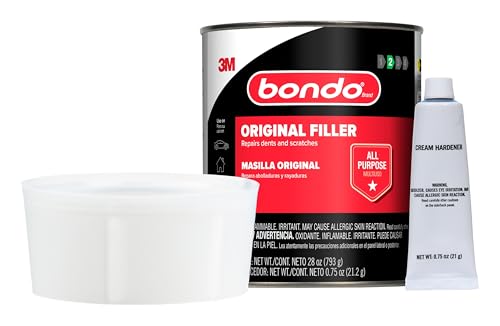
Body Filler for Dents
A two-part, lightweight filler (1.57 lb can plus hardener) for dents, dings, holes and scratches. Bondo says it cures in about 20 minutes, is non-shrinking, and can still be shaped days later. Shape it with 80 grit on a long block, then feather with 180 as in Step 2.
- ✅ Easy to find, easy to sand
- ✅ Fast cure for same-day repairs
- ❌ Sets fast: mix small batches
Best For: Small and medium dents on steel panels.
Dupli-Color Grease & Wax Remover, 1 Quart

Surface Cleaner Before and After Sanding
A quart of grease and wax remover, which Dupli-Color describes as the very first step in any paint project, for wiping panels before you sand and again before you spray. Washing doesn’t reliably take off silicone and wax residue; a dedicated remover does, and that’s the difference between paint that lays flat and paint that fish-eyes.
- ✅ Used twice in every paint job
- ✅ Quart lasts a whole car
- ❌ Use with gloves and good ventilation
Best For: Step 1 and the final wipe before base coat.
3M Performance Green Masking Tape 233+

Masking Tape for Body Work
The green automotive tape body shops use, here in an 18 mm roll. 3M lists it as resistant to moisture and to waterborne and solvent paints, removable without adhesive transfer, and heat resistant to 250°F for 30 minutes, for bake cycles. Use it to tape edges and body lines while you sand, and with masking film for painting.
- ✅ Clean paint lines
- ✅ Survives solvent paint and wet sanding
- ❌ Film for large areas sold separately
Best For: Trim, glass edges and body lines.
Pukamam Sanding Sponge Assortment, 80 to 3000 Grit

Sponges for Curves and Tight Spots
24 flexible wet or dry sanding sponges, two each across 80 to 3000 grit. The foam follows curves, door jambs and the area around handles and trim where a DA or a hard block can’t reach, and the fine ones are handy for easing edges so you don’t cut through.
- ✅ Reaches where blocks can’t
- ✅ Wide grit range in one pack
- ❌ Too soft to straighten panels
Best For: Curves, jambs and edges.
For the sander itself, the best sander for auto body guide has my picks from a budget electric to a Mirka DEROS and Dynabrade air sanders. If you’re working on rusty panels or bare steel parts off the car, my guide to sanding metal and the best sandpaper for metal cover the coarse end in more detail.
✨ The Bottom Line
Sanding is the foundation that determines everything about your finished paint job. Decide first whether the old paint stays or goes, follow the grit sequence without shortcuts, stop at 320 before primer and 600 before base coat, and use a guide coat to prove your panels are flat. Invest the time in masking and cleaning, work methodically panel by panel, and save the fine wet sanding for the clear coat after the paint has cured.
❓ Frequently Asked Questions
Should I sand my car with 600 or 400 grit first?+
What kind of sander do you use to sand a car?+
Should you wet sand or dry sand a car?+
How many hours does it take to sand a car?+
What is the fastest way to sand a car for paint?+
Can I paint immediately after sanding?+
Do I need to sand down to bare metal, or can I sand over existing primer?+
Conclusion
Sanding a car well is genuinely satisfying work: there’s something deeply gratifying about watching an old, tired panel turn into a smooth, paint-ready surface under your hands. The process isn’t complicated, but it does demand patience and respect for the grit sequence. Skip that logic and you’ll end up reworking panels or, worse, discovering the problem after the paint has set.
Your next step is simple: start with the masking. Spend a full hour getting that right, and you’ve eliminated the biggest source of frustration and cleanup. Then work methodically through one panel at a time, follow the grit progression without shortcuts, and use a guide coat to verify your work. When the paint has cured and you want that last bit of gloss, move on to wet sanding the clear coat.
The same principles (preparation, grit sequence and attention to flatness) carry over to metal parts off the car and even to concrete surfaces. For car-specific questions or a particular situation, drop me a note in the comments. Good luck with the project.
