
As an Amazon Associate I earn from qualifying purchases. All claims are strictly my personal opinion.
Editor’s Choice
Short on time? Of the 10 sanders on this list for wood, this is the one I'd buy.

A 6″ random orbit sander with a turbo mode, so one tool goes from flattening a glue-up to the last pass before finish.
- Also recommended Makita 9403
- Also recommended BLACK+DECKER Mouse

If you’ve spent any time browsing my blog, you already know I’m obsessed with matching the right tool to the right task. After publishing my random orbital sander guide, the single most common question in my inbox was: which sanders are genuinely best for woodworking specifically? It sounds like a simple question, but the honest answer is that “best” depends almost entirely on the job in front of you and the kind of woodworking you do.
The short answer: the best sander for wood is a random orbital sander for most smoothing and finishing, a belt sander when you need to remove wood fast, a sheet sander for flat panels and square inside corners, and a detail sander for corners and profiles. Curves, small parts and wide glued-up panels each have a machine of their own. So rather than give one generic list, I’ve matched a wood sander to every common woodworking job, and then grouped the same machines into three sets: one for professionals, one for serious DIY enthusiasts, and one for casual and occasional users.
Which Wood Sander for Which Job
Every type of wood sander does one job better than the others. Find your job in the left column, and the right-hand column tells you which machine on this page I’d use for it and the grit to start with. If you’re still choosing between types in general, my guide to the types of sanders covers all fourteen.

| Woodworking job | Sander type | Pick on this page | Start grit |
|---|---|---|---|
| Smoothing boards, tabletops and cabinet faces before finish | Random orbital | Bosch GET75-6N or Bosch ROS20VSC | 120 |
| Removing old finish, leveling glue lines, flattening rough boards | Belt sander | Makita 9403 or Metabo HPT SB8V2 | 60-80 |
| Flat panels, crisp edges, square inside corners | Sheet sander (1/2 or 1/4 sheet) | Bosch OS50VC or Makita BO4556K | 120 |
| Corners, dovetails, moldings, chair spindles | Detail sander | BLACK+DECKER Mouse | 120 |
| Inside curves, scroll-cut and bandsawn shapes | Oscillating spindle sander | WEN HA5932 | 80 |
| Small parts, end grain, outside curves, bevels | Benchtop belt and disc sander | WEN 6502T | 80 |
| Wide glue-ups, tabletops and panels to an even thickness | Drum sander | Powermatic PM2244 | 80 |
The start grits are for bare wood with machine marks; on new, smooth lumber you can often start one step finer. Finish at 150 to 180 before paint or stain and up to 220 under a clear finish. The full job-by-job sequence is in my guide on what grit sandpaper for wood, and the method itself is in how to sand wood.
Best Sanders for Wood: Comparison
The table below puts all ten machines side by side, one column each. The Bosch GET75-6N earns the Editor’s Choice nod as the single most versatile sander for woodworking. Price tiers compare today’s prices without printing them: $ is the lowest tier on the page and $$$$ the highest. The Amazon buttons show the live price.
| Product | ⭐ Bosch GET75-6N 🏆 EDITOR’S CHOICE |
Bosch ROS20VSC | Makita 9403 | Metabo HPT SB8V2 | Bosch OS50VC | Makita BO4556K | BLACK+DECKER Mouse | WEN HA5932 | WEN 6502T | Powermatic PM2244 |
|---|---|---|---|---|---|---|---|---|---|---|
| Image | |
 |
 |
 |
 |
 |
 |
 |
 |
 |
| Best job | Everything, rough to finish | Smoothing on a budget | Fast stock removal | Removal on a budget | Flat panels, edges, corners | Furniture and cabinets | Corners and profiles | Inside curves | Small parts, end grain | Wide panels to thickness |
| Type | 6″ random orbital, dual-mode | 5″ random orbital | Belt sander | Belt sander | 1/2-sheet orbital | 1/4-sheet orbital | Detail sander | Portable spindle sander | Benchtop belt and disc | Drum sander |
| Motor | 7.5 A | 2.5 A | 11 A | 9 A | 3.4 A | 2 A | 1.2 A | 5 A | 4.3 A | 1-3/4 HP |
| Speed | 3,300-7,300 OPM | 7,500-12,000 OPM | 1,640 ft/min | 820-1,475 ft/min | 8,000-11,000 OPM | 14,000 OPM | 16,000 OPM | 1,800-3,200 RPM | 3,600 RPM | 0-10 ft/min feed |
| Pad / belt / drum | 6″ disc | 5″ disc | 4″ x 24″ belt | 3″ x 21″ belt | 1/2 sheet | 1/4 sheet | Triangular pad + finger | 1/2″ to 1-1/2″ spindles | 4″ x 36″ belt, 6″ disc | 22″ drum, 44″ in 2 passes |
| Variable speed | ✅ Yes | ✅ Yes | ❌ No | ✅ Yes | ✅ Yes | ❌ No | ❌ No | ✅ Yes | ❌ No | Variable feed |
| Warranty | 1 year | 1 year | 1 year | 5 years | 1 year | 1 year | 2 years | 2 years | 2 years | 5 years |
| Price tier | $$$ | $$ | $$$ | $$ | $$$ | $$ | $ | $ | $$ | $$$$ |
| Availability | Check price on Amazon | Check price on Amazon | Check price on Amazon | Check price on Amazon | Check price on Amazon | Check price on Amazon | Check price on Amazon | Check price on Amazon | Check price on Amazon | Check price on Amazon |
Key takeaways
- My overall top pick is the Bosch GET75-6N: random orbit for finishing and a turbo mode for stock removal, in one 6″ sander.
- Fastest wood removal: the Makita 9403, an 11 A motor and a wide 4″ x 24″ belt for tabletops, wide panels and rough-sawn stock.
- Flat panels and square corners: the Bosch OS50VC, a half-sheet sander that sands true to edges and into corners.
- Curves and small parts need a stationary-style tool: a spindle sander for inside curves, a belt and disc sander for end grain and outside curves.
- The one tool in every set: the BLACK+DECKER Mouse, for the corners, profiles and joints no round pad can reach.
Best Sanders for Wood: Reviews
I’ve organized the reviews below by job: smoothing, fast removal, flat panels and corners, detail work, curves, small parts and wide panels. Every machine here has been chosen because it genuinely excels at its role. Further down, the same ten machines are grouped into a professional, a DIY and a casual set.
Best Sander for Smoothing and Finishing Wood
Most of the time you spend sanding wood is spent here: taking a board, a tabletop or a cabinet door from machine marks to a surface that’s ready for finish. A random orbital sander is the right tool because its pad spins and orbits at the same time, so it doesn’t leave the directional scratches that show through stain.
ℹ️ Comparing random orbitals?
This guide covers one machine of each type for woodworking. For the full head-to-head of corded and cordless random orbital models, from 5″ budget picks to Festool, see my guide to the best random orbital sander for your work.
Editor's Choice6-inch dual-mode random orbit
Bosch GET75-6N
Bosch GET75-6N 7.5 Amp 6″ Dual-Mode Random Orbit Sander
Random orbit for a swirl-free finish, plus a turbo mode for about 3x the stock removal: one sander from glue-up to final pass.
Check price on AmazonSpecs: Bosch
Best for
One sander for everything, from glue-ups to the final pass.
- Turbo mode for about 3x the stock removal
- Random orbit mode for swirl-free finishing
- 6" multi-hole pad takes a wide range of discs
Skip it if
You need square inside corners, which a round pad cannot reach.
- Dust port and vac adapters, no onboard canister
- Heavier than a 5" sander
Read full review
Best Sander for Wood Overall
For years Bosch’s 1250DEVS was the sander I used most every day, and the Bosch GET75-6N is the 6″ dual-mode random orbit sander Bosch makes today. It pairs a 7.5 Amp variable-speed motor (3,300-7,300 OPM) with two modes: random orbit for swirl-free finishing on furniture and cabinetry, and a turbo mode that Bosch rates at about 3x the stock removal of standard random orbit, enough to replace a belt sander on medium-sized flat work. The 6″ multi-hole pad takes a wide range of discs.
That range is why it’s the one sander I’d buy first for wood: turbo to flatten a glue-up or take off an old finish, random orbit for the 120, 150 and 180 passes, and a light touch for the last pass before stain. It’s heavier than a 5″ palm-grip model at 5.7 lbs, and it relies on a dust port and vacuum adapters rather than an onboard canister, so plan to hook it up to a shop vac.
Budget pick5-inch random orbit sander
Bosch ROS20VSC
Bosch ROS20VSC 5″ Random Orbit Sander
A light 3.5 lb random orbital with variable speed and a microfilter canister that keeps dust in when you empty it.
Check price on AmazonSpecs: Bosch
Best for
Smoothing and finish prep on furniture and new lumber, on a budget.
- Microfilter dust canister
- Variable speed, 7,500 to 12,000 OPM
- Light enough for one hand
Skip it if
You strip finishes or flatten glue-ups often: a dual-mode or belt sander is faster.
- Single mode: not for heavy stock removal
Read full review
Best Budget Sander for Wood
Bosch’s trademark quality at a budget price – sign me up! The ROS20VSC is a small random orbital sander with a 2.5 A motor, variable speed from 7,500 to 12,000 OPM, a 5″ hook-and-loop pad and a microfilter dust canister that keeps the fine dust in when you empty it. At 3.5 lbs it’s light enough for one hand, on a wall cabinet or a chair seat.
It has one mode only, so it isn’t the tool for stripping a tabletop or flattening a glue-up; that’s what the belt sanders below are for. For smoothing new lumber, sanding between grits and prepping furniture for stain, it does the same job as the bigger Bosch for a lot less. I’ve covered it in depth in my Bosch ROS20VSC review.
Best Sander for Removing Wood Fast
When the job is taking wood off rather than smoothing it (an old finish, a proud glue line, a cupped board, rough-sawn stock), a belt sander does in minutes what an orbital does in an hour. It cuts in one direction, with the grain, and it’s aggressive enough to gouge if you stop moving, so it’s always followed by orbital passes. My guide on how to use a belt sander covers the technique. Whole floors are a different job, done with rented drum or orbital floor sanders: see sanding a hardwood floor with an orbital sander.
4 x 24 belt sander
Makita 9403
Makita 9403 4″x24″ Belt Sander
The fastest wood remover here: an 11 A motor on a wide 4" x 24" belt.
Check price on AmazonSpecs: Makita
Best for
Fast removal on tabletops, wide panels, rough stock and glue lines.
- 11 A motor, the most powerful handheld tool here
- Wide 4" belt covers ground in fewer passes
- Weight keeps it flat on the board
Skip it if
You mostly do finish work or sand narrow stock.
- Heavy and aggressive: needs control to avoid gouging
- Single speed
Read full review
Best Belt Sander for Wood
The woodworking community has long dubbed this “the best 4×24 belt sander in the world”, and I don’t disagree. The Makita 9403 is the fastest wood remover on this page. Its 11 A motor driving a wide 4″ x 24″ belt at 1,640 ft/min takes down large rough surfaces in minutes: rough-sawn lumber, glue line leveling on wide panels, heavy stock removal on tabletops.
The wide belt is the key differentiator. At 4″ it covers ground in fewer passes than a 3″ belt sander, and the machine’s 12.6 lb weight does the pressing for you, which is what keeps it flat on the board. It runs at one speed only, and it’s a handful on narrow stock, where a 3″ belt is easier to control.
3 x 21 belt sander
Metabo HPT (Hitachi) SB8V2
Metabo HPT (Hitachi) SB8V2 9.0-Amp 3″x21″ Belt Sander
A 9 A variable-speed belt sander: slow it down for softwood and veneer, open it up for heavy removal.
Best for
DIY furniture projects, deck boards and floor repairs that need fast removal.
- Variable speed for softwood, veneer and heavy removal
- Soft grips for two-handed control
- 5-year warranty
Skip it if
You want the widest belt: the 4" Makita 9403 covers more per pass.
- 3" belt, narrower than the Makita 9403's 4"
Read full review
Best Budget Belt Sander for Wood
One of the most impressive value-for-price machines I’ve encountered in any tool category. The SB8V2, sold under the Hitachi name until the brand became Metabo HPT, runs a 3″ x 21″ belt at 820-1,475 ft/min via a 9 A motor. Variable speed is the feature that matters on wood: slow the belt for softwood and veneer, open it up for heavy removal on large flat surfaces.
Contoured soft grips and a 5-year warranty complete the package. For a DIY woodworker who needs fast removal on furniture builds, deck boards or floor repairs, this is the obvious choice. For deck boards specifically, see the best sander for a deck. My best belt sanders guide compares it with the rest of the category.
Best Sander for Flat Panels, Edges and Inside Corners
A round pad can’t reach into a 90-degree corner, and on a narrow edge it tends to rock and round it over. A sheet sander’s square pad does both jobs: it sands true to the edge of a board and right into the corner of a frame, a drawer box or a face frame. That’s why I keep one next to the random orbital rather than instead of it.
1/2-sheet finishing sander
Bosch OS50VC
Bosch OS50VC 3.4-Amp 1/2-Sheet Orbital Finishing Sander
A half-sheet sander that sands true to edges and into corners, with vibration control for long sessions.
Check price on AmazonSpecs: Bosch
Best for
Flat panels, clean edges and inside corners that a round pad cannot reach.
- Sands true to edges and into corners
- Vibration control for low fatigue
- Variable 8,000-11,000 OPM
Skip it if
You mostly remove heavy stock, where a belt sander is much faster.
- Sheet sandpaper costs a little more than discs
Read full review
Best Sheet Sander for Wood
My favourite sheet sander and one of the best woodworking tools I own. The Bosch OS50VC earns its place not just for its power and finishing quality, but for what its rectangular pad enables: it sands true to the edge of a board without rounding it over, works cleanly into right-angle corners, and handles glued-up panels where staying perfectly flat matters. The 3.4 A motor runs the half-sheet pad at a variable 8,000-11,000 OPM, and with fine paper and light pressure it leaves a smooth, even surface ready for finish.
Bosch’s vibration control on this machine is the best I’ve used on any sheet sander. When you’re running it for hours, that reduction in fatigue is real. The natural complement to the GET75-6N: the orbital for open surfaces, the OS50VC for edges, corners and panels that have to stay dead flat.
1/4-sheet finishing sander
Makita BO4556K
Makita BO4556K 1/4-Sheet Finishing Sander
A compact 1/4-sheet sander at 14,000 OPM that fits inside drawer boxes and cabinet carcasses.
Check price on AmazonSpecs: Makita
Best for
Furniture, cabinet boxes and small flat work with square corners.
- Small square pad reaches into corners and boxes
- Compact body for long sessions
- Dust bag and hard case
Skip it if
You need heavy stock removal: a belt or dual-mode orbital is faster.
- Not a stock remover
Read full review
Best Sander for Furniture and Cabinet Work
Makita’s popular BO4556 is a fantastic “bang for the buck” option and extremely versatile as well. It’s small but packs a punch: a 2 A motor at 14,000 OPM on a 1/4-sheet pad, with a dust bag and, in the K kit, a hard carrying case. The smaller pad is the point: it fits inside drawer boxes, cabinet carcasses and the frame of a chair, where a half-sheet sander is too big.
Because the body is so compact, you can use it comfortably for long sessions, and it takes standard sandpaper sheets cut to size. It isn’t a stock remover: for that, start with a belt sander or the GET75-6N in turbo. For more furniture picks, see the best sanders for furniture.
Best Sander for Corners, Profiles and Joinery
No matter how good your orbital or sheet sander is, it can’t reach inside a cabinet corner, into a dovetail, along a routed profile or between chair spindles. That’s the detail sander’s job.
💡 Pro Tip
Every set I recommend includes a detail sander. No matter how powerful your belt or orbital machine is, it cannot reach inside corners, carved profiles, or dovetail joints. The detail sander is the one tool that has no substitute, and it’s so affordable there’s no reason not to own one.
Mouse detail sander
BLACK+DECKER BDEMS600
BLACK+DECKER BDEMS600 Mouse Detail Sander
A pointed triangular pad and a detail finger for the corners, profiles and joints that no round pad can reach.
Best for
Cabinet interiors, dovetail joints, routed profiles and any tight corner.
- Pointed pad reaches corners and tight joints
- Detail finger for profiles and spindle work
- 16,000 OPM, strong for its size
Skip it if
You want one tool for large flat surfaces: the small pad is slow there.
- Small pad, not for large flat surfaces
Read full review
Best Detail Sander for Wood
Every set needs a detail sander, and the B+D Mouse is the one I recommend without hesitation at any budget level. It reaches inside cabinet carcass corners, into dovetail joints, along routed profiles, and into the tight junction between a shelf and its housing. At 16,000 OPM it’s strong for its size, and the pointed triangular pad is exactly what those tight spots demand. The detail finger attachment extends its reach further: spindles, turned profiles, carved areas, anywhere the main pad can’t follow.
The reason it appears next to much more expensive machines is simple: no amount of spending on large sanders eliminates the need for this tool. It’s also the cheapest machine on this page and comes with a 2-year warranty. The small pad is slow on anything bigger than a drawer front, so it’s a partner to an orbital, not a replacement.
Best Sander for Curves
A flat pad on a curved edge sands flat spots into it, and they show once the piece is finished. Inside curves, such as a bandsawn apron, a scroll-cut bracket or a chair rocker, need a sanding drum that oscillates up and down as it spins, so it sands the whole curve evenly without burning one line into it.
Portable oscillating spindle sander
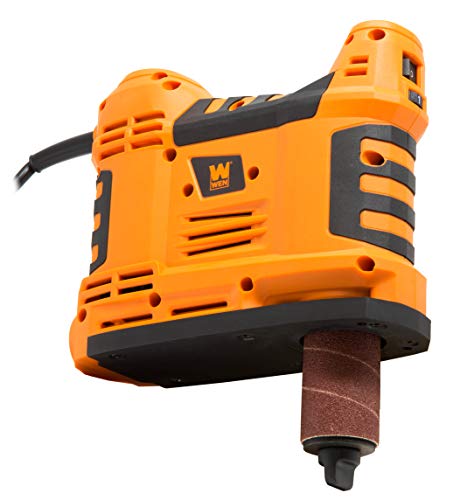
WEN HA5932
WEN HA5932 5-Amp Portable Oscillating Spindle Sander
A handheld spindle sander that also clamps to a bench, with variable speed for inside curves.
Check price on AmazonSpecs: WEN
Best for
Inside curves on bandsawn and scroll-cut parts, and curves on pieces too big to lift.
- Portable, or clamped down as a benchtop
- Variable speed, 1,800 to 3,200 RPM
- Oscillates to avoid burn lines
Skip it if
You sand curves daily: a full benchtop spindle sander has a bigger table.
- Little table support for large pieces
- Fewer spindle sizes than a full benchtop
Read full review
Best Sander for Curves
The WEN HA5932 is a spindle sander you can hold in your hand, then clamp to a bench to use it like a small benchtop machine. WEN lists a 5 A motor, variable speed from 1,800 to 3,200 RPM, 50 to 90 oscillations a minute, and sanding sleeves from 1/2″ to 1-1/2″ in diameter.
Being portable is what makes it a wood sander for the home shop: you take it to a curve on a piece that’s too big to lift onto a table, such as a headboard or a stair stringer. On a big workpiece it has little table to support it, and a full benchtop has more spindle sizes. If you sand curves every week, my best spindle sanders guide covers the benchtop machines, and the oscillating belt and spindle sanders add a belt for outside curves.
Best Sander for Small Parts and End Grain
Small parts are hard to hold under a handheld sander, and end grain is hard to sand flat with one. For both, it’s easier to bring the wood to the sander: a benchtop belt and disc sander lets you square an end, sand an outside curve to a line, shape a small part or put a clean bevel on an edge, with a work table to rest the piece on at the angle you set.
Benchtop belt and disc sander
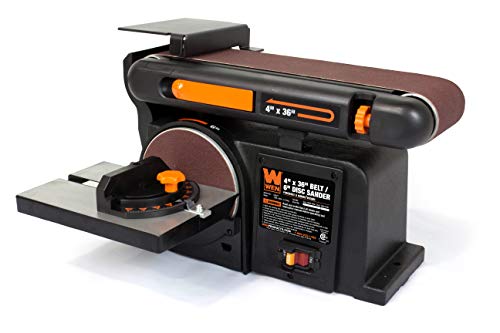
WEN 6502T
WEN 6502T 4″x36″ Belt and 6″ Disc Sander
A 4" x 36" belt and a 6" disc on a cast iron base, for end grain, outside curves and small parts.
Check price on AmazonSpecs: WEN
Best for
Squaring end grain, sanding outside curves to a line and shaping small parts.
- Cast iron base reduces vibration
- Belt tilts 0-90 degrees
- Tension release lever for fast belt changes
Skip it if
You work large furniture parts: a 6" x 48" belt covers more.
- 4" x 36" belt and 6" disc limit capacity
Read full review
Best Benchtop Sander for Small Wood Parts
The WEN 6502T puts a 4″ x 36″ belt and a 6″ disc on one 4.3 A motor, on a cast iron base that keeps it from walking across the bench. The belt tilts from horizontal to vertical, and a quick-release lever takes the tension off for fast belt changes.
On wood, the disc is for end grain and outside curves, and the belt is for faces, edges and chamfers. A 4″ x 36″ belt and a 6″ disc are on the small side for big parts; if you build furniture rather than boxes and toys, my best belt and disc sanders include 6″ x 48″ machines.
Best Sander for Wide Panels and Tabletops
Glued-up panels and tabletops come out of the clamps with steps between boards. You can flatten them by hand with a belt sander and an orbital, which takes skill and time, or feed them through a drum sander, which takes them to an even thickness and leaves a surface ready for the orbital.
22-inch drum sander
Powermatic PM2244
Powermatic PM2244 1-3/4 HP Drum Sander
A stationary drum sander that takes wide panels and glue-ups to an even thickness, up to 44" wide in two passes.
Best for
Shops that dimension wide panels, glue-ups and solid wood tabletops every week.
- 44" capacity in two passes
- Flat and smooth in a single pass
- LED control panel with board height readout
Skip it if
You sand only now and then, or have no floor space for a 328 lb machine.
- Stationary: needs dedicated floor space
- A big investment for casual use
Read full review
Best Drum Sander for Wood
Of all the tools on this page, the Powermatic PM2244 has the single biggest impact on workflow. A drum sander doesn’t just sand: it changes the way you process stock. Wide panels, glued-up blanks, large tabletops and solid wood boards that would take many minutes each to belt-sand can be sent through the PM2244 and come out flat and consistently smooth. It takes stock up to 4″ thick and 44″ wide in two passes on its 22″ drum.
The 1-3/4 HP motor runs on 115V, the LED control panel shows board height, and the conveyor feed is variable from 0 to 10 ft/min. It’s a 328 lb stationary machine that needs floor space and a dust collector, so it belongs in a shop that dimensions panels every week. For a smaller budget, my JET 16-32 review covers the open-stand alternative.
Sander Sets for Professional, DIY and Casual Woodworking
If you’d rather buy by the kind of woodworker you are than by the job, here are the same machines as three sets. Each one covers every sanding task you’ll meet at that level, from rough stock removal to the last detail pass.
Best Sanders for Professional Woodworking
If I had to strip my entire arsenal down to just the machines I couldn’t work without professionally (the ones that cover every task, handle daily sustained use, and produce the quality professional work demands) this is the set I’d keep: the Bosch GET75-6N for open surfaces, the Bosch OS50VC for edges and corners, the Makita 9403 for removal, the Powermatic PM2244 for panels, and the Mouse for detail.
Best Sanders for DIY Woodworking
The DIY set is built around value: machines that deliver quality results without professional-level investment. The GET75-6N still earns its place as the one sander for everything, with the Metabo HPT SB8V2 for fast removal, the Makita BO4556K for corners and cabinet work, the WEN 6502T for small parts and end grain, and the Mouse.
Best Sanders for Casual Woodworking
For occasional projects (a painted dresser, a new shelf, a garden bench), you need three tools that are easy to use and cover pretty much any task: the Bosch ROS20VSC for flat surfaces, the Makita BO4556K for edges and corners, and the Mouse for the tight spots. Add the WEN HA5932 the first time a project has a curve. Every pick here is corded; if you already own a battery platform, my battery-powered sander reviews match a sander to the batteries you have.
How I Chose the Best Sanders for Wood
I started from the jobs, not the machines: the seven things you actually do when you sand wood, from removing stock to sanding a curve, and the one type of sander that does each job best. Then I picked one or two machines per job, preferring makers that publish full specs (motor, speed, pad or belt size, warranty) and checking every figure on this page against the maker’s own product page or manual. Seven of the ten are machines I picked when I first wrote this guide in 2018 (the Bosch OS50VC and ROS20VSC, the Makita 9403 and BO4556, the Hitachi belt sander now sold as Metabo HPT, the Mouse and the Powermatic PM2244); the rest were added as models changed and as I split the guide by job. I don’t show customer ratings or prices, which change daily; more on how I choose the sanders I recommend.
How to Choose a Wood Sander
Five things decide whether a sander suits your woodworking: the jobs you do most, the power and speed, the pad shape and size, the dust collection, and the wood itself.
Match the Sander to the Job
Buy for the job you do most often, then add a second tool for the job the first one can’t do. For most people that means a random orbital first, then a detail sander for corners. If you mostly refinish old furniture or flatten rough boards, a belt sander pays for itself sooner. If you mostly build cabinets, a 1/4-sheet sander gets into the boxes. The table at the top of this page is the short version, and belt sander vs orbital sander and sheet sander vs random orbital sander go through the two most common choices in detail.
Power and Speed
On a handheld wood sander, amps tell you how well the motor holds its speed under load, and variable speed tells you how much control you have. Variable speed matters more on wood than on most materials: slow down for softwood, veneer and edges, where a fast pad cuts through or rounds over, and speed up on hardwood faces. Belt sanders are rated in feet per minute of belt travel; orbital and sheet sanders in orbits per minute (OPM).
Pad Size and Shape
A 5″ round pad is the most common size and the easiest to handle; a 6″ pad covers more area per pass but weighs more. A square pad (1/4 or 1/2 sheet) reaches into corners, a triangular pad into tighter ones. Belt width is the same trade-off: a 4″ belt covers more, a 3″ belt is easier to control on narrow boards.
Dust Collection
Wood dust clogs sandpaper, hides the scratches you’re trying to see, and is a health hazard: OSHA’s wood dust page notes that breathing the airborne particles from sanding may cause allergic and other respiratory symptoms, and cancer. Prefer a sander with a vacuum port and use it with a shop vac or dust extractor, and wear a respirator for long sessions.
Softwood, Hardwood and Veneer
Softwoods like pine sand fast and gouge easily, so use lighter pressure, slower speeds and a finer starting grit. Dense hardwoods like maple and oak take longer at each grit and show cross-grain scratches clearly under stain. Veneer is the trap: it can be thinner than a heavy belt-sander pass, so never use a belt sander on veneered plywood and keep an orbital moving with light pressure. For pressure-treated lumber, see can you sand pressure-treated wood.
What Grit to Use With Your Wood Sander
The sander doesn’t decide the finish, the last grit does. Start with the finest grit that removes the worst defect, move up one step at a time, and stop at 150 to 180 before stain or paint, or up to 220 under a clear finish. Between coats of finish, switch to 320 by hand. My sandpaper grit chart has the full range, and the best sandpaper for wood covers the discs and sheets to buy for these machines.
🏆 The Bottom Line
The Bosch GET75-6N is my overall Editor’s Choice: its random orbit and turbo modes give it a range no single-mode sander can match. Pair it with the Makita 9403 for heavy stock removal and the BLACK+DECKER Mouse for corners, and you have a set that covers almost every sanding job in woodworking.
Verdict: The Best Sanders for Woodworking
For most woodworkers, the Bosch GET75-6N is the standout choice: its dual random-orbit and turbo modes cover more ground than any single-mode sander can, from flattening glue-ups to the last pass before finish. On a budget, the Bosch ROS20VSC does the smoothing for much less. For fast removal, the Makita 9403 and the Metabo HPT SB8V2; for edges and corners, the Bosch OS50VC and the Makita BO4556K; and for curves, small parts and wide panels, the WEN HA5932, the WEN 6502T and the Powermatic PM2244. Whatever you buy first, add the Mouse: it’s the cheapest machine here and the one no other tool replaces.
❓ Frequently Asked Questions
What kind of sander is best for wood?+
What is a good cheap sander for wood?+
What is the easiest sander to use?+
What is the best all-round sander?+
What’s better, orbital or square sander?+
What’s better, orbital or palm sander?+
Questions about a sander for a specific wood project? Leave them in the comments below and I’ll be here to help. For the full method behind every pick on this page, read my guide on how to sand wood, and for the palm vs orbital question in detail, palm sander vs orbital sander.

It helped me a lot in developing my smart woodworking website. Thank you so much and I really cannot emphasize this.
Hi James,
My wife and I bought an old 100yr, old homestead and she wants me to pull up the nasty carpet & re-do the old wood floors. I can’t justify buying a drum sander, and don’t have any experience with belt sanders but need to go that route. Could you help me with picking the best belt sander for the job that will also be able to hook up somehow to a shop-vac ?
Hey Doug, the best fit for the type of work you’ll be doing is without a doubt the Makita 9403. If you’re on a strict budget, the Hitachi SB8V2 will also be a great choice. They’ve both got enough power to handle those old wooden floors with ease, enough speed to reach a beautiful finish and their belt width ensures you do it quickly as well. Any of them can also be very easily hooked up to a shop-vac – all you’ve got to do is detach their built-in dust collectors and attach the vacuum hose instead. Hope that helps and best of luck with the renovations Doug, I bet the ol’ homestead will look fantastic when it’s all done!
Hi James,
I recently retired and plan to take up woodworking as a serious hobby. I came across your excellent reviews and suggestions for sanders, and am thinking of going with the Bosch 3725DEVS.
I notice that the Bosch website also refers to a newer model, the 3725DEVSN, which will be available in stores in about a month.
I was wondering if you have an opinion on the newer model, and would it make sense to wait for it.
Thanks again for your wonderful blog.
Hey Lokendra, first of all congratulations on your retirement and excellent choice when it comes to hobbies – although I’m certainly a little biased, woodworking is one of the best by far.
The Bosch 3725DEVS is an incredible sander so you’re on the right track. The only difference between the DEVS and the DEVSN is the package (the first comes only with the tool while the other comes with a full kit complete with sandpaper and other accessories). There’s also the choice between the 3725 or the 3727 with the only difference being in the pad’s size (one is 5″ and the other is 6″).
Due to this, you can go ahead and get the machine today or wait a while and get the complete kit with the machine and a few accessories included when it gets released – it’s up to you.
Hope that helped Lokendra and good luck with your new hobby, I’m sure you’ll love it!
Hi James, Nice article about sanders, thank you. Will you help me choose one sander that will work for both the 3-drawer dresser I want to refinish and the wood cabinets I want to refinish (or repaint?) in my apartment that are a mess (I am a render).I am a first-time refinisher but excited about doing it.
Hey Helen, thanks for stopping by. I’d have to go with the Bosch ROS20VSC random orbital sander. It’s super versatile, delivers foolproof finishes and it’s also incredibly well built, all at a great price. It’ll also be a fantastic tool to deal with any future refinishing tasks that come up in the future. Best of luck with your woodworking debut and have a wonderful week!