


As an Amazon Associate I earn from qualifying purchases. All claims are strictly my personal opinion.
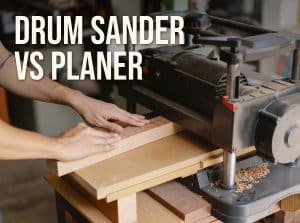
A thickness planer is the tool for making boards thinner, fast: its knives take off real shavings on every pass. A drum sander removes only a sliver per pass, but it can safely thickness what a planer can’t, like figured wood that tears out, very thin stock and wide glued-up panels, and it leaves a surface that’s ready for finish sanding. If you mill rough lumber, buy the planer first. Add a drum sander when tear-out, thin parts or wide panels become your problem.
Most shops that own a drum sander use it after the planer, not instead of it. Below is how each machine works, a side-by-side comparison, the jobs where each one wins, and the models I’d look at. For handheld tools, the matching comparison is belt sander vs planer.
⚡ Quick Answer
Milling rough lumber to thickness: a benchtop planer such as the DEWALT DW735X.
Figured wood, thin stock, wide panels, end-grain boards: a drum sander such as the JET JWDS-1632.
Both problems, one budget: a planer with a spiral cutterhead such as the WEN PL1326 reduces tear-out without a second machine.
Drum Sander vs Planer at a Glance
| Feature | Thickness Planer | Drum Sander |
|---|---|---|
| How it removes wood | Spinning knives cut shavings | Abrasive-wrapped drum grinds dust |
| Removal per pass | Large | Very small; many passes |
| Speed on rough lumber | Fast | Slow |
| Figured and interlocked grain | Can tear out | No tear-out |
| Very thin stock | Limited by a minimum thickness | Its specialty |
| Maximum width | Fixed by the throat (13″ on benchtop models) | Open-ended models do twice the drum width in two passes |
| End-grain cutting boards | Dangerous: can blow out the far edge | The standard way to flatten them |
| Surface left behind | Knife marks, possible snipe | Even scratch pattern, ready for a random orbital |
| Consumables | Knives or carbide inserts | Abrasive strips |
| Dust collection | Big volume of chips | Fine dust; a collector is a must |
| Typical price tier | $$$$, lower end for benchtop models | $$$$, usually more than a benchtop planer |
Thickness Planer
- How it removes wood
- Spinning knives cut shavings
- Removal per pass
- Large
- Speed on rough lumber
- Fast
- Figured and interlocked grain
- Can tear out
- Very thin stock
- Limited by a minimum thickness
- Maximum width
- Fixed by the throat (13″ on benchtop models)
- End-grain cutting boards
- Dangerous: can blow out the far edge
- Surface left behind
- Knife marks, possible snipe
- Consumables
- Knives or carbide inserts
- Dust collection
- Big volume of chips
- Typical price tier
- $$$$, lower end for benchtop models
Drum Sander
- How it removes wood
- Abrasive-wrapped drum grinds dust
- Removal per pass
- Very small; many passes
- Speed on rough lumber
- Slow
- Figured and interlocked grain
- No tear-out
- Very thin stock
- Its specialty
- Maximum width
- Open-ended models do twice the drum width in two passes
- End-grain cutting boards
- The standard way to flatten them
- Surface left behind
- Even scratch pattern, ready for a random orbital
- Consumables
- Abrasive strips
- Dust collection
- Fine dust; a collector is a must
- Typical price tier
- $$$$, usually more than a benchtop planer
How Each Machine Works
Thickness Planer
A thickness planer feeds a board under a cutterhead with two or three knives (or a spiral head with many small inserts) spinning at high speed, and rollers pull the board through at a set speed. The head is set to a height, and everything above that height is cut off in one pass. A benchtop model like the DEWALT DW735X runs a 15 amp motor with a three-knife head and two feed speeds, 96 or 179 cuts per inch, one for fast dimensioning and one for a finer finish. The WEN PL1326 and PL1337 plane boards up to 13″ wide and 6″ thick.
Drum Sander
A drum sander replaces the knives with a long drum wrapped in an abrasive strip, and a conveyor belt carries the board under it. It removes very little per pass, so you lower the drum a fraction of a turn at a time. On an open-ended (cantilevered) model, the drum is supported on one side only, so a panel wider than the drum can be sanded in two passes, flipping it end for end. It’s really a thicknessing sander: the job is to bring stock to an exact, even thickness and a sanded surface, not to take a lot off.
When to Use a Planer
- Milling rough-sawn lumber to thickness. A drum sander would take all day.
- Bringing a batch of boards to the same thickness for a project.
- Removing a lot of wood from reclaimed boards (after pulling every nail).
- Straight-grained species like pine, oak, poplar and walnut, which plane cleanly.
When to Use a Drum Sander
- Figured wood: curly maple, bird’s-eye, quartersawn stock and interlocked tropical species that tear out under knives.
- Thin stock: box sides, guitar tops and backs, veneer, inlay and marquetry.
- End-grain cutting boards, which should never go through a planer.
- Wide glued-up panels and cabinet doors wider than your planer.
- Short pieces that are too short for a planer’s rollers to hold safely.
- Removing planer marks and snipe before the finish sanding.
⚠️ Neither One Flattens a Cupped Board
Both machines make the top face parallel to the bottom face. If the board is cupped or twisted, the feed rollers or the conveyor press it flat under the head, and it springs back afterwards. Flatten one face first on a jointer, with a planer sled, or by hand, then thickness it.
Using Both: The Usual Order
Joint one face and one edge, plane to within about a sixteenth of an inch of final thickness, then run the boards through the drum sander at 80 or 100 grit to reach final thickness without tear-out. From there, finish sand with a random orbital at 120 or 150 and up to 180 or 220. The grit steps are in what grit sandpaper for wood. Both machines produce a lot of waste, so plan for a real dust collector rather than a shop vacuum.
Do You Need Both?
Most hobby shops don’t. If you buy rough or skip-planed lumber, the planer is the one you’ll use every week, so start with my thickness planer picks. A drum sander earns its space if you make boxes, instruments, cutting boards or furniture from figured wood, or if tear-out is costing you boards. A middle path is a planer with a spiral or helical cutterhead, which cuts at a shearing angle and tears out less than straight knives.
Planers and Drum Sanders to Consider
DEWALT DW735X 13″ Two-Speed Thickness Planer
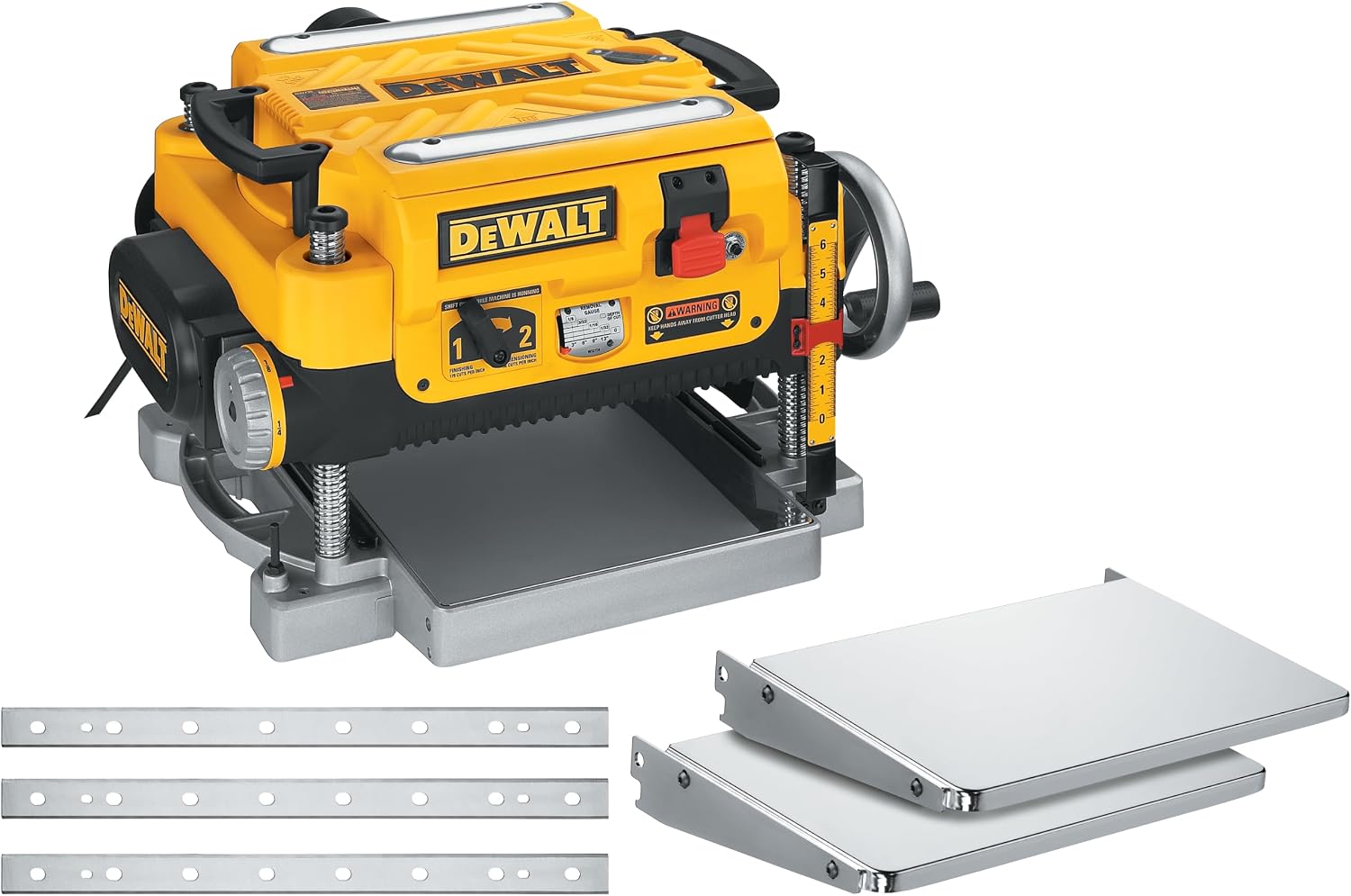
Best Thickness Planer Overall
A 15 A, 20,000 RPM motor drives a three-knife cutterhead at 10,000 RPM, and a two-speed gearbox gives 96 or 179 cuts per inch. The carriage locks automatically to reduce snipe, fan-assisted chip ejection blows the chips out of the machine, and the X package adds infeed and outfeed tables and a spare set of knives. DEWALT backs it with a 3-year limited warranty. Premium price tier.
- ✅ Two feed speeds
- ✅ Tables and spare knives included
- ✅ Automatic carriage lock against snipe
- ❌ Straight knives can tear out figured wood
- ❌ Premium price tier
Best For: Milling rough lumber in a home shop.
WEN PL1326 13″ Spiral Benchtop Thickness Planer

Best Planer for Less Tear-Out
Instead of long knives, the PL1326 uses a spiral cutterhead with 26 staggered, rotatable HSS inserts, which WEN designs for a cleaner finish. It planes boards up to 13″ wide and 6″ thick, the 15 A motor turns the head at 10,000 RPM with a 26 ft/min feed, and an onboard gauge shows how much each pass removes. When an insert dulls or chips, you rotate it to a fresh edge instead of replacing a whole knife.
- ✅ Spiral head reduces tear-out
- ✅ Rotatable inserts
- ✅ 13″ x 6″ capacity
- ❌ Single feed speed
Best For: Shops that want one machine and plane some figured wood.
JET JWDS-1632 16″ Drum Sander with Stand

Best Drum Sander for a Home Shop
An open-ended drum sander that handles stock up to 16″ wide in one pass or 32″ in two. JET’s SandSmart control watches the drum motor load and sets the conveyor speed for you, infinitely variable up to 10 ft/min, so you don’t burn the wood or stall the drum. The hood channels dust to a 4″ port, the conveyor tracks with tool-free adjusters, and it comes on an open steel stand with 80-grit abrasive installed and a 5-year warranty.
- ✅ 32″ panels in two passes
- ✅ Automatic feed control
- ✅ 5-year warranty
- ❌ Needs a real dust collector
- ❌ Premium price tier
Best For: Figured wood, thin stock, end-grain boards and wide panels.
More drum sanders, from compact 10-20 models to the 18-36, are compared in my drum sander reviews.
🏆 The Verdict
Buy a thickness planer first if you mill your own lumber: it does the heavy work in a fraction of the time. Add a drum sander when figured wood, thin stock, end-grain boards or panels wider than 13″ start to matter; it doesn’t replace the planer, it finishes what the planer can’t. If you only want one machine and tear-out is the worry, look at a spiral-head planer.
❓ Frequently Asked Questions
Do I need a sander if I have a planer?+
Is planing better than sanding?+
Do I really need a drum sander?+
Deciding between the two for your shop? Tell me what you build in the comments and I’ll give you my take.

