
As an Amazon Associate I earn from qualifying purchases. All claims are strictly my personal opinion.
My top pick

DAP Plastic Wood-X with DryDex
For nail holes, cracks and dents: it sands, drills and stains, and it changes color when it is dry.

A good wood filler disappears. A bad one shrinks into a dimple, cracks when the wood moves, or shows up as a pale blotch the moment stain goes on. For most indoor repairs, the best wood filler is a latex, stainable filler you can sand and drill, such as DAP Plastic Wood-X. For big holes, rot and anything structural, switch to a two-part filler like Bondo Wood Filler or an epoxy putty. A loose or broken joint needs wood glue and clamps, not filler, because filler isn’t an adhesive.
Below are my five picks by type of repair, a comparison table, short reviews, and a guide to choosing between filler and putty, water-based and two-part, and what to do when the repair has to take stain.
Best Wood Fillers: Comparison
All five cost little, so the table compares what matters in use: the formula, how deep you can fill, how fast it’s ready to sand, and whether it takes stain and survives outdoors.
| Product | ⭐ DAP Plastic Wood-X 🏆 EDITOR’S CHOICE |
Minwax Stainable | Gorilla All Purpose | Bondo Wood Filler | J-B Weld KwikWood |
|---|---|---|---|---|---|
| Image | |
 |
 |
 |
 |
| Price | $ | $ | $ | $ | $ |
| Formula | Latex, one-part | Latex, one-part | One-part, water resistant | Two-part with hardener | Two-part epoxy stick |
| Size | 16 oz | 6 oz | 6 oz tube | 30 oz + hardener | 1 oz stick |
| Ready to sand (maker) | 3-6 h up to 1/8″ deep | ~2 h for shallow fills | See label | 15 min | Cures in 1 h |
| Deep holes | Yes, 36 h at 1/4″+ | In 1/4″ layers | Small to medium | ✅ Best here | ✅ Rebuilds shapes |
| Stainable | ✅ | ✅ Made for Minwax stains | ✅ | ✅ | ✅ |
| Outdoor use | ✅ | ✅ | ✅ Water resistant | ✅ Rot repairs | ✅ Won’t rot |
| Holds screws | ✅ Drill, screw, nail | Not listed | ✅ Anchors nails and screws | Not listed | ✅ Drill and tap |
| Best For | Most indoor repairs | Furniture you’ll stain | Trim and outdoor wood | Large holes and rot | Quick, strong fixes |
| Availability | Check price on Amazon | Check price on Amazon | Check price on Amazon | Check price on Amazon | Check price on Amazon |
Key takeaways
- Latex one-part fillers like DAP Plastic Wood-X cover most nail holes, cracks and dents, and clean up with water.
- Two-part fillers such as Bondo and KwikWood cure by chemical reaction, so they don’t shrink and they handle big holes and rot.
- No filler takes stain exactly like real wood. Test on a scrap, or stain first and use a color-matched putty afterward.
- Filler goes on bare wood before sanding. Putty goes on finished wood and isn’t sanded.
- Fill slightly proud, let it dry fully, then sand flush with the grain.
Best Wood Fillers: Reviews
Each pick is here for a specific kind of repair. The specs are the makers’ own, from each product’s listing, and I’ve kept their claims in their words.
Editor's ChoiceLatex wood filler
DAP Plastic Wood-X
DAP Plastic Wood-X with DryDex
A latex filler that sands, drills and stains, and turns from pink to natural when it's dry enough to sand.
Check price on AmazonSpecs: DAP
Best for
Nail holes, cracks, dents and chipped edges in furniture, trim and cabinets.
- Dry-time indicator, pink to natural
- Can be drilled, screwed and nailed
- Holds on vertical surfaces and corners
Skip it if
You're filling large holes or rot, where a two-part filler like Bondo is faster.
- Deep fills take a day and a half
- 16 oz tub, more than small touch-ups need
Read full review
Best Wood Filler Overall
DAP Plastic Wood-X is a latex, knife-grade filler that stays where you put it, which makes it good on corners and vertical surfaces like door casings and table aprons. Once it’s dry, DAP says you can plane, cut, drill, screw, nail, sand, stain and paint it, and it’s rated for interior and exterior wood.
The feature that saves repairs is DryDex: the filler goes on pink and turns natural when it’s dry, so you don’t sand too early and tear the patch out. DAP lists 3 to 6 hours for repairs up to 1/8″ deep and 36 hours for fills of 1/4″ and over. Because it’s thick, you can also mold and sculpt it to rebuild a chipped edge.
Best stainableStainable latex filler
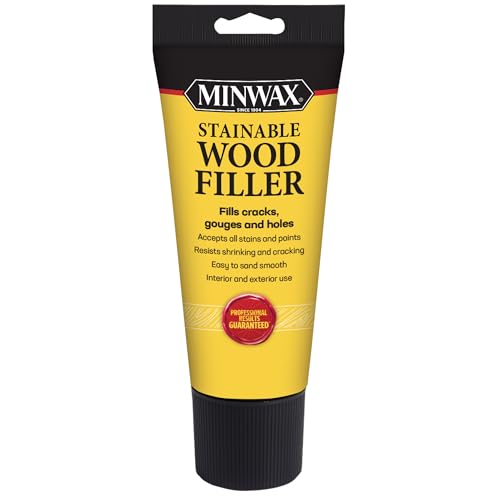
Minwax Stainable Wood Filler
Minwax Stainable Wood Filler
A latex filler made to take all Minwax stains, oil and water-based, for pieces you're about to stain.
Check price on AmazonSpecs: Minwax
Best for
Furniture and tabletops you're about to stain.
- Formulated for Minwax stains
- Shallow fills dry in about 2 hours
- Indoor and outdoor
Skip it if
The wood is already finished: this filler is for unfinished wood.
- Deep holes need several layers
- For unfinished wood only
Read full review
Best Stainable Wood Filler
Minwax Stainable Wood Filler is a latex filler that Minwax formulates to accept all Minwax stains, oil-based and water-based. If you’re refinishing a piece and already have a can of Minwax stain on the bench, this is the filler built to work with it. It’s for cracks, small gouges, nail holes and knot holes in unfinished wood, indoors or out.
Minwax says most shallow repairs are dry within 2 hours. For deeper holes it tells you to fill in 1/4″ layers, each taking 2 to 6 hours, which is slower than a two-part filler but gives a sounder patch than one thick blob. Fill slightly above the surface and sand it flush once it’s dry.
Best for trimWater-resistant filler
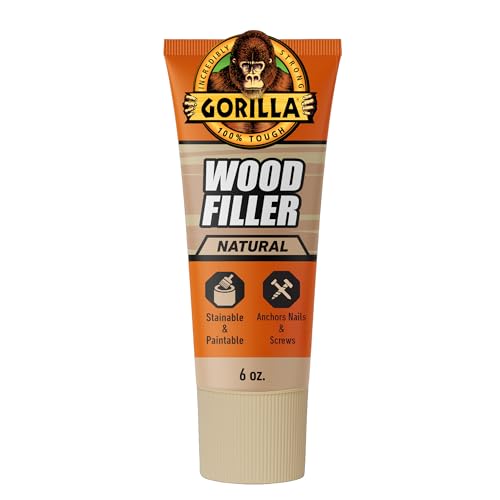
Gorilla All Purpose Wood Filler
Gorilla All Purpose Wood Filler
A water-resistant filler in a squeeze tube that anchors nails and screws, for trim and outdoor wood.
Check price on AmazonSpecs: Gorilla
Best for
Baseboards, window trim, doors and outdoor wood that sees moisture.
- Water resistant, indoor and outdoor
- Anchors nails and screws
- Tube is easy to control in small holes
Skip it if
You're repairing rotted wood or a large hole: go two-part.
- Not meant for large rot repairs
Read full review
Best Wood Filler for Trim and Outdoor Wood
Gorilla All Purpose Wood Filler is sold for strong, water-resistant repairs to cracks, gouges and holes, indoors or outdoors. Gorilla says it doesn’t shrink or crack, and it’s paintable, stainable and sandable. The squeeze tube makes it easy to work into nail holes along baseboards, casings and exterior trim without opening a tub.
One detail that sets it apart from cosmetic fillers: Gorilla says it anchors nails and screws, so a stripped hinge screw hole or a loose trim nail can be filled and refastened. It’s the filler I’d pick for anything that gets wet now and then, like window trim or a porch rail.
Best for rotTwo-part wood filler
3M Bondo Wood Filler
3M Bondo Wood Filler
A two-part filler that doesn't shrink and is sandable in 15 minutes.
Check price on AmazonSpecs: the Amazon listing; maker site unreachable
Best for
Large holes, rotted exterior wood and same-day repairs.
- Two-part, non-shrinking
- Sandable in 15 minutes
- Rotted sills, door bottoms, large gouges
Skip it if
You're only filling nail holes, where a latex filler is simpler.
- Short working time once mixed
- Strong smell: ventilate and wear gloves
Read full review
Best Wood Filler for Large Holes and Rotted Wood
Bondo Wood Filler is a two-part filler: you mix it with the cream hardener in the box and it cures by chemical reaction, bonding to the surface rather than just drying. 3M sells it for damaged and rotted wood on interior and exterior surfaces, and describes the repair as permanent and non-shrinking.
The big advantage is speed: it’s sandable in 15 minutes, and a 30 oz can fills the kind of hole that would take several layers and two days with a latex filler. It’s paintable, stainable and water resistant. The trade-off is working time: once mixed, you have minutes, not hours, so mix small batches. 3M lists rubber gloves and a spreader as the extra items you need.
Best epoxyEpoxy wood putty
J-B Weld KwikWood
J-B Weld KwikWood Epoxy Putty
A two-part epoxy stick you knead by hand to rebuild broken corners and knot holes. It cures in about an hour.
Best for
Rebuilding broken corners, stripped hinge areas and through-knots.
- Sets in 15-25 min, cures in 1 h
- Can be drilled and tapped
- No mixing cups: knead by hand
Skip it if
You need to fill a large area: the stick is small.
- 1 oz stick for small repairs only
Read full review
Best Epoxy Wood Filler for Quick, Strong Repairs
KwikWood is a two-part epoxy putty in a stick: cut off what you need, knead it by hand until the color is even, and press it in. It sets in 15 to 25 minutes and cures in 1 hour to a light tan. J-B Weld rates its strength at 2,450 PSI and says it won’t shrink or rot.
Because it’s a putty you shape by hand, it’s the one to use for rebuilding: a broken table-leg corner, a stripped hinge area, a knot hole that goes right through. Once cured it can be stained, molded, tapped, drilled, sanded and shaped. The 1 oz stick is small, so it’s a repair tool, not a filler for a whole door.
How I Chose These Wood Fillers
I picked fillers sold on Amazon today from makers that state clearly what their product does, then grouped them by the repair they suit rather than ranking them on one number. My criteria:
- The repair: nail holes and cracks, stained furniture, outdoor trim, large holes and rot, structural fixes.
- Formula: one-part latex for easy cleanup, two-part for depth and strength.
- What happens after: whether the maker says it takes stain, paint, screws and weather.
- Honest claims: dry times and strength figures are the makers’ own, quoted as theirs.
I don’t show star ratings or prices: prices change daily, so the Amazon buttons show the live price.
How to Choose the Best Wood Filler
Wood Filler vs Wood Putty
They are not the same product. Wood filler goes on bare wood before you sand and finish: it dries hard, you sand it flush, then stain or paint over it. Wood putty stays soft or semi-soft, comes pre-colored, and goes on after the finish: you press it into nail holes in finished trim or furniture and wipe off the excess, with no sanding. Rule of thumb: bare wood, use filler; finished wood, use putty. The full comparison, repair by repair, is in wood filler vs wood putty.
Water-Based (Latex) vs Two-Part
Latex fillers like DAP, Minwax and Gorilla are ready to use, clean up with water and are ideal for holes up to about 1/4″. They dry by evaporation, so a deep fill can shrink and needs layers. Two-part fillers, polyester like Bondo or epoxy like KwikWood, cure by reaction: they don’t shrink, they fill deep holes in one go, and they end up harder. The trade-off is short working time, a stronger smell and more cleanup.
Inside or Outside?
Outdoors, wood swells and shrinks with the weather and gets wet. Choose a filler the maker rates for exterior use and water resistance, and for rot, a two-part filler after you’ve cut back to sound wood. Then seal it: primer and paint, or a good exterior finish. An unsealed patch on a deck or sill won’t last. For deck boards, see my guide on how to sand a deck before you fill.
If You’re Going to Stain
This is where most filler repairs fail. Wood takes stain through open pores and end grain; filler doesn’t have either, so it usually stains lighter or darker than the wood around it. Three ways to get a better match:
- Use a filler made for staining and test it on a scrap of the same wood with the same stain.
- Tint the filler before you apply it, or choose a pre-colored filler close to the finished color.
- Stain first, fill after with a color-matched putty or wax stick, and touch up with a stain marker.
Size of the Hole
Nail holes and hairline cracks: any latex filler. Holes up to about 1/4″: latex in one or two passes. Anything deeper, wider or crumbling: a two-part filler. Missing corners and edges: an epoxy putty you can shape by hand.
How to Use Wood Filler (Step by Step)
- Clean and prep the hole. Remove loose fibers, old finish and dust. On rot, dig back to firm wood.
- Press it in hard. Work the filler into the hole with a putty knife, pressing to push out air.
- Leave it slightly proud. Overfill a little above the surface to allow for sanding, but don’t smear it across the surrounding grain, especially if you’re staining.
- Let it dry fully. Follow the label: deep fills take far longer than shallow ones. DAP’s DryDex color change takes the guessing out.
- Sand flush with the grain. Use a sanding block so you don’t dish the patch. My grit guide for wood covers which grits to use on filler.
- Remove the dust and finish. Wipe with a tack cloth, then stain, paint or clear-coat. Drying times, deep holes and staining without blotches are covered in my guide on how to use wood filler.
💡 Pro Tip
On a big sanding job, fill after your first coarse pass, not before. The coarse grit opens the surface and shows every defect; the filler then gets sanded with the finer grits along with the rest of the piece. A detail sander helps in corners: see my best detail sanders.
Best Wood Filler for Furniture, Cabinets and Tables
For furniture you’ll stain, start with Minwax Stainable Wood Filler if you’re using Minwax stain, and test on the underside first. For furniture and cabinets you’ll paint, DAP Plastic Wood-X is the easier all-rounder because it sands cleanly and holds on edges. If a tabletop has dents rather than holes, try steaming them out with a damp cloth and an iron before you reach for filler at all. My guides on how to sand and refinish a table and the best sanders for furniture cover the rest of the job.
🏆 The Verdict
For most repairs, get DAP Plastic Wood-X with DryDex: it handles nail holes, cracks and chipped edges, takes screws, and tells you when it’s dry. If you’re staining with Minwax, use Minwax Stainable Wood Filler and test it first. For trim and wood that gets wet, Gorilla All Purpose. For big holes and rot, mix Bondo Wood Filler. And keep a stick of J-B Weld KwikWood in the drawer for the repairs that need to be strong in an hour.
❓ Frequently Asked Questions
What is the strongest filler for wood?+
Which is better, wood filler or putty?+
What is the best product to fill a hole in wood?+
What wood filler dries the hardest?+
What is the best wood filler for large holes?+
Is there a wood filler that really takes stain?+
Have a repair you’re not sure how to fill? Describe it in the comments and I’ll tell you which filler I’d use.
