
As an Amazon Associate I earn from qualifying purchases. All claims are strictly my personal opinion.
Liquid sandpaper is a wipe-on deglosser: a cleaner that dulls a glossy painted or varnished surface so new paint can grip it, without the dust of sanding. It works on sound finishes that are clean and intact, like cabinets, doors and trim you want to repaint. It doesn’t level drips, smooth rough patches, remove peeling paint or prepare bare wood, and no maker gives it a grit number, because it doesn’t scratch the surface the way sandpaper does.
Below is what liquid sandpaper actually does, what the makers say on the label, the jobs where it really can replace sanding and the ones where it can’t, how to use it step by step, and the products and sanding tools worth having on hand.
⚡ Quick Answer
Use it: on sound, glossy paint or varnish you’re recoating, especially on moldings, spindles and raised panels that are slow to sand. Krud Kutter Gloss-Off and Klean-Strip Liquid Sandpaper are the two common ones.
Sand instead: when paint is peeling, rough, dripped or damaged, or the wood is bare. A fine sanding sponge or a 1/4-sheet sander does it quickly.
Equivalent grit: none. No maker publishes one, so treat any number you read online as a guess.
What Is Liquid Sandpaper?
“Liquid sandpaper” is a marketing name for a liquid deglosser: a solution you wipe onto an existing finish to clean it and take the shine off, so the next coat bonds instead of sliding around on a slick surface. The names are used interchangeably on store shelves. Klean-Strip calls its product Liquid Sandpaper and prints “Degreases and Deglosses” and “Use instead of sandpaper” on the can; Krud Kutter calls its version Gloss-Off Prepaint Surface Preparation; Sherwin-Williams sells M-1 Paint Deglosser and Pre-Paint Cleaner.
What It Does, According to the Makers
- Klean-Strip Liquid Sandpaper (QKLS285): the current label describes it as a no-mess degreaser and deglosser, in the product category “General Purpose Degreaser” with a maximum VOC of 0.5%. It contains dibasic esters and a glycol ether, and the label warns it is an eye irritant.
- Krud Kutter Gloss-Off: Rust-Oleum, which owns Krud Kutter, lists it as a no-rinse, one-step formula that “cleans and deglosses without sanding”, for use on all paints, varnish, lacquer and polyurethane, and says it may be coated over anytime after 10 minutes. It carries the EPA Safer Choice label.
- Sherwin-Williams M-1: a water-based deglosser that the company says eliminates the need for sanding before recoating, deglosses latex or oil-based painted surfaces, and has a 10-day open time.
What It Doesn’t Do
A deglosser works on the very top of the old finish. It doesn’t remove material the way an abrasive does, so it can’t flatten a drip, feather the edge of a chip, knock down brush marks or take off flaking paint. It also does nothing useful on bare wood, which has no gloss to remove. And it isn’t a stripper: if you want the old finish off, you need a paint stripper, a heat gun or a sander, which my guide on how to strip paint from wood compares.
What Grit Is Liquid Sandpaper Equivalent To?
There isn’t an equivalent grit, and none of the makers above claims one. Grit numbers describe the size of the abrasive particles on a sheet (see the sandpaper grit chart for how the CAMI and P scales work). A deglosser has no particles: it dulls and cleans the surface chemically, so the “scratch” it leaves isn’t comparable to 120, 180 or 220 grit. When you see a grit equivalence on a forum or blog, it’s someone’s impression, not a measurement.
What you can compare is the result. If a scuff-sanded surface and a deglossed surface both look evenly dull and the new coat passes an adhesion test (more on that below), both did the job. If you prefer to sand, our grit guide for wood recommends scuffing sound paint with 120 to 150 grit until the gloss is gone.
Liquid Sandpaper vs Sanding: When Each One Wins
| Surface or job | Liquid sandpaper | Sanding | Why |
|---|---|---|---|
| Sound, glossy paint on trim and moldings | Yes | Slow | Profiles are hard to sand evenly; a rag reaches every groove |
| Kitchen cabinets in good shape | Yes, after degreasing | Yes | Grease must go first; many pros do both |
| Peeling, chipped or flaking paint | No | Yes | Loose paint has to be removed and the edges feathered |
| Drips, runs, brush marks, dust nibs | No | Yes | Only an abrasive levels a surface |
| Bare wood | No | Yes | There’s no gloss to remove; wood needs smoothing |
| Old paint that may contain lead | Preferred | Only lead-safe | Sanding lead paint makes hazardous dust |
| Car paint | No | Yes | Klean-Strip’s label says not for automotive paint |
When Liquid Sandpaper Can Replace Sanding
The best case is a finish that’s sound, clean and simply too shiny to paint over: semi-gloss trim, enameled doors, varnished cabinets, a painted dresser with carved details. The paint is stuck to the wood; you only need the new coat to stick to it. Here a deglosser saves the slowest part of the job, which is sanding into every bead, cove and panel edge, and it makes no dust in a lived-in room.
When You Still Need to Sand
Any time the surface has to change shape. Peeling or chipped paint, old drips, deep scratches, a patched area and filler all need an abrasive to level and feather them. Raw wood needs sanding to smooth it. And a deglosser can’t fix poor adhesion underneath: if the old paint lifts with a fingernail, a new coat on top will lift with it. For flat areas, a sheet sander or a random orbital sander does the scuffing fastest.
The Middle Road Most Painters Take
On cabinets and trim, many painters combine both: degrease, scuff the flat areas lightly with a fine sponge or a sander, use the deglosser on the profiles the sponge can’t follow, and then prime with a bonding primer. It costs a little more time than wiping alone, but it removes the guesswork on a slick or unknown finish.
⚠️ Important
In homes built before 1978, painted woodwork may contain lead. Test it before you sand: dry sanding lead paint creates dust that’s dangerous to breathe, especially for children. A deglosser doesn’t make dust, which is one more reason to reach for it on old trim that is still sound. The first step of my guide to stripping paint from wood covers lead testing.
How to Use Liquid Sandpaper, Step by Step
These steps follow Klean-Strip’s label, which is the most detailed of the three; check the can of whatever you buy, because wait times differ.
- Protect yourself. Klean-Strip’s first instruction is to wear chemical splash goggles. Wear chemical-resistant gloves too, and ventilate the room.
- Degrease first if needed. The Klean-Strip label says kitchens and areas with heavy grease or wax build-up may need cleaning with TSP or a TSP substitute before the deglosser.
- Saturate a coarse, lint-free cloth with the product at full strength. Krud Kutter also says not to dilute Gloss-Off.
- Rub with pressure in a circular motion. Fold the cloth and re-wet it often so you aren’t wiping dirt back on, and change cloths as they load up.
- Let it dry. Klean-Strip says to apply the new coating anytime after the surface is dry; Krud Kutter says Gloss-Off can be coated over after 10 minutes. Sherwin-Williams gives M-1 a 10-day open time.
- Prime or paint. Don’t let dust and hand oils build up on the prepared surface before you coat it.
Do You Rinse It Off?
Not with these three. Krud Kutter calls Gloss-Off a no-rinse formula, and the Klean-Strip label says the product leaves a slight residue that can be painted over. Rinsing with water would add moisture to the wood for no reason. If your can says otherwise, follow your can.
How to Check It Worked
Look at the surface under a raking light: it should be evenly dull, with no shiny patches. After your first coat of primer has dried for the time on its label, do a small tape test somewhere hidden: score a small cross through the coating with a utility knife, press painter’s tape firmly over it and pull it off fast. A few flecks on the tape are a warning; sheets of paint on the tape mean the prep failed, and that area needs sanding. ASTM D3359 is the standard version of this tape test.
Mistakes That Make Liquid Sandpaper “Not Work”
- Wiping instead of scrubbing. Klean-Strip says to apply pressure. A light wipe leaves gloss behind.
- Using it on fresh paint. The Klean-Strip label says not to use it on freshly finished surfaces.
- Skipping the degreaser in a kitchen. Grease under paint is an adhesion problem no deglosser fixes.
- Using it on the wrong material. Klean-Strip’s listing excludes rubber or asphalt tile, synthetics, plastic, fiberglass and other solvent-sensitive surfaces.
- Expecting it to fix a bad surface. It removes gloss, not defects.
Liquid Sandpaper on Walls, Cabinets and Furniture
Walls
For semi-gloss or gloss wall paint in good condition, a deglosser is an easy way to take the shine off before repainting, and it cleans the wall at the same time. Patch and spackle first, sand the patches smooth, then degloss the whole wall so the new paint meets one even surface.
Kitchen Cabinets
Cabinets are the classic use: lots of profiles, lots of grease, and no wish to fill the kitchen with dust. Degrease, degloss, scuff the flat door panels lightly if you can, and use a bonding primer. If the cabinets have a factory catalyzed finish or a thermofoil (vinyl) skin, check the primer maker’s instructions: those are among the hardest surfaces to paint, and a plastic skin falls under the solvent-sensitive warning.
Furniture
On a painted piece that’s in good shape, a deglosser works the same way. If you plan to stain or show the wood, it’s the wrong product: you need the finish off, and my guide on how to refinish wood furniture covers stripping and sanding.
The Kit: Deglossers and the Sanding Tools That Back Them Up
The specs below are the makers’ own, from the product pages, labels and listings. I don’t show customer ratings or prices, which change daily.
Krud Kutter Gloss-Off Prepaint Surface Preparation

Best Liquid Deglosser for Most Jobs
Gloss-Off is the one I’d pick up first because the maker is clear about what it’s for. Rust-Oleum says it’s a no-rinse, one-step product that cleans and deglosses without sanding, works on paints, varnish, lacquer and polyurethane, and can be coated over after 10 minutes. It also removes dirt, grease and wax, and it’s EPA Safer Choice certified. Use it at full strength.
- ✅ No rinse, recoat after 10 minutes
- ✅ Rated for paint, varnish, lacquer and polyurethane
- ✅ Also cleans grease and wax
- ❌ No grit equivalent or “sanding level” given
Best For: Trim, doors and furniture with sound, glossy paint or varnish.
Krud Kutter Degreaser and Gloss-Off Bundle

Best for Kitchen Cabinets
Cabinet doors near a stove carry grease that a deglosser alone may not cut, and both Klean-Strip and Krud Kutter tell you to degrease heavy build-up first. This bundle pairs Krud Kutter Original Cleaner Degreaser, a water-based degreaser, with Gloss-Off, so the two steps use one brand’s system: clean, let dry, then degloss.
- ✅ Degreaser and deglosser in one order
- ✅ Water-based degreaser
- ✅ Right sequence for kitchens
- ❌ More product than a small trim job needs
Best For: Repainting kitchen and bathroom cabinets.
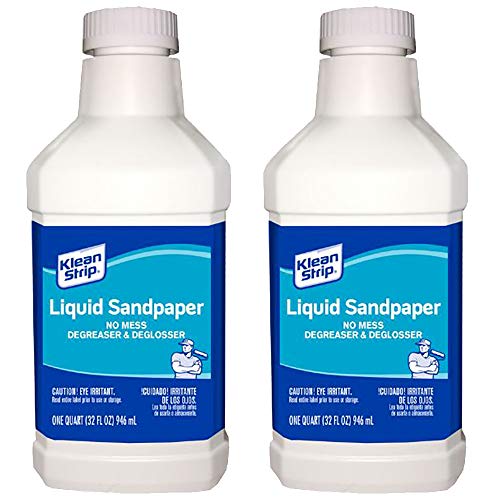
Klean-Strip Easy Liquid Sander Deglosser, 2-Pack
The Original “Liquid Sandpaper”
Klean-Strip’s product is the one most people mean when they say liquid sandpaper. The label directions are specific: scrub with a saturated, lint-free cloth in a circular motion, refold often, and apply the new coating once it’s dry. The listing says there’s no need to rinse before painting and that it helps new paint bond to old finishes, and the label adds that it’s not for automotive paint or freshly finished surfaces. This listing is a pack of two quarts.
- ✅ Clear, step-by-step label directions
- ✅ No rinse before painting
- ✅ Low VOC (0.5% maximum on the label)
- ❌ Not for car paint, plastics or fiberglass
Best For: Painted walls, trim and doors before repainting.
3M Sanding Sponge Block, Fine

Best for Scuffing by Hand
When the deglosser leaves a stubborn shiny patch, or you want to knock down a few dust nibs, a sponge does it without cutting through edges. This 3M block is extra large, 2-7/8 x 8 in, works wet or dry and rinses clean to reuse. It flexes around rounded edges and turned parts where folded paper would dig in. For more options, see my best sanding blocks and sponges.
- ✅ Follows edges and profiles
- ✅ Wet or dry, reusable
- ✅ No dust cloud when used wet
- ❌ 3M grades it “fine”, not by grit number
Best For: Touching up spots the deglosser missed and scuffing small parts.
DEWALT DWE6411K 1/4-Sheet Palm Sander

Best Sander When the Surface Needs Real Sanding
For flat cabinet doors, drawer fronts and panels that need more than a wipe, a 1/4-sheet sander scuffs evenly and reaches into square corners that a round pad can’t. The DWE6411K has a 2.3 amp motor at 14,000 OPM, a paper clamp that takes ordinary sheets cut into quarters, and a punch for dust holes. Load it with 120 or 150 to take the gloss off sound paint.
- ✅ Square pad reaches corners
- ✅ Uses cheap, standard sheets
- ✅ Light, gentle cut for scuffing
- ❌ Slow for removing paint completely
Best For: Cabinet doors, panels and furniture tops before repainting.
How I Put This Guide Together
The product facts come from the makers: Klean-Strip’s current label and safety data sheet for Liquid Sandpaper (QKLS285), Rust-Oleum’s product page for Krud Kutter Gloss-Off, and Sherwin-Williams’ page for M-1 Deglosser. Where a claim comes from an Amazon listing instead, I say so. The grit advice for sanding sound paint matches my wood grit guide. The products are on sale on Amazon today; I don’t show customer ratings or prices. More on how I choose the products I recommend.
🏆 The Verdict
Liquid sandpaper is a good shortcut on one kind of job: sound, glossy paint or varnish that you want to recoat, especially on detailed trim and cabinets. Scrub it on with pressure, let it dry and prime. It has no grit equivalent and it doesn’t level anything, so peeling paint, drips and bare wood still need an abrasive. Keep Krud Kutter Gloss-Off for the profiles and a fine sanding sponge for whatever it can’t fix.
❓ Frequently Asked Questions
Does liquid sandpaper really work?+
Is liquid sandpaper better than sanding?+
Do I need to rinse off liquid sandpaper?+
What are the disadvantages of liquid sander?+
Is deglosser the same as liquid sandpaper?+
Do you have to wipe off deglosser before painting?+
Conclusion
Liquid sandpaper earns its place when the old finish is sound and the only problem is shine, and it’s at its best on profiles and cabinets where sanding is slow and dusty. It isn’t sandpaper in a bottle: there’s no grit, no leveling and no help on bare or damaged surfaces. When the job calls for real sanding, the grit chart tells you where to start, and my guide to types of sandpaper explains which abrasive to buy.

