
As an Amazon Associate I earn from qualifying purchases. All claims are strictly my personal opinion.

An electric hand planer shaves wood off in thin, flat curls and is the faster, straighter tool for taking a door, beam or board edge down to size; a belt sander grinds wood away and is the better tool for smoothing wide surfaces, leveling glue-ups and removing paint. If you need to remove more than about a sixteenth of an inch, plane it. If you need a smooth, even surface, sand it. On most real projects you do both: plane first, then sand.
This comparison is about the two handheld tools. If you’re choosing between a benchtop thickness planer and a drum sander for dimensioning boards, that’s a different decision, covered in drum sander vs planer.
⚡ Quick Answer
Trimming doors, fitting boards, chamfering beams: a power planer such as the Makita KP0800K.
Smoothing tabletops, leveling glue-ups, stripping paint: a belt sander such as the Metabo HPT SB8V2.
On a budget: the WEN 6530 planer.
Belt Sander vs Planer at a Glance
| Feature | Electric Hand Planer | Belt Sander |
|---|---|---|
| How it cuts | Spinning knives slice shavings | Abrasive belt grinds dust |
| Depth per pass | Set by a dial, up to 1/16″ to 1/8″ on common 3-1/4″ models | Not set; depends on grit and time |
| Width of cut | 3-1/4″ on most models | 3″ or 4″ belts |
| Surface left behind | Flat and straight, may show ridges or tear-out | Even scratches that need finer sanding |
| Straightening an edge | Excellent: long sole bridges the dips | Poor: follows the dips |
| Painted or dirty wood | Dulls knives; hidden nails ruin them | Fine: the belt is a consumable |
| Wide flat surfaces | Leaves steps between passes | The better tool |
| Extra jobs | Chamfers and rabbets on many models | Shaping and rounding edges |
| Mess | Chips, easy to sweep | Fine dust, needs collection |
How Each One Works
Electric Hand Planer
A power planer has a small drum, the cutterhead, carrying two knives that spin between a front and a rear shoe. My guide on how to use a hand planer covers the technique, and the best hand planer picks compare seven corded and cordless models. You set the depth with the front knob, and every pass removes exactly that much wood across the width of the knives. The Makita KP0800K, for example, planes 3-1/4″ wide and up to 3/32″ deep in one pass, and the WEN 6530 adjusts from 0 to 1/8″ in 16 steps. Because the long base rides on the high spots and bridges the low ones, a planer straightens an edge instead of just following it.

Belt Sander
A belt sander runs a loop of abrasive over a flat platen. It has no depth setting: it removes wood as long as you keep it on the surface, and how much depends on the grit, the wood and how long you stay in one place. That makes it slower and less precise for sizing, but far better for making a wide surface smooth and even, and it doesn’t care about old paint or a hidden staple the way planer knives do. My guide on how to use a belt sander covers the technique.
When to Use a Planer
- Trimming a sticking door. A planer takes a clean, straight shaving off the edge. Plane the latch side, or the bottom, and work from each end toward the middle so the end grain doesn’t split.
- Fitting boards, shelves and countertop edges to a line.
- Taking down high joists, studs and beams, and flattening rough timber.
- Chamfers and rabbets: many planers have a V-groove in the front shoe for chamfering, and some take a rabbeting guide (the WEN 6530 cuts rabbets up to 1 inch).
When to Use a Belt Sander
- Leveling glued-up panels and tabletops, wider than the planer’s 3-1/4″ cut.
- Removing paint and old finish from flat surfaces. See how to strip paint from wood.
- Smoothing planer marks before finer sanding.
- Scribing and shaping small amounts to a curved line.
- Any surface with hidden metal, where planer knives would chip.
Using Both: Plane, Then Sand
The two tools work best as a sequence. Plane to size and to a straight line, then belt sand at 80 or 100 grit to blend the passes and remove any ridges or tear-out, then finish with a random orbital from 120 up to 180 or 220 before stain or paint. For a broader comparison of the belt sander with finishing sanders, see belt sander vs orbital sander.
⚠️ Important
Before planing reclaimed or installed wood, run a magnet or a metal detector over it and set every nail and screw well below the surface. One hidden nail chips both knives. And keep your hands on both handles of a planer until the cutterhead stops: the knives keep spinning after you let go of the trigger.
Planers I’d Buy
Makita KP0800K 3-1/4″ Planer

Best Planer Overall
The KP0800K planes 3-1/4″ wide and up to 3/32″ deep per pass with a 6.5 A motor and a two-blade carbide cutterhead at 17,000 RPM. The depth knob clicks in 0.1 mm steps, a spring-loaded stand lifts the base off the work when you set it down, and the blade-setting system makes knife changes quick. It weighs 5.7 lb and comes with a case.
- ✅ Fine 0.1 mm depth steps
- ✅ Spring-loaded stand protects the blades
- ✅ Carbide blades
- ❌ Mid-to-premium price tier
Best For: Doors, fitting and finish carpentry, where a precise cut matters.
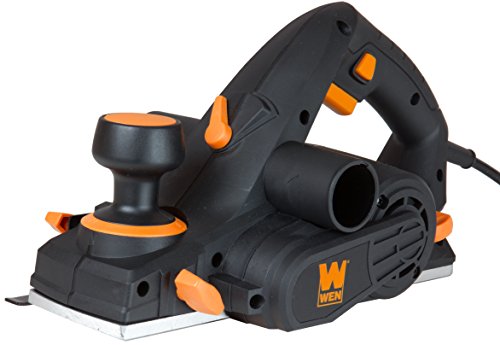
WEN 6530 6-Amp 3-1/4″ Electric Hand Planer
Best Budget Planer
The WEN 6530 cuts 0 to 1/8″ deep in 16 positive stops and makes rabbets up to 1″ with its rabbeting guide. The 6 A motor gives up to 34,000 cuts per minute, it weighs 6 lb, and the kit includes a dust bag, a kickstand and a parallel fence bracket, with a 2-year warranty. It sits in the lowest price tier.
- ✅ Deepest cut here, 1/8″
- ✅ Rabbets up to 1″
- ✅ Lowest price tier
- ❌ Coarser depth steps than the Makita
Best For: Occasional door trimming and rough carpentry on a budget.
Belt Sanders I’d Buy
For more options, including 4″ x 24″ and cordless models, see my full belt sander reviews.
Metabo HPT SB8V2 3″ x 21″ Belt Sander

Best Belt Sander to Pair With a Planer
A 9 A, 1,020 W motor with a variable speed dial at the base of the handle, a clear front cover so you can see the belt when sanding up to a surface, and a left-side dust bag that stays out of the way in corners. Metabo HPT backs it with a 5-year limited warranty.
- ✅ Variable speed
- ✅ Clear front cover
- ✅ 5-year warranty
- ❌ Heavier than 3″ x 18″ sanders
Best For: Blending planer passes, leveling glue-ups and stripping flat surfaces.
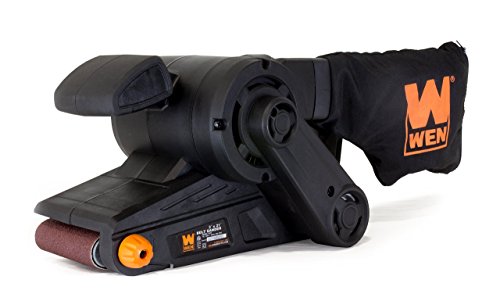
WEN 6321 7-Amp 3″ x 21″ Belt Sander
Best Budget Belt Sander
The WEN 6321 runs a 3″ x 21″ belt with a 7 A motor and weighs about 6 lb, light for this belt size. It has a lock-on switch for long passes, a detachable dust bag, and a 2-year warranty. It sits in the lowest price tier.
- ✅ Light for a 3″ x 21″
- ✅ Lock-on switch
- ✅ Lowest price tier
- ❌ Single speed
Best For: Occasional sanding next to a budget planer.
🏆 The Verdict
Choose a power planer when the job is removing a measured amount of wood in a straight line: doors, edges, beams, fitting. Choose a belt sander when the job is making a wide surface flat and smooth, or taking off paint. If you only buy one for general home repairs, the planer solves the jobs a sander can’t; the belt sander is the one to add when you start building furniture.
❓ Frequently Asked Questions
Can a planer be used as a sander?+
Can I plane a door with a sander?+
Can I sand my wood floor with a belt sander?+
Do you need to sand after planing?+
Trying to decide for a specific job? Describe it in the comments and I’ll tell you which tool I’d reach for.

