
As an Amazon Associate I earn from qualifying purchases. All claims are strictly my personal opinion.
Editor’s Choice
Short on time? Of the 6 sanding belt cleaners on this list, this is the one I'd buy.
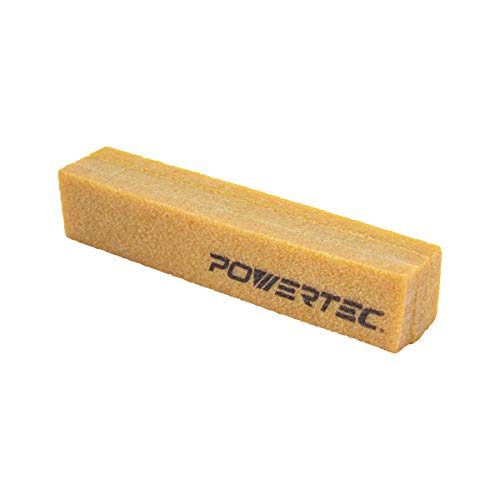
An 8-1/2″ natural rubber stick, long enough to keep your hand well back from belts and discs.
- Also recommended POWERTEC 71407
- Also recommended Big Horn 19545

A sanding belt cleaner is a block of soft natural rubber that you press against a running belt or disc. The rubber grabs the packed-in sawdust, pitch and glue and pulls it out of the grit, so a belt that had stopped cutting cuts again. Norton and Big Horn both say regular cleaning can make a belt last up to 10 times longer. For most shops, the best sanding belt cleaner is the POWERTEC 71002, a large 8-1/2″ natural rubber stick from a maker that is clear about what it cleans and what it doesn’t. For wide belts and drums, go up to a 12″ stick; for handheld sanders, a short one.
Below are my six picks, a comparison table, short reviews, a step-by-step guide to cleaning sanding belts and discs, what to do when a stick isn’t enough, and how to tell when a belt is finished.
Best Sanding Belt Cleaners: Comparison
Tiers compare today’s prices without printing them: $ is the lowest tier on the page and $$ the next one up. The Amazon buttons show the live price.
| Product | ⭐ POWERTEC 71002 🏆 EDITOR’S CHOICE |
Norton Belt Cleaning Stick | POWERTEC 71407 | Big Horn 19545 | WEN WA0002 | POWERTEC 71424 2-Pack |
|---|---|---|---|---|---|---|
| Image | |
 |
 |
 |
 |
 |
| Size | 8-1/2″ x 1-1/2″ x 1-1/2″ | 6″ x 1-3/8″ x 1-3/8″ | 12″ x 2″ x 2″ | 6″ x 2″ x 1-1/2″ + handle | 8″ x 1-1/2″ x 1-1/2″ | 2 x 4-1/2″ x 1-3/8″ x 1-3/8″ |
| Material | Natural rubber | Solid natural rubber | Natural rubber | Rubber, plastic handle | FSC-certified natural rubber | Natural rubber |
| Best for | Belt, disc and spindle sanders | Narrow belts, handheld sanders | 6″ belts, 12″ discs, open drums | Big machines, two-handed cleaning | All-round, palm to disc sanders | Handheld sanders, grip tape |
| Tier | $ | $ | $ | $$ | $ | $ |
| Availability | Check price on Amazon | Check price on Amazon | Check price on Amazon | Check price on Amazon | Check price on Amazon | Check price on Amazon |
Best Sanding Belt Cleaners: Reviews
All six are the same idea, a block of soft rubber; what changes is the size, the handle and who makes it. The specs below are the makers’ own, from each product’s listing.
Editor's Choice8-1/2" cleaning stick
POWERTEC 71002
POWERTEC 71002 Abrasive Cleaning Stick, 8-1/2″
A long natural rubber stick that lifts dust, pitch and dried glue from belts, discs and drums with your hand well clear.
Check price on AmazonSpecs: POWERTEC's Amazon listing
Best for
Benchtop belt and disc sanders, spindle sanders and handheld belt sanders.
- Long enough to keep fingers clear
- Belts, discs and drums
- Lowest price tier
Skip it if
You clean a drum sander with a conveyor feed: POWERTEC says it isn't meant for those.
- Not for conveyor-feed sanders
- Best on dry residue, not wet glue
Read full review
Best Sanding Belt Cleaner Overall
The POWERTEC 71002 is the size most woodworkers want: 8-1/2″ x 1-1/2″ x 1-1/2″ of natural rubber, long enough that your hand stays well back from the belt, thick enough to last. POWERTEC lists it for sanding belts, disc sanders and drum sanders, and says it removes sawdust, pitch, gum and glue without damaging the grit. Hold it against the running abrasive and the rubber pulls the build-up out.
Two details from the listing are worth knowing before you use it. POWERTEC says it works best on cured or dry residue, so fresh, wet glue or sap will smear rather than lift, and that it is not intended for conveyor-feed sanders, which rules out using it on a drum sander that feeds the board on a moving belt. The same stick also comes in 2- and 4-packs if you want one at every machine.
Best for narrow belts6" cleaning stick
Norton Belt Cleaning Stick
Norton Belt Cleaning Stick, 6″
The abrasives maker's own solid rubber stick, sized for handheld belt sanders and narrow belts.
Check price on AmazonSpecs: Norton's Amazon listing
Best for
3" and 4" handheld belt sanders and narrow benchtop belts.
- From an abrasives maker
- Compact for narrow belts
- Clear about what it cleans
Skip it if
You clean wide belts or big discs, where a 12" stick keeps your hand farther away.
- Shorter: hands closer to big machines
- Not for metal loading
Read full review
Best from an Abrasives Maker
Norton makes sanding belts, so its cleaning stick is the one designed by the people who make the abrasive. It’s solid natural rubber, 6″ x 1-3/8″ x 1-3/8″, made to be used while the belt is running, and Norton says regular use increases the cut rate and extends belt life up to 10 times.
Norton is specific about what it cleans: wood, plastic and other nonmetallic materials. If you grind metal on the same belt, a rubber stick won’t pull steel or aluminum out of the grit (see the section on metal below). The shorter, narrower stick is easy to control on a 3″ or 4″ handheld belt sander.
Best for wide belts12" cleaning stick
POWERTEC 71407
POWERTEC 71407 Abrasive Cleaning Stick, 12″
The 12" version: one sweep across a 6" belt or a 12" disc, with more rubber to wear down.
Check price on AmazonSpecs: POWERTEC's Amazon listing
Best for
6" x 48" belt and disc combos, 12" disc sanders, edge sanders and open drums.
- 12" reach across wide belts
- Most rubber of the sticks here
- Same tier as the 8-1/2" stick
Skip it if
You only own handheld sanders: a short stick is easier to aim.
- Too big for palm and detail sanders
Read full review
Best for Wide Belts and Large Discs
The 71407 is the big version of the 71002: 12″ x 2″ x 2″. The extra length lets you sweep across a 6″ belt or a 12″ disc in one pass with your hand far from the abrasive, and the extra bulk gives you more rubber to wear down in a shop that cleans belts every day. It has the same natural rubber, the same uses (belts, discs, drums) and the same two cautions: dry residue works best, and it’s not for conveyor-feed sanders.
Best with a handleBelt cleaner with handle
Big Horn 19545
Big Horn 19545 Sanding Belt Cleaner with Handle
A rubber cleaner on a plastic handle with a knob, so you clean with two hands kept away from the belt.
Check price on AmazonSpecs: Big Horn's Amazon listing
Best for
Large belt and disc sanders, classrooms and anyone who wants fingers far from the belt.
- Handle keeps both hands clear
- Better control on big machines
Skip it if
A plain stick feels fine to you: it does the same cleaning for less.
- Higher tier than a plain stick
- Smaller block than the 12" stick
Read full review
Best Belt Cleaner with a Handle
Every other stick here puts your hand on the rubber. The Big Horn 19545 mounts a 1-1/2″ x 2″ x 6″ cleaner on a plastic handle with a knob, so you hold it like a plane, with two hands, well away from the abrasive. Big Horn says it can increase the life of belts and discs up to 10 times and cut down on how often you buy new ones.
That makes it the one to buy for a large stationary machine, for a shop where students or beginners clean the belts, or if a belt has ever grabbed a stick out of your hand. It’s the only pick in the next price tier up, and the cleaner block is smaller than the 12″ stick, so on a very wide belt you’ll make a few more passes.
8" cleaning stick
WEN WA0002
WEN WA0002 8-Inch Sandpaper Cleaning Stick
An 8" FSC-certified rubber stick listed for aluminum oxide, silicon carbide and ceramic paper.
Check price on AmazonSpecs: WEN
Best for
Shops with a mix of sanders and abrasives, from palm sanders to disc sanders.
- FSC-certified natural rubber
- Listed for all common abrasives
- Fits belt, disc, palm and drywall sanders
Skip it if
You need extra reach for wide belts: pick the 12" POWERTEC.
- No size advantage over the POWERTEC
Read full review
Best for Mixed Abrasives
WEN’s stick is the same 1.5″ x 1.5″ x 8″ format as the POWERTEC, made from FSC-certified natural rubber. WEN lists it for belt, disc, palm and drywall sanders and for grip tape, and says it works with aluminum oxide, silicon carbide and ceramic sandpaper, which covers every abrasive you’re likely to own.
If you already own WEN machines, like the spindle and belt sanders in my oscillating belt and spindle sander picks, it’s the natural add-on. Otherwise, pick it or the POWERTEC on whichever is in stock.
Best for handheld sanders4-1/2" cleaning sticks
POWERTEC 71424 2-Pack
POWERTEC 71424 Cleaning Stick, 4-1/2″, 2-Pack
Two short sticks that are easy to aim at the small, fast pad of an orbital or palm sander.
Check price on AmazonSpecs: POWERTEC's Amazon listing
Best for
Random orbital, palm and detail sanders, and skateboard grip tape.
- Two sticks per pack
- Easy to control on small pads
- Fits in a sander case
Skip it if
You clean benchtop belts and discs: a longer stick keeps your hand farther away.
- Too short for stationary machines
Read full review
Best for Handheld Sanders
Two short sticks, 4-1/2″ x 1-3/8″ x 1-3/8″ each, in the same natural rubber as the bigger POWERTEC models. A short stick is easier to aim at the small, fast pad of a random orbital or palm sander, and two in the pack means one can live in the sander case and one on the bench.
How I Chose These Belt Cleaners
A cleaning stick is a block of rubber, so the differences that matter are size, a handle or not, who makes it, and whether the listing is clear about what it can and can’t do. I picked cleaners on sale on Amazon today from makers that publish those details (POWERTEC, Norton, Big Horn and WEN) and one for each kind of machine: big stationary sanders, narrow belts, handheld sanders and two-handed use. I left out unbranded multipacks whose listings don’t say who makes them. I don’t show customer ratings or prices, which change daily; more on how I choose the sanders I recommend.
How to Clean a Sanding Belt
A loaded belt is one whose grit is packed with dust, pitch or glue. It stops cutting, gets hot, and starts to burn the wood and leave dark streaks. Cleaning it with a rubber stick takes seconds and is worth doing every time you notice the cut slowing down, not only when the belt is caked.
With a Cleaning Stick, Step by Step
- Clear the table. Take the workpiece away and make sure nothing can be pulled into the belt.
- Turn the sander on and let it reach full speed. Every maker here says the same thing: the stick is used on a running belt or disc.
- Hold the stick firmly by the end farthest from the belt, with your fingers on top and away from the abrasive.
- Press it lightly against the moving belt where the belt runs away from you and down onto the table or platen, so the belt pulls the stick down rather than up toward your hand.
- Sweep it slowly from side to side across the full width. The rubber will turn dark as it picks up dust and pitch.
- Stop when the abrasive looks like grit again, not like a shiny, darker band. Switch the machine off before you put the stick down.
⚠️ Important
Never clean a belt with a rag, a brush held in your fingers or anything that can wrap around the belt. On a handheld belt sander, clamp the sander upside down in a vise or a sanding stand first, so both hands are free and the sander can’t walk. POWERTEC says its sticks are not for conveyor-feed sanders, so for a drum sander with a feed belt, follow the cleaning method in your machine’s manual.
Cleaning Discs, Drums and Spindles
On a disc sander, hold the stick on the half of the disc that turns down toward the table, the same side you sand on, and move it from the center to the rim. On a spindle sander, press the stick against the sleeve as it spins and oscillates, top to bottom. On a random orbital or palm sander, clamp the sander pad-up or hold it firmly, run it, and touch a short stick to the pad: dust lifts out of hook-and-loop paper and net abrasives the same way.
Pitch, Resin and Glue
Sap from pine, cherry and other resinous woods and wet glue are the stubborn cases. POWERTEC’s listing says its sticks work best on cured or dry residue, so let glue squeeze-out harden before you sand it, and let a resinous belt cool before you clean it. When a belt glazes with pitch again and again, the abrasive itself may be the problem: Klingspor recommends open-coat belts, where 50% to 70% of the grain has been left off the backing, for soft, gummy or resinous woods, because the gaps give the dust somewhere to go.
Washing Belts
Klingspor’s technical FAQ says belts with a polyester backing (waterproof by nature) or a chemically waterproofed backing can be washed to clean them out, and that some shops use a degreaser such as Purple Power on them. Klingspor only suggests it for waterproof backings, so don’t try it on paper or cloth belts that aren’t waterproof: water softens and weakens a backing that isn’t made for it. Let a washed belt dry completely before you run it again.
Metal on the Belt
If you grind metal on a belt, the rubber stick won’t do much: Norton lists its stick for wood, plastic and nonmetallic materials. The usual fix is to keep separate belts for metal and wood, which also stops hot metal particles from ending up in a pile of sawdust. Belts used on metal are better replaced than cleaned.
Sanding Belt Cleaner Alternatives
Cleaning sticks are soft natural rubber, and some are sold as crepe rubber (Taytools calls its stick a crepe-rubber belt cleaner), the same kind of rubber used on crepe shoe soles. That’s why the classic shop alternative is an old crepe-soled shoe: on the Sawmill Creek forum, one woodworker says he has cleaned his belts with an old Wallabee shoe for more than 40 years. It works the same way, pressed against a running belt. Keep anything that can snag, like rags, gloves or loose brushes, away from the belt, and keep solvents off paper-backed belts. Given that a branded stick is in the lowest price tier, the alternatives are for emergencies.
How Long Should a Sanding Belt Last?
There’s no number of hours, because it depends on the grit, the wood and the pressure. What you can control is how much of that life you use. A belt is done when cleaning no longer brings the cut back: the grit itself is worn flat and the belt feels smooth to the touch, it burns the wood even when clean, it has a glazed, shiny band that the stick won’t lift, or it is torn, frayed at the edges or splitting at the joint. Press lighter and let the belt cut: heavy pressure makes heat, and heat is what bakes pitch into the grit. For grit choices by job, see the sandpaper grit chart.
💡 Pro Tip
Clean little and often. A five-second pass with the stick after each workpiece keeps the belt cutting cool; waiting until the belt is black means the pitch has already been baked on, and no stick fully removes that.
Belt Cleaners by Machine
- Handheld belt sanders: a 6″ stick like the Norton, with the sander clamped upside down. For the sanders themselves, see the best handheld belt sanders and how to use a belt sander.
- Benchtop belt and disc sanders: the 8-1/2″ POWERTEC 71002 or the WEN. My picks for belt and disc sanders cover the machines.
- 6″ x 48″ belts, 12″ discs and edge sanders: the 12″ POWERTEC 71407 or the Big Horn with a handle. See the best edge sanders and best disc sanders.
- Spindle sanders: any 8″ stick on the sleeve; my spindle sander guide has the machines.
- Random orbital and palm sanders: the short POWERTEC 71424 sticks, and good discs from the best sanding discs list.
🏆 The Verdict
Buy the POWERTEC 71002 for a benchtop belt, disc or spindle sander; step up to the 12″ POWERTEC 71407 for wide belts and big discs, or the Big Horn 19545 if you want a handle. For a handheld belt sander, the Norton stick is the right size. Use it on a running belt, little and often, and you’ll get far more work out of every belt you buy.
❓ Frequently Asked Questions
What is the best way to clean a sanding belt?+
What is a good cleaning stick for sanding belts?+
What should be used to clean belts?+
What is a good cleaning block for sandpaper?+
What to use to clean sandpaper?+
How long should a sanding belt last?+
Conclusion
A sanding belt cleaner is the cheapest upgrade in a sanding shop: one stick in the lowest price tier can save you a box of belts. Get the size that fits your machine, use it on a running belt little and often, and replace belts only when cleaning no longer brings the cut back. If you’re shopping for the machine as well, start with the best benchtop belt and disc sanders, and ask any questions in the comments.
