
As an Amazon Associate I earn from qualifying purchases. All claims are strictly my personal opinion.
First power tool to buy
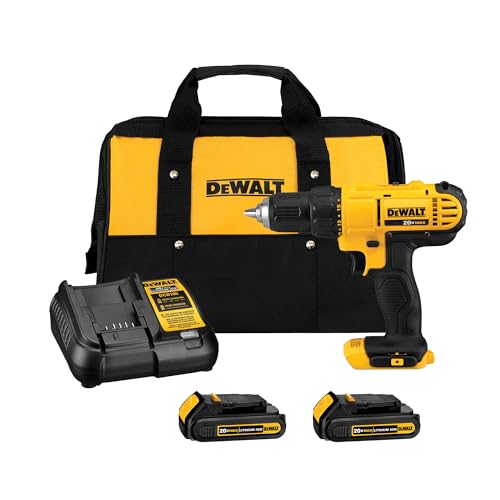
DEWALT DCD771C2 Drill/Driver Kit
A compact 20V MAX drill/driver with two speeds, a 1/2-inch ratcheting chuck, batteries and a charger.

The right woodworking tools for beginners are fewer than most lists suggest, and the order you buy them in matters more than the brand. Start with a way to measure and mark, a saw, clamps, a drill, a sander and a respirator; that kit builds shelves, boxes, cutting boards and a workbench. Add a router, a jigsaw and pocket-hole joinery when a project asks for them, and leave the big machines until you know what you like to build.
This guide lists 19 beginner woodworking tools in the order I’d buy them, in four stages, with a starter kit for each budget and the tools each first project needs. Every tool links to the full buying guide on this site if you want to compare more models. I don’t print prices, because they change by the week: each Check Price button opens the live Amazon price.
⚡ Start Here
First power tool: the DEWALT DCD771C2 – a compact two-speed drill/driver kit with batteries and a charger.
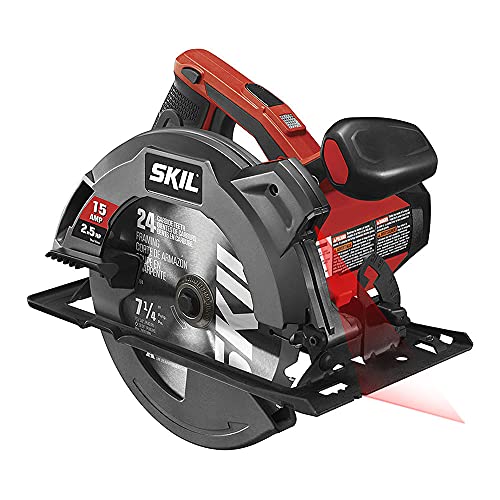
First sander: the Bosch ROS20VSC. First saw: the SKIL 5280-01 circular saw, or the Gyokucho ryoba if you start with hand tools.
First joinery tool: the Kreg 320 pocket-hole jig. First safety buy: the GVS Elipse P100 respirator.
The Essential Woodworking Tools List, in Buying Order
If you only read one section, read this one. These are the essential woodworking tools for a beginner, in the order that wastes the least money, because each one is used by every project that comes after it:
- Measuring and marking: a tape measure, a pencil and a combination square.
- Safety gear: safety glasses, hearing protection and a P100 respirator.
- Clamps: a pair of one-handed clamps to start, more as projects grow.
- A drill/driver: the first power tool for holes, screws and pocket holes.
- A saw: a circular saw for sheet goods and boards, or a Japanese pull saw for hand work.
- A random orbital sander: the sander that finishes every project.
- A work surface: a folding workbench until you build a real one.
- Dust control: a shop vac with a cyclone separator.
- Joinery and shaping: a pocket-hole jig, a compact router, chisels and a jigsaw.
- The first machines: a table saw, a thickness planer or a belt and disc sander, once you know you’ll use them.
Steps one to eight are the basic woodworking tools almost every list agrees on. Steps nine and ten are where your projects, not a list, should decide what comes next.
Beginner Woodworking Tools Compared
The four stages side by side. The budget column uses three tiers instead of exact prices: $ is a small buy, roughly under fifty dollars; $$ is roughly fifty to two hundred and fifty; $$$ is above that.
Stage 1: Hand Tools and Safety Gear
| Product | IRWIN Combination Square | IRWIN Marples Chisels | Gyokucho Ryoba | IRWIN Mini Clamps | Milescraft Sand-It | GVS Elipse P100 |
|---|---|---|---|---|---|---|
| Image |  |
 |
 |
 |
 |
 |
| Budget | $ | $ | $ | $ | $ | $ |
| What it’s for | The marking tool you use on every project | Three chisel widths for joinery and clean-up | One hand saw that rips and crosscuts | The first two of many clamps | Hand sanding for flats, edges and curves | A respirator you’ll actually wear |
| Details | Read more | Read more | Read more | Read more | Read more | Read more |
| Amazon | Shop Now at Amazon | Shop Now at Amazon | Shop Now at Amazon | Shop Now at Amazon | Shop Now at Amazon | Shop Now at Amazon |
Stage 2: The First Power Tools
| Product | DEWALT DCD771C2 | Bosch ROS20VSC | SKIL 5280-01 | BLACK+DECKER BDEJS600C | Makita RT0701CX7 | Kreg 320 |
|---|---|---|---|---|---|---|
| Image | |
 |
 |
 |
 |
 |
| Budget | $$ | $$ | $$ | $$ | $$ | $ |
| What it’s for | The first power tool to buy | The sander for nearly every project | The beginner’s table saw substitute | Curves, cutouts and rough cuts | The tool that makes projects look finished | The fastest strong joint for a beginner |
| Details | Read more | Read more | Read more | Read more | Read more | Read more |
| Amazon | Shop Now at Amazon | Shop Now at Amazon | Shop Now at Amazon | Shop Now at Amazon | Shop Now at Amazon | Shop Now at Amazon |
Stage 3: Workspace and Dust Control
| Product | WORX Pegasus | Vacmaster VBV1210 | Dust Deputy DIY | General Tools MMD4E |
|---|---|---|---|---|
| Image | 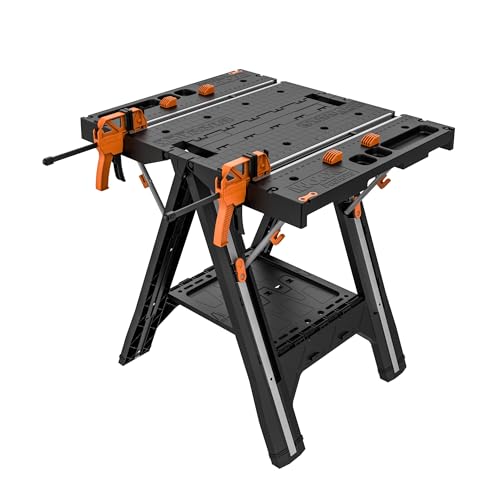 |
 |
 |
 |
| Budget | $$ | $$ | $ | $ |
| What it’s for | A bench and sawhorse that folds away | Dust control and clean-up in one machine | Keeps the shop vac filter from clogging | Know if the wood is dry before you build |
| Details | Read more | Read more | Read more | Read more |
| Amazon | Shop Now at Amazon | Shop Now at Amazon | Shop Now at Amazon | Shop Now at Amazon |
Stage 4: The First Machines
| Product | DEWALT DWE7485 | WEN PL1326 | WEN 6502T |
|---|---|---|---|
| Image |  |
 |
 |
| Budget | $$$ | $$$ | $$ |
| What it’s for | The first stationary saw | Buy rough lumber, mill it yourself | A benchtop shaping station |
| Details | Read more | Read more | Read more |
| Amazon | Shop Now at Amazon | Shop Now at Amazon | Shop Now at Amazon |
Stage 1: Essential Hand Tools and Safety Gear
These are the tools you buy before the first project and keep for the rest of your woodworking life. None of them is expensive, and every power tool you add later depends on them: the square marks the cut, the clamps hold the work, and the respirator keeps the dust out of your lungs.
IRWIN 12-Inch Combination Square
The marking tool you use on every project ($)
A 12-inch rust-proof stainless steel blade with black etched scales, on a cast zinc head. It marks 90 and 45 degree lines, checks that a cut or a glue-up is square, and works as a depth and marking gauge when you lock the head at a set distance from the end of the blade.
Accuracy starts with layout. A line that is a hair off becomes a joint that is a hair off, whatever saw you cut it with. Check a new square before you trust it: draw a line along the blade against a straight board edge, flip the square and draw again. If the two lines don’t overlap, return it.
IRWIN Marples 3-Piece Chisel Set
Three chisel widths for joinery and clean-up ($)
Three chisels, 1/2, 3/4 and 1 inch, with hardened steel blades, ProTouch grips and a large strike cap made to take a hammer or mallet. A folding wallet keeps the edges from knocking into other tools.
A beginner reaches for a chisel to cut hinge recesses, pare off dried glue, square the corners of a routed groove and fit a joint that is slightly tight. Three widths cover most of that. Keep them sharp: a dull chisel needs force, and force is what makes a chisel slip.
Gyokucho Ryoba Japanese Pull Saw
One hand saw that rips and crosscuts ($)
A double-edged ryoba with a 9-1/2-inch blade: one edge crosscuts at 22 TPI, the other rips at 9 TPI. The blade is only 0.018 inch thick and is made for hard and abrasive woods.
A Japanese saw cuts on the pull stroke, so a thin blade stays straight and leaves a narrow kerf. For a beginner it is the easiest hand saw to cut accurately with, and it handles the cuts power tools are clumsy at: trimming a dowel flush, cutting a tenon cheek, or a quick crosscut without setting up a machine.
More hand saws: best hand saws for woodworking.
IRWIN QUICK-GRIP Mini Bar Clamps, 2-Pack
The first two of many clamps ($)
Two 12-inch one-handed bar clamps with a quick-release trigger, non-marring pads and about 140 lb of clamping force. They are 25 percent smaller than IRWIN’s regular QUICK-GRIP clamps and carry IRWIN’s lifetime guarantee.
Clamps are how a beginner’s work gets square and tight: they hold a board while you cut it, a fence while you rout, and a joint while the glue dries. One-handed clamps are the ones you’ll use daily because the other hand stays on the work. Start with this pair, then add longer bar or parallel clamps when your first glue-up asks for them.
Which clamps to add next: best clamps for woodworking.
Milescraft Sand-It Sanding Block
Hand sanding for flats, edges and curves ($)
A rigid hand-sanding block with four profiles: flat, convex, concave and a tight edge. It takes any quarter sheet of sandpaper with a quick-snap lock, so you can change grit in seconds, and it comes with 150-grit paper.
Even with a power sander, the last pass on edges, profiles and between coats of finish is done by hand. A block keeps the paper flat so you don’t round over edges you meant to keep crisp.
More options: sanding blocks and sponges, and the best sandpaper for wood.
GVS Elipse P100 Half Mask Respirator
A respirator you’ll actually wear ($)
A compact NIOSH-approved P100 half mask (approval TC-84A-6949) made of a soft elastomer without latex or silicone. The filters sit low and to the sides, which leaves room for safety glasses and hearing protection, and GVS rates the filters for up to five years.
Fine wood dust from sanding and routing is the health risk most beginners ignore, because you can’t see the particles that do the damage. A paper dust mask leaks around the nose; a half mask with P100 filters seals.
How to choose one: best respirator for woodworking.
Stage 2: The First Woodworking Power Tools
These are the woodworking power tools a beginner actually uses. Buy the drill and the sander first, then the saw your projects need, then the router and the pocket-hole jig when you start building furniture. Corded tools are still the cheaper way into saws and routers; cordless pays off for drills and drivers you pick up dozens of times a day.
DEWALT 20V MAX DCD771C2 Drill/Driver Kit
The first power tool to buy ($$)
A compact cordless drill/driver with two speeds (0-450 and 0-1,500 rpm), a 1/2-inch single-sleeve ratcheting chuck and a motor DEWALT rates at 300 unit watts out. DEWALT sells the DCD771C2 kit with two compact 20V MAX batteries and a charger, and covers it with a 3-year limited warranty.
The drill does more jobs in a beginner’s shop than any other power tool: pilot holes, driving screws, pocket holes, and sanding drums for curves. The low gear drives screws with control; the high gear drills clean holes.
Choose the battery platform with care. Every cordless tool you add later should run on the same batteries, so pick a brand whose sanders, saws and lights you would also buy.
Drill add-on for curves: drill sanding attachment guide.
Bosch ROS20VSC Random Orbital Sander
The sander for nearly every project ($$)
A 5-inch random orbital sander with a 2.5 A motor, variable speed from 7,500 to 12,000 OPM, hook-and-loop discs and a pad dampening system to limit swirl marks. The twist-off canister has a microfilter, and a vacuum adapter is in the kit.
Sanding is where beginner projects go from homemade to finished. A random orbital sander removes material fast and still leaves a surface ready for stain, which is why it is the first sander I’d point any new woodworker to, ahead of palm, belt or detail sanders.
Compare models: best random orbital sanders, my Bosch ROS20VSC review and how to use an orbital sander.
SKIL 5280-01 Circular Saw
The beginner’s table saw substitute ($$)
A 15 A corded circular saw spinning a 7-1/4-inch carbide-tipped blade (included) at 5,300 RPM. It bevels to 51 degrees with a positive stop at 45, has a single-beam laser guide, a dust blower that keeps the line clear, a spindle lock for blade changes and a guarded trigger.
With a clamped straightedge, a circular saw breaks down full sheets of plywood and crosscuts boards cleanly, which covers most of what a beginner would buy a table saw for, at a fraction of the cost and floor space.
BLACK+DECKER BDEJS600C Jigsaw
Curves, cutouts and rough cuts ($$)
A 5 A corded jigsaw with variable speed up to 3,000 SPM, a 3/4-inch orbital blade stroke, four Curve Control settings for tight turns, and a shoe that bevels to 45 degrees.
The jigsaw is the beginner’s band saw: it cuts curves, inside cutouts for a sink or an outlet, and rough lengths of board. Expect to clean the edge with a sanding block or a spindle sander afterwards; a jigsaw cut is never as square as a table saw cut.
Smoothing the curves: best spindle sanders.
Makita RT0701CX7 Compact Router Kit
The tool that makes projects look finished ($$)
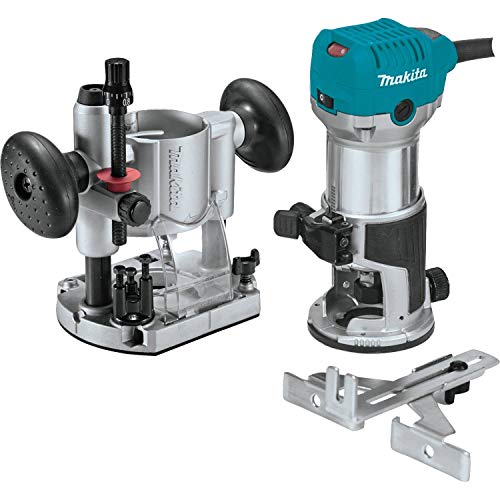
A compact 1-1/4 HP router with variable speed from 10,000 to 30,000 RPM, electronic speed control under load, rack-and-pinion fine depth adjustment and a quick-release cam lock. The CX7 kit adds a plunge base to the trimmer base, so one motor handles edges and grooves.
A router rounds over sharp edges, cuts rabbets and dadoes for shelves, flush-trims to templates and cuts hinge mortises. A compact router is the easier one to learn on: light enough to control with one hand on an edge, and it takes the common 1/4-inch shank bits.
Full-size options: best routers for woodworking, and before your first cut, how to use a router.
Kreg Pocket-Hole Jig 320
The fastest strong joint for a beginner ($)
A portable pocket-hole jig for stock from 1/2 to 1-1/2 inches thick, with two drill guides, removable material-thickness stops, a thickness gauge that doubles as a hex wrench, an easy-set drill bit and stop collar, and sample screws. Kreg gives the drill guides a lifetime warranty, and this listing bundles the jig with Kreg’s Classic 2-inch face clamp.
Pocket holes join boards with a drill and screws, with no glue-up to wait for and no joint to cut by hand. They are how most beginners build their first bookshelves, cabinets, face frames and workbenches, and they hide on the back or underside of the piece.
One more tool many beginners end up wanting is an oscillating multi-tool, for flush cuts, plunge cuts in trim and sanding in corners. It is a renovation tool more than a woodworking one, so it comes after the six above: see the best oscillating multi-tools when you need one.
Stage 3: Workspace and Dust Control
A place to work and a way to keep the dust down are what make woodworking possible in a garage or a spare room. They aren’t exciting purchases, but they decide how often you actually go into the shop.
WORX Pegasus WX051 Folding Workbench
A bench and sawhorse that folds away ($$)
A folding work table with a 31 x 25-inch surface at a 32-inch working height that converts into a sawhorse. WORX rates it for 300 lb as a table and 1,000 lb as a sawhorse. It weighs 30 lb, and the box includes two 24-inch quick clamps and four clamp dogs.
A beginner needs a flat, solid surface to cut, clamp and sand on before building a proper bench. In a shared garage, a bench that folds flat against the wall is the difference between woodworking and not.
More benches: best portable workbenches and, when you have the room, the best workbenches.
Vacmaster VBV1210 12-Gallon Shop Vac
Dust control and clean-up in one machine ($$)
A 12-gallon wet/dry vac with 5 peak HP and a published 106 CFM of airflow. The motor head detaches to work as a handheld blower, and hose plus cord give a 22-foot cleaning reach.
A shop vac is a beginner’s dust collector: hook it to the sander and the circular saw, and use it to clean the floor so sawdust doesn’t follow you into the house.
Compare vacs: best shop vac for dust collection.
Oneida Dust Deputy DIY Cyclone
Keeps the shop vac filter from clogging ($)
A cyclone separator that sits between the tool and the shop vac, with tapered 2-inch ports. The DIY version is the cyclone, gasket and mounting hardware only: you add a bucket and hose. Oneida says it stops over 99 percent of the dust before it reaches the vac.
Fine sanding dust clogs a shop vac filter within minutes, and suction drops with it. The cyclone drops the dust into the bucket instead, so the vac keeps pulling and the filter lasts.
More separators: best dust separators.
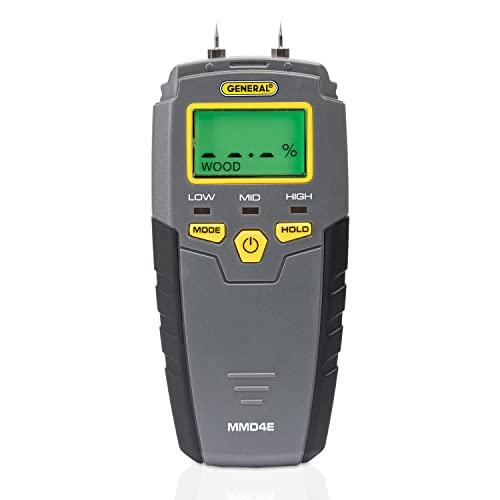
General Tools MMD4E Moisture Meter
Know if the wood is dry before you build ($)
A pin-type meter with a range of 5 to 50 percent for wood and 1.5 to 33 percent for building materials, read on a backlit LCD. Spare stainless steel pins are included, and the protective cap doubles as a calibration check.
Lumber from a home center or a sawmill can be wetter than it looks, and wet wood shrinks, warps and cracks after you build with it. A meter tells you to wait a few weeks before you cut, instead of after the tabletop has split.
Pin or pinless: best moisture meters for wood.
Stage 4: The First Big Machines
Don’t buy these on day one. Buy them when a real project shows you the limit of the stage 2 tools: when you rip boards to width every weekend, when you want to buy rough lumber, or when you spend more time hand-sanding small parts than building. That is also when they give the most for the money.
DEWALT DWE7485 Compact Jobsite Table Saw
The first stationary saw ($$$)
A 15 A compact jobsite table saw with an 8-1/4-inch blade and 24.5 inches of rip capacity, enough to rip a 4×8 sheet down the middle. It has rack-and-pinion fence rails, a Site-Pro modular guard that adjusts without tools, a power-loss reset and a metal roll cage, with a 3-year limited warranty.
A table saw rips boards to width with a repeatability a circular saw can’t match, and it is the machine most woodworkers build their shop around. It is also the most dangerous one: learn it with the guard and riving knife on and push sticks in hand, and read the manual before the first cut.
Keeping it clean: dust collection for table saws and other tools.
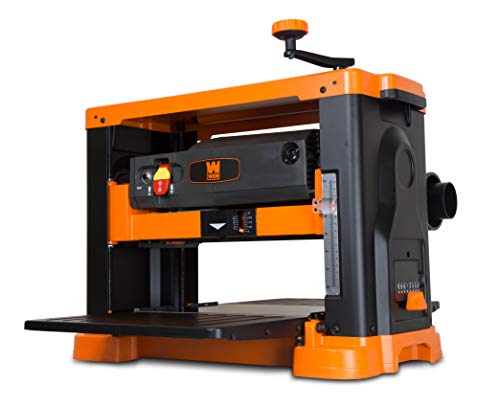
WEN PL1326 Spiral Thickness Planer
Buy rough lumber, mill it yourself ($$$)
A benchtop planer for boards up to 13 inches wide and 6 inches thick, with a spiral cutterhead of 26 staggered, rotatable HSS inserts, a 15 A motor and a 26 ft/min feed rate. An onboard gauge shows how much each pass removes, and WEN covers it for 2 years.
A planer lets you buy rough or reclaimed lumber, which costs less than surfaced boards, and bring it to any thickness you want. The spiral head tears out less on figured grain and is quieter than straight knives.
Compare planers: best thickness planers, jointer vs planer and how to use a thickness planer.
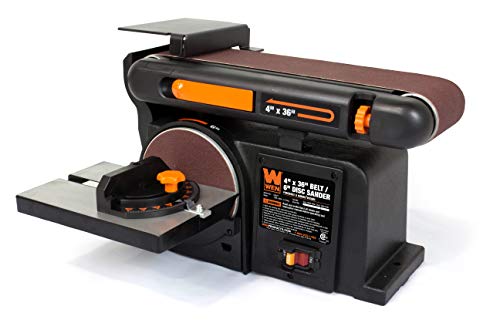
WEN 6502T Belt and Disc Sander
A benchtop shaping station ($$)
A benchtop combination sander with a 4 x 36-inch belt that tilts from 0 to 90 degrees and a 6-inch disc, driven by a 4.3 A motor at up to 3,600 RPM. The cast iron base keeps vibration down, and a tension release lever makes belt changes quick. WEN covers it for 2 years.
It squares ends, shapes curves to a line, cleans up saw marks and sharpens a pencil-thin chamfer on small parts, all jobs that are slow with a handheld sander.
More machines: best belt and disc sanders.
Beginner Woodworking Starter Kits by Budget
Three ways to build a first kit from the tools above. Each kit is complete in itself: you can build real projects with it, and nothing in it becomes useless when you move up.
The Hand-Tool Starter Kit ($)
For small projects, apartments and anyone who wants to learn the craft from the bench up: the combination square, the ryoba, the Marples chisels, the QUICK-GRIP clamps, the Sand-It block with a pack of sandpaper, and the respirator. It builds boxes, small shelves and cutting boards, quietly, and fits in one drawer.
The Weekend Builder Kit ($$)
Everything in the hand-tool kit, plus the drill/driver, the random orbital sander, the circular saw, the pocket-hole jig and the folding workbench. This is the kit for bookshelves, outdoor furniture, storage and a first real workbench, and the one I’d recommend to most beginners.
The Small-Shop Kit ($$$)
The weekend kit, plus the compact router, the jigsaw, the shop vac with a Dust Deputy, the moisture meter and one of the stage 4 machines. Choose the table saw if you build furniture from boards, the planer if you want to buy rough lumber, or the belt and disc sander if you make small parts.
What Tools Your First Project Needs
The best way to buy tools is one project at a time. Here is what four classic first projects ask for, so you can buy only what the next one needs.
A Cutting Board
Saw (the ryoba or the circular saw), at least four clamps for the glue-up, the random orbital sander and a food-safe oil. A router with a roundover bit softens the edges. The sanding takes longer than the cutting, so follow a grit sequence rather than starting fine.
A Bookshelf
Circular saw and a straightedge for the plywood, the drill and pocket-hole jig for the joints, the square to keep the case square, clamps, and the sander. A router cuts dadoes for fixed shelves if you want a stronger, cleaner joint than pocket screws.
A Workbench
The classic first big build: circular saw, drill, square, clamps and a lot of screws. Build it on the folding bench or a pair of sawhorses. Many woodworkers build their bench before buying anything else on this list, because every later project is easier on a flat, solid top.
A Small Box
The ryoba, the chisels, the square, the clamps and the sanding block. A box teaches accurate layout and joinery, and it is the project where a belt and disc sander first starts to make sense.
How to Choose Woodworking Tools as a Beginner
Hand Tools or Power Tools First?
Both work, and most woodworkers end up with some of each. Power tools get a project done faster and are more forgiving of technique; hand tools are cheaper, quieter and teach you how wood behaves. If you live in an apartment or want to learn joinery, start with stage 1 and add a drill and a sander. If you want to build furniture for the house this year, go straight to the weekend builder kit.
Cordless or Corded?
Buy cordless where you pick the tool up often and the job is short: the drill/driver, and later an impact driver. Buy corded where the tool runs for a long time or needs a lot of power, like the sander, the router and the saws, unless you already own the batteries. Whatever you choose, stay on one battery platform.
Buy Fewer, Better Tools
A 100-piece kit of mediocre tools teaches you to blame yourself for the tool. One good square, one good saw and one good sander will produce better work than a whole case of cheap ones. Mid-range tools from established brands are the sweet spot for a beginner: good enough to learn on, and with resale value if you change direction.
What to Skip as a Beginner
Skip specialty machines until a project needs them: drum sanders, jointers, spindle sanders and bandsaws are great tools, but they solve problems you don’t have yet. Skip giant router bit sets too; three or four bits (a roundover, a straight bit, a flush-trim bit and a chamfer) cover almost everything. When you’re curious about what each sander is for, the types of sanders guide explains all of them.
Safety Is Part of the Kit
Eye protection, hearing protection and a respirator go on before every power tool, not just the loud ones. Add push sticks the day you buy a table saw or a router table, and keep the guards on. And deal with dust from the start: a dust extractor or a shop vac on the sander, and a shop air cleaner if you work in a closed garage.
💡 Pro Tip
Before you buy the next tool, write down the last three times you wished you had it. If you can’t name three, the tool can wait, and the money is better spent on clamps, sandpaper or lumber for the next project.
How I Chose These Tools
Every tool on this list is one I’d point a beginner to, chosen from manufacturer specifications and documentation, and most of them come from my full buying guides on sanderscore.com. I didn’t test every tool here for this guide, so the reviews above describe what each tool is and does from the makers’ specs, not hands-on claims. I kept tools that:
- Do a job every beginner runs into, from layout to finishing, with no niche or novelty tools.
- Are made by established brands with published specifications and a warranty.
- Were on sale on Amazon US when I checked the listings for this guide.
- Cover every budget, so a complete starter kit is possible at each level.
🏆 The Short Version
Buy a combination square, clamps and a respirator first, then the DEWALT DCD771C2 drill and the Bosch ROS20VSC sander. Add a circular saw and the Kreg 320 for your first furniture, and wait for a real project before you buy a table saw or a planer.
❓ Frequently Asked Questions
What are the essential tools every woodworker needs?+
What are the top 5 woodworking tools?+
Can I teach myself woodworking?+
What power tools does a beginner woodworker need?+
What are the best woodworking tools for a small shop?+
Should a beginner buy cordless or corded woodworking tools?+
Conclusion
A beginner’s tool kit is built one project at a time. Start with the stage 1 hand tools and safety gear, add a drill and a random orbital sander, then the saw and the joinery tools your next build needs. Leave the table saw and the planer for the day a project shows you why you need them, and you’ll have a shop full of tools you actually use.
Buying tools for someone else? My gifts for woodworkers guide sorts ideas by budget and by recipient, and the Black Friday woodworking deals page lists the machines worth watching when prices drop. Ready for your first sander? Compare the best random orbital sanders or the best sanders overall.
