
As an Amazon Associate I earn from qualifying purchases. All claims are strictly my personal opinion.
Best all-round hand saw

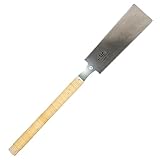
SUIZAN Ryoba 9.5" Double Edge Saw
Rip and crosscut teeth on one 0.5 mm blade that leaves a 0.8 mm kerf.

For most woodworkers, the best hand saw is a Japanese ryoba pull saw such as the SUIZAN 9.5″ Ryoba: one thin blade with rip teeth on one edge and crosscut teeth on the other, so a single saw handles most cuts in a home shop. If you’d rather push than pull, a Western panel saw like the STANLEY FatMax 20-045 is the sturdier choice for construction lumber.
Power saws are very efficient wood cutting tools; unfortunately, they come with many complexities and are hardly user-friendly. Luckily, hand saws are equally effective and less cumbersome substitutes for a lot of jobs. There’s a wide variety on sale: Japanese pull saws (ryoba, dozuki, flush cut), Western panel saws for crosscut and rip, backsaws for joinery, coping saws and hacksaws. Choosing the right saw depends on the kind of job at hand.
Over time, I have worked with various types of these tools. While some hand saws are durable, lightweight, easy to sharpen, and comfortable to handle, others are of mediocre quality and require constant sharpening. That experience shapes what I look for in a saw: a straight, stiff blade, teeth that suit the cut, and a handle you can hold for a long cut. The ten below are chosen on those criteria and on each manufacturer’s specifications.
⚡ Quick Pick
Best all-round hand saw: the SUIZAN Ryoba 9.5″ – rip and crosscut teeth on one 0.5 mm blade that leaves a 0.8 mm kerf.
Fine joinery and dovetails? The SUIZAN Dozuki 9.5″ has 25 TPI and a stiffening spine.
Push-stroke saw for 2x4s and plywood? The STANLEY FatMax 20-045.
Best Hand Saws: Comparison
| Saw | Type | Blade | Teeth | Best for |
|---|---|---|---|---|
| Japanese pull, double edge | 9.5 in, 0.5 mm | Rip and crosscut | All-round woodworking | |
| Japanese pull, double edge | 9.5 in, 0.45 mm | Fine crosscut, progressive rip | Hardwoods | |
| Japanese pull, backsaw | 9.5 in, 0.3 mm | 25 TPI crosscut | Dovetails, tenons | |
| Japanese pull, no set | 7 in, 0.2 mm | 30 TPI | Dowels, plugs, trim | |
| Pull, single edge | 8-3/8 in | 17 TPI | Trim, PVC, small parts | |
| Pull, replaceable blade | 12 in | 14 TPI | General carpentry | |
| Western push | 15 in | 9 PPI (8 TPI) | Toolbox saw, 2x4s | |
| Western push | 15 in, 0.85 mm | 11 TPI | Mixed materials | |
| Western push | 19 in | 7 TPI | Fast cuts in boards | |
| Western backsaw | 10 in | 18 TPI | Small joints, dowels |


The 10 Best Hand Saws for Woodworking
1. SUIZAN Ryoba 9.5″ Double Edge Saw
Best Overall Hand Saw
A ryoba carries rip teeth on one edge and crosscut teeth on the other, so you flip the saw instead of changing it. SUIZAN’s SR-001 has a 240 mm (9.5 in) blade, 0.5 mm thick, with 9 TPI on the rip side and 15 TPI on the crosscut side, and a 0.8 mm kerf; overall it is 59 cm (23.2 in) long with a cane-wrapped handle. Because a pull saw is in tension on the cutting stroke, the blade can be much thinner than a Western saw’s, which is why the kerf is so narrow and the cut is easy to start on a line. The blade is replaceable when the teeth dull, as is usual with Japanese saws of this type.
Good to know: without a spine, a ryoba can wander in deep rips if you force it. Let the saw do the work and keep the stroke long.
2. Gyokucho Razorsaw 651 Ryoba

Best Ryoba for Hardwoods
Gyokucho’s “Blue Hard” 651 is a 240 mm ryoba with a thinner 0.45 mm (0.018 in) blade, fine crosscut teeth on one edge and progressive rip teeth (coarser toward the far end) on the other. The teeth are impulse-hardened, which keeps them sharp longer in oak, maple and other hard or abrasive woods, the job Gyokucho designs this model for. Overall length is about 23 in, with a rattan-wrapped handle and a replaceable blade. Hardened teeth can’t be resharpened with a file, so when they dull you replace the blade.
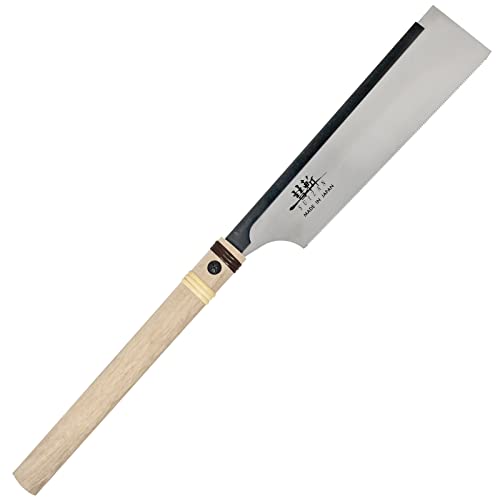
3. SUIZAN Dozuki 9.5″ Dovetail Saw
Best for Dovetails and Fine Joinery
A dozuki is the Japanese backsaw: a stiff spine along the top keeps a very thin blade straight. This one (model D-001) has a 0.3 mm blade with 25 TPI crosscut teeth and a 0.5 mm kerf, on a 240 mm blade and 54.8 cm overall. The spine limits the depth of cut, so it is a joinery saw for dovetails, tenon shoulders and miters rather than for cutting boards to length. The fine teeth leave a surface that often needs no more than a light pass with sandpaper.
4. SUIZAN Flush Cut Saw 7″

Best Flush Cut Saw
Flush cut saws have no set (the teeth don’t bend outward), so the blade can lie flat on the surface and trim a dowel, plug or tenon without scratching the wood around it. SUIZAN’s SFL-003 has a 180 mm blade just 0.2 mm thick with 30 TPI, and the kerf equals the blade thickness. The blade is flexible on purpose: press it flat with your fingers near the cut. Expect to remove a hair of material afterwards with a block plane or 180-grit paper on a flat sanding block.
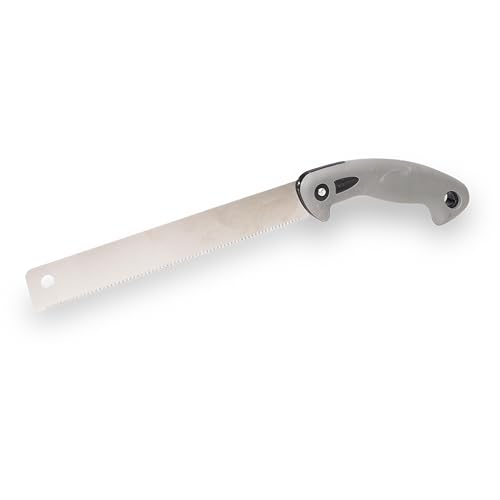
5. Vaughan Bear Saw BS240P
Best Budget Pull Saw for Trim
Vaughan’s Bear Saws are built primarily for cutting on the pull stroke, with a thin, plated spring-steel blade that resists rust. The BS240P is the extra-fine model: an 8-3/8 in blade with 17 TPI, aimed at trim, molding, PVC and ABS pipe, flush cuts and plywood, where its thin blade delivers accurate and quick cuts. The same handle takes Vaughan’s other Bear Saw blades, from a coarse 13 in blade for framing to a double-edge blade.
6. Shark Corp 10-2312 12″ Carpentry Saw

Best Pull Saw for General Carpentry
The Shark 10-2312 is a 12 in, 14 TPI pull saw that is suitable for all types of trimming. Shark says it cuts all types of wood and does a wonderful job in PVC and ABS plastic pipe, and the flexible blade can also make flush cuts. The blade releases from the ABS handle with a button, so a dull blade is replaced in seconds (the replacement is the 01-2312). It offers a one-year warranty.
7. STANLEY FatMax 20-045 15″ Hand Saw

Best Western Toolbox Saw
If you need a reliable hand saw that cuts construction lumber and sheet goods for carpentry and woodwork, the 15 in STANLEY 20-045 is a safe bet. STANLEY lists it at 9 points per inch (8 TPI), with SharpTooth teeth ground on three cutting surfaces, which STANLEY says cut 50% faster than its conventional hand saws, and induction-hardened teeth that it says stay sharp up to five times longer. The handle lets you mark 45 and 90 degree angles, and it carries a limited lifetime warranty. Like any panel saw, it is unsuitable for cutting curves; that’s a coping saw’s job.
8. IRWIN Universal Hand Saw 15″ (1773465)

Best Budget Western Saw
IRWIN’s Universal saw is an accurate representation of its name: a universal triple-ground tooth meant to cut wood, plastic and laminate without binding. It has a 15 in, 11 TPI blade, 0.85 mm thick, with a water-based lacquer coating, a tapered nose for clearance and a high-density resin handle with 45 and 90 degree markings. IRWIN claims it cuts up to three times faster than traditional hand saws and backs it with a lifetime guarantee. The finer 11 TPI leaves a cleaner edge than the 8 TPI STANLEY at the cost of a slower cut in thick lumber.
9. BAHCO PC-19-GT7 ProfCut 19″ Hand Saw

Best Long Western Saw for Boards
A longer blade means more teeth per stroke and less effort on wide boards. The Swedish-made BAHCO ProfCut PC-19-GT7 has a 19 in blade with 7 TPI GT toothing, ground on three sides, which BAHCO says gives clean results in all types of wood, plus a two-component handle and a reusable tooth protector. At 7 TPI it is the most aggressive saw here: the right choice for 2x4s, decking and rough cuts, and the wrong one for fine furniture parts.
10. Crown FLINN1 10″ Dovetail Saw

Best Western Backsaw for Small Joints
Crown Hand Tools makes this saw in Sheffield, England: a 10 in blade with 18 TPI, a stiffening back and a beech handle. It is handy for carrying out small repairs, tabletop and wood joint work, and for trimming dowels close to a flat surface. It is one product I consider a woodworking essential, and the choice for anyone who prefers the push stroke of a Western backsaw to a dozuki.
Types of Hand Saws: Names and Uses
Most “which hand saw” questions are really “which type”. These are the hand saw names you’ll meet and what each one is for:
| Saw | Cuts on | Typical teeth | Used for |
|---|---|---|---|
| Ryoba | Pull | Rip edge + crosscut edge | General woodworking, one saw for both directions |
| Dozuki | Pull | Fine crosscut, with spine | Dovetails, tenons, miters |
| Kataba | Pull | One edge, no spine | Deep cuts a dozuki can’t reach |
| Flush cut saw | Pull | Fine, no set | Dowels, plugs, through tenons |
| Panel saw (crosscut) | Push | 7 to 12 TPI, knife-like teeth | Cutting boards to length |
| Rip saw | Push | 4 to 6 TPI, chisel-like teeth | Cutting along the grain |
| Backsaw (tenon, dovetail) | Push | 12 to 20 TPI, with spine | Joinery, miter box work |
| Coping saw | Pull or push | Thin blade in a frame | Curves, coped trim joints |
| Hacksaw | Push | 18 to 32 TPI | Metal, bolts, plastic pipe |
How to Choose a Hand Saw
Pull Saw or Push Saw?
Japanese saws cut on the pull stroke, which keeps the blade in tension. That allows a thin blade, a narrow kerf and less effort, and most beginners find it easier to follow a line. Western saws cut on the push stroke, so the blade has to be thicker to avoid buckling; in exchange they are more forgiving of rough handling, better for construction lumber and easy to find in any hardware store. Many woodworkers end up with one of each: a ryoba or dozuki for the bench, a panel saw for the job site.
TPI: Teeth Per Inch
Fewer, larger teeth cut faster and rougher; more, smaller teeth cut slower and cleaner. As a rough guide, 7 to 8 TPI suits 2x4s and rough work, 10 to 12 TPI is a good general-purpose cut, and 15 TPI and up is for joinery and thin stock. Western saws are often labelled in points per inch (PPI), which counts one more than TPI for the same tooth size: that’s why STANLEY’s 9 PPI saw is an 8 TPI saw.
Rip vs Crosscut Teeth
Rip teeth are filed straight across like small chisels and cut along the grain. Crosscut teeth are beveled like small knives that sever the fibers across the grain. A ryoba gives you both; hardpoint Western saws use a “universal” triple-ground tooth that does both reasonably well.
Hardpoint or Resharpenable?
Almost every modern saw on this list has induction- or impulse-hardened teeth. They stay sharp much longer but can’t be filed, so when they dull you replace the saw or, on most Japanese saws and the Shark and Vaughan, just the blade. A traditional resharpenable saw makes sense only if you plan to learn saw filing.
Blade Length
Longer blades cut faster on wide boards because each stroke uses more teeth; shorter blades are easier to control and fit in a toolbox. For most home shops, a 9.5 in Japanese blade or a 15 in Western blade is the sweet spot.
Hand Saw Tips: Cutting Straight and Cleaning Up
- Start the cut on the waste side of the line with a few light strokes, guiding the blade with your thumb knuckle.
- Use the full length of the blade and let the teeth do the work. Pushing hard is what makes cuts wander.
- Clamp the work. A board that moves gives a crooked cut; even one clamp on the bench helps (see the best clamps for woodworking).
- Sand after cutting. A fine Japanese saw leaves a surface that needs only light sanding; a coarse panel saw leaves tear-out that you’ll take down at 80 or 120 grit before moving up. My guide to what grit sandpaper to use on wood has the full sequence, and end grain sands cleaner on a hard block than with a soft pad.
- For shelves and joints, a dozuki or backsaw cuts the shoulders, but for long dadoes a router guide is faster: see these DIY router dado jig plans.
🏆 The Bottom Line
If you buy one saw for woodworking, make it a 9.5 in ryoba like the SUIZAN: it rips and crosscuts with a thin, accurate kerf. Add a dozuki when you start cutting joints and a flush cut saw for dowels and plugs. If most of your work is construction lumber, a 15 in Western saw like the STANLEY FatMax or the IRWIN Universal will take more abuse.
Frequently Asked Questions
What is the best quality hand saw?+
Are Japanese hand saws better?+
What is the best saw for home use?+
What is a good Japanese rip cut saw?+
What is the best hand saw for cutting a 2×4?+
Which hand saw brands are the sharpest?+
As much as I would like to continue elaborating on my experiences with handsaws, I must now take a bow. Handsaws are versatile tools; you have to know how to make the right choice. I hope this article will assist in pointing you in the right direction when next you want to purchase one.
