
As an Amazon Associate I earn from qualifying purchases. All claims are strictly my personal opinion.
Best deck stain overall
Ready Seal Exterior Wood Stain and Sealer
An oil-based semi-transparent that goes on with no back-brushing and no temperature limits.
The best deck stain is the one that soaks into your boards and comes back off them evenly when it’s time to recoat. For most wood decks, the best deck stain is Ready Seal: an oil-based semi-transparent stain and sealer that its maker says goes on with no laps, no runs and no streaks, with no temperature limits and no back-brushing. If you want soap-and-water cleanup, DEFY Extreme is the water-based pick, and if your deck is old, patchy or already painted, a solid color stain like Olympic Maximum hides what a semi-transparent can’t.
Below are seven deck stains and sealers you can order on Amazon today, compared on what their makers publish: type, opacity, coverage per gallon, number of coats, dry time, the weather each one needs and how long the maker says it lasts. I haven’t run a multi-year weathering test on these, so every figure here comes from the technical data sheets, which I link at the end of each review. After the reviews: how to choose between oil and water, semi-transparent and solid, and which stain suits pressure-treated, cedar and old decks.
Best Deck Stains: Comparison
Coverage, coats, dry times and application temperatures are from each maker’s data sheet or product page. “Lasts” is only what the maker itself states; where a maker doesn’t put a number on it, the table says so. Tiers describe the price per gallon in today’s market; I don’t print prices, and the Amazon buttons show the live one.
| Product | ⭐ Ready Seal 🏆 EDITOR’S CHOICE |
DEFY Extreme | Cabot Australian Timber Oil | TWP 1500 | Sikkens ProLuxe SRD | Thompson’s WaterSeal Semi-Transparent | Olympic Maximum Solid |
|---|---|---|---|---|---|---|---|
| Image |  |
 |
 |
 |
 |
 |
 |
| Base | Oil | Water | Oil (linseed, tung, alkyd) | Oil, EPA-registered preservative | Alkyd-oil | Water | 100% acrylic latex |
| Opacity | Semi-transparent | Semi-transparent | Translucent | Semi-transparent | Transparent, matte | Semi-transparent | Solid |
| Coverage per gallon | 150 to 175 sq ft, both coats | 100 to 150 sq ft, both coats | 400 to 600 smooth, 250 to 350 rough | 150 to 400 sq ft | 250 to 400 smooth, 150 to 200 weathered | 150 to 400 sq ft | 250 to 350 sq ft |
| Coats | 2 light coats | 1 on dense wood, 2 wet-on-damp on porous | 1 only | 2 wet-on-wet (1 on hardwoods) | 1 | 1 | 2 thin coats |
| Ready for use | Within hours; cures in up to 14 days | 24 hours | Dries in 24 to 48 hours | 24 hours minimum | Foot traffic 48 hours | Touch dry in 2 hours | Foot traffic 24 to 48 hours |
| Weather to apply | No temperature limits; wood at 12% moisture or less | 45 to 95°F, no rain for 12 hours | 50°F or above for 48 hours, no direct sun | No rain or cold for 2 to 3 days | 50 to 90°F, dry for 48 hours | Above 50°F for 48 hours, no rain for 24 hours | 35 to 90°F, rain-ready in 12 hours |
| Lasts on a deck (maker) | 1 to 3 years | Not stated | 1 to 3 years | Not stated; color on decks not guaranteed | Maintain every 2 to 4 years | Guaranteed 5 years | Not stated |
| Cleanup | Mineral spirits | Soap and water | Mineral spirits | Mineral spirits | Mineral spirits | Soap and water | Soap and water |
| Price tier | $$ | $$ | $$ | $$ | $$$ | $ | $ |
| Buy | Shop Now at Amazon | Shop Now at Amazon | Shop Now at Amazon | Shop Now at Amazon | Shop Now at Amazon | Shop Now at Amazon | Shop Now at Amazon |
Best Deck Stains and Sealers: Reviews
Every stain below could be ordered on Amazon when I checked it. Colors are sold as separate listings, so the button takes you to one color and the listing lets you switch.
Editor's ChoiceOil-based semi-transparent stain
Ready Seal
Ready Seal Exterior Wood Stain and Sealer
No lap marks, no back-brushing and no temperature limits on bare, dry wood.
Shop Now at AmazonSpecs: Ready Seal
Best for
First-time stainers and big decks.
- No laps, no back-brushing
- No temperature restrictions
Skip it if
The deck still has an old film finish.
- Needs wood at 12% moisture or less
Read full review
Best Deck Stain Overall
Ready Seal is the easiest stain on this list to get right, and that is most of what makes a deck stain good. It’s an oil-based semi-transparent penetrating stain made from natural resins, trans-oxide pigments for UV protection and oils, with no linseed oil, which Ready Seal says can feed algae and mildew. The maker’s pitch is “no laps, no runs, no streaks”: you don’t need to back-brush, there are no temperature restrictions, you can apply it in direct sun, and you can even walk on the deck while you work. It goes on as two light coats, at least 45 minutes apart, and its published coverage of 150 to 175 sq ft per gallon on decks already counts both.
The catch is the prep, and Ready Seal is unusually strict about it. The wood must be bare and at 12% moisture or less, checked with a moisture meter, and new smooth deck boards need their mill glaze removed first (it recommends a 25% bleach solution and a light rinse). It doesn’t recommend sanding at all, because sanding closes the pores; if you have to sand off an old finish, it says to use 60 to 80 grit. It won’t go over another product, and Ready Seal estimates 1 to 3 years on horizontal surfaces like decks, with darker tones lasting longer.
Best water-basedWater-based semi-transparent stain
DEFY Extreme
DEFY Extreme Semi-Transparent Wood Stain
Soap-and-water cleanup and zinc against mildew; clean and stain the same day.
Shop Now at AmazonSpecs: DEFY
Best for
A water-based, one-day job.
- Soap-and-water cleanup
- Stain the same day you clean
Skip it if
You want the most coverage per gallon.
- Lowest coverage per gallon here
Read full review
Best Water-Based Deck Stain
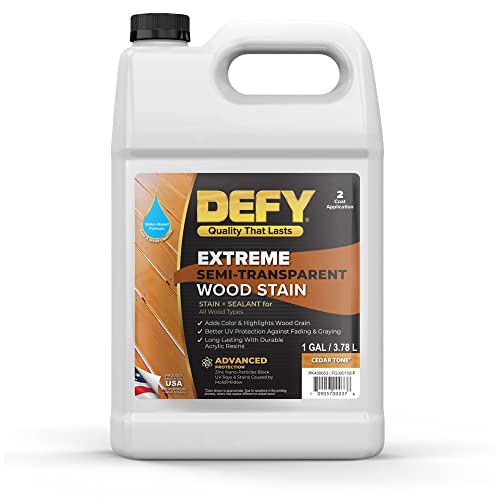
DEFY Extreme is the pick if you want a penetrating semi-transparent without solvents. It’s water-based, cleans up with soap and water, dries to a natural flat finish, and DEFY adds zinc nano-particles to resist mold and mildew. The practical advantage is timing: DEFY says you can stain as soon as the wood is visibly dry, so you can clean in the morning and stain in the afternoon. Its test is simple: sprinkle water on the boards, and if the drops soak in within seconds, the wood is ready.
On decks, dense woods like cedar and mahogany get one coat; pressure-treated and other porous woods get two wet-on-damp coats, 10 to 20 minutes apart, so the second goes on before the first dries. Coverage is 100 to 150 sq ft per gallon with two coats, the lowest here, so budget for more cans. Apply between 45 and 95°F, out of direct sun, with no rain due for 12 hours, and let the deck cure 24 hours before use. DEFY says a glossy look means you put on too much, and it advises against rollers and fine-grit sanding, both of which keep the stain from soaking in.
Best for hardwoodTranslucent penetrating oil
Cabot Australian Timber Oil
Cabot Australian Timber Oil
A one-coat oil made for dense hardwoods, with the highest coverage here.
Shop Now at AmazonSpecs: Cabot
Best for
Ipe, mahogany and smooth softwood decks.
- One coat, highest coverage
- Made for dense hardwoods
Skip it if
Nights will drop below 50°F.
- Needs 48 hours above 50°F
Read full review
Best for Hardwood Decks
Cabot formulated Australian Timber Oil for dense Australian hardwoods like tallowwood, cambara and merbau, and it’s the one-coat oil I’d choose for ipe, mahogany or any dense deck board that won’t drink a second coat. The data sheet describes a three-way oil blend: linseed oil for penetration, long-oil alkyds for durability and tung oil for color depth and water repellency, with translucent iron-oxide pigments for UV protection. It’s a one-coat product, and Cabot warns that over-applying can leave it glossy and slow to dry.
Coverage is the best on this list: 400 to 600 sq ft per gallon on smooth boards and 250 to 350 on rough ones. The trade-off is drying, which takes 24 to 48 hours, and the weather window: no direct sun, no hot surfaces, and air and surface temperatures of 50°F or above for 48 hours after you apply. Cabot tells you to work 1 to 3 boards at a time from one end to the other, and to blend all your cans together when the job needs more than one. It estimates the finish lasts 1 to 3 years on decks.
Best for pressure-treatedOil preservative stain
TWP 1500
TWP 1500 Series Wood Preservative Stain
An EPA-registered wood preservative that penetrates instead of forming a film.
Best for
Weathered pressure-treated pine.
- EPA-registered preservative
- No film to peel
Skip it if
Your treated deck is brand new.
- Long wait on new lumber
Read full review
Best for Pressure-Treated and Softwood Decks
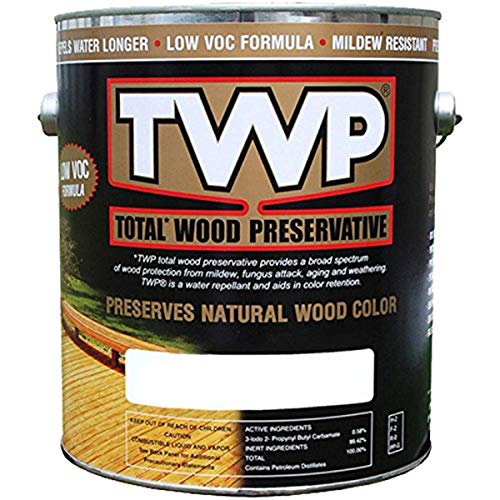
TWP 1500 is the only stain here registered with the EPA as a wood preservative (EPA No. 51578-1): its maker, Gemini, says it protects exterior wood from rot, surface mildew, water absorption and loss of color, and it penetrates rather than building a film, so it won’t crack, peel or blister when applied correctly. It’s an oil-based semi-transparent under 350 g/L VOC, sold in ten colors that can be intermixed, and covers 150 to 400 sq ft per gallon depending on how porous the wood is.
The application is wet-on-wet: saturate the boards, wait 15 to 30 minutes, and if the first coat has soaked in, apply the second right away; then wipe off whatever hasn’t soaked in within 30 to 60 minutes. Two coats are typical, one on hardwoods. TWP wants new pressure-treated wood to weather for 6 to 12 months before its first coat (4 to 6 for cedar and redwood) and no rain or cold for 2 to 3 days after. If you’re removing an old finish by sanding, its data sheet says 60 to 80 grit. It doesn’t guarantee color retention on horizontal surfaces, so plan on maintenance coats.
Premium pickAlkyd-oil one-coat finish
Sikkens ProLuxe SRD
Sikkens ProLuxe Cetol SRD Wood Finish
A high-solids one-coat matte finish with the longest maintenance window here.
Best for
Careful DIYers who prep by the book.
- One-coat, high-solids formula
- 2 to 4 year maintenance window
Skip it if
You want a quick weekend job.
- Most demanding prep
Read full review
Premium One-Coat Pick
ProLuxe SRD, still sold as Cetol SRD on many listings, is PPG’s high-solids alkyd-oil finish for siding, rails and decks. It’s a transparent matte, one-coat product with transoxide pigments and UV absorbers, water-repellent and mildew-resistant, and it covers 250 to 400 sq ft per gallon on smooth surfaces or hardwoods and 150 to 200 on rough or weathered wood. PPG gives a maintenance window of about 2 to 3 years on south and west exposures and 3 to 4 on north and east.
It asks for the most careful prep of the seven. PPG’s data sheet calls for a TSP-and-bleach scrub, a power wash at 500 to 800 psi, 48 hours of drying (or 18% moisture or less), and then sanding the deck at 60 to 80 grit, with the finish applied within a week. It needs 50 to 90°F and 48 hours with no rain, dew or temperatures below 40°F. It’s slow: 12 hours to touch, 48 hours to light foot traffic and 72 hours to full service. A natural-bristle brush is PPG’s preferred tool.
Budget pickWater-based semi-transparent
Thompson's WaterSeal Semi-Transparent
Thompson’s WaterSeal Semi-Transparent Waterproofing Stain
Guaranteed 5 years on decks, in one coat, in the lowest price tier.
Best for
A new pressure-treated deck on a budget.
- Guaranteed 5 years on decks
- 30-day wait on new treated wood
Skip it if
Your deck is a dense hardwood.
- Needs 48 hours above 50°F
Read full review
Best Budget Deck Stain
Thompson’s semi-transparent is the budget pick and the only one here with a written durability promise: it’s guaranteed 5 years on decks and 7 years on fences and siding. It’s a water-based stain and sealer that Thompson’s says exceeds the industry waterproofing standard ASTM D4446, adds moderate color while showing the grain, and gives a mold-and-mildew-resistant finish in one coat (a second only if you want more color).
Coverage is 150 to 400 sq ft per gallon, and it dries to the touch in about 2 hours. The weather rules are the usual ones for a water-based stain: surface and air above 50°F during application and for 48 hours after, and no rain in the forecast for 24 hours. On new pressure-treated lumber, Thompson’s asks you to wait 30 days, the shortest wait of any stain here. It’s sold at Amazon as well as home centers, in several semi-transparent colors.
Best solid colorSolid color acrylic stain
Olympic Maximum Solid
Olympic Maximum Solid Color Stain and Sealant
Covers old stain and gray boards, and applies down to 35°F.
Shop Now at AmazonSpecs: Olympic
Best for
Old, patchy or previously stained decks.
- Covers old stain and gray wood
- Self-priming
Skip it if
You want to see the grain.
- Hides the wood grain
Read full review
Best Solid Color Stain for Old Decks
When a deck has mismatched boards, old stain you can’t fully strip, or gray patches that a semi-transparent would only highlight, a solid color stain is the honest fix. Olympic Maximum Solid is a 100% acrylic latex stain and sealant that hides the grain but lets the texture show, and Olympic’s data sheet says it can go on new, weathered, or previously stained or painted wood (not freshly painted or sealed surfaces). It’s self-priming, with Olympic’s SunBlock UV protection and Scuff Guard formula.
It has the widest weather window here: Olympic’s “Weather-Ready” formula can be applied from 35°F to below 90°F and is rain-ready in 12 hours. It goes on as two thin coats, 2 to 4 hours apart, with a brush, pad or sprayer and back-brushing; Olympic’s current product page gives 250 to 350 sq ft per gallon. Allow 24 to 48 hours before foot traffic or furniture, and 30 days before washing the deck. Like any film-forming solid stain, it will eventually need scraping and sanding where it wears through, rather than a simple maintenance coat.
How I Chose These Deck Stains
I started from the brands that come up again and again in deck stain searches and kept the ones I could buy on Amazon from Amazon itself or an established paint and stain dealer, with a technical data sheet or product page that publishes coverage, coats and application limits. Then I picked one stain for each real job: the easiest all-rounder, a water-based option, a hardwood oil, a preservative for softwood, a premium one-coat finish, a budget stain and a solid color for old decks. Behr and Sherwin-Williams SuperDeck are popular, but they’re sold through their own store networks and I couldn’t find them sold on Amazon, so they’re not here. I don’t show customer ratings or prices: each stain has a tier, and the Amazon button shows the live price. More on how I choose the products I recommend.
How to Choose the Best Deck Stain
Oil-Based vs Water-Based Deck Stain
Oil-based deck stains (Ready Seal, Cabot Australian Timber Oil, TWP 1500, Sikkens ProLuxe SRD) soak into the wood and wear away gradually, so a maintenance coat goes straight over a clean, dry deck. They need dry wood, they clean up with mineral spirits, and oily rags can self-heat: TWP’s and PPG’s data sheets both tell you to put used rags in a sealed, water-filled metal container. Water-based stains (DEFY Extreme, Thompson’s, Olympic Maximum) dry faster, smell less and clean up with soap and water, and DEFY can go on wood that is visibly dry but slightly damp. Neither type is “better” in the abstract; the right one is whichever your deck already has, because most makers won’t go over another product without stripping first.
Transparent, Semi-Transparent or Solid
The more pigment, the more UV protection and the less grain you see. Transparent and translucent finishes (Sikkens SRD, Cabot Australian Timber Oil) show the most wood and suit decks in good condition. Semi-transparent stains (Ready Seal, DEFY, TWP, Thompson’s) are the usual choice: real color, visible grain, and no film to peel. Solid stains (Olympic Maximum) behave more like paint: they hide stains, gray wood and mismatched boards, but form a film that has to be scraped and sanded where it fails.
Best Deck Stain for Pressure-Treated Wood
Pressure-treated pine is porous once it has dried out, and that’s the key word: dried out. The makers’ waiting times range from 30 days (Thompson’s) to 3 to 6 months (DEFY) and 6 to 12 months (TWP), and Ready Seal skips the calendar and asks for 12% moisture on a meter. Do the water test: if drops soak in within seconds, the boards are ready. For weathered treated pine, TWP 1500 or Ready Seal are the strongest picks; for a new treated deck you want to protect this season, Thompson’s. If the boards need sanding first, my guide to sanding pressure-treated wood covers the safety side.
Best Deck Stain for Old Decks
An old deck with bare, gray boards takes a semi-transparent stain well once it’s cleaned and brightened, and it will drink more: Cabot’s rough-surface coverage is about half to two thirds of its smooth figure. An old deck with failing stain is the harder case. Either strip it to bare wood and use any stain here, or, if stripping won’t get it uniform, switch to a solid color stain like Olympic Maximum. Pressing a semi-transparent over patchy old stain gives a patchy result.
Cedar, Redwood and Hardwood Decks
Dense woods take less stain. DEFY and TWP both drop to one coat on dense or hard woods, Cabot Australian Timber Oil was built for dense hardwoods, and PPG tells you to wipe ipe, mahogany and teak with acetone just before applying SRD so the finish can penetrate. Cedar and redwood bleed tannins; an oxalic acid wood brightener removes that discoloration before you stain.
💡 Pro Tip: Don’t Sand a Deck Smooth
Every maker here that mentions sanding puts the limit at 60 to 80 grit on a deck: TWP, Ready Seal and PPG’s Sikkens data sheet all say so, and DEFY warns against fine grits. Sanding finer closes the pores and the stain can’t soak in. The grit-by-grit detail is in what grit sandpaper to use on a deck, and the machines that do it fastest are in my best sanders for deck refinishing.
How Long Does Deck Stain Last?
Less time on a deck than anywhere else, because a deck takes direct sun, standing water and foot traffic. The makers’ own figures show it: Ready Seal estimates 1 to 3 years on horizontal surfaces and 2 to 5 on vertical ones, Cabot gives 1 to 3 years on decks and 2 to 4 on siding and fences, and PPG puts the maintenance window at 2 to 4 years depending on exposure. Thompson’s 5-year deck guarantee is the longest written promise here. Darker tones and more pigment last longer, and a yearly wash and a light maintenance coat on worn areas extend all of them.
How Much Deck Stain Do You Need?
Coverage ranges from 100 to 600 sq ft per gallon across these seven, so the same deck can need two cans or six. Measure the floor, add the railings and stairs, and divide by your stain’s rate for each coat; my deck stain calculator does it for you with the makers’ coverage figures. Then follow the full process, from cleaning to the last coat, in my guide on how to stain a deck.
🏆 The Verdict
The best deck stain for most decks is Ready Seal: no lap marks, no temperature limits and easy maintenance, as long as the wood is bare and dry. Choose DEFY Extreme for a water-based stain, Cabot Australian Timber Oil for hardwood, TWP 1500 for weathered pressure-treated pine, and Olympic Maximum Solid when an old deck needs covering rather than coloring.
❓ Frequently Asked Questions
What is the #1 deck stain?+
What is the best long-lasting decking stain?+
Is Cabot or Behr stain better?+
What is the best deck stain for pressure-treated wood?+
What is the best stain for an old deck?+
Is oil-based or water-based deck stain better?+
Conclusion
Picking the best deck stain comes down to your wood and your patience with prep. Ready Seal is the most forgiving choice for most decks, DEFY Extreme is the water-based alternative, Cabot Australian Timber Oil suits hardwoods, TWP 1500 protects softwood, Sikkens SRD rewards careful prep, Thompson’s keeps a budget deck covered and Olympic Maximum Solid rescues an old one. Whatever you buy, it will only soak in as well as the prep allows, so sand no finer than 80 grit, clean and brighten the boards, and work out the gallons with the deck stain calculator before you order. Questions about your deck? Ask in the comments.
