


As an Amazon Associate I earn from qualifying purchases. All claims are strictly my personal opinion.
Editor’s Choice
Short on time? Of all the dust extractor I tested for woodworking and power tools, this is the one I'd buy.
- Also recommended Bosch VAC090AH
- Also recommended Festool CT 15

A dust extractor is a vacuum built to run behind a power tool: it has a HEPA filter, cleans that filter by itself so suction doesn’t fade, and switches on when you pull your tool’s trigger. For most woodworkers, the best dust extractor is the DEWALT DWV010: 8 gallons, 150 CFM, a HEPA filter that pulses clean every 30 seconds, and a tool-activated outlet.
Below are six extractors from DEWALT, Bosch, Festool, Fein and Makita, a comparison table, short reviews, and a guide to the numbers that actually matter when you choose one: airflow, suction, tank size, filter cleaning and noise.
⚡ Quick Pick
Best all-round extractor for sanders and saws: the DEWALT DWV010.
Sanding drywall, plaster or old paint? The Bosch VAC090AH cleans its HEPA filter twice as often.
Small shop or carrying it to jobs? The Festool CT 15 is the most compact here.
Best Dust Extractors: Comparison
| Extractor | Tank | Airflow | Water lift | Filter cleaning | Best for | Tier |
|---|---|---|---|---|---|---|
| DEWALT DWV010 | 8 gal | 150 CFM | Not listed | Auto, every 30 s | Best overall | $$$$ |
| Bosch VAC090AH | 9 gal | 150 CFM | 97 in. | Auto, every 15 s | Fine dust | $$$$ |
| Bosch VAC140AH | 14 gal | 150 CFM | 97 in. | Auto, every 15 s | Biggest tank | $$$$ |
| Festool CT 15 | About 4 gal | 130 CFM | Not listed | AutoClean | Most compact | $$$$ |
| Fein Turbo II HEPA | 8.5 gal | 151 CFM | Not quoted | Not listed | Quietest listed, 66 dB(A) | $$$$ |
| Makita VC4210L | 11 gal | 148 CFM | 92 in. | Auto | Wet and dry HEPA | $$$$ |
Tank
- DEWALT DWV010
- 8 gal
- Bosch VAC090AH
- 9 gal
- Bosch VAC140AH
- 14 gal
- Festool CT 15
- About 4 gal
- Fein Turbo II HEPA
- 8.5 gal
- Makita VC4210L
- 11 gal
Airflow
- DEWALT DWV010
- 150 CFM
- Bosch VAC090AH
- 150 CFM
- Bosch VAC140AH
- 150 CFM
- Festool CT 15
- 130 CFM
- Fein Turbo II HEPA
- 151 CFM
- Makita VC4210L
- 148 CFM
Water lift
- DEWALT DWV010
- Not listed
- Bosch VAC090AH
- 97 in.
- Bosch VAC140AH
- 97 in.
- Festool CT 15
- Not listed
- Fein Turbo II HEPA
- Not quoted
- Makita VC4210L
- 92 in.
Filter cleaning
- DEWALT DWV010
- Auto, every 30 s
- Bosch VAC090AH
- Auto, every 15 s
- Bosch VAC140AH
- Auto, every 15 s
- Festool CT 15
- AutoClean
- Fein Turbo II HEPA
- Not listed
- Makita VC4210L
- Auto
Best for
- DEWALT DWV010
- Best overall
- Bosch VAC090AH
- Fine dust
- Bosch VAC140AH
- Biggest tank
- Festool CT 15
- Most compact
- Fein Turbo II HEPA
- Quietest listed, 66 dB(A)
- Makita VC4210L
- Wet and dry HEPA
Tier
- DEWALT DWV010
- $$$$
- Bosch VAC090AH
- $$$$
- Bosch VAC140AH
- $$$$
- Festool CT 15
- $$$$
- Fein Turbo II HEPA
- $$$$
- Makita VC4210L
- $$$$
Dust Extractor vs Dust Collector: Which Do You Need?
The two names get mixed up constantly, and buying the wrong one is an expensive mistake.
- A dust extractor pulls hard through a small hose, typically 1-1/4″ to 1-1/2″, which is exactly what the tiny dust port on a sander, track saw or router needs. It filters the exhaust through a HEPA filter, cleans that filter automatically or at the push of a button, and has an outlet that starts it with your tool.
- A dust collector moves a large volume of air through a 4″ or wider duct at low pressure. It is built for chip-making machines: table saws, jointers, planers, drum sanders. It can’t pull effectively through a sander’s small hose.
If most of your dust comes from handheld tools, you want an extractor. If it comes from stationary machines, see my dust collector reviews. Many shops end up with both, plus an air filtration unit for what escapes into the room.
Best Dust Extractors: Reviews
DEWALT DWV010 8-Gallon HEPA Dust Extractor

Best Dust Extractor Overall
The DEWALT DWV010 covers what a woodworker needs from an extractor without extras. Its 15 A motor moves 150 CFM, the HEPA filter is pulsed clean every 30 seconds so you never stop to knock it out, and the tool outlet turns the vacuum on and off with your sander or saw. The 15 ft anti-static hose is 1-1/4″, the right size for tool ports, and a universal connector swivels at the tool end. DEWALT notes it meets the EPA Lead Renovation, Repair and Painting (RRP) rule for HEPA vacuums only when fitted with its DWV9330 filters. DEWALT’s own random orbital sanders have dust ports designed to fit it directly.
- ✅ 150 CFM, HEPA, auto filter cleaning
- ✅ Tool-activated outlet
- ✅ 15 ft anti-static hose sized for tools
- ❌ RRP compliance needs the specific DWV9330 filters
- ❌ Water lift not published
Best For: A home or small-pro shop running sanders, routers and track saws.
Bosch VAC090AH 9-Gallon Dust Extractor
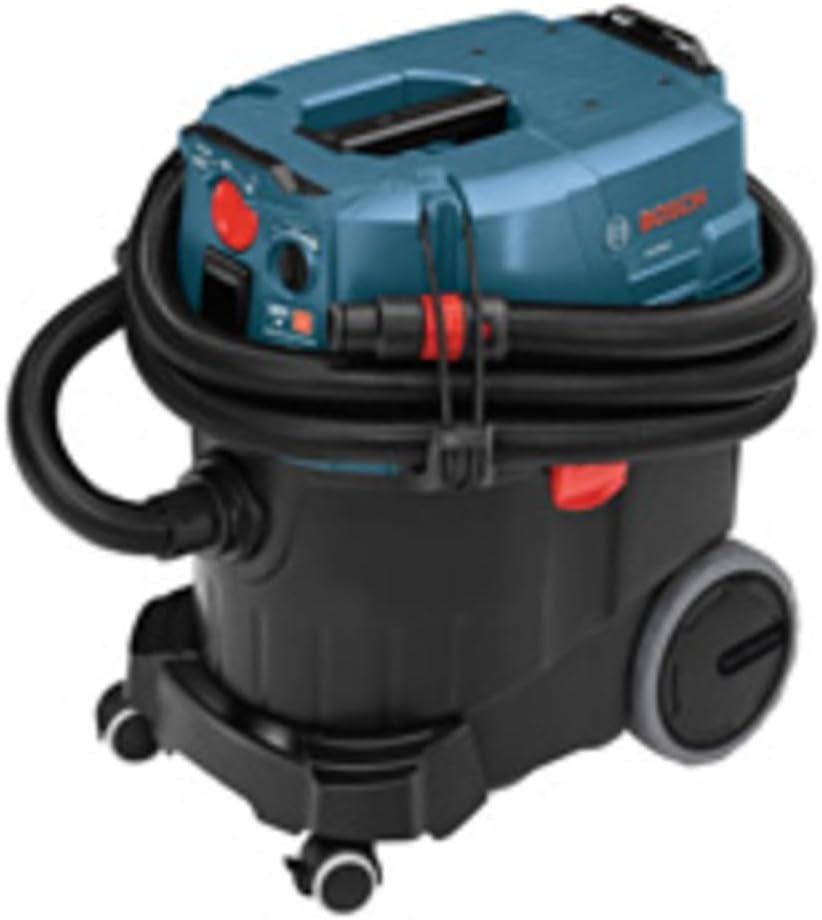
Best for Fine Dust
Bosch publishes both numbers for the VAC090AH: 150 CFM of airflow and 97 inches of water lift. Its automatic filter cleaning fires every 15 seconds, twice as often as the DEWALT’s, which matters most with the finest dust: drywall compound, plaster and paint. The HEPA filter is rated at 99.97% of particles at 0.3 micron, a fleece bag protects it, and the Power Broker dial lets you turn suction down so a sander doesn’t clamp itself to the surface. Tool activation is included, and Bosch positions it as part of its PRO+GUARD system for OSHA silica compliance on masonry work.
- ✅ Filter cleaned every 15 seconds
- ✅ Airflow and water lift both published
- ✅ Suction dial for sanders
- ❌ Heavier-duty build than a woodworking-only shop needs
Best For: Drywall, plaster and paint sanding, and concrete grinding.
Bosch VAC140AH 14-Gallon Dust Extractor

Biggest Tank
The VAC140AH is the same Bosch system in a 14-gallon tank: 150 CFM, 97 inches of water lift, automatic filter cleaning every 15 seconds, a HEPA filter rated at 99.97% at 0.3 micron and a fleece filter bag. Power tool activation and the Power Broker suction dial carry over, and it comes with a 9.85 ft hose. The larger tank means fewer stops to empty on long sanding or grinding jobs; the trade-off is a bigger machine to move around.
- ✅ 14 gallons, the largest here
- ✅ 15-second auto filter cleaning, HEPA
- ❌ Bulky for carrying up stairs
- ❌ Shorter hose than the DEWALT’s
Best For: Long jobs and remodels where emptying the tank is the bottleneck.
Festool CT 15 HEPA Dust Extractor
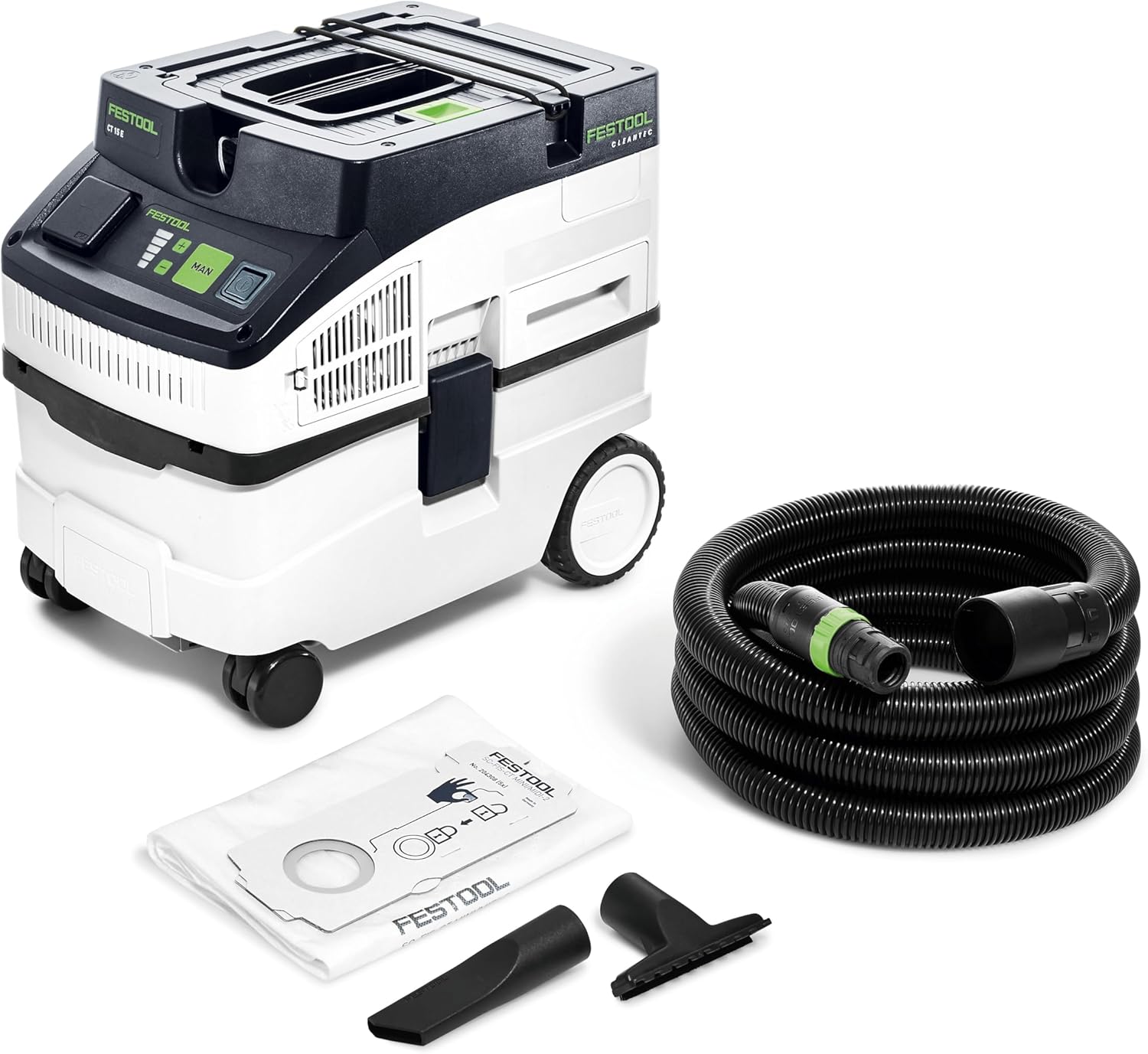
Most Compact
The Festool CT 15 is the smallest extractor here, with a container of about 4 gallons (15 L), a HEPA filter, automatic tool start, an AutoClean filter system and touch controls. Festool rates it at 130 CFM of maximum airflow. The crevice and upholstery nozzles store inside the machine, the flat top holds tools, and it carries Festool’s 3-year comprehensive warranty, including wear and tear. Its compact size and steel-axle chassis are built for carrying from job to job.
- ✅ Most compact, easy to carry
- ✅ 3-year warranty including wear and tear
- ✅ Fits the Festool system of hoses and tools
- ❌ Smallest container, more frequent emptying
Best For: Small shops, finish carpenters and anyone who moves the extractor between rooms. It pairs naturally with premium sanders like the Mirka DEROS or Festool’s own.
Fein Turbo II HEPA Set

Quietest Listed
The Fein Turbo II HEPA is rated at 66 dB(A), the lowest noise figure among these six. It has an 8.5-gallon tank, a 1,100 W motor rated at 151 CFM, a 13 ft hose and a 19 ft power cord, and an autostart outlet that starts it with your tool, with a short start delay to avoid overloading the circuit. An anti-static system prevents shocks from dry dust, and it handles liquids too. Fein lists a 1-year warranty. The listing does not mention automatic filter cleaning, so plan on knocking the filter clean yourself during long sanding sessions.
- ✅ 66 dB(A), the quietest here
- ✅ Long 13 ft hose and 19 ft cord
- ✅ Wet and dry use
- ❌ Automatic filter cleaning not listed
- ❌ 1-year warranty, shorter than the others
Best For: Basement and garage shops where noise travels to the rest of the house.
Makita VC4210L 11-Gallon HEPA Dust Extractor

Best Wet/Dry HEPA Extractor
The Makita VC4210L pairs an 11-gallon wet/dry tank with a 12 A motor rated at 148 CFM and 92 inches of water lift. Its filtration is two-stage: a main flat filter rated at 99.95% of particles at 2 microns, backed by a HEPA filter at 99.97% at 0.3 micron. Automatic filter cleaning keeps suction up, and the tool-activated outlet has a 10-second off delay that clears the hose after you let go of the trigger.
- ✅ Two-stage filtration with HEPA
- ✅ Wet and dry, 11 gallons
- ✅ 10-second hose-clearing delay
- ❌ Highest price tier of the group
Best For: Makita tool owners and jobs that mix dust with water or slurry.
How I Chose These Dust Extractors
I looked only at machines sold as dust extractors, from established tool makers, that are on sale on Amazon today and publish enough numbers to compare. The criteria, in order:
- HEPA filtration as standard, because sanding and drywall dust are the fine particles that matter for your lungs.
- Filter cleaning, automatic where possible, because fine dust chokes a filter in minutes.
- Published airflow and suction, taken from the maker’s listing. Where a figure was missing or used the wrong unit, I left it out rather than guess.
- A tool-activated outlet, so extraction runs every time the tool does.
I left out listings that mixed up two models, and unbranded extractors with no maker specifications. I don’t show star ratings or prices: prices change daily, so each pick carries a price tier and the Amazon button shows the live price.
How to Choose a Dust Extractor
Airflow (CFM) vs Water Lift
Airflow, in cubic feet per minute, is how much air the extractor moves. Water lift, in inches, is how hard it pulls against resistance: a long, narrow hose and a sander’s small port. You need both. High airflow with weak lift loses power at the end of 15 feet of small hose; high lift with little airflow can’t carry the dust away from the pad. The extractors here all sit between 130 and 151 CFM, so the differences between them come down to lift, filter cleaning and hose.
Tank Size
Eight to nine gallons is the sweet spot for a home shop: big enough for a day of sanding, small enough to carry. Go larger, like the 14-gallon Bosch, for remodeling and long jobs. Go smaller, like the Festool CT 15, when portability matters more than capacity. Adding a cyclone dust separator in front of any extractor multiplies its effective capacity for chips and heavy debris.
Filter Cleaning
Sanding dust coats a filter fast, and a coated filter means falling suction. Automatic cleaning pulses air back through the filter on a timer: every 30 seconds on the DEWALT, every 15 on the Boschs. Manual cleaning works too, but you have to remember to do it.
HEPA and Lead Paint
A HEPA filter is rated to capture 99.97% of particles at 0.3 micron. If you sand paint in a pre-1978 home, the EPA’s lead-safe work practices call for HEPA vacuums; DEWALT, for example, states that the DWV010 meets the EPA’s RRP rule for HEPA vacuums only with its DWV9330 filters. Check the fine print for your model before relying on it for regulated work.
Hose Diameter and Length
A 1-1/4″ hose suits sanders and small tools; a 1-1/2″ hose moves more air for routers and track saws. Longer hoses give you reach but lose some suction. Anti-static hoses stop the small shocks that dry dust builds up in plastic. Pair it with one of the sanders built to hook up to a vacuum.
Noise
An extractor runs as long as your tool does, so noise adds to your sander’s. If the maker publishes a figure, compare it; the Fein’s 66 dB(A) is the lowest listed here.
💡 Pro Tip
On a random orbital sander, too much suction can pull the pad down onto the wood and slow its rotation, which causes swirls. If your extractor has a suction dial, turn it down until the sander glides freely, then stop.
Dust Extractor or Shop Vac?
A good shop vac with a fine filter, a bag and a separator can get surprisingly close to an extractor for occasional work, at a lower price. What it lacks is automatic filter cleaning, a HEPA rating as standard, and usually a tool outlet. If you sand every week, the extractor pays for itself in steady suction and cleaner air. If you sand a few times a year, start with my guide to the best shop vac for dust collection.
🏆 The Verdict
For most woodworkers the DEWALT DWV010 is the dust extractor to buy: HEPA, 150 CFM, 30-second auto cleaning and a tool outlet. For drywall, plaster and paint, the Bosch VAC090AH keeps the finest dust from choking its filter. If you carry your extractor from room to room, the Festool CT 15 is the one you’ll actually bring along.
❓ Frequently Asked Questions
What is the most powerful dust extractor?+
What is the best dust extractor for home use?+
What’s the difference between a dust collector and a dust extractor?+
What is the best device for removing dust?+
What is the best dust extractor for a small workshop?+
What is the best dust extractor for sanding?+
Conclusion
The right dust extractor is the one that keeps suction steady for the whole job and starts every time your tool does. That means HEPA, automatic filter cleaning and a tool outlet, in a size you’ll happily move around your shop. Any of the six above does that; choose by tank size, noise and the tools you already own.
Sanding walls and ceilings? My guide to the best sanders for drywall pairs well with an extractor. Picking the sander first? Start with the best random orbital sanders. Questions about your setup? Ask in the comments.
