
As an Amazon Associate I earn from qualifying purchases. All claims are strictly my personal opinion.
Best dovetail jig

Variable-spaced through and half-blind dovetails, sliding dovetails and box joints on boards up to 24 inches wide.

A dovetail jig turns the most famous joint in woodworking into a router job: clamp the boards, guide the router around a template, and the pins and tails come out matched. The right jig depends on which dovetails you want (through, half-blind or both), how wide your boards are, and whether you rout by hand or on a table. The best dovetail jig for most serious woodworkers is the Leigh D4R Pro, because it cuts through, half-blind and sliding dovetails with spacing you choose, on boards up to 24 inches wide. The Keller 1500 is the simplest way to cut through dovetails, the General Tools 861 is the budget starting point, and the Leigh RTJ400 is the one for a router table.
Below are six jigs for different shops and budgets, a comparison table built from the makers’ specifications, short reviews, a diagram of the two main joints, a buying guide and a step-by-step section on how to use a dovetail jig.
Best Dovetail Jigs: Comparison
Joint types, board width, stock thickness and what comes in the box are taken from the makers’ pages (Leigh, Keller, Woodstock) or, where the maker publishes only its Amazon listing (CMT, General Tools), from that listing. Where a figure isn’t published, the table says “not listed” instead of guessing. I don’t print prices: they range from budget to premium, and the Amazon buttons show the live price.
| Product | ⭐ Leigh D4R Pro 🏆 EDITOR’S CHOICE |
Keller 1500 Journeyman | General Tools 861 | CMT300 Universal | Woodstock D2796 | Leigh RTJ400 |
|---|---|---|---|---|---|---|
| Image | |
 |
 |
 |
 |
 |
| Joints | Through, half-blind, sliding, box joints | Through dovetails | Half-blind, through, box joints (listing) | 1/2″ half-blind (more with templates) | 1/2″ half-blind | Through, half-blind, box joints |
| Board width | Up to 24″ | Unlimited | 12″ template | Not listed | Up to 12″ | 16″ template |
| Stock thickness | Through to 1-1/4″, half-blind to 1-1/2″ | 3/8″ to 3/4″ (1/8″ with small bits) | Not listed | 7/16″ to 1″ | 1/2″ to 1-1/4″ | Tails to 1″, pins to 13/16″ |
| Bits included | 3 carbide bits | 7° dovetail + straight, bearing-guided | 1/2″ 14° dovetail bit | Template guide only | None (needs 7/16″ bushing, 14° bit) | Cutters + eBush guide bushing |
| Router | Handheld, 1-1/2 to 2-1/4 HP | 1 HP+, 1/4″ collet | Handheld or router table | Handheld router | Handheld router | Router table (1-3/8″ insert ring) |
| Availability | Shop Now at Amazon | Shop Now at Amazon | Shop Now at Amazon | Shop Now at Amazon | Shop Now at Amazon | Shop Now at Amazon |
Best Dovetail Jigs: Reviews
Every jig here could be ordered on Amazon when I checked it. The Porter-Cable 4200 series, long the default recommendation for half-blind jigs, isn’t in the list because I couldn’t find it sold new on Amazon, and hand-saw dovetail guides are left out because they’re a different tool for a different way of working.
Editor's ChoiceAdjustable finger dovetail jig
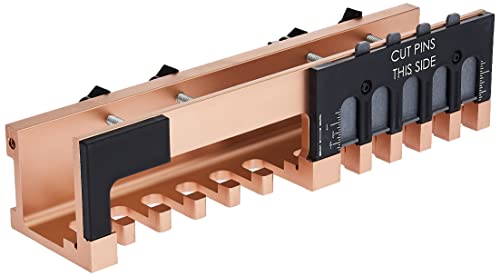
Leigh D4R Pro
Leigh D4R Pro Dovetail Jig
Variable-spaced through and half-blind dovetails, sliding dovetails and box joints on boards up to 24 inches: the reference jig.
Shop Now at AmazonSpecs: Leigh
Best for
Variable spacing and every common dovetail from one jig.
- Variable spacing on through and half-blind
- Boards up to 24" wide
- 5-year warranty
Skip it if
You only need drawers in batches: a half-blind template jig is faster to set up.
- Longer learning curve than a template jig
- Premium price tier
Read full review
Best Dovetail Jig Overall
The D4R Pro is the jig the others get compared to, and the reason is the finger assembly. Instead of a fixed template, it has guide fingers you slide along a bar, so you choose where every pin and tail goes. Leigh says it routs equally or variably spaced through and half-blind dovetails, which template jigs can’t do, plus sliding dovetails, box joints in 3/8″ and 3/4″, angled, rabbeted and end-on-end dovetails from the same assembly. Leigh lists through dovetails in boards up to 1-1/4″ thick and half-blind up to 1-1/2″, and the listing gives a board width of up to 24″, enough for a blanket chest. The base is a one-piece aluminum extrusion, and the listing includes three carbide router bits. Leigh recommends a mid-size router of 1-1/2 to 2-1/4 HP, ideally a fixed base, fitted with a Leigh guide bushing; depending on your router you may need an adaptor, which Leigh’s selector tool identifies. There’s a 5-year warranty and a 90-day satisfaction guarantee. It takes longer to learn than a template jig and it’s a premium-tier tool, so it makes most sense if dovetails will be a regular part of your work.
Through dovetail template
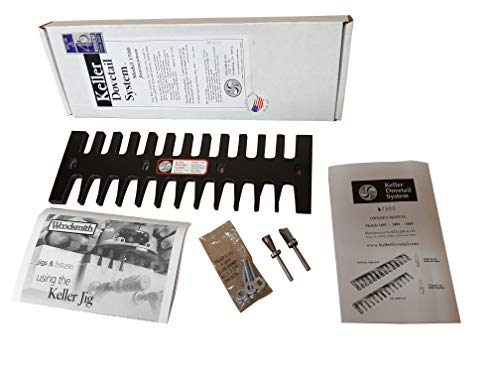
Keller 1500 Journeyman
Keller 135-1500 Journeyman Dovetail Jig
A fixed through-dovetail template with bearing-guided bits: no test cuts and no limit on board width.
Shop Now at AmazonSpecs: Keller
Best for
Simple, repeatable through dovetails in wide boards.
- Setup with no test cuts
- Unlimited board width
- Bearing-guided bits included
Skip it if
You need half-blind dovetails for drawer fronts.
- Through dovetails only
- Backing block not included
Read full review
Best for Through Dovetails
Keller’s approach is the opposite of Leigh’s: no adjustments, no test cuts. The 1500 is a 15″ back-to-back template milled from 1/2″ phenolic plate, with the tails on one edge and the pins on the other. You screw it to a wooden backing block (not included), clamp the board under it, and rout with the bearing-guided bits in the box: a 7° dovetail bit and a straight bit. Because the bearings ride the template, no guide bushing is needed, and because the board isn’t clamped inside a frame, Keller rates it for stock of unlimited width and length; you simply move the template along a wide board. The standard bits cut wood 3/8″ to 3/4″ thick, and an optional small bit set covers 1/8″ to 3/8″ for boxes. Pins sit on 1-1/8″ centers. Keller asks for a router of 1 HP or more with a 1/4″ collet, and short parts can be run with the template upside down on a router table. It cuts through dovetails only; for hidden joints on drawer fronts you’d add a half-blind jig. Made in the USA, mid-range price tier.
Budget template dovetail jig
General Tools 861
General Tools 861 E-Z Pro Dovetailer II
A 12-inch template jig with a 14° bit in the box: the low-cost way to start cutting dovetails with a router.
Shop Now at AmazonSpecs: Amazon listing
Best for
A first dovetail jig on a small budget.
- Includes a 1/2" 14° dovetail bit
- 12" capacity for drawers and boxes
- Lightest jig here
Skip it if
You want variable spacing or wide carcasses.
- Stock thickness not listed
- Needs firm clamping to the bench
Read full review
Best Budget Dovetail Jig
If you want to try machine-cut dovetails without a big outlay, the 861 is the usual starting point. It’s a 12″ aluminum template jig with built-in clamping and knobs to adjust the fit, and the box includes a 1/2″ 14° dovetail router bit, so you only need a router and a guide bushing to start. General Tools lists it for half-blind and through dovetails and box joints and says it works with a handheld router or a router table. The facts here come from the Amazon listing; General Tools doesn’t publish a detailed spec sheet for stock thickness, so check the manual for your board size before you buy wood. It’s light at under 3 lb, which makes it easy to store, but a light jig also needs to be clamped firmly to the bench so it doesn’t shift during the cut. Set it up with scrap of the same thickness as your project and expect a few test joints before the fit is right; that’s normal for any template jig. Budget price tier.
Steel half-blind dovetail jig
CMT300 Universal
CMT300 Universal Dovetail Jig
A steel half-blind jig with factory-set stops for 7/16 to 1 inch stock, built for drawers in batches.
Shop Now at AmazonSpecs: Amazon listing
Best for
Repeatable half-blind drawer joints.
- Steel body, templates and clamps
- Factory-set stops for batch drawers
- Takes 7/16" to 1" stock
Skip it if
You want through dovetails out of the box.
- Dovetail bit not listed as included
- Maximum width not listed
Read full review
Best Mid-Range Half-Blind Jig
The CMT300 is built for the classic drawer joint. The body, templates, stops and clamping bars are all steel, and the stops are factory-set: you push the drawer side and front against them, clamp, set the bit depth and rout. That fixed geometry is what makes half-blind dovetails quick in batches, because nothing drifts between drawers. CMT lists stock from 7/16″ to 1″ thick, and the standard jig includes a template for 1/2″ half-blind dovetails and a template guide (the bushing). The name “Universal” refers to the extra templates CMT sells for other joints, so the jig can grow with you. CMT’s listing doesn’t name a router bit in the box or give a maximum board width, so plan on buying a dovetail bit that matches the template. The listing gives a weight of about 13 lb, which helps it stay put on the bench during a cut. Mid-range price tier.
12-inch half-blind dovetail jig
Woodstock D2796
Woodstock D2796 Dovetail Jig with Aluminum Template
A dedicated 12-inch half-blind jig with cam clamps that takes stock from 1/2 to 1-1/4 inches thick.
Best for
Half-blind drawers in thick stock.
- Cam-action clamps
- Takes stock up to 1-1/4" thick
- Steel body, aluminum template
Skip it if
You want through dovetails or box joints.
- Half-blind only
- Bit and bushing sold separately
Read full review
Best for Thick Drawer Stock
Woodstock’s jig does one job: 1/2″ half-blind dovetails, cut on the pin and tail boards at the same time in one pass of the router. Its cam-action clamps lock both boards quickly, the adjusting knobs are large instead of wing nuts, and the body is formed steel with a 1/2″ aluminum template. Woodstock rates it for stock from 1/2″ to 1-1/4″ thick and boards up to 12″ wide, so it handles thicker drawer fronts than most budget jigs. Plan on two extras: the router needs a 7/16″ guide bushing and a 1/2″ 14° dovetail bit, neither included. That makes it a good fit if you already own a router with a bushing set. It doesn’t cut through dovetails or box joints, and 12″ covers most drawers but not cabinet sides. Budget to mid-range price tier.
Router table dovetail jig
Leigh RTJ400
Leigh RTJ400 Router Table Dovetail Jig
Through, half-blind and box joints routed on the router table, with cutters and Leigh's guide bushing included.
Shop Now at AmazonSpecs: Leigh
Best for
Dovetails and box joints on a router table.
- Through, half-blind and box joints on a table
- Tails up to 1" thick
- Cutters and guide bushing included
Skip it if
You don't own a router table or need variable spacing.
- Needs a 1-3/8" counterbore insert ring
- Equal spacing only
Read full review
Best for the Router Table
If your router lives in a table, the RTJ400 brings dovetails to it: you clamp the board in the jig and slide the whole jig across the table, around a guide bushing mounted in the insert plate. The 16″ template is CNC-machined aluminum, and Leigh lists five sizes of through dovetails at two pitches, three depths of single-pass half-blind dovetails and four sizes of box joints (3/4″ down to 3/32″), plus angled and end-on-end dovetails. Tails can be up to 1″ thick and pins up to 13/16″ on full-pitch through dovetails. Leigh’s elliptical guide bushing sets the joint fit without trial-and-error adjustments, and the kit includes the template, cam clamps, cutters, the eBush guide bushing and setup gauges. One requirement to check before you buy: the eBush needs a 1-3/8″ counterbore insert ring in your router table or plate. It works with equally spaced joints only, and it’s a premium-tier jig, priced below the D4R Pro. See my best router table guide if you’re still choosing the table.
How I Chose These Dovetail Jigs
I started from the jobs people buy a dovetail jig for: drawers (half-blind), boxes and carcasses (through), wide chests, small boxes, and router-table work. Then I looked at the jigs sold on Amazon today from makers that publish real specifications, and picked the best for each job and budget. I favored jigs whose makers state the joint types, board width and stock thickness, which is why the two Leigh jigs and the Keller are here: Leigh and Keller publish full spec pages. I don’t show customer ratings or prices. For how I pick products across the site, see how I choose.
Through vs Half-Blind Dovetails
Almost every jig is built around these two joints, so it’s the first thing to decide. A through dovetail shows the end grain of both the pins and the tails on the outside of the corner: it’s the joint for boxes, chests and carcasses, where the joinery is part of the look. A half-blind dovetail stops short of the front face, so the joint is hidden when you look at the front: it’s the classic joint for drawer fronts. Half-blind template jigs usually cut both boards at once; through dovetails take two passes, one for the tails and one for the pins.
Both joints seen from above. Dark: pin board (drawer front on the right). Light: tail board.
How to Choose a Dovetail Jig
Which Joints You Need
If you mostly build drawers, a half-blind jig like the CMT300 or Woodstock D2796 is all you need, and it’s the fastest way to make them in batches. If you build boxes and chests, you want through dovetails: the Keller is the simplest route. If you want both, plus sliding dovetails and box joints, look at the Leigh D4R Pro or, on a router table, the RTJ400.
Fixed Template or Adjustable Fingers
Template jigs space every pin the same distance apart, which is quick and repeatable but looks machine-made. Adjustable finger jigs like the D4R Pro let you place each pin and vary the spacing, so the result looks closer to hand-cut work. The trade-off is setup time: finger jigs take longer to learn and to set for each project.
Board Width and Thickness
Width decides the biggest drawer or carcass side you can join in one setup: 12″ covers most drawers, 16″ to 24″ covers chests and cabinets, and open templates like the Keller have no width limit. Thickness matters too: check the range against your usual stock, especially for 1″ drawer fronts or 1/2″ box sides.
Router, Guide Bushing and Bits
Most jigs are guided by a bushing fitted to the router base, so your router has to take the bushing size the jig specifies, and the dovetail bit has to match the template’s angle and diameter. The Keller is the exception: its bits carry their own bearings. A mid-size router of about 1-1/2 to 2-1/4 HP is the sweet spot, and a fixed base is steadier than a plunge base on a jig; my guide to the best router for woodworking covers the options, and types of router bits explains dovetail bit angles.
Handheld or Router Table
Handheld jigs clamp to the bench and you move the router. Table jigs like the RTJ400 hold the board while you slide the jig over a bit sticking up from the table, which many people find easier to control. If you already own a router table, a table jig saves you from balancing a router on a narrow template.
How to Use a Dovetail Jig
Every jig has its own manual and setup gauges, so follow yours first. The general sequence for a template jig with a handheld router looks like this:
- Mill the stock flat, square and to one thickness. Jigs assume square ends and flat faces; a cupped board or an out-of-square end shows up as gaps.
- Fit the guide bushing and the bit the jig specifies, with the router unplugged. Center the bushing if your router allows it.
- Set the bit depth with the jig’s gauge. On half-blind jigs, depth controls the fit: a little deeper makes the joint tighter, a little shallower makes it looser.
- Clamp the boards against the stops. For half-blind joints, the drawer front goes flat on top and the drawer side vertically at the front, both tight to their stops, inside face out.
- Rout a light pass first from left to right along the front to score the fibers and prevent tear-out, then rout in and out of each template slot, keeping the bushing against the template the whole time.
- Let the bit stop before you lift the router off the jig, then unclamp and test the fit before cutting your real parts.
- Adjust and repeat on scrap until the joint goes together with hand pressure, then cut the project parts and glue up with a thin coat on the long-grain faces.
For through dovetails, the tails and pins are cut in two separate setups, often with two different bits, and the fit is adjusted by the template position or the bit rather than only the depth. If you’re new to the router itself, start with my guide on how to use a router before you put one on a jig.
💡 Pro Tip: Keep a Setup Board
Once a test joint fits perfectly, label one pair of offcuts with the bit, the depth and the stock thickness, and keep them by the jig. Next time, set the bit to the saved board instead of starting from scratch. It saves most of the test cuts on every project after the first.
🏆 The Verdict
The best dovetail jig for most serious woodworkers is the Leigh D4R Pro: every common dovetail plus box joints, with spacing you choose, on boards up to 24 inches. The Keller 1500 is the no-fuss pick for through dovetails, the General Tools 861 the low-cost way to start, the CMT300 and Woodstock D2796 the dedicated half-blind jigs for drawers, and the Leigh RTJ400 the one to buy if your router lives in a table.
❓ Frequently Asked Questions
How do dovetail joints work?+
What are the downsides of dovetail joints?+
How do you use a dovetail jig with a router?+
Can you cut dovetails with a router without a jig?+
What is the best dovetail jig for beginners?+
What router bit do I need for a dovetail jig?+
Conclusion
Pick a dovetail jig by the joint you’ll cut most. For drawers in batches, a half-blind jig like the CMT300 or the Woodstock D2796 is fast and repeatable; for boxes and chests, the Keller 1500 makes through dovetails with no fuss; and if you want every joint, with spacing that looks hand-cut, the Leigh D4R Pro is the one to own, or the RTJ400 if you work on a router table. Mill your stock square, match the bit to the template, and make test joints first. Questions about your project? Ask in the comments.
