


As an Amazon Associate I earn from qualifying purchases. All claims are strictly my personal opinion.
Editor’s Choice
Short on time? Of all the sandpaper I tested for wood: sheets, discs and hand sanding pads, this is the one I'd buy.
- Budget pick POWERTEC 50-pack assortment
- Also recommended Mirka Goldflex Soft

Good sandpaper cuts faster, lasts longer and leaves a more even scratch pattern than cheap paper, and on wood you see the difference as soon as the stain goes on. For hand sanding and sheet sanders, the best sandpaper for wood is 3M’s Pro Grade Precision: an aluminum oxide sheet with a tear-resistant backing that works wet or dry. For a random orbital sander, a 5″ hook-and-loop assortment covers the full grit sequence.

Below are my picks for sheets, discs and soft pads, a comparison table, short reviews, and a guide to the three things that decide how sandpaper performs on wood: the abrasive, the backing and the grit.
⚡ Quick Pick
Sheets for hand sanding and sheet sanders: 3M Pro Grade Precision.
Discs for a 5″ random orbital sander on a budget: the POWERTEC 50-pack assortment.
Curves, moldings and turned parts: Mirka Goldflex Soft foam pads.
Best Sandpaper for Wood: Comparison
| Sandpaper | Format | Grits in the pack | Use with | Wet or dry | Tier |
|---|---|---|---|---|---|
| 3M Pro Grade Precision | 9″ x 11″ sheets, 20 | 180 (other grits sold) | Hand, block, sheet sander | Both | $ |
| 3M Aluminum Oxide Assorted | 9″ x 11″ sheets, 5 | 100, 150, 220 | Hand, block, cut for sanders | Not stated | $ |
| POWERTEC 5″ 8-Hole Discs | 5″ hook-and-loop, 50 | 80, 100, 120, 150, 220 | 5″ random orbital, 8-hole pad | Both | $ |
| Mirka Goldflex Soft | Foam pads on a roll, 200 | 240 (other grits sold) | Hand, curves and profiles | Both | $$ |
Format
- 3M Pro Grade Precision
- 9″ x 11″ sheets, 20
- 3M Aluminum Oxide Assorted
- 9″ x 11″ sheets, 5
- POWERTEC 5″ 8-Hole Discs
- 5″ hook-and-loop, 50
- Mirka Goldflex Soft
- Foam pads on a roll, 200
Grits in the pack
- 3M Pro Grade Precision
- 180 (other grits sold)
- 3M Aluminum Oxide Assorted
- 100, 150, 220
- POWERTEC 5″ 8-Hole Discs
- 80, 100, 120, 150, 220
- Mirka Goldflex Soft
- 240 (other grits sold)
Use with
- 3M Pro Grade Precision
- Hand, block, sheet sander
- 3M Aluminum Oxide Assorted
- Hand, block, cut for sanders
- POWERTEC 5″ 8-Hole Discs
- 5″ random orbital, 8-hole pad
- Mirka Goldflex Soft
- Hand, curves and profiles
Wet or dry
- 3M Pro Grade Precision
- Both
- 3M Aluminum Oxide Assorted
- Not stated
- POWERTEC 5″ 8-Hole Discs
- Both
- Mirka Goldflex Soft
- Both
Tier
- 3M Pro Grade Precision
- $
- 3M Aluminum Oxide Assorted
- $
- POWERTEC 5″ 8-Hole Discs
- $
- Mirka Goldflex Soft
- $$
Best Sandpaper for Wood: Reviews
3M Pro Grade Precision Sanding Sheets
Best Sandpaper for Wood Overall
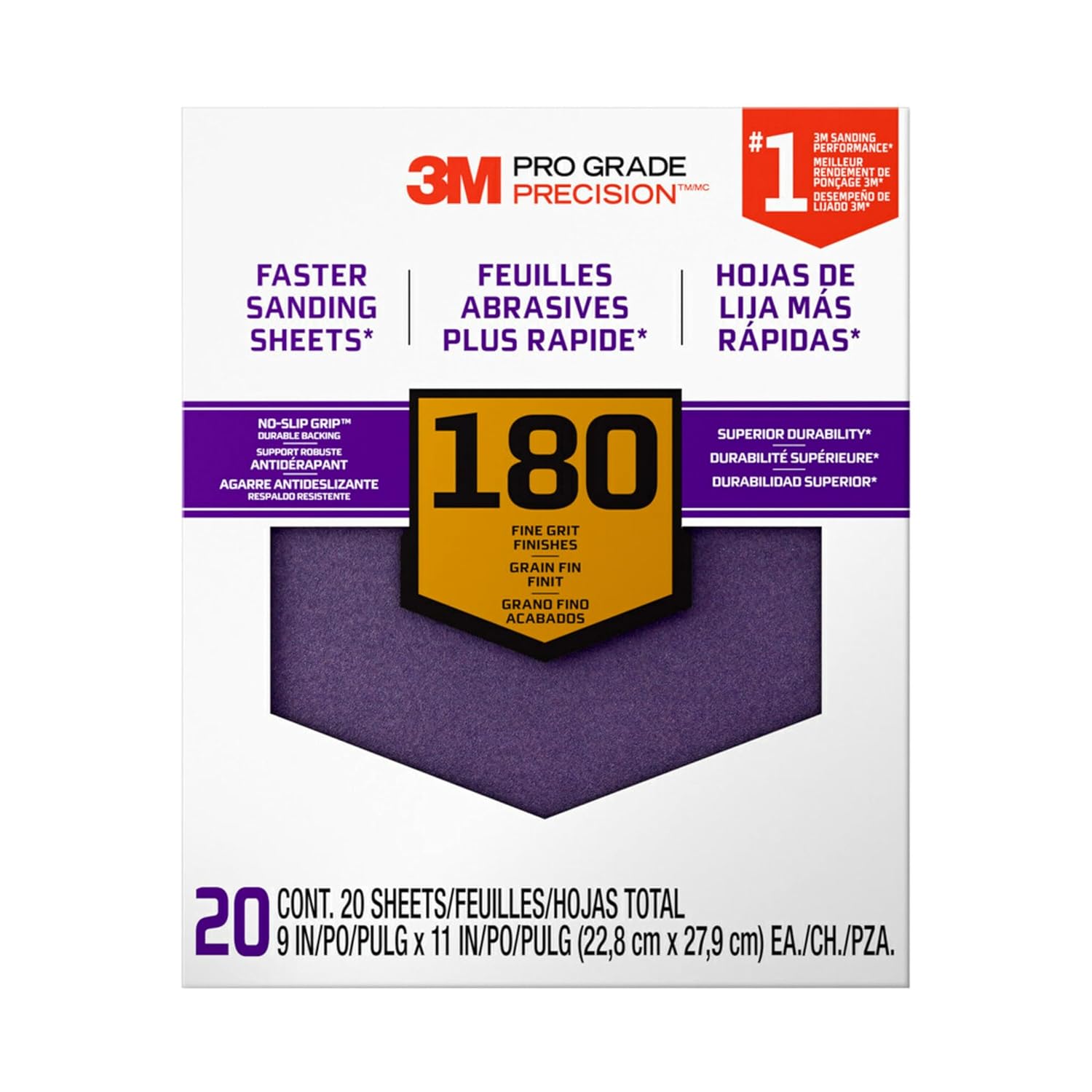
3M’s Pro Grade Precision sheets are the upgrade most people notice first. The abrasive is made, in 3M’s words, with technology from its Cubitron II industrial abrasives, and the no-slip grip backing is designed to resist tearing and reduce hand fatigue, which matters when you fold a sheet around a block or clamp it in a sheet sander. The sheets work wet or dry, flex to follow the surface, and 3M says the paper’s color won’t transfer to light woods. This pack is 20 full 9″ x 11″ sheets of 180 grit, the grit most bare wood gets just before finishing; 3M sells the same line in coarser and finer grits.
- ✅ Tear-resistant backing for blocks and sheet sanders
- ✅ Wet or dry
- ✅ Won’t discolor light woods, per 3M
- ❌ Single grit per pack: buy two or three grits
Best For: Hand sanding and 1/4-sheet sanders on furniture, cabinets and trim.
3M Aluminum Oxide Sandpaper, Assorted Grits
Best Starter Assortment
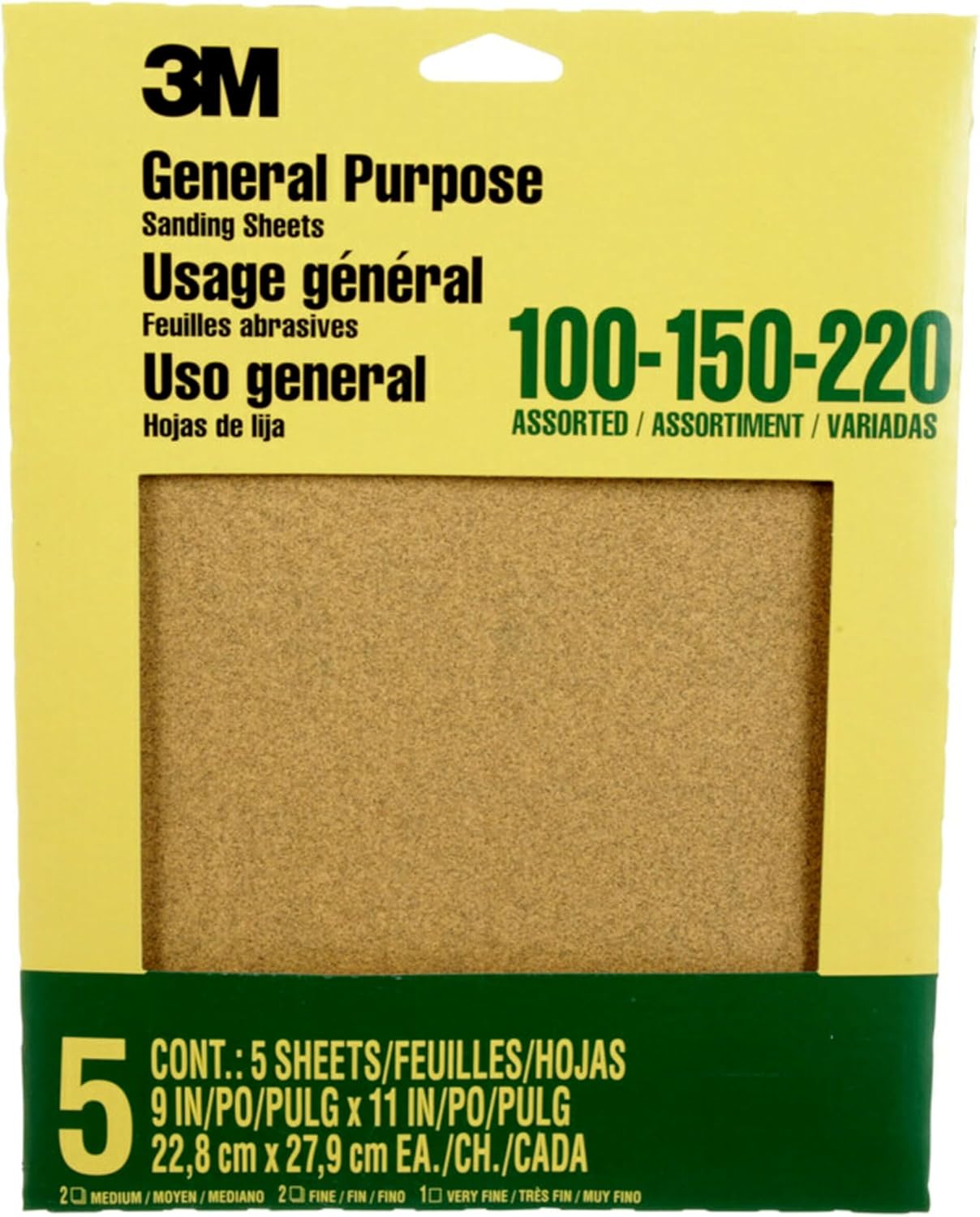
If you only need a few sheets for one project, this 3M 9005NA pack gives you five 9″ x 11″ aluminum oxide sheets in 100, 150 and 220 grit: exactly the sequence for smoothing bare wood and prepping it for a finish. Use them by hand, wrapped on a block, or cut to size for a sheet sander. It is the lowest-cost way to try a proper grit progression.
- ✅ Three useful grits in one pack
- ✅ Aluminum oxide, the standard for wood
- ✅ Lowest price tier
- ❌ Only five sheets
Best For: A single project, a first toolbox, or touch-ups.
POWERTEC 5″ 8-Hole Hook-and-Loop Sanding Discs, 50-Pack

Best Budget Discs for a Random Orbital Sander
For a 5″ random orbital sander with the common 8-hole pad, this POWERTEC assortment covers the whole job with 10 discs each of 80, 100, 120, 150 and 220 grit. The abrasive is aluminum oxide with a resin-on-resin bond, and a stearate anti-clog coating helps the discs keep cutting on resinous woods and old finish. The backing is flexible and tear-resistant and can be used dry or with light misting. POWERTEC lists it as compatible with most 5″ 8-hole sanders, including DEWALT, Bosch, Makita, Ryobi and SKIL.
- ✅ Five grits, the full sequence for bare wood
- ✅ Anti-clog stearate coating
- ✅ Fits common 5″ 8-hole pads
- ❌ Paper discs: for maximum dust extraction, mesh discs do better
Best For: Everyday random orbital sanding on furniture, tabletops and DIY projects.
Mirka Goldflex Soft Hand Sanding Pads

Best for Curves, Moldings and Turned Parts
Goldflex Soft puts aluminum oxide on a flexible, latex-impregnated A-weight paper backed with foam, so it follows curves and profiles that a flat sheet or a sanding block would flatten or skip. The 200 pads come on a perforated roll that tears off one pad at a time from the box. Mirka designs it for hand sanding, wet or dry, on wood, paint, primer and lacquer. This roll is 240 grit, the right grit for final smoothing and for sanding between coats of finish; other grits are sold in the same format.
- ✅ Foam backing follows curves and profiles
- ✅ Tear-off roll, 200 pads
- ✅ Wet or dry, great between coats
- ❌ Fine grit only in this roll: not for shaping
- ❌ Higher price tier than the others, for a bulk quantity
Best For: Chair spindles, moldings, carvings, turnings and sanding between coats.
How I Chose This Sandpaper
I looked at sandpaper from established abrasive makers that is on sale on Amazon today, and chose one product for each way people actually sand wood: sheets by hand or in a sheet sander, discs on a random orbital, and flexible pads for shapes. I compared the abrasive, the backing, the grits in the pack and whether it works wet. I left out a disc pack whose listing says it is not for consumer use, and unbranded assortments with no maker specifications. I don’t show star ratings or prices: prices change daily, so each pick carries a price tier and the Amazon button shows the live price.
How to Choose Sandpaper for Wood
The Abrasive
- Aluminum oxide is the standard for wood. It is tough, it fractures to expose fresh cutting edges as it wears, and it works by hand and in power sanders. Every pick above uses it.
- Garnet is the traditional hand-sanding abrasive for wood. It cuts quickly and then dulls, which leaves a slightly burnished surface some finishers like before stain. It wears out faster than aluminum oxide.
- Silicon carbide is sharp and brittle, and usually comes on waterproof “wet or dry” paper. It is the choice for sanding between coats of finish and for fine wet sanding.
- Ceramic abrasives are the most aggressive. They belong on belts and discs for heavy stock removal and stripping, not on fine finishing work.
The Backing
Paper backings are graded by weight. Light papers (A-weight) are flexible, good for hand sanding and profiles; heavier papers stand up to sheet sanders and clamping. Film and foam backings last longer and flex without cracking. Discs for random orbitals use hook-and-loop backing, and the holes must line up with your sander’s pad for dust extraction to work.
Anti-Clog Coatings
A stearate coating, often sold as “no-load” or “anti-clog”, keeps wood resin and old finish from packing the gaps between grains. On softwoods, resinous woods and painted surfaces it makes a big difference to how long a sheet or disc keeps cutting.
Grit in One Minute
Lower numbers are coarser. For most bare wood the sequence is 80 or 100, then 120, then 150 or 180, finishing at 180 to 220, and you shouldn’t skip more than one step at a time. Use 60 to 80 only to remove old finish or level rough stock, and 240 to 320 between coats. Different finishes want different final grits: my sandpaper grit chart covers stain, paint, clear coat and floors job by job.
Match the Sandpaper to the Tool
- Hand sanding and sanding blocks: full sheets, torn to size. Flexible pads for curves. My picks for the best sanding blocks and sponges cover the holders.
- Sheet sanders: quarter, third or half sheets cut from 9″ x 11″ paper; a paper punch adds dust holes. See my sheet sander reviews.
- Random orbital sanders: hook-and-loop discs with a hole pattern that matches the pad. For a full comparison of disc brands and hole patterns, see my guide to the best sanding discs for random orbital sanders.
- Detail sanders: triangular hook-and-loop sheets for your model; see the best detail sanders.
💡 Pro Tip
Change sandpaper before it stops cutting, not after. Worn paper doesn’t just slow down: it burnishes the wood and makes you press harder, and pressure is what causes swirl marks. A fresh sheet at the same grit almost always finishes faster than a tired one.
Sandpaper for Common Wood Jobs
- Furniture refinishing: discs from 80 or 100 to 180 on flat surfaces, sheets and soft pads on legs and moldings. My guide on how to sand furniture to paint has the full routine.
- Before painting: 120 to 150 is enough on bare wood; paint doesn’t need a 220 surface. Scuff old paint with 180 to 220.
- Before stain: stop at 150 to 180 on most woods; much finer can keep stain from soaking in evenly.
- Wood filler: once it’s dry, level it with 120, then blend with 150 to 180 so the patch doesn’t show. For choosing a filler, see the best wood filler guide.
- Doors: a random orbital with 120 then 150 on the flat panels, and soft pads or sheets in the profiles.
🏆 The Verdict
For sheets, buy 3M Pro Grade Precision in two or three grits; it resists tearing and works wet or dry. For a 5″ random orbital, the POWERTEC 50-pack covers the full grit sequence at the lowest tier. And keep a roll of Mirka Goldflex Soft for curves and between coats. Whatever you buy, don’t skip grits and change the paper while it still cuts.
❓ Frequently Asked Questions
What grit sandpaper is best for wood?+
Is 60 or 120 grit stronger?+
Is 120 grit sandpaper good for wood?+
What is the best sandpaper for hand sanding wood?+
Is aluminum oxide sandpaper good for wood?+
What sandpaper should I use on wood filler?+
Conclusion
The best sandpaper for wood is aluminum oxide on a backing that suits how you sand: sheets for blocks and sheet sanders, hook-and-loop discs for a random orbital, and flexible pads for anything curved. Buy a real grit sequence rather than one grit, and change the paper while it still cuts. Your finish will show the difference.
New to sanding? My guide on how to sand wood walks through the whole process. Picking a sander to go with your sandpaper? Start with the best random orbital sanders. Questions? Ask in the comments.
