As an Amazon Associate I earn from qualifying purchases. All claims are strictly my personal opinion.
Best cutting board oil

Howard Butcher Block Conditioner
Food-grade mineral oil with beeswax and carnauba wax, to oil and protect a board in one step.

A wooden cutting board needs oil for the same reason your hands need lotion: washing pulls moisture out of the wood, and dry wood cracks, warps and soaks up juices. The right oil is food safe, never goes rancid and is easy to reapply. The best cutting board oil for most kitchens is Howard Butcher Block Conditioner, because it combines food-grade mineral oil with beeswax and carnauba wax in one bottle. John Boos Mystery Oil is the best deep-penetrating oil, Thirteen Chefs mineral oil is the best budget pick and Hope’s 100% Pure Tung Oil is the best hardening finish.
Below are seven oils, waxes and creams, a comparison table, reviews from the makers’ own data, what to avoid, and how to finish a new cutting board from bare wood.
Best Cutting Board Oils: Comparison
Ingredients and food-contact claims come from the makers’ product pages; CLARK’S and Thirteen Chefs publish their details only on their Amazon listings, so those columns come from there. I don’t print prices: each review gives a price tier, and the Amazon buttons show the live price.
| Product | ⭐ Howard Butcher Block Conditioner 🏆 EDITOR’S CHOICE |
John Boos Mystery Oil | John Boos Board Cream | Walrus Oil Cutting Board Oil | CLARK’S Cutting Board Oil | Thirteen Chefs Mineral Oil | Hope’s 100% Pure Tung Oil |
|---|---|---|---|---|---|---|---|
| Image | |
 |
 |
 |
 |
 |
 |
| Ingredients | Mineral oil, beeswax, carnauba wax, vitamin E | White mineral oil, beeswax | Unbleached beeswax, mineral oil | Mineral oil, fractionated coconut oil, beeswax, vitamin E | Mineral oil, orange and lemon oil | 100% mineral oil | 100% pure tung oil |
| Food-contact claim | Mineral oil exceeds FDA food-contact rules | NSF certified | NSF certified | NSF certified | Lab tested food grade, FDA-compliant bottling | NSF certified | Non-toxic when dry (maker) |
| Hardens | No | No | No | No | No | No | Yes, cures |
| Maker’s reapply advice | Not stated | Monthly, overnight soak | Not stated | Every 1 to 2 months (heavy use) | About 1 oz every 3 months | About 1 oz every 3 months | Not stated |
| Availability | Shop Now at Amazon | Shop Now at Amazon | Shop Now at Amazon | Shop Now at Amazon | Shop Now at Amazon | Shop Now at Amazon | Shop Now at Amazon |
Best Cutting Board Oils: Reviews
Every pick could be ordered on Amazon when I checked it. Most are sold in several sizes and in care sets; the buttons go to the most common size.
Editor's ChoiceOil and wax conditioner
Howard Butcher Block Conditioner
Howard Butcher Block Conditioner
Food-grade mineral oil with beeswax and carnauba in one bottle. The easiest way to oil and protect a board.
Best for
One easy, food-safe product for boards, blocks and utensils.
- Oil and waxes in one bottle
- Mineral oil meets FDA food-contact rules
- Easy to buy in stores and online
Skip it if
You want a finish that cures hard: pure tung oil does that.
- Wax can look cloudy if not buffed
- Not a hard, film-forming finish
Read full review
Best Cutting Board Oil Overall
Howard’s conditioner is the cutting board finish most people should buy, because it does the two jobs a board needs in one bottle. The base is USP food-grade mineral oil, which soaks into the wood and keeps it from drying out and cracking, and it’s blended with beeswax and Brazilian carnauba wax, which sit near the surface and help water bead instead of soaking in. Howard says the mineral oil exceeds U.S. FDA regulations for direct and indirect contact with food, and it’s stabilized with vitamin E. Mineral oil is tasteless and odorless and won’t go rancid, which is the main reason it beats kitchen oils. Because it’s thicker than plain oil, it’s easy to control on a board and doesn’t run off the edges. It works on butcher block countertops, bowls and wooden utensils too. Budget price tier.
Penetrating board oil
John Boos Mystery Oil
John Boos Boos Block Mystery Oil
NSF-certified mineral oil and beeswax from a board maker since 1887. Thin enough to soak deep into dry wood.
Shop Now at AmazonSpecs: John Boos
Best for
Deep monthly oiling of butcher block and end-grain boards.
- NSF certified
- Thin, penetrates dry wood well
- Clear routine from the board maker
Skip it if
You want one bottle that also leaves a wax layer: the Howard conditioner does both.
- Wants an overnight soak
- Best with a separate cream on top
Read full review
Best Oil From a Board Maker
John Boos has made butcher blocks since 1887, and Mystery Oil is what it tells its own customers to use. Boos describes it as a natural white mineral oil and beeswax formula, NSF certified and safe for food surfaces. It’s thin enough to penetrate deep into the grain, so it’s the one to use on a new or very dry board. The maker’s routine is simple: apply a generous amount once a month, more often in dry climates, let it soak in overnight and wipe off the excess in the morning, without over-oiling. Boos pairs it with its Board Cream as a top coat, and you’ll find both in the maker’s care sets. The 16 oz bottle lasts a long time on one or two boards. Budget price tier.
Beeswax board cream
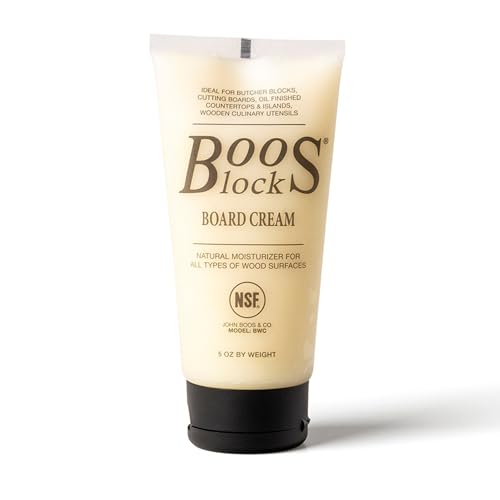
John Boos Board Cream
John Boos Board Cream With Beeswax
Unbleached beeswax and mineral oil in a thick cream that seals an oiled board against juices.
Shop Now at AmazonSpecs: John Boos
Best for
A wax top coat over an oiled board.
- NSF certified
- Thick wax layer sheds liquids
- Small tube goes a long way
Skip it if
Your board is new or very dry: oil it first.
- Needs an oiled board underneath
- Must be buffed to avoid a tacky film
Read full review
Best Board Cream (Top Coat)
A board cream is the second half of a good routine: oil to feed the wood, then a thicker wax layer to seal the surface. Boos makes its cream from unbleached beeswax and food-grade mineral oil, and it’s NSF certified. The thicker formula leaves what Boos calls a silky, hydrophobic barrier that helps the board shed juices and liquids instead of absorbing them, which also helps with stains and odors. Rub a thin coat on after the oil has soaked in, let it sit, then buff off the excess with a clean cloth. A 5 oz tube goes a long way because you only need a thin film. On its own it doesn’t penetrate as deeply as an oil, so use it on a board that’s already been oiled. Budget price tier.
Oil with coconut and beeswax
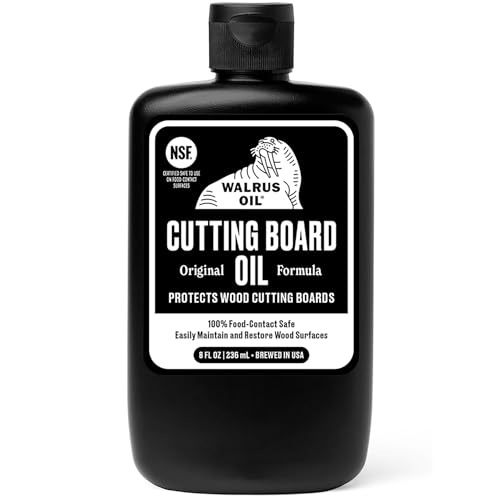
Walrus Oil Cutting Board Oil
Walrus Oil Cutting Board Oil
Mineral oil, fractionated coconut oil, beeswax and vitamin E, NSF certified, with clear maker instructions.
Shop Now at AmazonSpecs: Walrus Oil
Best for
A ready-made oil and wax blend for regular board care.
- NSF certified, short ingredient list
- Clear prep and reapply instructions
- Coconut oil fraction won't go rancid
Skip it if
You want the cheapest option for lots of boards: plain mineral oil costs less.
- Costs more per ounce than plain mineral oil
- Contains coconut, which some buyers avoid
Read full review
Best Blend for Regular Maintenance
Walrus Oil makes finishes aimed at woodworkers, and its board oil is a common choice for people who make and sell boards. The maker lists four ingredients: pure mineral oil, fractionated coconut oil, beeswax and vitamin E. Fractionated coconut oil stays liquid and doesn’t go rancid like regular cooking oils, and the beeswax adds a little water resistance. It’s NSF certified food-contact safe and certified by the American Vegetarian Association. Walrus gives the clearest instructions here: on new boards, sand to 220 to 400 grit, apply, let it sit 6 to 12 hours, then buff off the excess, and reapply every 1 to 2 months on boards in heavy use. Walrus also sells a matching wood wax and a pure tung oil. Budget price tier.
Scented mineral oil
CLARK'S Cutting Board Oil
CLARK’S Cutting Board Oil, Orange and Lemon
Food-grade mineral oil with orange and lemon oil for a fresh smell, in an easy push-cap bottle.
Shop Now at AmazonSpecs: the maker's Amazon listing; no spec page found
Best for
Everyday boards where a citrus scent is welcome.
- Citrus scent freshens used boards
- Push cap, easy dosing
- Matching wax available
Skip it if
You want an odorless, colorless oil: Thirteen Chefs is pure mineral oil.
- Not colorless
- Scent isn't for everyone
Read full review
Best Scented Cutting Board Oil
CLARK’S is plain food-grade mineral oil with a touch of orange and lemon essential oil for a fresh citrus smell, which is the point of buying it over unscented oil: a board that’s been used for onions and garlic smells cleaner after oiling. CLARK’S doesn’t publish a separate spec sheet, so these details come from its listing: the oil is lab tested to food-grade standards and bottled in the USA in FDA-compliant facilities. The bottle has a push cap for easy dosing, and the maker suggests letting it soak about 4 hours and using about 1 oz every 3 months for a board up to 18″. CLARK’S also sells a matching finishing wax and oil-and-wax kits. Note that this oil isn’t colorless like pure mineral oil. Budget price tier.
Pure mineral oil
Thirteen Chefs Mineral Oil
Thirteen Chefs Food Grade Mineral Oil
Pure, NSF-certified food-grade mineral oil: the cheapest way to keep many boards and utensils oiled.
Shop Now at AmazonSpecs: the maker's Amazon listing; no spec page found
Best for
Oiling many boards and utensils for the least money.
- Pure, NSF-certified mineral oil
- Colorless and odorless
- Cheapest per ounce in big bottles
Skip it if
You want oil and wax in one step: the Howard conditioner.
- No wax, less surface water resistance
- Needs a cream or wax for best protection
Read full review
Best Budget Cutting Board Oil
If you have several boards, wooden spoons and a butcher block counter, plain mineral oil is the cheapest way to keep them all oiled, and Thirteen Chefs is one of the best-known brands of it. The listing describes it as 100% pure food-grade mineral oil, NSF certified, colorless, odorless and tasteless, bottled in the USA. It comes in a squeeze bottle with a push-applicator cap, and the maker suggests a generous coat, 4 hours to overnight to soak in, then wipe off, about 1 oz every 3 months for a board up to 18″. Pure oil has no wax, so it penetrates well but leaves less water resistance on the surface; a wax or board cream on top fixes that. Larger bottles up to a gallon suit butcher block counters. Budget price tier.
Curing (hardening) oil
Hope's 100% Pure Tung Oil
Hope’s 100% Pure Tung Oil
Pure tung oil cures to a solid in the wood and outlasts mineral oil, if you can wait days for it to cure.
Shop Now at AmazonSpecs: Hope's
Best for
A longer-lasting, hardening finish on new boards.
- Cures hard inside the wood
- Longer-lasting than mineral oil
- 100% pure, no solvents
Skip it if
You need the board back today: mineral oil is ready in hours.
- Days of curing between coats
- Nut-derived oil: check allergies
Read full review
Best Hardening Finish for Cutting Boards
Mineral oil never dries; it just sits in the wood until it washes out, which is why boards need regular oiling. Pure tung oil is different: it cures to a flexible, non-oily solid inside the wood fibers. Hope’s sells 100% pure tung oil, not a “tung oil finish” blend with solvents and varnish, and says that because tung oil is non-toxic once dry, it’s suitable for cutting boards, butcher block, countertops, bowls and utensils. The maker says it resists moisture, alcohol and oil and lasts many times longer than mineral oil and wax products. The trade-off is time: you wipe on thin coats and let each one cure at room temperature, which takes days, before the board goes back into service. Tung oil comes from a nut, so check for nut allergies before using the board for anyone who has one. Budget price tier.
How I Chose These Cutting Board Oils
I started from what a board finish has to be: safe in contact with food, stable (no going rancid), and easy to reapply at home. That rules out most kitchen oils and any finish with solvents or driers. Then I looked at the board oils, creams and pure oils sold on Amazon today and picked one for each approach: an oil and wax conditioner, a deep-penetrating oil, a wax cream for the top coat, a ready-made blend, a scented oil, plain mineral oil for budget and bulk use, and a pure curing oil. I compared ingredients, the maker’s food-contact statement or certification, and the maker’s own application and reapply instructions. I don’t show customer ratings or prices. For how I pick products across the site, see how I choose.
Types of Cutting Board Finish
Mineral Oil
Food-grade (USP) mineral oil is the standard board oil. It’s colorless, odorless and tasteless, it soaks in easily and it never goes rancid, because it isn’t a plant or animal fat. It also never hardens: it stays liquid in the wood, slowly washes out and has to be topped up. That’s not a flaw, it’s the deal: a mineral-oiled board is easy to renew in minutes, and any knife scratch can be sanded and re-oiled with no finish to match.
Oil and Wax Blends, and Board Creams
Adding beeswax (and sometimes carnauba wax) to the oil leaves a thin, water-repellent layer on the surface. Juices bead instead of soaking in, which helps with stains and smells. You can buy oil and wax in one product, like the Howard conditioner or Walrus Oil, or oil first and then add a thicker board cream as a top coat, which is the routine board makers like John Boos recommend.
Curing Oils: Pure Tung and Linseed
Pure tung oil and raw linseed oil cure: they react with air and harden inside the wood, giving more lasting protection than mineral oil. The catch is cure time, measured in days per coat, and the label. Many products sold as “tung oil finish” or “Danish oil” contain varnish and solvents, so for a board, buy one labeled 100% pure, like Hope’s. For finishes on furniture rather than boards, my guide to the best wood finish for furniture compares tung oil, Danish oil, hardwax oils and polyurethanes.
What Not to Use on a Cutting Board
- Olive, vegetable, canola and other cooking oils: they’re food, but they can turn rancid in the wood and leave a sticky, smelly board.
- Polyurethane, varnish and lacquer: a film finish gets cut by knives, chips into food and is hard to repair. They belong on serving trays and furniture, not working boards.
- “Tung oil finish” blends and Danish oil: most contain solvents and metallic driers. Use pure tung oil if you want a curing oil.
How to Finish a Cutting Board
These steps are for a new board or one you’ve sanded back to bare wood. A good finish starts with sanding: oil shows every scratch, and a board sanded smooth stays cleaner, because there’s less raised grain for food to catch on.
- Sand flat and smooth. Start at 80 or 120 grit to remove planer marks, knife scars or glue lines, then work up through 150 and 180 to 220 grit. Walrus Oil suggests 220 to 400 for a new board. A random orbital sander is the fastest way to do this without leaving swirls; my guide to what grit sandpaper to use for wood explains the sequence.
- Raise the grain. Wipe the board with a damp cloth and let it dry. The water lifts loose wood fibers, which would otherwise stand up the first time you wash the board. Sand them off lightly with your final grit.
- Remove the dust with a dry cloth or a vacuum, including from end-grain pores.
- Flood on the oil. Pour a generous amount and spread it over every surface: top, bottom, edges and especially end grain, which drinks oil fastest. Oil both faces so the board takes up moisture evenly and stays flat.
- Let it soak. The makers here suggest 4 hours to overnight. Add more oil to any dry-looking spots.
- Wipe off all the excess with a clean cloth. A board should feel dry to the touch, not greasy.
- Repeat once a day for several days on a new board, until the wood stops drinking it in.
- Add a wax or cream top coat if you use one: rub in a thin layer, let it sit, then buff with a clean cloth.
💡 Pro Tip: Resurface Instead of Replacing
A scarred, stained board isn’t finished: sand it back with 120, then 150 and 180 grit until the knife marks and stains are gone, raise the grain, and oil it like new. Thick end-grain boards can be resurfaced many times. Sand outdoors or with dust collection, and wipe the board clean before oiling. If you’re shopping for abrasives, my best sandpaper for wood guide covers sheets and discs.
How Often to Oil a Cutting Board
The makers’ own advice ranges from monthly (John Boos) to every 1 to 2 months for boards in heavy use (Walrus Oil) and about every 3 months for smaller amounts (CLARK’S, Thirteen Chefs). The board will tell you: when the wood looks pale and dry, or water soaks in instead of beading, it’s time. Boards washed often, used in a dry climate, or made from thirsty end grain need it more often. Never soak a wooden board or put it in a dishwasher: wash it by hand, dry it standing on edge, and oil it once it’s fully dry.
🏆 The Verdict
The best cutting board oil for most kitchens is Howard Butcher Block Conditioner: food-grade mineral oil with beeswax and carnauba wax in one bottle. For deep oiling, John Boos Mystery Oil followed by Boos Board Cream is the board maker’s own routine. Walrus Oil is the ready-made blend, CLARK’S the scented option and Thirteen Chefs the cheapest pure mineral oil. For a hardening finish, use Hope’s 100% Pure Tung Oil and give it time to cure.
❓ Frequently Asked Questions
What is the best oil to use on cutting boards?+
Which is better for cutting boards, mineral oil or tung oil?+
What type of oil is best for protecting a cutting board?+
Can you use olive oil on a cutting board?+
How often should you oil a cutting board?+
Is mineral oil safe for cutting boards?+
Conclusion
Choose a cutting board finish by how much time you want to spend on it. For most kitchens, a mineral oil and wax conditioner like Howard’s keeps boards healthy with a few minutes a month; a deep oil plus a board cream is the board maker’s routine; and pure tung oil is the longer-lasting option if you can wait for it to cure. Start from a well-sanded board, oil every surface, wipe off the excess and reapply when the wood looks dry. Questions about your board? Ask in the comments.
