
As an Amazon Associate I earn from qualifying purchases. All claims are strictly my personal opinion.

Is the JET 16-32 drum sander a good tool? Yes: the JWDS-1632 is the most sensible way into an open-ended drum sander for a home or small shop. It runs on an ordinary 115V, 20 A circuit, sands boards up to 32″ wide in two passes, regulates its own feed rate with SandSmart, and carries a 5-year warranty. If you regularly sand wider panels or thicker stock, the SuperMax 19-38 gives you 3″ more per pass and 1″ more thickness, in a clearly higher price tier and with a shorter warranty.
Below I go through what the JET 16-32 is, what changed in the current version, how it compares with the SuperMax 19-38 line by line, and who should buy which. Every spec on this page comes from JET’s and SuperMax’s own manuals and product sheets.
⚡ Quick Verdict
For most home shops: the JET JWDS-1632. 16″ drum, 32″ in two passes, 3″ thickness, SandSmart feed control, 5-year warranty.
Sanding tabletops, wide glue-ups or thick slabs? The SuperMax 19-38: 19″ per pass, 38″ in two, 4″ thickness, 1-3/4 HP.
Fighting scratch lines on figured wood? Look at the oscillating JET JWDS-1632OSC.
JET 16-32 vs SuperMax 19-38 at a Glance
| Spec (from the makers) | JET JWDS-1632 | SuperMax 19-38 |
|---|---|---|
| Drum motor | 1-1/2 HP, TEFC, 14 A | 1-3/4 HP, TEFC, continuous duty |
| Power | 115V only, 20 A circuit recommended | 110V, 1 phase, 20 A |
| Drum | 5″ x 16″, 1,725 RPM | 5″ diameter, 19″, 1,740 RPM |
| Max width | 16″ (32″ in two passes) | 19″ (38″ in two passes) |
| Thickness | 1/32″ to 3″ | 1/32″ to 4″ |
| Shortest board | 2-3/8″ | 2-1/4″ |
| Feed control | 0-10 FPM, SandSmart | 0-10 FPM, INTELLISAND |
| Dust port / minimum airflow | 4″ / 400 CFM | 4″ / 600 CFM |
| Weight | 156 lb net (manual) | 286 lb shipping, 3 boxes (manual) |
| Warranty | 5 years | 2 years |
| Price tier | $$$$ | $$$$ (higher) |
What Is the JET 16-32 Drum Sander?
The JET 16-32 (model JWDS-1632, stock number 723520K with the open stand) is an open-ended drum sander. A 5″ aluminum drum wrapped in abrasive spins above a powered conveyor belt, and you set the gap between them with a handwheel. Boards ride through on the belt and come out flat, even in thickness and sanded across their full width. Because one end of the drum is open, a board wider than the drum can be fed through twice, flipped end for end, which is where the “32” in the name comes from.
It does a different job from a handheld sander. A random orbital levels a surface you hold it against; a drum sander calibrates thickness, takes the glue line off a panel, flattens figured wood that would tear out in a planer and sands parts too thin to plane at all. If you’re still deciding whether you need one, my drum sander vs planer guide covers that question first.
What Changed in the Current JWDS-1632
JET has sold the 16-32 for well over a decade, and the current version is a redesign of the original machine. According to JET’s product sheet, the changes that matter are:
- Tool-less parallelism. A dial on the outside of the conveyor bed sets it parallel to the drum, with a stop that returns the bed to flat. On older open-ended sanders this was a wrench job.
- A conveyor that pulls instead of pushes, which JET says reduces stress on the belt, plus belt trackers that keep it centered.
- A depth scale on the handwheel. One full turn moves the drum 1/16″, and the scale lets you zero it for each project.
- A dust hood with an internal channel shaped to the drum, which directs chips to the 4″ port.
- SandSmart, which watches the load on the drum motor and slows the conveyor before the motor bogs down, then speeds it back up.
JET 16-32 Drum Sander Review
JET JWDS-1632 16″ Drum Sander with Open Stand

The Sensible Drum Sander for Most Shops
The JWDS-1632 pairs a 1-1/2 HP, 115V drum motor drawing 14 A with a separate DC conveyor motor that runs 0 to 10 feet per minute. JET’s manual lists a 5″ x 16″ drum at 1,725 RPM, a capacity of 1/32″ to 3″ thick and boards as short as 2-3/8″, and recommends a dedicated 20 A circuit. Dust leaves through a 4″ port, and JET asks for at least 400 CFM of collection. The Amazon listing ships the head, conveyor and a complete steel stand with a 20″ x 37″ footprint, with 80-grit abrasive already on the drum.
What makes it the default recommendation is the combination of power supply and warranty. It plugs into a standard 115V outlet on a 20 A breaker, so most garages can run it without an electrician, and JET backs it with a 5-year warranty (the listing notes that commercial or industrial use drops it to 2 years). For a machine you will keep for twenty years, that is worth more than any single spec.
- ✅ Runs on standard 115V, 20 A household power
- ✅ SandSmart feed control protects the motor and the finish
- ✅ Tool-less parallelism dial and handwheel depth scale
- ✅ 5-year warranty
- ❌ 16″ per pass: wide panels mean two passes and careful setup
- ❌ 3″ maximum thickness
Best For: Home and small shops building furniture, doors and boxes, where most parts are under 16″ wide.
JET JWDS-1632OSC Oscillating Drum Sander

The Same Size, With a Drum That Moves
JET also sells the 16-32 as an oscillating model, the JWDS-1632OSC, listed with a 1-1/2 HP, 115V single-phase motor. An oscillating drum shifts side to side as it spins, so the abrasive grains don’t trace the same line down the board on every pass. In general that means fewer visible scratch lines and longer abrasive life, which matters most on figured maple, cherry and anything you finish clear. It sits in a higher price tier than the standard 1632, so it is worth it only if scratch lines are the problem you are trying to solve.
- ✅ Oscillation helps hide scratch lines on figured wood
- ✅ Same 115V power as the standard model
- ❌ Higher price tier than the standard JWDS-1632
Best For: Fine furniture makers who sand to finish grits on the drum sander and see lines in the final coat.
SuperMax 19-38 Review: The Bigger Rival
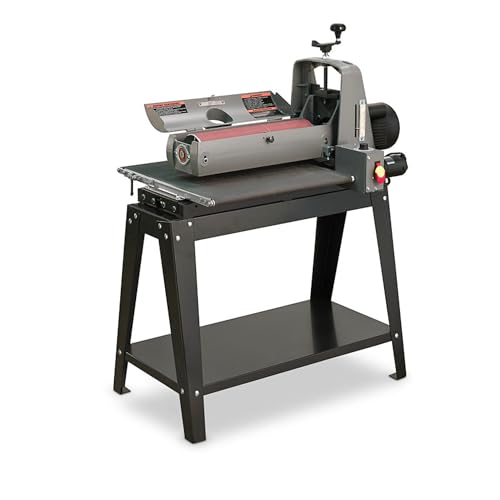
SuperMax 19-38 Drum Sander (71938-D)
More Width, More Thickness, More Iron
The SuperMax 19-38 is the machine most people cross-shop with the JET. SuperMax’s manual lists a 1-3/4 HP continuous-duty TEFC motor on 110V, 20 A, a 5″ drum at 1,740 RPM, a capacity of 38″ in two passes and 1/32″ to 4″ thick, boards down to 2-1/4″, and an infinitely variable 0 to 10 ft/min DC conveyor. Its INTELLISAND control does the same job as JET’s SandSmart, slowing the conveyor under load. The Amazon listing is sold by Laguna Tools itself and adds a flatness guarantee on the steel conveyor bed of less than 0.010″ across its width, cast iron construction and a patented abrasive attachment system that keeps the wrap tensioned.
The catch is in the paperwork: the manual states a 2-year warranty, against JET’s 5, and it asks for 600 CFM of dust collection, against JET’s 400. It also ships as freight (the listing asks for a phone number to schedule delivery) in three boxes with a combined shipping weight of 286 lb.
- ✅ 19″ per pass and 38″ in two: tabletops in fewer passes
- ✅ 4″ maximum thickness
- ✅ Cast iron and a guaranteed-flat conveyor bed
- ❌ 2-year warranty
- ❌ Needs a bigger dust collector (600 CFM minimum)
Best For: Shops that build tables, wide doors and slab work, and already run a real dust collector.
JET 16-32 vs SuperMax 19-38: Which Should You Buy?
On the spec sheet the SuperMax wins on capacity and the JET wins on cost of ownership. Here is how that plays out.
Capacity: 3″ Per Pass Is the Real Difference
The useful number is not 32 vs 38, it is 16 vs 19. Two-pass sanding works, but the second pass has to line up with the first, and the overlap is where you see a ridge if the drum is not perfectly set. Every inch of width you can sand in one pass is an inch you never have to blend. If your typical part is a cabinet door, a drawer front or a box side, 16″ covers it. If it is a tabletop or a wide glue-up, 19″ saves time on every job.
The extra inch of thickness (4″ vs 3″) matters for butcher blocks, thick cutting boards and slab work. For 3/4″ and 4/4 furniture stock it never comes up.
Power and Wiring
Both run on 110 to 115V and both want a 20 A circuit, so neither forces a 240V upgrade. The SuperMax has a 1/4 HP advantage and a continuous-duty rating, which helps at full width in hardwood. Either way, a drum sander should be on its own circuit, not shared with a dust collector on the same breaker.
Dust Collection
This is the hidden cost. JET asks for 400 CFM at the 4″ port; SuperMax asks for 600 CFM. A small single-stage collector may cover the JET and struggle with the SuperMax. If you need one, start with my guide to the best dust collector for a small shop, or the full dust collector reviews for bigger machines.
Warranty and Ownership
JET’s 5-year warranty against SuperMax’s 2 years is the single biggest difference in the long run. A drum sander has two motors and an electronic feed control, and a five-year window covers them through the years when a defect is most likely to show up. JET’s product sheet also points to its network of authorized service centers across the US for warranty repairs and parts.
💡 Pro Tip
On any open-ended drum sander, take light cuts: a quarter turn of the handwheel or less per pass, which is 1/64″ on both machines. Let the auto-feed control slow the belt rather than cranking the drum down. Deep cuts are what burn abrasive, leave chatter marks and make the motor control step in.
What to Know Before You Buy Either
- Abrasive wraps are a running cost. Both machines use pre-cut strips wrapped in a spiral around the drum. Buy them in the grits you use most (80 and 120 cover most work) and keep spares.
- Snipe is a setup issue. Both machines use adjustable tension rollers to hold the board down at the ends. Support long boards on the way in and out; JET sells infeed and outfeed tables for the 1632.
- It is not a planer. A drum sander removes wood slowly. Use a planer for heavy thicknessing and the drum sander for the last fraction of an inch and the finish. See my thickness planer guide if you need both.
- Bigger JET options exist. If you like the JET but need more width, the JWDS-1836 and the Powermatic PM2244 are in my best drum sanders roundup.
How I Reviewed It
This review is based on JET’s operating manual and product sheet for the JWDS-1632, SuperMax’s owner’s manual for the 19-38, and each product’s current Amazon listing, checked on the day of writing. Where a listing and a manual disagreed, I used the manual. I haven’t put these two specific machines side by side in my shop, so I don’t describe them as if I had; I compare what the makers publish and explain what those numbers mean in use, from years of running sanders on furniture work. My full method is on the how I choose page. I don’t show star ratings or prices: each product carries a price tier, and the Amazon button shows the live price.
🏆 The Verdict
The JET JWDS-1632 is the right drum sander for most home and small shops: household power, smart feed control, tool-free setup and a 5-year warranty, in a lower price tier than its rival. Choose the SuperMax 19-38 if your work is mostly wider than 16″ or thicker than 3″, and you have the dust collection to feed it. Choose the JWDS-1632OSC only if scratch lines on fine work are your main complaint.
❓ Frequently Asked Questions
Is the JET 1632 drum sander a good tool?+
What are the specifications of the JET 16-32 drum sander?+
What is the weight of the JET 1632 drum sander?+
Who makes SuperMax tools?+
How much does the SuperMax 19-38 drum sander weigh?+
What are the differences between the SuperMax drum sander and the JET drum sander?+
Conclusion
The JET 16-32 has stayed JET’s best-known woodworking machine for a reason: it does the job most home shops need, on the power most garages have, with a warranty that outlasts the learning curve. The SuperMax 19-38 is the better machine only if you need its extra width and thickness often enough to justify the higher tier and the bigger dust collector. Decide by the width of the parts you actually build.
Still comparing drum sanders more widely? My drum sander roundup covers the JET range, Powermatic and budget options. Questions about the JET 16-32 or the SuperMax? Ask in the comments below.

