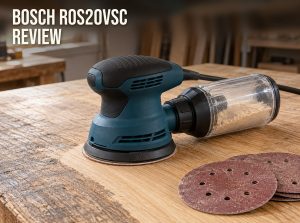
Is the Bosch ROS20VSC still worth buying? Yes, for most DIY and furniture work it is still the safest budget random orbital sander to recommend: a 2.5 A, 5″ sander with variable speed from 7,500 to 12,000 OPM, a pad dampening brake that fights swirl marks, a microfilter dust canister and a 3.5 lb body you can use one-handed. It is not the tool for heavy stock removal or all-day professional use, where a stronger, more expensive sander pays for itself.
Below I go through what Bosch builds into the ROS20VSC, what it does well, where it falls short, how it compares with the Makita BO5041K and a Festool, and who should buy it. Every spec comes from Bosch’s own product page.
⚡ Quick Verdict
Your first random orbital, or a reliable everyday 5″ sander: the Bosch ROS20VSC. Variable speed, swirl-fighting pad brake, kit with bag and vacuum adapter.
Want more motor and a bigger speed range? Compare the Makita BO5041K in my best random orbital sanders guide.
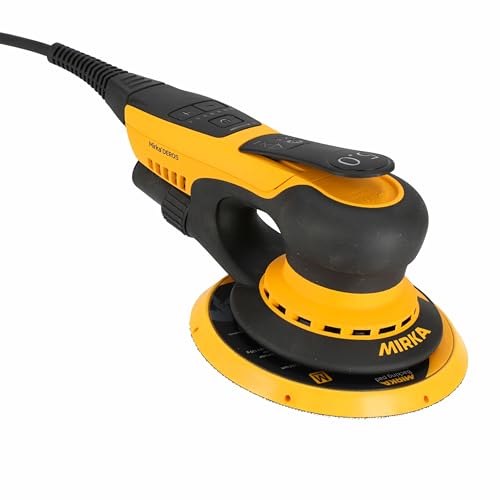
Sanding for hours every day? Look at a premium sander such as the Mirka DEROS instead.
Bosch ROS20VSC Specs at a Glance
| Spec (from Bosch) | Bosch ROS20VSC |
|---|---|
| Motor | 2.5 A, 120V corded |
| Speed | 7,500-12,000 OPM, variable dial |
| Pad and disc | 5″, hook-and-loop |
| Orbit diameter | 3/32″ (2.5 mm) |
| Weight | 3.5 lb |
| Swirl control | Integral pad dampening brake system |
| Dust | Microfilter canister, vacuum adapter for 1-1/4″ or 1-1/2″ hose |
| Switch | Separate on/off and speed control |
| In the box | Soft pad (RS034), disc, dampening ring, canister, vacuum adapter, carrying bag |
| Warranty | 1 year (per the Amazon listing) |
| Price tier | $$ |
What Is the Bosch ROS20VSC?
The ROS20VSC is Bosch’s 5″ corded palm random orbit sander, sold by Bosch as a sander and polisher. “Palm” means you hold it by the top of the body, with no separate front handle, and “random orbit” means the pad spins and moves in a small offset orbit at the same time, so the scratches never repeat in a pattern. That combination is why it can take off material faster than a quarter-sheet finishing sander and still leave a finish ready for stain. If the difference between the two types is new to you, my guide to sheet sander vs random orbital sander explains it.
It has been one of the most common recommendations for a first random orbital for years, and it is still on Bosch’s US site and sold new by Amazon. In the name, ROS stands for random orbit sander and VS for variable speed, which is the feature that separates it from Bosch’s simplest single-speed models.
Bosch ROS20VSC Review
Bosch ROS20VSC 5″ Random Orbit Sander/Polisher

The Budget Random Orbital That Keeps Its Place
Bosch lists the ROS20VSC with a 2.5 A motor, a 5″ pad, a 3/32″ (2.5 mm) orbit diameter and a speed dial from 7,500 to 12,000 OPM, at 3.5 lb. The features that set it apart in its tier are the integral pad dampening brake system, which Bosch designs to prevent swirl marks, a microcellular backing pad for fine finishes on flat and contoured surfaces, Hook-Tight hook-and-loop with more than 35,000 hooks (up to twice the standard number, Bosch says), and an on-board microfilter dust canister. It also has a separate on/off switch, so the speed dial stays where you set it.
The kit is complete for a first sander: the soft RS034 pad, a sanding disc, the dampening ring, the canister, a vacuum hose adapter and a carrying bag. Bosch also sells extra-soft (RS033) and hard (RS035) pads that fit it, so you can tune it for curved work or for flattening.
- ✅ Variable speed from 7,500 to 12,000 OPM
- ✅ Pad dampening brake helps prevent swirl marks
- ✅ Microfilter canister and vacuum adapter included
- ✅ Separate on/off switch and speed dial
- ❌ 2.5 A is modest for heavy stock removal
- ❌ Fine 3/32″ orbit: slower at leveling than an aggressive 3/16″ sander
Best For: DIYers and hobby woodworkers who want one reliable 5″ sander for furniture, doors, trim and refinishing.
What the ROS20VSC Does Well
A Finish-Friendly Orbit and a Swirl Brake
The ROS20VSC uses a 3/32″ orbit diameter. A smaller orbit removes material more slowly than a large one, but it leaves finer scratches, which is exactly what you want in the last grits before stain or finish. Add the pad brake, which keeps the pad from spinning up uncontrolled when you lift the sander or touch it down, and you get fewer of the curly swirl marks that show up under the first coat of finish.
Variable Speed That Is Actually Useful
A dial from 7,500 to 12,000 OPM covers the jobs a home shop throws at a 5″ sander: full speed for flattening and leveling, lower speeds for veneer, edges, and sanding between coats of finish where you want control rather than cut. With the separate on/off switch you set the speed once and it stays put.
Dust Collection for Its Tier
The twist-off microfilter canister traps fine dust right on the tool, which matters when you sand indoors without a vacuum. For bigger jobs the included adapter connects a shop vac hose, and Bosch lists compatibility with its own 22 mm and 35 mm hoses. If you plan to run it on a vacuum most of the time, my shop vac for dust collection guide covers the hoses and auto-start setups.
Weight and Handling
At 3.5 lb it is light enough for vertical surfaces and one-handed use. Palm sanders of this size are what most people learn on, and the low body keeps your hand close to the work, which makes it easier to keep the pad flat. My guide on how to use an orbital sander covers technique.
Where the ROS20VSC Falls Short
- Not a stock-removal tool. With 2.5 A and a fine orbit, flattening a rough glue-up or stripping thick paint is slow. A 6″ sander with a bigger orbit, or a belt sander, does that job faster.
- No front handle. On big panels a two-handed grip helps control, and some competitors offer one.
- Brushed motor and a 1-year warranty. It is built as a mid-priced tool, and the Amazon listing states a 1-year manufacturer warranty, shorter than many premium and cordless sanders.
- Corded. If you sand away from outlets, look at the cordless options in my cordless sander guide.
💡 Pro Tip
Empty the canister before it is full. A canister that is half packed with dust pulls much less air through the pad, the disc clogs faster and the sander starts to leave swirls. Tap the filter out after every disc change, and switch to a vacuum hose for anything bigger than a small table.
Bosch ROS20VSC vs the Alternatives
Bosch ROS20VSC vs Makita BO5041K
This is the “Bosch or Makita” question. On published specs, Makita lists the BO5041K at 3 A with a wider speed range of 4,000 to 12,000 OPM, also at 3.5 lb, and in the same mid-range price tier. The extra motor and the lower bottom speed make the Makita more flexible for heavier sanding and for very gentle work, while the Bosch’s strengths are its pad dampening brake and the microfilter canister. For pure finishing on a budget, the Bosch is the better value; if you want one sander to do more, the Makita is worth the step up. Both sit side by side in my best random orbital sanders roundup.
Bosch ROS20VSC vs Festool
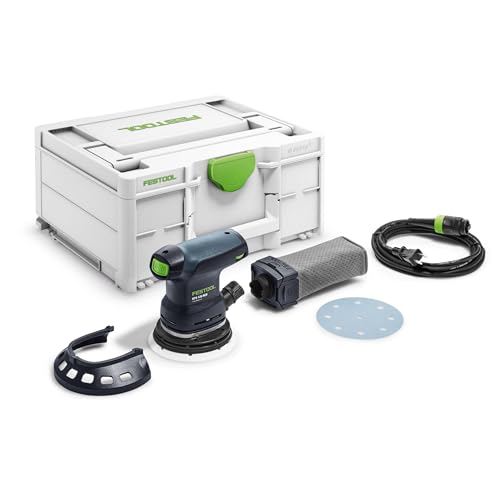
A Festool such as the ETS 125 REQ is a different class of tool: Festool lists it at 250 W with a 6,000 to 12,000 OPM range and a fine 2 mm stroke, a 3-year warranty when registered and a dust extraction system built around its own extractors. It is several price tiers above the Bosch. The Festool makes sense for people who sand for hours and run an extractor; for weekend projects, the Bosch gets you a comparable finish with more patience and far less money.
When to Step Up Within Bosch
Bosch’s own range goes up from here: the GET65-5N and GET75-6N are dual-mode sanders with far more power for removal work, and the cordless GEX18V-5N gives you a brushless 5″ sander with no cord. All three are covered in my random orbital roundup.
How I Reviewed It
This review is based on Bosch’s product page for the ROS20VSC (technical data, included parts, compatible pads and hoses), the current Amazon listing, checked on the day of writing, and the published specs of the Makita and Festool models I compare it with. I describe what the specs mean in use from years of sanding furniture and trim with random orbitals, but I don’t present this page as a hands-on test of this exact unit. My full method is on the how I choose page. No star ratings or prices: the sander carries a price tier, and the Amazon button shows the live price.
🏆 The Verdict
The Bosch ROS20VSC is still the budget random orbital sander I’d point most beginners and hobby woodworkers to: variable speed, a swirl-fighting pad brake, a fine orbit that suits finishing, good on-tool dust control and a complete kit, at 3.5 lb. Buy something stronger only if your work is mostly heavy removal or you sand for hours every day.
❓ Frequently Asked Questions
Which Bosch sander is considered the best?+
Which orbital sander is better, Bosch or Makita?+
Is there a difference between an orbital sander and a random orbital sander?+
What is the price of the Bosch ROS20VSC?+
Which sander is better, Bosch or Festool?+
Is the Bosch ROS20VSC discontinued?+
Conclusion
The Bosch ROS20VSC has lasted because it gets the basics right: a fine orbit and a pad brake for clean finishes, a useful speed range, light weight and dust control that works without a vacuum. It won’t flatten a rough tabletop quickly, and it isn’t built for all-day professional sanding, but as a first random orbital or the everyday sander in a home shop, it is still the one to beat in its price tier.
Comparing it with other models? My random orbital sander reviews cover Bosch, Makita, Festool and cordless picks. Questions about the ROS20VSC? Ask in the comments below.