


As an Amazon Associate I earn from qualifying purchases. All claims are strictly my personal opinion.
My top pick
Mirka DEROS 650CV Random Orbital Sander
An electric DA with a 6" pad and a 5 mm orbit, about 2.4 lb, no compressor needed.

Auto body work asks something different of a sander than woodworking does. Car panels are thin sheet metal with body lines you must not flatten, and filler, primer and clear coat all need to be feathered smooth, not gouged. The best sander for auto body work is a dual-action (DA) random orbital sander with a 5 mm (3/16″) orbit and a 6″ pad, air-powered if you have a big enough compressor, electric if you don’t. In a home garage, an electric DA such as the Mirka DEROS is the easiest route; in a shop with air, a Dynabrade or Ingersoll Rand air DA is the classic choice.
Below are six sanders that suit body work, a comparison table, short reviews, and a guide to the choices that matter: air or electric, orbit size, pad size, and which grits to run.
⚡ Quick Pick
Best electric DA for body work: the Mirka DEROS 650CV, 6″ pad, 5 mm orbit, about 2.4 lb, no compressor needed.
Best air DA: the Dynabrade 56830, 6″ pad and a 1″ vacuum port.
Best value air DA: the Ingersoll Rand 4152, vacuum-ready and under 2 lb.
Best Sanders for Auto Body: Comparison
The table compares what each maker publishes. Air sanders also have an air-consumption rating that decides whether your compressor can keep up; check it on the maker’s spec sheet before you buy.
| Product | ⭐ Mirka DEROS 650CV 🏆 EDITOR’S CHOICE |
Dynabrade 56830 | Dynabrade 56815 | Ingersoll Rand 4152 | Makita BO6050J | Bosch GET65-5N |
|---|---|---|---|---|---|---|
| Image |  |
 |
 |
 |
 |
 |
| Price | $$$$ | $$$$ | $$$$ | $$$ | $$$$ | $$$$ |
| Power | Electric, brushless | Air | Air | Air | Electric | Electric, 6.5 A |
| Pad | 6″ | 6″ | 5″ | 6″ | 6″ | 5″ |
| Orbit | 5 mm | 3/16″ (5 mm) | 3/16″ (5 mm) | 3/16″ | 7/32″ | Random orbit + Turbo |
| Speed | Variable | Up to 12,000 RPM | Up to 12,000 RPM | 12,000 RPM | 1,600-6,800 OPM | 3,300-7,300 OPM |
| Dust extraction | Built for a vacuum | 1″ central-vac port | Non-vacuum | Vacuum ready | Dust port | Hose adapter, needs a vac |
| Best For | Home garage, no compressor | Shop with air and central vac | Curves, door skins | Air on a budget | Heavy filler and paint removal | Stripping to bare metal |
| Availability | Shop Now | Shop Now | Shop Now | Shop Now | Shop Now | Shop Now |
⭐ Mirka DEROS 650CV
🏆 EDITOR’S CHOICE
- Price
- $$$$
- Power
- Electric, brushless
- Pad
- 6″
- Orbit
- 5 mm
- Speed
- Variable
- Dust extraction
- Built for a vacuum
- Best For
- Home garage, no compressor
Dynabrade 56830
- Price
- $$$$
- Power
- Air
- Pad
- 6″
- Orbit
- 3/16″ (5 mm)
- Speed
- Up to 12,000 RPM
- Dust extraction
- 1″ central-vac port
- Best For
- Shop with air and central vac
Dynabrade 56815
- Price
- $$$$
- Power
- Air
- Pad
- 5″
- Orbit
- 3/16″ (5 mm)
- Speed
- Up to 12,000 RPM
- Dust extraction
- Non-vacuum
- Best For
- Curves, door skins
Ingersoll Rand 4152
- Price
- $$$
- Power
- Air
- Pad
- 6″
- Orbit
- 3/16″
- Speed
- 12,000 RPM
- Dust extraction
- Vacuum ready
- Best For
- Air on a budget
Makita BO6050J
- Price
- $$$$
- Power
- Electric
- Pad
- 6″
- Orbit
- 7/32″
- Speed
- 1,600-6,800 OPM
- Dust extraction
- Dust port
- Best For
- Heavy filler and paint removal
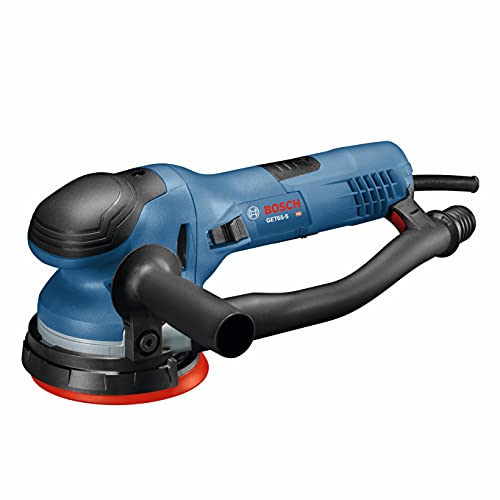
Bosch GET65-5N
- Price
- $$$$
- Power
- Electric, 6.5 A
- Pad
- 5″
- Orbit
- Random orbit + Turbo
- Speed
- 3,300-7,300 OPM
- Dust extraction
- Hose adapter, needs a vac
- Best For
- Stripping to bare metal
⚡ Key Takeaways
- For body work you want a DA (random orbital) sander, never a belt sander: belts cut through thin panels and flatten body lines.
- A 5 mm (3/16″) orbit is the common body-shop middle ground for shaping filler and feathering paint.
- Air DAs are light and cheap to buy but need a compressor that can keep up. Electric DAs like the Mirka DEROS just need an outlet.
- For stripping to bare metal on an electric budget, a forced-rotation or Turbo mode, as on the Makita BO6050J or Bosch GET65-5N, removes paint much faster.
- Filler and paint dust is fine and hard to see: extract it at the pad and wear a respirator.
DA Sander, Rotary or Block: What Body Work Needs
Three tools do most of the sanding on a car. A DA (dual-action) sander spins its pad and moves it in small random orbits at the same time, so it removes material without leaving the circular scratches a pure rotary tool would. It does most of the work: stripping, shaping filler, feathering edges and sanding primer. A sanding block or long board, by hand, is what gets panels truly straight, because it bridges low spots instead of following them, as in the photo above. A rotary polisher is for compounding and polishing after paint, not for sanding.
A woodworking random orbital is technically a DA as well, which is why some of the picks here are the same tools that sand furniture. What changes is the pad size, the orbit and, for air tools, the power source. If you’re new to body work, my guide on how to sand a car covers the whole process step by step.
Best Sanders for Auto Body: Reviews
Figures come from the makers’ product pages and listings, read this month. Each pick is here for a specific kind of body work.
Mirka DEROS 650CV (Electric)
Best Electric DA Sander for Auto Body Work
Electric DAs used to be too heavy and slow for body work, which is why shops ran air. The Mirka DEROS changed that: it is a brushless electric random orbital with a 6″ pad and a 5 mm orbit, the same orbit as the classic air DAs below, in a low body that weighs about 2.4 lb. Mirka lists automotive work alongside woodworking and drywall, and the paint-supply trade sells it as a dust-free body-shop sander.
For a home garage, the big advantage is that it doesn’t need a compressor. Variable speed lets you slow down for primer and feather edges, and soft start keeps the pad from jumping when it touches a panel. It is designed for vacuum extraction, which matters on filler dust; see my picks for the best dustless sander for how to set that up, and my Mirka DEROS review for the full specs.
- ✅ 5 mm orbit and 6″ pad, like a classic body-shop air DA
- ✅ No compressor needed
- ✅ Brushless, about 2.4 lb, variable speed, soft start
- ✅ Built for vacuum extraction
- ❌ Top price tier
- ❌ Stock was low on Amazon when checked
Best For: Home-garage restorers and hobbyists who want a professional DA without buying a large compressor.
Dynabrade 56830 Dynorbital Supreme 6″ (Air)
Best Air DA Sander for Panels
The Dynabrade 56830 is a professional air DA with a 6″ pad, a 3/16″ (5 mm) orbit and a 0.28 hp air motor rated up to 12,000 RPM. It has a 1″ vacuum port for a central vacuum system, which is how body shops keep filler dust off freshly primed cars.
The 6″ pad covers hoods, roofs and door faces quickly. Like every air tool, it only performs if your compressor supplies enough air continuously at the working pressure; compare the tool’s air consumption on Dynabrade’s spec sheet with your compressor’s rating before you buy.
- ✅ Classic 3/16″ orbit on a 6″ pad
- ✅ 1″ vacuum port for central extraction
- ✅ Light, simple air motor
- ❌ Needs a compressor and an air supply that keeps up
- ❌ Needs a vacuum system to use the port
Best For: Shops and serious garages with a large compressor, sanding large flat panels.
Dynabrade 56815 Dynorbital Supreme 5″ (Air)
Best Air DA for Curves and Door Skins
The Dynabrade 56815 is the 5″ version, with the same 3/16″ orbit and 0.28 hp motor rated up to 12,000 RPM. The smaller pad follows door skins, quarter panels and tighter curves better than a 6″, which is why many body techs own both sizes. This model is the non-vacuum version, so plan on a respirator and good ventilation, or buy the 6″ vacuum model above.
- ✅ 5″ pad follows curves and body lines
- ✅ 3/16″ orbit, up to 12,000 RPM
- ❌ No vacuum port on this model
- ❌ Needs a compressor
Best For: Curved panels, fenders and door skins, as a second DA next to a 6″.
Ingersoll Rand 4152 Random Orbital Air Sander
Best Value Air DA Sander
The Ingersoll Rand 4152 is the most affordable way into a name-brand air DA. It has a 6″ pad, a 12,000 RPM motor with a 3/16″ orbit, and a composite body that Ingersoll Rand says weighs under 2 lb. It is vacuum ready: dust can be extracted through and around the pad into a central or portable vacuum system.
A precision-ground counterbalance keeps vibration down, which you’ll notice over a long session of blocking primer. As with the Dynabrades, check its air consumption against your compressor before buying.
- ✅ 6″ pad, 3/16″ orbit, 12,000 RPM
- ✅ Under 2 lb, counterbalanced
- ✅ Vacuum ready
- ✅ The lowest price tier of the six
- ❌ Needs a compressor
Best For: Garage restorers who already own a decent compressor and want a light, name-brand air DA for less.
Makita BO6050J 6″ Random Orbit Sander (Electric)
Best Electric Sander for Heavy Filler and Paint Removal
The Makita BO6050J has a feature most DAs lack: a 2-mode switch for normal “random orbit” and “random orbit with forced rotation”. Forced rotation drives the pad round instead of letting it spin freely, so it keeps cutting under pressure, which is what you want when knocking down cured filler or taking old paint off a panel. Switch back for a swirl-free finish from the 7/32″ orbit.
Speed is variable from 1,600 to 6,800 OPM, low enough for primer and polishing work, and the barrel grip and side handle give two-handed control on vertical panels. The pad changes without tools.
- ✅ Forced-rotation mode for aggressive removal
- ✅ Wide speed range, 1,600-6,800 OPM
- ✅ Side handle for two-handed control
- ❌ Heavier and bulkier than the Mirka
- ❌ Stock was low on Amazon when checked
Best For: Restoration projects with a lot of filler and old paint to remove, without a compressor.
Bosch GET65-5N Dual-Mode Random Orbit Sander (Electric)
Best for Stripping Car Paint to Bare Metal
If the job is taking a panel down to bare metal, the Bosch GET65-5N is built for it. Its Turbo mode uses direct-drive eccentric rotation that Bosch rates at 3x the stock removal of its standard random-orbit mode, and its 6.5 A motor runs from 3,300 to 7,300 OPM in random-orbit mode. Switch modes and the same tool feathers the edges.
It has no onboard dust bag: it is meant to run with a vacuum, and the kit includes a hose adapter. At 5.3 lb it is heavy for overhead work on a roof, and its 5″ pad is smaller than the 6″ pads most body shops prefer for flat panels.
- ✅ Turbo mode rated at 3x standard stock removal
- ✅ One tool strips and feathers
- ✅ Vacuum hose adapter included
- ❌ 5.3 lb
- ❌ Always needs a vacuum
Best For: Stripping paint and surface rust from panels, fenders and small parts when you don’t want to buy media blasting or a compressor.
How I Chose These Auto Body Sanders
I started from what people ask about sanding cars: the best sanding machine for body work, the best electric sander, and the best sander for stripping paint. Then I kept only DA sanders from established makers, sold on Amazon today, with published orbit, pad and speed figures. The criteria, in order:
- Random orbital action: no belt sanders and no rotary-only tools for sanding panels.
- Orbit and pad: 5 mm (3/16″) class orbits and 5″ or 6″ pads, the common body-shop setup.
- Power source: both air and electric, because the right choice depends on your compressor.
- Dust: vacuum-ready designs were preferred, since filler and primer dust is fine and gets everywhere.
I don’t show star ratings or prices: prices change daily, so each pick carries a price tier and the Amazon button shows the live price.
How to Choose a Sander for Auto Body Work
Air or Electric
Air DAs are light, simple and cheaper to buy, and body shops have run them for decades. The catch is the compressor: a DA runs continuously, so your compressor must deliver the tool’s rated air consumption at working pressure without stopping to catch up. That figure is on the maker’s spec sheet; compare it with your compressor’s delivery rating before you buy. If you don’t have a big compressor, an electric DA such as the Mirka DEROS or Makita BO6050J is the better buy.
Orbit Size
A bigger orbit removes material faster and leaves a coarser scratch; a smaller one finishes finer. The 5 mm (3/16″) orbit on most of these picks is the all-round choice for shaping filler and feathering paint. Specialists add a 2.5 mm finishing DA for primer and clear coat.
Pad Size
6″ pads cover hoods, roofs and doors faster; 5″ pads follow curves and fit tighter areas. If you’ll only buy one, a 6″ does more of a whole car.
Dust Extraction
Filler and primer dust is very fine and settles on everything, including wet paint. A vacuum-ready DA connected to extraction is the cleanest way to work, and a respirator is still needed. My guide to the best respirator for woodworking and sanding explains which filter class to use.
Discs
Buy hook-and-loop discs with a hole pattern that matches your pad, or a universal multi-hole pattern. For 5″ DAs, Mirka Gold Multifit discs use a universal hole pattern that Mirka says fits any 5″ dust-free sanding tool.
⚠️ Don’t Use a Belt Sander on a Car
A belt sander, or a coarse grinding disc, can cut through thin body panels in seconds, flatten body lines and heat the metal enough to warp it. The belt sanders on my paint removal page are for wood. On a car, use a DA and let the grit do the work.
What Grit to Use for Auto Body Work
Grit plans vary by product and by shop, so always check the filler and primer makers’ instructions. As a typical starting point:
- Stripping paint and shaping filler: coarse grits, around 40 to 80.
- Refining filler and feathering paint edges: around 150 to 220.
- Sanding primer before paint: finer grits, often 320 to 600, per the paint system’s instructions.
For sanding bare steel and aluminum parts off the car, see my guide on how to sand metal.
🏆 The Verdict
Without a big compressor, the Mirka DEROS 650CV is the best sander for auto body work: a 6″ electric DA with the classic 5 mm orbit at about 2.4 lb. With shop air, the Dynabrade 56830 is the professional choice and the Ingersoll Rand 4152 the value one. For heavy filler and paint removal, the Makita BO6050J‘s forced-rotation mode and the Bosch GET65-5N‘s Turbo mode do the hard work.
❓ Frequently Asked Questions
What is the best sanding machine for car body?+
What grit sandpaper is best for auto body work?+
What is the best electric sander for car bodywork?+
What is the best sander for stripping car paint?+
Can I use a woodworking orbital sander on a car?+
Do I need a compressor for a DA sander?+
Conclusion
For auto body work, the tool is a DA sander, and the main decision is air or electric. If you already run a large compressor, a Dynabrade or Ingersoll Rand air DA is light and proven; if not, a modern electric DA does the same job from a wall outlet. Add a hand block for straightening, discs that match your pad, extraction and a respirator.
For the complete process, from stripping to primer, see my guide on how to sand a car. For cordless options, see my cordless sander reviews, and for the whole random orbital field, my random orbital sander reviews. Questions about your project car? Leave a comment below.
