
As an Amazon Associate I earn from qualifying purchases. All claims are strictly my personal opinion.
Best overall
The two-speed DW735 with infeed and outfeed tables and a spare set of knives.
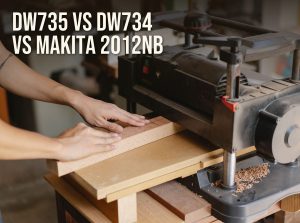
The DeWalt DW735 is the better planer: it’s 13″ wide instead of 12-1/2″, has two feed speeds that give 96 or 179 cuts per inch, and a fan that blows chips out of a 4″ port. The DW734 is the simpler, lower-priced DeWalt with one speed at 96 cuts per inch and no fan. The Makita 2012NB is the lightest and quietest of the three, with an automatic head clamp against snipe, but it has two knives, a single feed rate that works out to about 51 cuts per inch, and its dust hood is an optional extra.
Below is the DW735 vs DW734 vs Makita 2012NB comparison spec by spec from the makers’ own manuals and product pages, what each difference means at the bench, the DW735 vs DW735X question, how each one handles snipe and chips, and which to buy. For the wider field, including spiral-head planers, see my best thickness planer picks.
⚡ Quick Picks
Best overall: the DeWalt DW735X – the two-speed DW735 with infeed and outfeed tables and a spare set of knives.
Same planer, no extras: the DeWalt DW735, if you’ll build your own support tables.
Lower price tier: the DeWalt DW734, one speed, 12-1/2″ wide.
Lightest and quietest: the Makita 2012NB, 61.9 lb with Interna-Lok against snipe.
DW735 vs DW734 vs Makita 2012NB at a Glance
Figures come from DeWalt’s product pages and manuals (DW735 and DW734) and Makita’s product page and manual (2012NB). Cuts per inch for the Makita are calculated from Makita’s own cutterhead speed, knife count and feed rate, the same way DeWalt gets its 96 and 179.
| Spec | DeWalt DW735 | DeWalt DW734 | Makita 2012NB |
|---|---|---|---|
| Max. width | 13″ | 12-1/2″ | 12″ |
| Max. thickness | 6″ | 6″ | 6-3/32″ |
| Max. depth per pass | 1/8″ (boards up to 6″ wide) | 1/8″ (boards up to 6″ wide) | 1/8″ under 5-7/8″ wide, 3/64″ at full width |
| Motor | 15 A | 15 A | 15 A |
| Cutterhead | 3 knives, 10,000 RPM | 3 knives, 10,000 RPM | 2 knives, 8,500 RPM |
| Feed rate | 14 or 26 ft/min | 26 ft/min | 27.9 ft/min |
| Cuts per inch | 96 or 179 | 96 | about 51 (calculated) |
| Snipe control | Automatic carriage lock | Four-column carriage lock | Interna-Lok automated head clamp |
| Chip handling | Fan-assisted ejection, 4″ port | Dust hood included, no fan | Dust hood sold separately |
| Weight | 91.3 lb (DW735X 101 lb) | 83.4 lb | 61.9 lb |
| Noise (maker figure) | Not published | Not published | 83 dB |
| Warranty | 3 years limited | 3 years limited | 1 year limited |
| Price tier on Amazon | $$$ | $$ | $$$$ at the moment |
What the Differences Mean at the Bench
Width: 13″ vs 12-1/2″ vs 12″
Half an inch sounds trivial until you glue up a panel that comes out 12-3/4″ wide. The DW735 takes it in one piece; the DW734 and the 2012NB don’t, and you’re left with a hand plane, a drum sander or a rip and reglue. If you build tabletops, cabinet doors or wide boxes, the DW735’s 13″ is the most practical difference on this page. The depth limits shrink as boards get wider on all three: DeWalt allows the full 1/8″ only on boards up to 6″ wide, and Makita drops from 1/8″ to 1/16″ above 5-7/8″ and to 3/64″ above 9-1/2″.
Cuts Per Inch and Surface Finish
Cuts per inch is how many knife strikes land on each inch of board, and more strikes leave smaller scallops. DeWalt rates the DW734 at 96 cuts per inch with three knives at 10,000 RPM and a 26 ft/min feed. The DW735 has the same head plus a two-speed gearbox: speed 2 matches the DW734 at 96 for fast stock removal, and speed 1 slows the feed to 14 ft/min for 179 cuts per inch. DeWalt’s manual recommends speed 1 for finish passes because the slower feed reduces tear-out and knife wear. The Makita turns two knives at 8,500 RPM and feeds at 27.9 ft/min, which works out to about 51 cuts per inch. You’ll see larger knife marks to sand away, so plan on starting a random orbital sander around 120 grit.
Snipe
Snipe is the deeper cut at the ends of a board when the cutterhead carriage moves as the board enters or leaves the rollers. All three attack it at the carriage. The DW734 has a four-column carriage lock that DeWalt says drastically reduces the movement. The DW735 locks the carriage automatically, so you can’t forget. Makita’s Interna-Lok clamps the head automatically, and Makita says it eliminates snipe. Whatever the machine, support long boards level with the bed at both ends; DeWalt’s manual describes snipe as what happens when an unsupported end drops.
Chips and Dust Collection
This is where the DW735 pulls furthest ahead. Its fan-assisted chip ejection blows chips out through a port that takes a 4″ dust collector hose, and DeWalt’s manual says it’s not recommended to connect a shop vac, because most vacs can’t keep up with the volume of chips and the hose can clog. The DW734 ships with a dust hood but no fan, so it relies on the suction of whatever you connect. The Makita needs its optional dust hood before you can connect anything. A planer makes more chips than any other tool in a small shop, so budget for a real collector: my dust collector for a small shop guide covers 115V machines that suit all three planers, and dust collection for woodworking tools covers the hoses and hoods.
Weight and Noise
The Makita weighs 61.9 lb on Makita’s spec sheet, about 21 lb less than the DW734 and 29 lb less than the DW735. If the planer lives on a shelf and comes out for each project, or rides in a truck, that matters. Makita also publishes an 83 dB noise rating and calls it low noise for operator comfort; DeWalt doesn’t publish a figure for either model. Wear hearing protection with all three.
Warranty
DeWalt lists a 3-year limited warranty, 1 year of free service and a 90-day satisfaction guarantee on both DeWalt planers. Makita’s 2012NB manual carries Makita’s limited one-year warranty.
DeWalt DW735 vs DW735X
It’s the same planer. The DW735X is the DW735 sold as a package with DeWalt’s folding infeed and outfeed tables and an extra set of knives, which is why DeWalt lists it at 101 lb against 91.3 lb for the bare planer. The tables support long boards to reduce snipe, and the spare knives save a trip when the first set dulls, since each DeWalt knife is reversible. When the two sell in the same price tier, as they often do on Amazon, the X is the better buy. If you plan to build a planer cart with its own long tables, the bare DW735 is enough.
Is the DeWalt DW734 a Good Planer?
Yes. It shares the DW735’s motor, three-knife head and 96 cuts-per-inch finish at its single speed, it has DeWalt’s reversible knives, a turret depth stop and a material removal gauge, and its infeed and outfeed tables give 33-1/2″ of support. What you give up is the half inch of width, the slow 179 cuts-per-inch finishing speed, the fan-assisted chip ejection and the automatic carriage lock. If you plane mostly narrow, straight-grained stock and your dust collector is decent, the DW734 does the job a tier lower.
DeWalt DW735 vs Makita 2012NB
The Makita’s case is weight, noise and its anti-snipe head clamp. The DeWalt’s case is width, a smoother finish at 179 cuts per inch, chip ejection that works with a 4″ collector out of the box, and two more years of warranty. For a home shop where the planer stays on a stand, the DW735 is the stronger machine. For a finish carpenter who carries a planer to job sites, the Makita’s 29 lb saving is real. Check the price before you choose: on Amazon the 2012NB is listed in a higher price tier than the DW735 at the moment, which removes the reason most people used to pick it.
⚠️ A Planer Won’t Flatten a Warped Board
All three are thickness planers: they make the top face parallel to the bottom one. DeWalt’s manual notes that a bowed board is pressed flat by the rollers and the bow returns after planing. Flatten one face first on a jointer or a planer sled; my jointer vs planer guide explains the order.
Common DW735 Problems and How to Avoid Them
- Clogged chip chute with a shop vac. DeWalt’s manual warns against it: connect a dust collector with a 4″ hose, or let the fan blow chips into a bin.
- Snipe on long boards. Use the folding tables (included with the DW735X) and lift the far end of long boards as they exit.
- Tear-out in figured wood. Switch to speed 1 for 179 cuts per inch, take light passes and feed with the grain. Straight knives tear out more than a spiral head on curly maple; for that, a spiral planer such as the WEN PL1326 below is the alternative.
- Dull knives. DeWalt’s knives are double-edged: turn them around to the fresh edge before buying a new set.
- Short stock. DeWalt says never to plane anything shorter than 12″.
Which Should You Buy?
- Most home shops: DW735X. Width, finish, chip ejection and tables in one box.
- You already have support tables or a planer cart: DW735.
- Tighter budget and narrower boards: DW734.
- Job-site carpentry where weight decides: Makita 2012NB, if the price is close to the DeWalts when you buy.
- Lots of figured or reclaimed wood: a spiral-head planer like the WEN PL1326.
The Planers Compared
DeWalt DW735X 13″ Two-Speed Thickness Planer with Tables and Spare Knives

Best Overall: the DW735 Package
DeWalt describes the DW735X as the DW735 that includes infeed and outfeed tables and an extra set of knives. Underneath it’s the same machine: a 15 A, 20,000 RPM motor driving a three-knife cutterhead at 10,000 RPM, a two-speed gearbox for 96 or 179 cuts per inch, capacity of 13″ wide by 6″ thick, an automatic carriage lock against snipe, fan-assisted chip ejection and a 19-3/4″ cast aluminum base that DeWalt says is twice as rigid as a standard 10″ base. A turret stop returns to 1/8″, 1/4″, 1/2″, 3/4″, 1″ and 1-1/4″. DeWalt lists 101 lb with the tables and a 3-year limited warranty.
- ✅ 13″ width and two feed speeds
- ✅ Fan-assisted chip ejection to a 4″ port
- ✅ Tables and spare knives included
- ❌ Heaviest of the three
- ❌ Straight knives can tear out figured wood
Best For: Home shops milling rough and surfaced lumber to final thickness.
DeWalt DW735 13″ Two-Speed Thickness Planer

Same Planer Without the Extras
The bare DW735 has everything that matters in the comparison above: 13″ width, 96 or 179 cuts per inch from feed rates of 26 or 14 ft/min, the automatic carriage lock, the material removal gauge and the fan-assisted chip ejection. DeWalt includes a dust hose adapter, a blade-change T-wrench and the crank handle, and lists 91.3 lb assembled. Its manual allows up to 1/8″ per pass on boards up to 6″ wide and says not to plane anything shorter than 12″. Choose it over the X if you’ll mount it on a cart with your own long tables.
- ✅ Same performance as the DW735X
- ✅ About 10 lb lighter without the tables
- ✅ 3-year limited warranty
- ❌ No folding tables or spare knives
- ❌ Often sold in the same price tier as the X
Best For: A planer cart or bench setup that already has long infeed and outfeed support.
DeWalt DW734 12-1/2″ Thickness Planer

Best Value DeWalt
The DW734 is the one-speed DeWalt. Its 15 A motor and three-knife head at 10,000 RPM give 96 cuts per inch at a 26 ft/min feed, which DeWalt calls one of the finest finishes of any portable planer. It takes boards 12-1/2″ wide and 6″ thick, uses a four-column carriage lock to reduce snipe, and has disposable, reversible knives that DeWalt says last 30% longer. The extra-long tables give 33-1/2″ of support, and a turret stop returns to 0″, 1/4″, 1/2″ and 3/4″. It ships with a dust hood but no fan. DeWalt lists 83.4 lb and a 3-year limited warranty.
- ✅ Same three-knife head as the DW735
- ✅ Long tables built in
- ✅ Lower price tier
- ❌ 12-1/2″ width, one speed
- ❌ No chip-ejection fan
Best For: Narrower boards and occasional planing on a tighter budget.
Makita 2012NB 12″ Portable Planer with Interna-Lok

Lightest and Quietest
Makita’s 2012NB weighs 61.9 lb on Makita’s spec sheet and lists 83 dB, which Makita calls low noise for operator comfort. Its Interna-Lok automated head clamp is Makita’s answer to snipe. A 15 A motor turns two double-edged knives at 8,500 RPM, the feed is 27.9 ft/min, and capacity is 12″ wide by 6-3/32″ thick on a 12″ x 30-3/8″ table. The manual limits depth to 1/8″ on boards under 5-7/8″ wide, 1/16″ up to 9-1/2″ and 3/64″ at full width. The dust hood (193036-7) is an optional extra, and the manual carries a one-year limited warranty.
- ✅ About 21 to 29 lb lighter than the DeWalts
- ✅ Interna-Lok head clamp against snipe
- ✅ Published 83 dB noise rating
- ❌ Two knives, coarser finish
- ❌ Dust hood sold separately
- ❌ Currently in a higher price tier than the DW735
Best For: Carpenters who carry a planer to job sites and value weight over width.
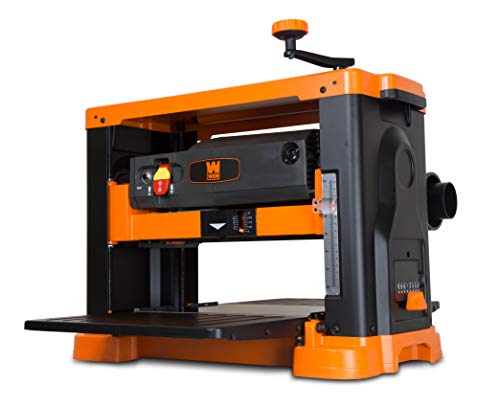
WEN PL1326 13″ Spiral Benchtop Thickness Planer
Spiral-Head Alternative
If tear-out in figured or reclaimed wood is your main problem, a spiral head changes more than any feature on the three planers above. The WEN PL1326 uses 26 staggered, rotatable inserts instead of long knives, on a 15 A motor, and planes boards up to 13″ wide and 6″ thick at a single 26 ft/min feed. When an insert dulls or chips, you rotate it to a fresh edge instead of replacing a whole knife. It sits in a lower price tier than the DW735.
- ✅ Spiral head reduces tear-out
- ✅ Rotatable inserts
- ✅ 13″ capacity in a lower price tier
- ❌ Single feed speed
- ❌ No slow finishing speed like the DW735’s
Best For: Figured, reclaimed or mixed-grain lumber where straight knives tear out.
🏆 The Verdict
In the DW735 vs DW734 vs Makita 2012NB match-up, the DeWalt DW735X wins: 13″ width, 179 cuts per inch for finish passes, fan-assisted chip ejection, an automatic carriage lock and a 3-year warranty, with the tables and spare knives included. The DW734 is the right call a tier lower if your boards are narrow. The Makita 2012NB is lighter and quieter, but its two-knife finish, extra-cost dust hood and current price make it a niche pick.
❓ Frequently Asked Questions
Which DeWalt planer is considered the best?+
What is the difference between the DeWalt DW735 and DW735X?+
Is the DeWalt DW734 a good planer?+
What are the common problems with the DW735?+
Is the Makita 2012NB better than the DeWalt DW735?+
Can you connect a shop vac to a DeWalt planer?+
Choosing between these three for a specific project? Tell me what you mill and how wide your boards get in the comments, and I’ll help you pick.

