An electric hand planer shaves wood off in thin, flat curls and is the faster, straighter tool for taking a door, beam or board edge down to size; a belt sander grinds wood away and is the better tool for smoothing wide surfaces, leveling glue-ups and removing paint. If you need to remove more than about a sixteenth of an inch, plane it. If you need a smooth, even surface, sand it. On most real projects you do both: plane first, then sand.
This comparison is about the two handheld tools. If you’re choosing between a benchtop thickness planer and a drum sander for dimensioning boards, that’s a different decision, covered in drum sander vs planer.
⚡ Quick Answer
Trimming doors, fitting boards, chamfering beams: a power planer such as the Makita KP0800K.
Smoothing tabletops, leveling glue-ups, stripping paint: a belt sander such as the Metabo HPT SB8V2.
Set by a dial, up to 1/16″ to 1/8″ on common 3-1/4″ models
Not set; depends on grit and time
Width of cut
3-1/4″ on most models
3″ or 4″ belts
Surface left behind
Flat and straight, may show ridges or tear-out
Even scratches that need finer sanding
Straightening an edge
Excellent: long sole bridges the dips
Poor: follows the dips
Painted or dirty wood
Dulls knives; hidden nails ruin them
Fine: the belt is a consumable
Wide flat surfaces
Leaves steps between passes
The better tool
Extra jobs
Chamfers and rabbets on many models
Shaping and rounding edges
Mess
Chips, easy to sweep
Fine dust, needs collection
How Each One Works
Electric Hand Planer
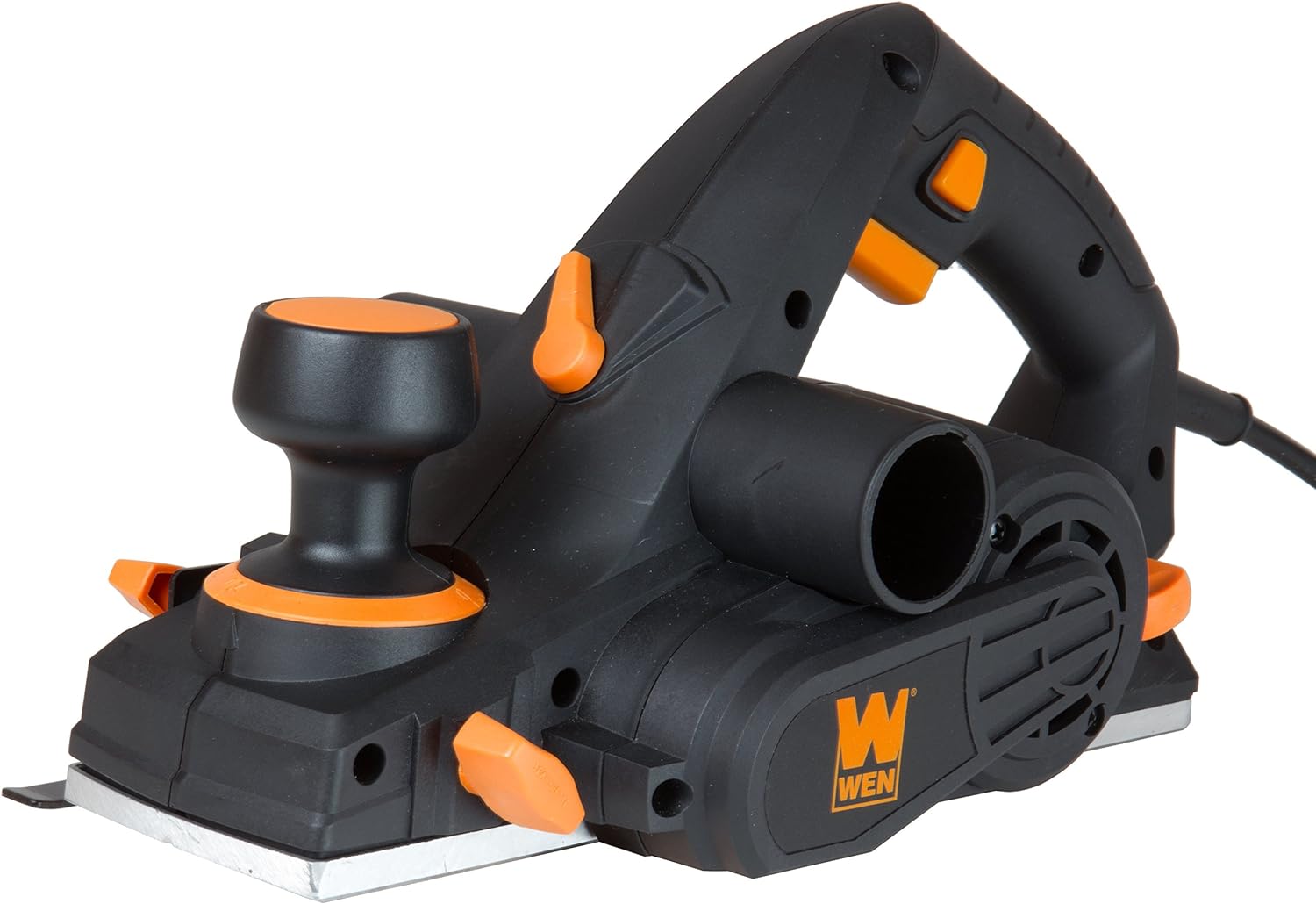
A power planer has a small drum, the cutterhead, carrying two knives that spin between a front and a rear shoe. You set the depth with the front knob, and every pass removes exactly that much wood across the width of the knives. The Makita KP0800K, for example, planes 3-1/4″ wide and up to 3/32″ deep in one pass, and the WEN 6530 adjusts from 0 to 1/8″ in 16 steps. Because the long base rides on the high spots and bridges the low ones, a planer straightens an edge instead of just following it.
Belt Sander
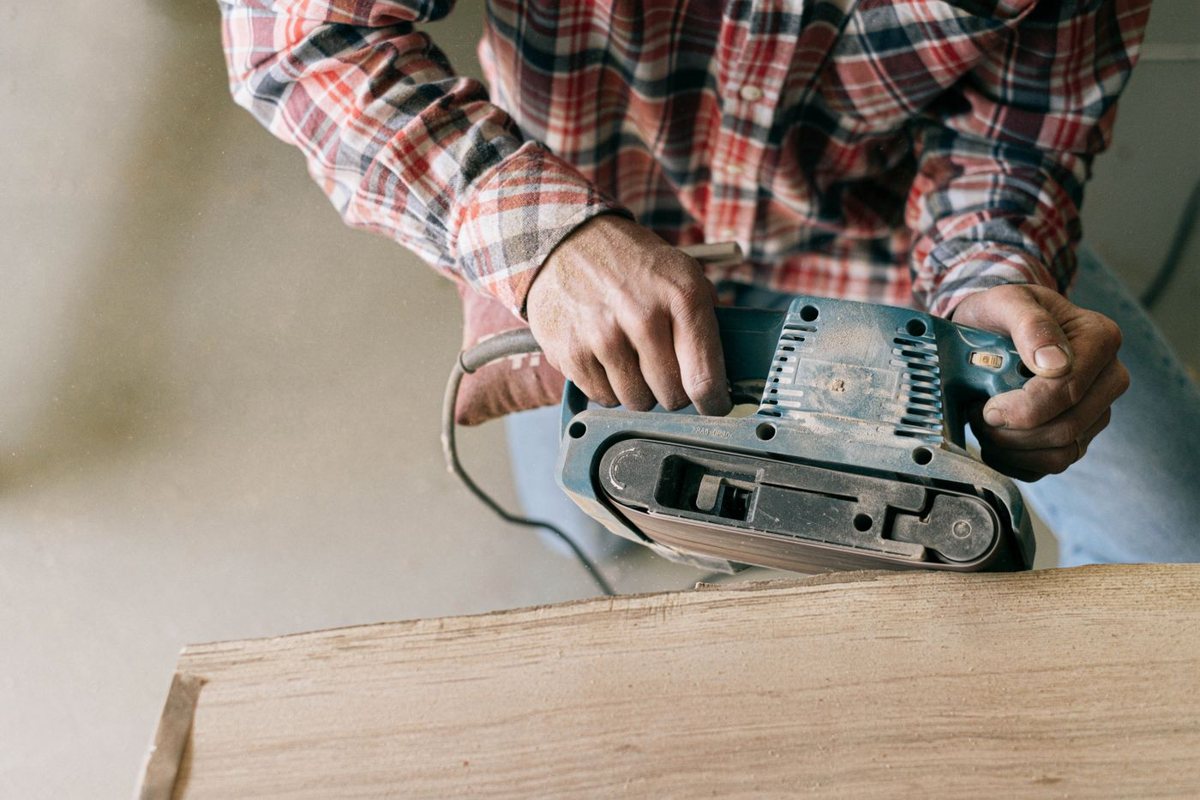
A belt sander runs a loop of abrasive over a flat platen. It has no depth setting: it removes wood as long as you keep it on the surface, and how much depends on the grit, the wood and how long you stay in one place. That makes it slower and less precise for sizing, but far better for making a wide surface smooth and even, and it doesn’t care about old paint or a hidden staple the way planer knives do. My guide on how to use a belt sander covers the technique.
When to Use a Planer
Trimming a sticking door. A planer takes a clean, straight shaving off the edge. Plane the latch side, or the bottom, and work from each end toward the middle so the end grain doesn’t split.
Fitting boards, shelves and countertop edges to a line.
Taking down high joists, studs and beams, and flattening rough timber.
Chamfers and rabbets: many planers have a V-groove in the front shoe for chamfering, and some take a rabbeting guide (the WEN 6530 cuts rabbets up to 1 inch).
When to Use a Belt Sander
Leveling glued-up panels and tabletops, wider than the planer’s 3-1/4″ cut.
Scribing and shaping small amounts to a curved line.
Any surface with hidden metal, where planer knives would chip.
Using Both: Plane, Then Sand
The two tools work best as a sequence. Plane to size and to a straight line, then belt sand at 80 or 100 grit to blend the passes and remove any ridges or tear-out, then finish with a random orbital from 120 up to 180 or 220 before stain or paint. For a broader comparison of the belt sander with finishing sanders, see belt sander vs orbital sander.
⚠️ Important
Before planing reclaimed or installed wood, run a magnet or a metal detector over it and set every nail and screw well below the surface. One hidden nail chips both knives. And keep your hands on both handles of a planer until the cutterhead stops: the knives keep spinning after you let go of the trigger.
Planers I’d Buy
Makita KP0800K 3-1/4″ Planer
Best Planer Overall
The KP0800K planes 3-1/4″ wide and up to 3/32″ deep per pass with a 6.5 A motor and a two-blade carbide cutterhead at 17,000 RPM. The depth knob clicks in 0.1 mm steps, a spring-loaded stand lifts the base off the work when you set it down, and the blade-setting system makes knife changes quick. It weighs 5.7 lb and comes with a case.
Best For: Doors, fitting and finish carpentry, where a precise cut matters.
WEN 6530 6-Amp 3-1/4″ Electric Hand Planer
Best Budget Planer
The WEN 6530 cuts 0 to 1/8″ deep in 16 positive stops and makes rabbets up to 1″ with its rabbeting guide. The 6 A motor gives up to 34,000 cuts per minute, it weighs 6 lb, and the kit includes a dust bag, a kickstand and a parallel fence bracket, with a 2-year warranty. It sits in the lowest price tier.
Best For: Occasional door trimming and rough carpentry on a budget.
Belt Sanders I’d Buy
For more options, including 4″ x 24″ and cordless models, see my full belt sander reviews.
Metabo HPT SB8V2 3″ x 21″ Belt Sander
Best Belt Sander to Pair With a Planer
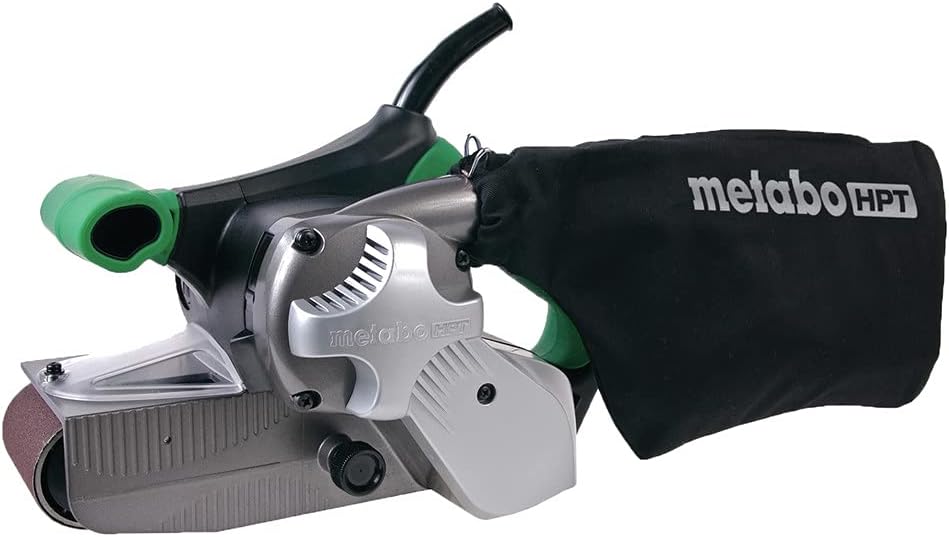
A 9 A, 1,020 W motor with a variable speed dial at the base of the handle, a clear front cover so you can see the belt when sanding up to a surface, and a left-side dust bag that stays out of the way in corners. Metabo HPT backs it with a 5-year limited warranty.
Best For: Blending planer passes, leveling glue-ups and stripping flat surfaces.
WEN 6321 7-Amp 3″ x 21″ Belt Sander
Best Budget Belt Sander
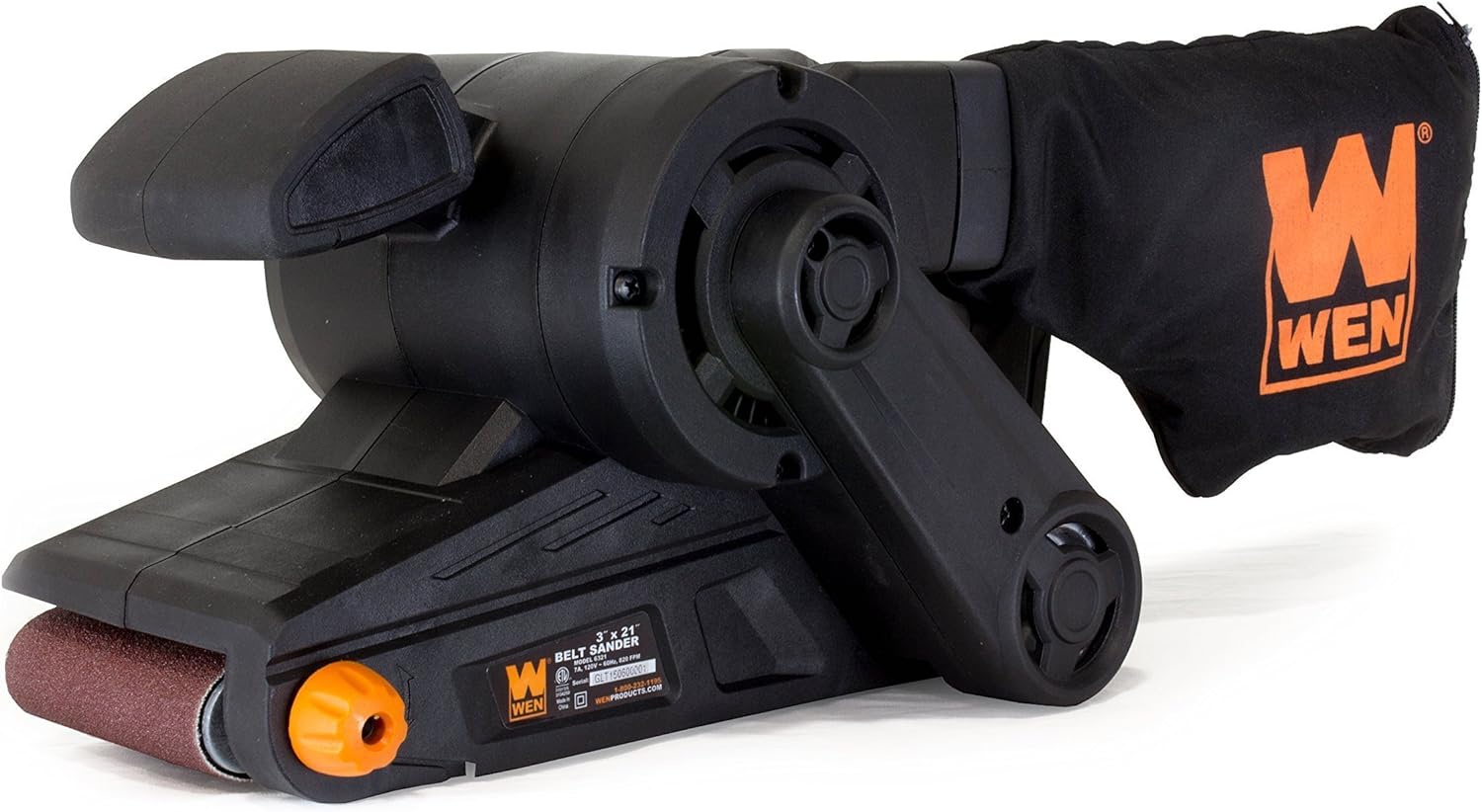
The WEN 6321 runs a 3″ x 21″ belt with a 7 A motor and weighs about 6 lb, light for this belt size. It has a lock-on switch for long passes, a detachable dust bag, and a 2-year warranty. It sits in the lowest price tier.
Best For: Occasional sanding next to a budget planer.
🏆 The Verdict
Choose a power planer when the job is removing a measured amount of wood in a straight line: doors, edges, beams, fitting. Choose a belt sander when the job is making a wide surface flat and smooth, or taking off paint. If you only buy one for general home repairs, the planer solves the jobs a sander can’t; the belt sander is the one to add when you start building furniture.
❓ Frequently Asked Questions
Can a planer be used as a sander?+
Not really. A planer set to a very shallow cut can take a board close to smooth, but it leaves slight ridges between passes and can tear out around knots and reversing grain. It can’t smooth a surface wider than its cut in one even plane, either. Plane to size, then sand.
Can I plane a door with a sander?+
For a very small amount, yes: a belt sander with an 80 grit belt, run with the grain along the edge, can take off a paper-thin rub. For anything more, a planer is faster and keeps the edge straight, while a belt sander tends to round it over. Either way, seal the fresh edge afterwards so the door doesn’t take on moisture.
Can I sand my wood floor with a belt sander?+
Not a whole floor with a handheld belt sander: it’s too narrow and leaves waves over a large area. Floors are sanded with rental drum or orbital floor sanders and an edger. A handheld belt sander is fine for leveling a single raised board. See my guide to the best sanders for floors.
Do you need to sand after planing?+
Yes, if the surface will be seen or finished. Power planers leave small ridges and the occasional patch of tear-out that stain makes obvious. A pass with 100 or 120 grit, then 150 to 180 with a random orbital, is usually enough. A door edge or a hidden framing member can be left as planed.
Trying to decide for a specific job? Describe it in the comments and I’ll tell you which tool I’d reach for.
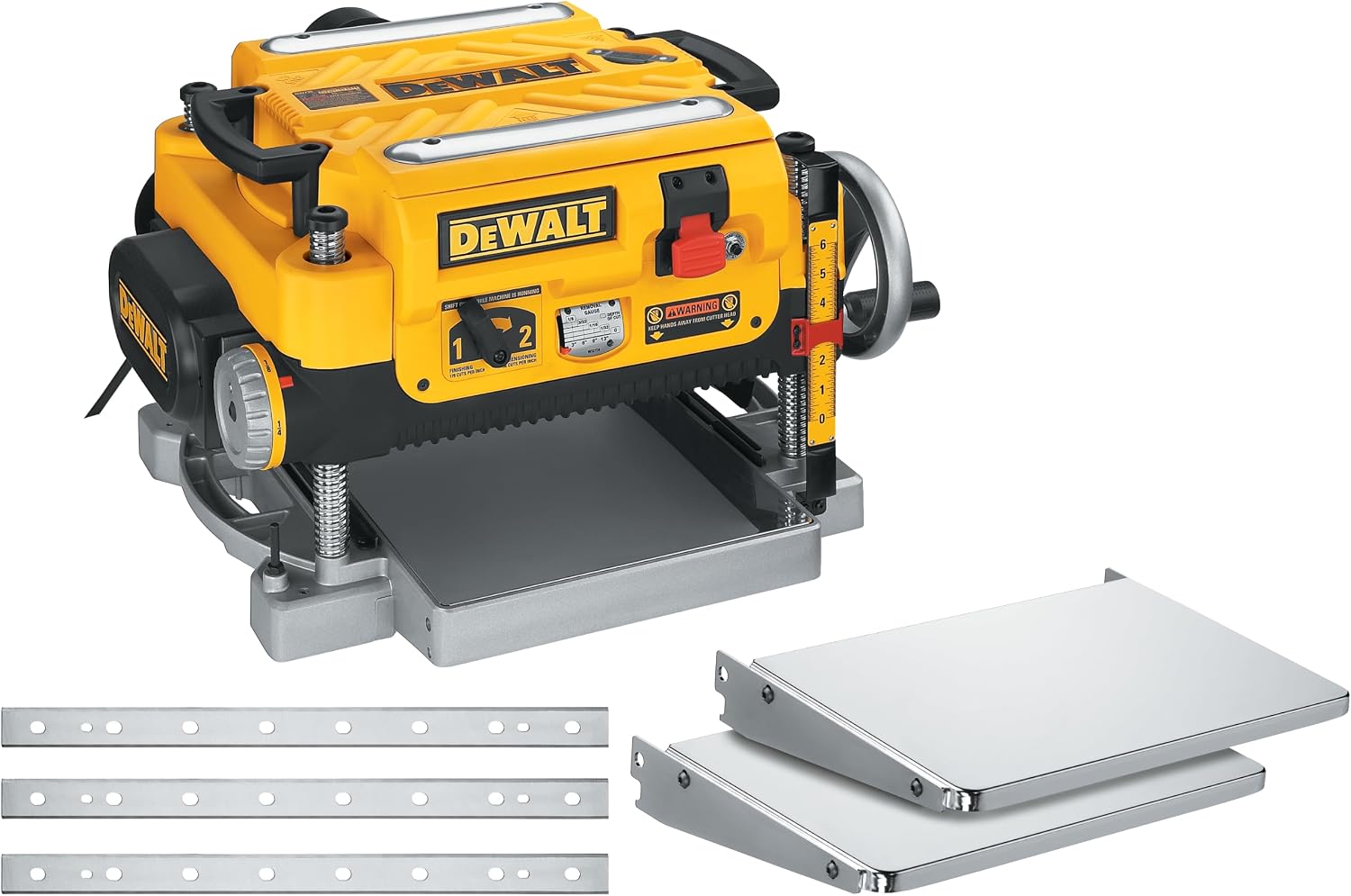
A thickness planer is the tool for making boards thinner, fast: its knives take off real shavings on every pass. A drum sander removes only a sliver per pass, but it can safely thickness what a planer can’t, like figured wood that tears out, very thin stock and wide glued-up panels, and it leaves a surface that’s ready for finish sanding. If you mill rough lumber, buy the planer first. Add a drum sander when tear-out, thin parts or wide panels become your problem.
Most shops that own a drum sander use it after the planer, not instead of it. Below is how each machine works, a side-by-side comparison, the jobs where each one wins, and the models I’d look at. For handheld tools, the matching comparison is belt sander vs planer.
⚡ Quick Answer
Milling rough lumber to thickness: a benchtop planer such as the DEWALT DW735X.
Figured wood, thin stock, wide panels, end-grain boards: a drum sander such as the JET JWDS-1632.
Both problems, one budget: a planer with a spiral cutterhead such as the WEN PL1326 reduces tear-out without a second machine.
Drum Sander vs Planer at a Glance
Feature
Thickness Planer
Drum Sander
How it removes wood
Spinning knives cut shavings
Abrasive-wrapped drum grinds dust
Removal per pass
Large
Very small; many passes
Speed on rough lumber
Fast
Slow
Figured and interlocked grain
Can tear out
No tear-out
Very thin stock
Limited by a minimum thickness
Its specialty
Maximum width
Fixed by the throat (13″ on benchtop models)
Open-ended models do twice the drum width in two passes
End-grain cutting boards
Dangerous: can blow out the far edge
The standard way to flatten them
Surface left behind
Knife marks, possible snipe
Even scratch pattern, ready for a random orbital
Consumables
Knives or carbide inserts
Abrasive strips
Dust collection
Big volume of chips
Fine dust; a collector is a must
Typical price tier
$$$$, lower end for benchtop models
$$$$, usually more than a benchtop planer
How Each Machine Works
Thickness Planer
A thickness planer feeds a board under a cutterhead with two or three knives (or a spiral head with many small inserts) spinning at high speed, and rollers pull the board through at a set speed. The head is set to a height, and everything above that height is cut off in one pass. A benchtop model like the DEWALT DW735X runs a 15 amp motor with a three-knife head and two feed speeds, 96 or 179 cuts per inch, one for fast dimensioning and one for a finer finish. The WEN PL1326 and PL1337 plane boards up to 13″ wide and 6″ thick.
Drum Sander
A drum sander replaces the knives with a long drum wrapped in an abrasive strip, and a conveyor belt carries the board under it. It removes very little per pass, so you lower the drum a fraction of a turn at a time. On an open-ended (cantilevered) model, the drum is supported on one side only, so a panel wider than the drum can be sanded in two passes, flipping it end for end. It’s really a thicknessing sander: the job is to bring stock to an exact, even thickness and a sanded surface, not to take a lot off.
When to Use a Planer
Milling rough-sawn lumber to thickness. A drum sander would take all day.
Bringing a batch of boards to the same thickness for a project.
Removing a lot of wood from reclaimed boards (after pulling every nail).
Straight-grained species like pine, oak, poplar and walnut, which plane cleanly.
When to Use a Drum Sander
Figured wood: curly maple, bird’s-eye, quartersawn stock and interlocked tropical species that tear out under knives.
Thin stock: box sides, guitar tops and backs, veneer, inlay and marquetry.
End-grain cutting boards, which should never go through a planer.
Wide glued-up panels and cabinet doors wider than your planer.
Short pieces that are too short for a planer’s rollers to hold safely.
Removing planer marks and snipe before the finish sanding.
⚠️ Neither One Flattens a Cupped Board
Both machines make the top face parallel to the bottom face. If the board is cupped or twisted, the feed rollers or the conveyor press it flat under the head, and it springs back afterwards. Flatten one face first on a jointer, with a planer sled, or by hand, then thickness it.
Using Both: The Usual Order
Joint one face and one edge, plane to within about a sixteenth of an inch of final thickness, then run the boards through the drum sander at 80 or 100 grit to reach final thickness without tear-out. From there, finish sand with a random orbital at 120 or 150 and up to 180 or 220. The grit steps are in what grit sandpaper for wood. Both machines produce a lot of waste, so plan for a real dust collector rather than a shop vacuum.
Do You Need Both?
Most hobby shops don’t. If you buy rough or skip-planed lumber, the planer is the one you’ll use every week, so start with my thickness planer picks. A drum sander earns its space if you make boxes, instruments, cutting boards or furniture from figured wood, or if tear-out is costing you boards. A middle path is a planer with a spiral or helical cutterhead, which cuts at a shearing angle and tears out less than straight knives.
Planers and Drum Sanders to Consider
DEWALT DW735X 13″ Two-Speed Thickness Planer
Best Thickness Planer Overall
A 15 A, 20,000 RPM motor drives a three-knife cutterhead at 10,000 RPM, and a two-speed gearbox gives 96 or 179 cuts per inch. The carriage locks automatically to reduce snipe, fan-assisted chip ejection blows the chips out of the machine, and the X package adds infeed and outfeed tables and a spare set of knives. DEWALT backs it with a 3-year limited warranty. Premium price tier.
Instead of long knives, the PL1326 uses a spiral cutterhead with 26 staggered, rotatable HSS inserts, which WEN designs for a cleaner finish. It planes boards up to 13″ wide and 6″ thick, the 15 A motor turns the head at 10,000 RPM with a 26 ft/min feed, and an onboard gauge shows how much each pass removes. When an insert dulls or chips, you rotate it to a fresh edge instead of replacing a whole knife.
Best For: Shops that want one machine and plane some figured wood.
JET JWDS-1632 16″ Drum Sander with Stand
Best Drum Sander for a Home Shop
An open-ended drum sander that handles stock up to 16″ wide in one pass or 32″ in two. JET’s SandSmart control watches the drum motor load and sets the conveyor speed for you, infinitely variable up to 10 ft/min, so you don’t burn the wood or stall the drum. The hood channels dust to a 4″ port, the conveyor tracks with tool-free adjusters, and it comes on an open steel stand with 80-grit abrasive installed and a 5-year warranty.
Best For: Figured wood, thin stock, end-grain boards and wide panels.
More drum sanders, from compact 10-20 models to the 18-36, are compared in my drum sander reviews.
🏆 The Verdict
Buy a thickness planer first if you mill your own lumber: it does the heavy work in a fraction of the time. Add a drum sander when figured wood, thin stock, end-grain boards or panels wider than 13″ start to matter; it doesn’t replace the planer, it finishes what the planer can’t. If you only want one machine and tear-out is the worry, look at a spiral-head planer.
❓ Frequently Asked Questions
Do I need a sander if I have a planer?+
Yes. A planer leaves knife marks and sometimes tear-out and snipe, and stain shows all of them. You don’t need a drum sander for that, though: a random orbital sander from 120 up to 180 or 220 is the normal follow-up to planing. A drum sander is for thicknessing what the planer can’t handle.
Is planing better than sanding?+
For removing wood, yes: planing is much faster and leaves a flat, crisp surface. For a surface ready to finish, sanding wins, because it removes knife marks and never tears out. Most projects use both, planing to size and sanding to finish. On difficult grain, sanding to thickness with a drum sander is the safer option.
Do I really need a drum sander?+
Only if your work calls for it: figured wood that tears out, stock thinner than your planer handles, end-grain cutting boards, or panels wider than your planer. For general furniture from straight-grained lumber, a planer and a random orbital sander do the job, and the money is better spent on dust collection.
Deciding between the two for your shop? Tell me what you build in the comments and I’ll give you my take.
An orbital sander is the tool for sanding flat surfaces quickly and evenly; a detail sander is the tool for the corners, edges and narrow spaces an orbital sander can’t reach. If you can only buy one, buy the orbital sander, because it does most of the work on almost every project. Add a detail sander when your projects have inside corners, trim, louvers or small parts.
They are not competing tools as much as two halves of the same job. Below is a side-by-side comparison, what each is good and bad at, which gives the better finish, and two of each I’d buy.
Detail Sander vs Orbital Sander at a Glance
Feature
Detail Sander (mouse or delta)
Random Orbital Sander (5″)
Pad shape
Pointed: iron or triangle
Round
Pad size
Small
5″ or 6″ diameter
Motion
Small fixed orbit (some oscillate)
Orbit plus free rotation
Stock removal
Slow
Fast
Inside corners
✅ Reaches right in
❌ Leaves an unsanded arc
Large flat surfaces
❌ Slow, uneven
✅ Its main job
Weight
Light, one hand
Heavier, one or two hands
Abrasive
Shaped hook-and-loop sheets, specific to the tool
Standard 5″ or 6″ discs
Best for
Corners, trim, spindles, louvers, small parts
Tabletops, panels, doors, stripping, leveling
Typical price tier
$ to $$$
$$ to $$$
⚡ Quick Answer
First sander for general woodworking or furniture? A 5″ random orbital like the Bosch ROS20VSC.
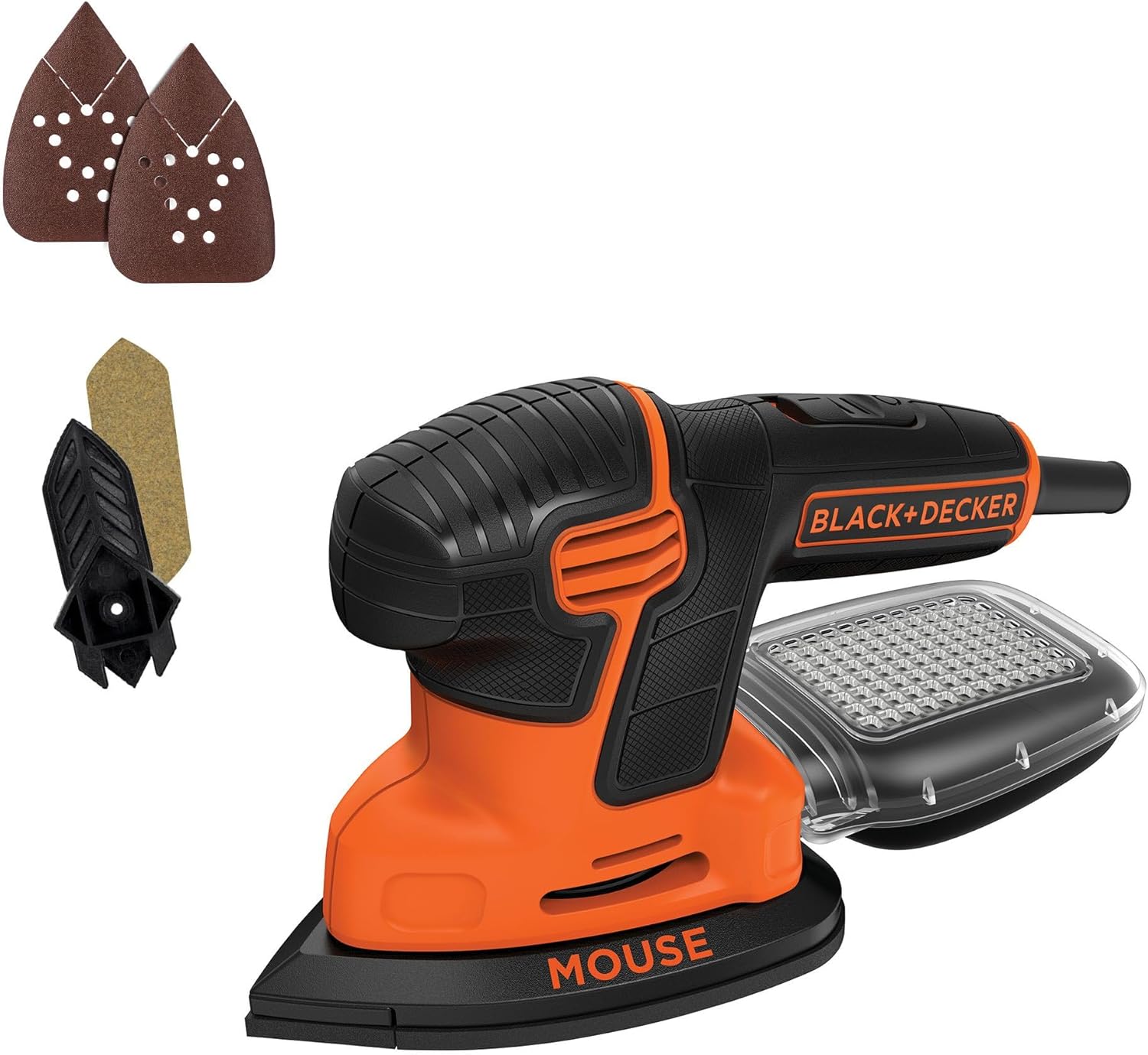
Already have an orbital and keep hand-sanding corners? Add a mouse sander like the BLACK+DECKER BDEMS600.
A detail sander is a small, light sander with a pointed pad. The most common type is the “mouse” sander, with an iron-shaped pad that comes to a point; delta sanders use a triangle. The pad moves in a small, fast orbit, so the tip can be pushed right into a corner and still sand. Many come with finger attachments that stretch the tip into narrow molding profiles and between spindles.
What Is a Detail Sander Good For?
Inside corners of cabinets, drawer boxes, bookcases and face frames.
Window frames, trim and moldings.
Stair spindles, chair rungs and furniture legs.
Louvered doors and shutters.
Small parts that a bigger pad would tip over on.
Stripping the last bit of old finish from corners after the main surfaces are done.
Types of Detail Sander
Mouse sanders are the budget, all-round choice. Delta sanders have a larger triangular pad, somewhat faster on small flat areas. Oscillating detail sanders, like the Proxxon OZI, swing a small triangle back and forth instead of orbiting and are the most precise for tiny work. File sanders run a narrow belt for slots and louvers. I review all four types in my guide to the best detail sanders.
What Is an Orbital Sander?
When people compare an orbital sander with a detail sander, they almost always mean a random orbital sander: a round 5″ or 6″ pad that orbits and spins freely at the same time. That combination removes wood quickly and leaves a scratch pattern that is hard to see under a finish, so it is the most useful single sander for woodworking and refinishing.
What an Orbital Sander Is Good For
Flattening and smoothing tabletops, panels, doors and cabinet sides.
Removing old paint and finish from flat surfaces.
Taking out planer and saw marks.
Final sanding before stain on any open, flat surface.
What About Square-Pad “Orbital” Sanders?
Some tools sold as orbital sanders, or orbital finishing sanders, have a square pad that doesn’t spin: these are sheet sanders, or palm sanders in the 1/4-sheet size. Their square corners reach further into a corner than a round pad, but still not as far as a pointed detail pad. I compare them with random orbitals in sheet sander vs random orbital sander.
Head to Head
Speed
Winner: orbital sander, by a wide margin. A 5″ random orbital sander has far more pad area, more power and the added rotation. On a tabletop it does in minutes what a detail sander would take an hour to do, and less evenly.
Reach
Winner: detail sander, clearly. A round pad physically can’t sand the last inch of an inside corner. A pointed pad goes right into it. This is the entire reason detail sanders exist.
Finish Quality
Winner: orbital sander on flat surfaces. The random pattern hides scratches and the large flat pad keeps the surface level. A detail sander leaves a good finish in its small area, but used on a large surface it tends to leave an uneven, patchy result. In the corners, the detail sander wins by default, because the orbital sander leaves them unsanded.
Control and Comfort
Winner: detail sander for small and vertical work. It weighs little, fits in one hand and works overhead or inside a cabinet. The orbital sander is more comfortable for long sessions on large panels, especially one with a front handle.
Running Costs
Winner: orbital sander. 5″ discs are standard, sold everywhere and cheap in bulk. Detail sander sheets are shaped for each tool, and the tip of the sheet, where all the work happens, wears out first. Some pads let you rotate the sheet to use a fresh point.
What Type of Sander Gives the Best Finish?
For flat surfaces, a random orbital sander gives the best finish of any power sander, because its non-repeating scratch pattern is the hardest to see under stain and clear coat. Some finishers follow it with a very light pass by hand with the grain at the final grit. Detail sanders give a comparable finish in corners and small areas, and a belt sander, while fast, leaves the coarsest finish and needs an orbital sander after it. So the best-finish setup for a piece of furniture is an orbital sander on the flats and a detail sander in the corners, both taken to the same final grit.
Downsides of Each
Downsides of an Orbital Sander
It can’t reach inside corners, it is bulky on small parts and it leaves swirl marks if you press down or tilt it. For how to avoid those, see how to use an orbital sander.
Downsides of a Detail Sander
It is slow, it only suits small areas, the shaped sheets cost more per sanding area and wear fastest at the tip, and budget models vibrate and are loud for their size.
Are Detail Sanders Any Good?
Yes, for the job they are made for. As a second sander next to a random orbital, a detail sander saves a lot of hand-sanding in corners and on trim, and it is the only power sander that reaches those spots. Where people are disappointed is when they buy one as their only sander and try to sand a tabletop with it. It will do it, slowly and unevenly. Budget mouse sanders are fine for occasional use; if you sand trim or cabinets often, a better-built model with lower vibration is worth it.
Which One Should You Buy?
For Woodworking
Random orbital first. Most woodworking is flat panels and boards. Add a detail sander when you build boxes, cabinets or anything with inside corners.
For Furniture Refinishing and Cabinets
Both, ideally. The orbital sander strips and smooths the flat surfaces, the detail sander gets the corners, legs and molding. My guides to the best sanders for furniture and the best sanders for cabinets go into this in detail.
For Trim, Windows and Stairs
Detail sander first. These jobs are almost all narrow profiles and corners; a round pad has little to do.
For Decks, Floors and Large Panels
Orbital sander, or bigger. A detail sander has no role here beyond the odd corner.
A 1.2 A mouse sander that Black+Decker rates at 14,000 to 16,000 orbits per minute (its own listings give both figures). The 3-position grip lets you hold it by the body, by the nose or at an angle, the finger attachment reaches into narrow profiles, and dust goes into a clip-on canister. 2.4 lb, 2-year limited warranty, and the lowest price tier.
Milwaukee M12 FUEL Orbital Detail Sander (2531-20)
Best Cordless Detail Sander
1.3 lb, four speed settings from 4,000 to 14,000 OPM plus a variable-speed trigger, and a small 1.5 mm orbit Milwaukee designed for a stain-grade finish. A sponge interface pad in the box lets the abrasive follow trim profiles. Sold as a bare tool with a 5-year limited warranty; you need an M12 battery.
A 2.5 A motor with a speed dial from 7,500 to 12,000 OPM, a pad dampening system Bosch designs to reduce swirl marks, and a micro-filter canister that twists off and shows how full it is.
A 3 A motor at 8,000 to 12,000 OPM in a low-profile body that keeps your hand close to the work, a counterweight to cut vibration, a dust-sealed switch and a 3-year limited warranty.
Buy the orbital sander first: it does the bulk of the sanding on almost every project, faster and flatter. The Bosch ROS20VSC is a good place to start. Add a detail sander as soon as you find yourself hand-sanding corners, trim or spindles; the BLACK+DECKER BDEMS600 is the easy first one, and the Milwaukee M12 FUEL is the upgrade for regular trim and cabinet work. Together they cover everything from the tabletop to the last inch of the corner.
❓ Frequently Asked Questions
What is a detail sander good for?+
A detail sander is good for anywhere a bigger pad can’t reach: inside corners of cabinets and drawers, window frames, trim and moldings, stair spindles, chair legs, louvered doors and small parts. Its pointed pad gets into the corner, and many come with a finger attachment for narrow profiles.
What are the downsides of using an orbital sander?+
Compared with a detail sander, a random orbital sander can’t reach into inside corners and is awkward on small parts and narrow trim. It can also leave swirl marks if you press down or tilt it, and it makes a lot of dust without a vacuum attached.
What type of sander gives the best finish?+
On flat surfaces, a random orbital sander gives the best finish of any power sander, because its random scratch pattern is the hardest to see under a finish. In corners and on trim a detail sander gives the best result, since an orbital can’t reach there. Taking both to the same final grit gives the most even finish on furniture.
Are detail sanders any good?+
Yes, as a second sander for corners, trim and small parts, where they save a lot of hand-sanding. They are a poor choice as your only sander, because their small pad makes large surfaces slow and uneven. Budget mouse sanders are fine for occasional jobs; better-built models vibrate less for regular use.
Which is better, a detail sander or an orbital sander?+
Neither is better overall: they do different jobs. An orbital sander is better for almost all flat sanding and should be your first sander. A detail sander is better for corners, trim and tight spaces. Most people who refinish furniture or build cabinets end up owning both.
Is a mouse sander the same as an orbital sander?+
No. A mouse sander is a type of detail sander, with a small, pointed pad that moves in a fixed orbit. An orbital sander usually means a random orbital sander, with a round 5″ or 6″ pad that also spins. The mouse sander reaches corners; the orbital sander covers flat areas far faster.
Trying to decide for a specific project? Describe it in the comments and I’ll tell you which one I’d reach for.
A belt sander is for removing a lot of wood fast on flat surfaces; an orbital (random orbital) sander is for smoothing and finishing. If you are leveling rough boards, taking a door down to size or stripping thick old paint, a belt sander does it in a fraction of the time. For almost everything else, including every final pass before stain or paint, a random orbital is the better and safer tool.
Many shops use both, one after the other. Below is a side-by-side comparison, the projects where each one wins, the mistakes to avoid, and three sanders I’d buy of each type.
Belt Sander vs Orbital Sander at a Glance
Feature
Belt Sander
Random Orbital Sander
Motion
Continuous loop, straight line
Orbit plus free rotation
Stock removal
Very fast
Moderate
Finish quality
Coarse, needs follow-up sanding
Ready for finish at 180-220 grit
Direction
Must follow the grain
Any direction
Learning curve
Steep: easy to gouge
Gentle, beginner friendly
Weight and size
Heavier, two hands
Light, one or two hands
Abrasive
Belts (3″ x 18″ or 3″ x 21″ most common)
5″ or 6″ hook-and-loop discs
Best for
Leveling, scribing, stripping flat stock
Smoothing, finishing, furniture
Typical price tier
$ to $$$ (premium $$$$)
$ to $$$
⚡ Quick Answer
Your first or only sander? A random orbital such as the Bosch ROS20VSC.
Leveling rough lumber, fitting doors or stripping flat surfaces? Add a belt sander such as the Metabo HPT SB8V2.
First belt sander on a budget? The SKIL 7510-01 warns you when you press too hard.
How Each One Works
Belt Sander
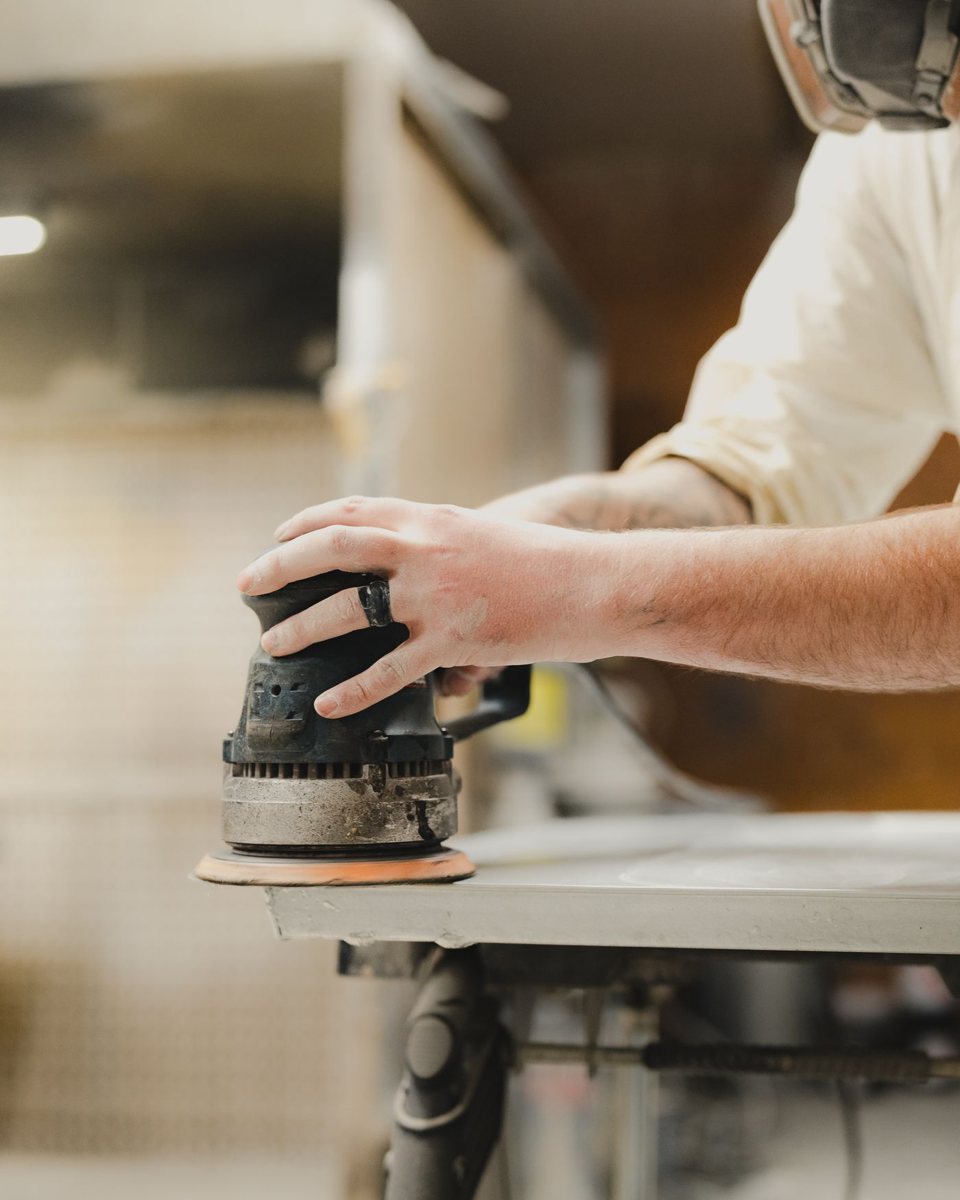
A belt sander drives a continuous loop of abrasive around two drums, so the whole flat platen under the belt cuts in one direction, fast. It removes material aggressively, which is its strength and its danger: tilt it or stop moving and it digs a groove in seconds. Because it cuts in straight lines, you always sand with the grain. Handheld models are sized by the belt, and 3″ x 18″ and 3″ x 21″ are the common sizes for home shops; my belt sander reviews cover larger 4″ x 24″ machines too.
Random Orbital Sander
A random orbital sander moves its round pad in a small orbit while the pad also spins freely. No grain of abrasive follows the same path twice, so the scratches are small and random and disappear under a finish. It removes wood much more slowly than a belt sander but is far more forgiving, and it works in any direction on any surface. It is the sander most people should buy first; the full lineup is in my best random orbital sanders guide.
Where Each One Wins
Belt Sander: Heavy Removal on Flat Stock
Leveling glued-up panels and rough boards before finer sanding.
Taking doors and shelves down to size, and scribing cabinet sides to a wavy wall.
Stripping thick paint or varnish from large flat surfaces like deck boards and tabletops. For the full comparison, see the best sanders to remove paint.
Shaping and rounding edges and ends, with the sander turned over and clamped (only on models designed for it).
Random Orbital: Smoothing and Finishing
Every final pass before stain, paint or clear coat.
Furniture and cabinets, where one gouge ruins the piece.
Veneer and plywood, which a belt sander can cut through in seconds.
Curved and uneven surfaces, where a flat belt platen can’t follow the shape.
Belt Sander vs Orbital Sander by Project
Floors
A handheld belt sander is not the tool for a whole floor: it is too narrow, and on a large area it leaves dips and waves. Full floors are done with rental drum or large orbital floor sanders, plus an edger at the walls. A handheld belt sander can help level a small raised board or a patch. See my guides to the best sanders for floors, sanding wood floors yourself and sanding hardwood floors with an orbital sander.
Decks
A belt sander is fast on flat deck boards with thick, peeling finish, as long as you keep it moving with the grain and set nail heads first. Railings, balusters and the final pass are random orbital work. My guide to the best sanders for deck refinishing and how to sand a deck go step by step.
Tabletops and Glue-Ups
Belt sander first, at 80 grit, to flatten the joints; then the random orbital from 120 up to 180 or 220 to remove the belt’s straight scratches and prepare for finish.
Furniture Refinishing
Random orbital almost always. A belt sander on a veneered dresser is the classic way to ruin it.
⚠️ Important
Sanding paint in a home built before 1978 can release lead dust. Test before you sand, contain the area and use a vacuum with a HEPA filter. A belt sander makes dust faster than any other handheld sander.
Common Mistakes
Belt Sander Mistakes
Sanding across the grain. The straight scratches are deep and show through any finish.
Stopping in one spot. Keep it moving, or it cuts a hollow.
Tipping at the edges. Let the platen hang no more than a third of the way off the edge, or you round it over.
Pressing down. The weight of the sander is enough.
Starting on the wood. Start the belt before it touches the surface, and lift it off before you switch it off.
Random Orbital Mistakes
Pressing too hard, which stops the pad spinning and causes swirls.
Tilting the pad onto its edge.
Skipping grits after a belt sander: go 80 (belt) to 120 to 150 or 180, not straight to 220.
The Best Belt Sanders to Buy
All three are handheld 3″ belt sanders. For 4″ x 24″ machines and cordless models, see my full belt sander reviews.
Metabo HPT SB8V2 3″ x 21″ Belt Sander
Best Belt Sander Overall
The SB8V2 pairs a 9 A, 1,020 W motor with a variable speed dial at the base of the handle, so you can slow the belt for softwoods and paint and run it fast for leveling. The clear front cover lets you see the belt’s edge when you sand up to a wall, and the dust bag sits on the left side so it stays out of the way in corners. Metabo HPT backs it with a 5-year limited warranty.
Best For: Leveling, door fitting and stripping on a home-shop budget.
SKIL 7510-01 3″ x 18″ Belt Sander
Best Budget Belt Sander for Beginners
The SKIL 7510-01 is a 6 A, 3″ x 18″ belt sander with the one feature a first-time belt sander user needs: pressure control technology that warns you when you press too hard, the most common cause of gouges. The belt tracks itself, the micro-filtration dust box catches fine dust, it fits standard 1-1/4″ vacuum hoses, and it sands flush up to an edge.
Best For: Occasional stripping and leveling, and learning to use a belt sander safely.
Makita 9903 3″ x 21″ Belt Sander
Best Premium Belt Sander
The Makita 9903 is built for control: an 8.8 A motor that Makita rates at 85 dB, a variable speed dial from 690 to 1,440 ft/min, and an auto-tracking belt that stays centered without adjustment. Its nose and side are designed to sand flush to a wall, and the front grip gives a comfortable two-handed hold on long passes.
Best For: Frequent use, finish carpentry and anyone who wants the most control from a belt sander.
The Best Orbital Sanders to Buy
All three are 5″ random orbital sanders with variable speed, useful for following a belt sander with finer grits.
Bosch ROS20VSC 5″ Random Orbital Sander
Best Random Orbital for Beginners
The Bosch ROS20VSC has a 2.5 A motor with a speed dial from 7,500 to 12,000 OPM, a pad dampening system Bosch designs to minimize swirl marks, and a hook-and-loop pad with more than 35,000 hooks to hold discs firmly. The micro-filter dust canister, which Bosch rates for particles as small as 1/2 micron, twists off and shows when it’s full.
Best For: A first sander for furniture and general woodworking.
Makita BO5041K 5″ Random Orbit Sander
Best for Following a Belt Sander
The Makita BO5041K has a 3 A motor and the widest speed range here, 4,000 to 12,000 OPM, with a rubberized palm grip and a second handle for two-handed control. That combination suits the job right after a belt sander: full speed to erase belt scratches at 120 grit, low speed for delicate finishing. The K kit includes a case.
Best For: Tabletops, doors and panels after heavy sanding.
DEWALT DCW210D1 20V MAX Cordless 5″ Random Orbital Sander
Best Cordless Random Orbital
The DCW210D1 is a brushless 5″ random orbital with variable speed from 8,000 to 12,000 OPM and a low-profile body. Its 8-hole hook-and-loop pad is replaceable, the switch is dust-sealed, and this kit includes a 2.0 Ah battery, charger and storage bag. No cord makes it the easy choice for decks, railings and work away from an outlet. More options are in my cordless sander reviews.
Buy a random orbital sander first: it handles most projects and is hard to ruin work with. The Bosch ROS20VSC is my pick to start. Add a belt sander when you start leveling glue-ups, fitting doors or stripping big flat surfaces; the Metabo HPT SB8V2 gives you variable speed and a 5-year warranty. Used together, belt first and orbital second, they cover almost every sanding job in a home shop.
❓ Frequently Asked Questions
What are the 5 most common mistakes people make with a random orbital sander?+
Pressing down, tilting the pad, moving too fast, starting or stopping it off the surface, and skipping grits. The last one is the big one after a belt sander: the belt’s straight scratches are deep, so go from 80 to 120 to 150 or 180 with the random orbital rather than jumping to 220. My guide on how to use an orbital sander covers each mistake.
What are the disadvantages of using a belt sander?+
A belt sander removes wood so fast that it is easy to gouge, dish or round over the work; it has to be used with the grain; it leaves a coarse finish that needs follow-up sanding; it is heavier and louder than an orbital; and it throws a lot of dust. It is also the wrong tool for veneer, plywood faces and curved surfaces.
Which sander is best for beginners?+
A random orbital sander. It works in any direction, removes wood at a controllable pace and leaves a finish-ready surface, so mistakes are rare and easy to fix. A variable-speed 5″ model like the Bosch ROS20VSC is an ideal first sander. Add a belt sander later, when a project calls for heavy stock removal.
Can I sand my wood floor with a belt sander?+
Not a whole floor with a handheld belt sander: its narrow belt leaves dips and waves over a large area, and it is slow. Full floors are sanded with a rental drum or large orbital floor sander and an edger. A handheld belt sander is fine for leveling a single raised board or a small area, used with the grain and kept moving.
Should I use a belt sander or an orbital sander on a deck?+
Both. A belt sander is fastest for stripping thick, peeling finish from flat deck boards, as long as nail and screw heads are set below the surface. Use a random orbital for railings, balusters and the final smoothing pass before stain. A cordless random orbital saves dragging cords around the deck.
Should I use a belt sander or a planer?+
A thickness planer is the right tool to make a board uniformly thinner and flat on both faces, and it is much faster at it. A belt sander is better for flattening glued-up panels too wide for your planer, leveling joints, and work on installed surfaces like doors and countertops, where a planer can’t go. I cover the full comparison in belt sander vs. planer.
Still unsure which one your project needs? Describe it in the comments and I’ll help you choose.
A palm sander and an orbital sander are not really opposites: “palm sander” describes the size and grip, “orbital” describes the motion. In everyday use, though, “palm sander” means a small square-pad finishing sander, and “orbital sander” means a round-pad random orbital sander. The square palm sander reaches into corners and finishes gently; the random orbital removes wood faster and leaves fewer visible scratches.
So the real question is which pad and which motion suit your project. Below I clear up the names, compare the two tools side by side, and pick three sanders I’d buy on each side, from budget to premium.
Why “Palm Sander” Confuses Everyone
Tool makers and stores use “palm sander” for any sander small enough to hold in one hand with your palm on top. That includes two very different tools:
Palm-grip sheet sanders (also called finishing sanders or 1/4-sheet sanders). They have a square pad that clamps a piece of ordinary sandpaper and moves in a small, fixed orbit.
Palm-grip random orbital sanders. They have a round 5″ pad that orbits and spins freely at the same time. Bosch even names its ROS10 a “Palm Random Orbit Sander”.
Most people searching “palm sander vs orbital sander” mean the first against the second: square pad versus round pad. That is the comparison on this page. If you want the full technical breakdown of the two motions, I cover it in my sheet sander vs random orbital sander guide.
Palm Sander vs Orbital Sander at a Glance
Feature
Palm Sander (square pad)
Orbital Sander (random orbital)
Pad
Square, sized for a 1/4 sheet of sandpaper
Round, usually 5″
Motion
Small fixed orbit
Orbit plus free rotation
Removes wood
Slowly
Faster
Inside corners
✅ Reaches them
❌ Leaves an arc
Scratch pattern
Repeating loops, can show under stain
Random, harder to see
Sandpaper
Cut from ordinary sheets
Hook-and-loop discs
Best for
Finish sanding, corners, between coats, drywall patches
General woodworking, tabletops, removing finish
Typical price tier
$ to $$ (premium $$$$)
$ to $$ (premium $$$$)
⚡ Quick Answer
One sander for general woodworking? A 5″ random orbital such as the DEWALT DWE6421K.
Painting prep, drywall patches, cabinets and corners? A square palm sander such as the BLACK+DECKER BDEQS300.
Want the palm-size feel with a round pad? The Bosch ROS10 is a true palm-grip random orbital.
Where Each One Wins
The Palm Sander Wins at Corners and Finishing
The square pad goes all the way into an inside corner, which a round pad can’t. Its small fixed orbit removes very little wood, so it is hard to sand through a veneer or round over a crisp edge. That makes it the tool for the last pass before finish, for scuffing between coats of paint or varnish, and for cabinets, drawer boxes and face frames. It also runs on cheap sandpaper you cut from full sheets.
The Orbital Sander Wins at Speed and Scratch Pattern
A random orbital’s pad spins as it orbits, so it cuts faster and its scratches cross in every direction. On a tabletop, a glued-up panel or a door that needs its old finish removed, it does in minutes what a palm sander does in an hour, and the random pattern is much less visible under stain. For flat surfaces, it is the better tool.
They Tie on Size and Control
Both come in palm-sized bodies you can use with one hand, and both have small models light enough for vertical work. Control depends more on the pad: a square pad is easy to keep flat on edges and narrow parts, while a round pad can tip and dig if you tilt it.
The Downsides of Each
Orbital Sander Downsides
It can’t reach inside corners. You’ll finish those by hand or with a detail sander.
It can leave swirls if you press too hard, tilt the pad or skip grits.
Discs cost more than sheets, and the holes have to match your pad for dust extraction to work.
It is aggressive on veneer and edges: easy to sand through at coarse grits.
Palm Sander Downsides
It is slow on anything that needs real stock removal.
Its repeating scratch loops can show under stain if you rush or skip grits.
Paper clamps can loosen, and a loose sheet tears at the edges.
Which One for Your Project?
Woodworking
Start with a random orbital: it does the leveling and most of the smoothing on boards, tabletops and panels. Add a palm sander later for corners and final passes. The complete lineup is in my best random orbital sanders guide.
Drywall
For patches and repairs, a square palm sander at 120 to 150 grit is the easier tool: its flat pad stays level on a wall and it removes compound gently, so you don’t dig into the paper face. Connect it to a vacuum. For whole rooms, a dedicated drywall sander is faster; see the best sanders for walls and drywall and my guide on how to sand a drywall patch.
Painting Prep and Between Coats
A palm sander at 180 to 220 grit scuffs a surface evenly without cutting through, which is what paint needs. Painters working on doors, trim and cabinets usually reach for one; for large flat areas, a random orbital on an extractor is faster.
Furniture Refinishing
Both: the random orbital for tops and flat panels, the palm sander for corners, rails and the final pass. I explain the whole routine in my guide to the best sanders for furniture refinishing.
💡 Pro Tip
When a product title just says “orbital sander”, look at the pad before you buy. Square means a sheet-style palm sander; round means a random orbital. The name is often the same, the tool isn’t.
The BDEQS300 runs a 2 A motor at 16,000 orbits per minute and is built to sand flush on three sides, with 270 degrees of clearance, so it gets right up to edges and into corners. A soft-grip paddle switch on top locks on for one-handed use, the paper clamps make sheet changes quick, and a tri-layer dust bag keeps the surface clear.
Best For: Paint prep, drywall patches and occasional finish sanding.
DEWALT DCW200B 20V MAX XR Cordless 1/4 Sheet Sander
Best Cordless Palm Sander
The DCW200B takes the palm sander off the cord. Its brushless motor runs at a variable 8,000 to 14,000 OPM, so you can slow it down for delicate finishing, and the low-profile body keeps your hand close to the work. It has a paper clamp, a dust-sealed switch and a one-handed locking dust bag. It is sold as a bare tool: you need a DEWALT 20V MAX battery and charger. More battery-powered options are in my cordless sander reviews.
Best For: Painters and remodelers already on DEWALT 20V batteries.
Festool RTS 400 REQ-Plus Finish Sander
Best Premium Palm Sander
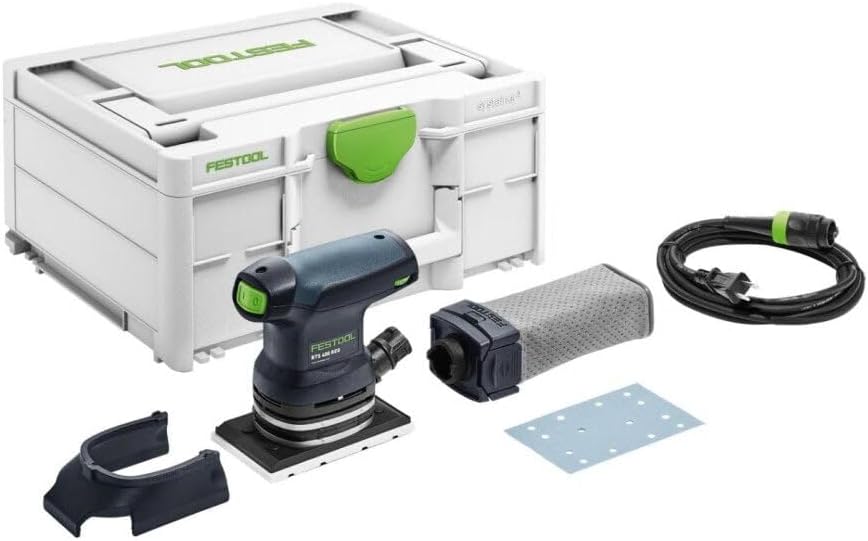
The Festool RTS 400 is a rectangular-pad finish sander for people who sand every day. Its 250 W motor with MMC electronics is, per Festool, a 25% increase over the previous version, the grip has rubberized textured surfaces, and the interlocking dust port locks onto Festool’s current CT hose connector, so it is designed to run on an extractor. Festool backs it with a 3-year warranty.
Best For: Professional finishers and cabinetmakers with a dust extractor.
The Best Orbital Sanders to Buy
All three are 5″ random orbital sanders small enough to hold in one hand.
Bosch ROS10 5″ Palm Random Orbit Sander
Best “Palm” Random Orbital
The Bosch ROS10 is the answer to “palm sander or orbital sander?” in one tool: a palm-grip body with a 5″ random orbit pad. The 2.5 A motor runs at 12,000 OPM (single speed), a pad dampening braking system is designed to prevent swirl marks when you set it down, and the microcellular backing pad helps with fine finishes. Discs attach with hook-and-loop.
Best For: Anyone who likes the one-handed feel of a palm sander but wants random orbital results.
DEWALT DWE6421K 5″ Random Orbital Sander
Best Orbital Sander for Most People
The DWE6421K has a 3 A motor at 12,000 OPM in a shorter body that puts your hand closer to the work. A separate counterweight reduces vibration, rubber overmold covers the grip areas, and the dust-sealed switch keeps sanding dust out. The one-handed locking dust bag comes off easily, and the port fits DEWALT’s DWV010 and DWV012 extractors directly (other 1-1/4″ hoses need DEWALT’s DWV9000 connector).
Best For: A first sander for woodworking and furniture.
SKIL SR211601 5″ Random Orbital Sander
Best Budget Orbital Sander
The SKIL SR211601 brings variable speed to the lowest price tier: a 2.8 A motor at up to 13,000 OPM, a counterweight to reduce hand fatigue and a compact body for tight spaces. Its cyclonic “X-flow” dust box is see-through, so you can tell when to empty it, and the on/off switch is dust-sealed.
If you’re choosing one sander for woodworking, choose the orbital (random orbital): it’s faster and leaves a less visible scratch pattern. The DEWALT DWE6421K is a great first one. If your work is mostly paint prep, drywall patches, cabinets and corners, choose a square palm sander like the BLACK+DECKER BDEQS300. And if you want both in feel, the Bosch ROS10 is a palm-grip random orbital.
❓ Frequently Asked Questions
What are the downsides of using an orbital sander?+
A random orbital sander can’t reach into inside corners because its pad is round, it can leave swirl marks if you press too hard or tilt it, and its hook-and-loop discs cost more than plain sandpaper. It is also aggressive enough to sand through thin veneer at coarse grits. A square palm sander or a detail sander covers the corners it misses.
What is the best palm sander?+
For most people, a 1/4-sheet palm sander with a good paper clamp and a vacuum port is the right buy. On a budget, the BLACK+DECKER BDEQS300; cordless, the DEWALT DCW200B; for professional all-day use, the Festool RTS 400. My full palm sander reviews compare more models.
What sanders do professional painters use?+
Painters mostly use small sanders for prep: square palm sanders for trim, doors and cabinets, and 5″ or 6″ random orbitals for larger flat areas, usually connected to a dust extractor to keep dust off fresh surfaces. For whole walls and ceilings, they use long-reach drywall sanders.
What is a palm sander good for?+
A square palm sander is good for finish sanding before paint or stain, scuffing between coats, sanding into inside corners on cabinets and furniture, and smoothing drywall patches. It removes wood slowly and gently, so it is not the tool for stripping or leveling.
Is a palm sander or an orbital sander better for drywall?+
For patches and small repairs, a square palm sander is usually better: its flat pad stays level on the wall and removes joint compound gently without digging into the paper. Use 120 to 150 grit and a vacuum. A random orbital works too, but it cuts faster and is easier to overdo. For whole rooms, use a dedicated drywall sander.
Is a palm sander or an orbital sander better for woodworking?+
For woodworking, a random orbital sander is the better first sander: it removes machining marks and levels boards faster and leaves a less visible scratch pattern under stain. A square palm sander is a useful second tool for corners, edges and the final light pass.
Still deciding? Tell me what you’re sanding in the comments and I’ll point you to the right tool.
A random orbital sander removes wood faster and leaves fewer visible swirl marks, so it is the better first sander for most people. A sheet sander (the square “palm sander”) is slower but its square pad reaches right into corners and runs on cheap, cut-to-size sandpaper, which makes it the better finishing tool for furniture, cabinets and anything with inside corners.
Plenty of woodworkers end up owning both, because they do different halves of the job. Below is a side-by-side comparison of the two tool types, what each is best at, the mistakes that ruin a finish with either one, and three sanders I’d buy on each side.
Sheet Sander vs Random Orbital Sander at a Glance
Feature
Sheet Sander (1/4, 1/3, 1/2 sheet)
Random Orbital Sander (5″ or 6″)
Pad shape
Square or rectangular
Round
Motion
Small fixed orbit, pad does not spin
Orbit plus free rotation, pattern never repeats
Stock removal
Slower
Faster
Swirl marks
More likely if you rush or skip grits
Fewer, as long as the pad stays flat
Corners and edges
✅ Square pad reaches inside corners
❌ Round pad leaves an unsanded arc
Abrasive
Standard sandpaper sheets, cut to size
Hook-and-loop discs with dust holes
Abrasive cost
Lower
Higher
Best for
Finish sanding, corners, sanding between coats
General sanding, tabletops, stripping, fast leveling
Typical price tier
$ to $$
$$ to $$$
⚡ Quick Answer
Buying only one sander for general woodworking? Get a 5″ random orbital such as the Bosch ROS20VSC.
Refinishing furniture or cabinets with lots of inside corners? Get a 1/4-sheet sander such as the DEWALT DWE6411K.
On a tight budget and mostly doing light finish work? The SKIL 7292-02 costs the least of anything here.
What Is a Sheet Sander?
A sheet sander, also called a finishing sander, an orbital sheet sander or, for the quarter-sheet size, a palm sander, holds a flat piece of ordinary sandpaper against a square or rectangular pad. The pad moves in a small, fixed orbit many thousands of times a minute. It does not spin.
How It Moves
Because the orbit is fixed, every abrasive grain traces the same small loop over and over. That loop is tiny, so the tool removes wood gently. It is predictable and easy to control, which is why it is a favorite for final passes and for sanding between coats of finish, where you want to scuff the surface, not cut into it.
Sheet Sizes: 1/4, 1/3 and 1/2
The name comes from how much of a standard 9″ x 11″ sheet of sandpaper the pad takes. A 1/4-sheet sander uses a 4-1/2″ x 5-1/2″ piece and fits in one hand; this is the common “palm sander”. Third-sheet and half-sheet sanders are larger, heavier and need two hands, and they cover big flat panels faster. I compare all three sizes in my sheet sander reviews.
What a Sheet Sander Is Best Used For
Finish sanding before stain, paint or clear coat, at 150 to 220 grit.
Getting right into inside corners: drawer boxes, cabinet face frames, the inside of a bookcase.
Light scuff-sanding between coats of finish.
Small parts and edges, where a round pad tips over.
What Is a Random Orbital Sander?
A random orbital sander has a round pad, usually 5″ or 6″, that does two things at once: it moves in a small orbit, and it also spins freely on its bearing. The combination means no single grain ever follows the same path twice.
How It Moves
That random path is the whole point. The scratches cross each other in every direction, so they are harder to see under a finish than the repeating loops of a sheet sander. The same motion also cuts more aggressively, which is why a random orbital levels boards and removes old finish much faster.
5-Inch vs 6-Inch
Five-inch models are the standard for home shops: they are lighter, easier to hold with one hand and use the most common disc size. Six-inch models cover more area per pass and suit large tabletops and cabinet sides, at the cost of weight. My full breakdown of both sizes is in the best random orbital sanders guide.
Orbital vs Random Orbital: Not the Same Tool
This trips up a lot of buyers. In tool catalogs, a plain “orbital sander” often means a sheet sander, the fixed-orbit, square-pad tool described above. A “random orbital sander” is the round-pad tool with the free-spinning pad. When a product title just says “orbital”, check the pad shape: square means sheet sander, round means random orbital.
Head to Head: Where Each One Wins
Stock Removal Speed
Winner: random orbital. The added rotation makes it cut faster at the same grit. If you are flattening glued-up boards, removing an old finish or taking out planer marks, a random orbital saves a lot of time. A sheet sander can do the same work, just slowly.
Finish Quality and Swirl Marks
Winner: random orbital, with a caveat. Its non-repeating pattern hides scratches better. But both tools leave swirls if you press too hard, move too fast or skip grits. A sheet sander used patiently at 180 or 220 grit leaves a perfectly good surface for paint, and many finishers use one for the very last pass on flat panels because it is so easy to keep flat.
Corners and Edges
Winner: sheet sander, clearly. A square pad sands right into a 90-degree inside corner. A round pad can’t, and leaves an arc of unsanded wood that you then have to hand-sand. On furniture, where inside corners are everywhere, this is the reason the sheet sander stays in the shop. I explain why pad shape matters so much in my guide to the best sanders for furniture. For corners tighter than a square pad can reach, a triangular detail sander is the next step.
Sandpaper Cost and Convenience
Winner: sheet sander. It clamps ordinary sandpaper, so you can buy full sheets in any grit and cut four quarter-sheets from each. Some sheet sanders, like the DEWALT below, include a punch to add dust holes. A random orbital needs hook-and-loop discs whose holes match the pad, and those cost more per sanding area. If you sand a lot, the difference adds up.
Dust Collection
Roughly a tie. Both types come with a bag or canister and a port for a shop vac. Random orbitals pull dust through holes spread across the disc, which works well when the holes line up. Sheet sanders depend on the holes you punch or buy. In both cases a shop vac works far better than the onboard bag.
Control and Comfort
Depends on the job. A 1/4-sheet sander is small, light and easy to use one-handed on vertical surfaces and small parts. A random orbital has more torque and can skate or catch an edge if you tilt it. For long sessions on big panels, a random orbital with a front handle is more comfortable; for fiddly work, the palm-size sheet sander is.
Which One for Your Project?
Woodworking and Tabletops
Random orbital. It levels glue-ups and removes machining marks quickly, and a tabletop has no inside corners to worry about.
Furniture Refinishing and Cabinets
Sheet sander for the finish work and all the inside corners, ideally with a random orbital for the big flat surfaces first. If you can only have one for this work, choose the sheet sander.
Walls and Drywall Patches
Either works for small patches at 120 to 150 grit with a vacuum attached, and a sheet sander is easier to keep flat on a vertical wall. For whole rooms, a dedicated drywall sander is the right tool.
Sanding Between Coats
Sheet sander at 220 to 320 grit, very light pressure. It scuffs evenly without cutting through a thin coat on the edges.
Paint and Finish Removal
Random orbital, or a belt sander on flat stock. A sheet sander clogs quickly and removes old paint slowly.
Common Mistakes With Each Sander
Random Orbital Sander Mistakes
Pressing down. Extra pressure stops the pad from spinning freely and turns random scratches into swirls. Let the weight of the tool do the work.
Lifting or starting off the wood. Start and stop the sander with the pad flat on the surface, or it gouges the edge as it spins up.
Tilting the pad. Sanding on the edge of the disc digs a groove. Keep the pad flat, even near the edges of the board.
Moving too fast. Slow, overlapping passes, roughly an inch per second, cut better than quick sweeps.
Skipping grits. Going from 80 straight to 220 leaves the 80-grit scratches in place. Step through 80, 120, 150 or 180, then 220.
Sheet Sander Mistakes
Loose paper. A sheet that isn’t clamped tight wrinkles and tears at the edges. Tension it properly every time.
Expecting it to remove material fast. Use it after the heavy work, not instead of it.
Using worn paper. Paper wears quickly on a sheet sander. When the tool stops cutting, change the sheet rather than pressing harder.
Is a Random Orbital Sander Better Than a 1/4 Sheet Sander?
For general sanding, yes: it is faster and more forgiving about scratch patterns, so if you are buying your first sander for woodworking, start there. But “better” depends on the job. A 1/4-sheet sander is better in corners, cheaper to feed with sandpaper and easier to keep flat for light finish work. That is why the most common two-sander setup in a home shop is one of each: the random orbital does the leveling, the sheet sander does the corners and the last pass.
💡 Pro Tip
Before your final grit, wipe the surface with mineral spirits or look at it under a light held low and to the side. Swirls and cross-grain scratches show up clearly, and you can fix them before the stain makes them permanent.
The Best Sheet Sanders to Buy
All three are 1/4-sheet palm sanders running at 14,000 OPM. For the larger 1/3 and 1/2-sheet tools, see my full palm sander reviews.
DEWALT DWE6411K 1/4 Sheet Palm Sander
Best Sheet Sander Overall
The DEWALT DWE6411K pairs a 2.3 A motor at 14,000 OPM with the details that matter on a sheet sander: an improved paper clamp that holds the sheet tight, a foam pad for a flatter sanding plane, a separate counterweight to cut vibration, and a locking dust port for a vacuum hose. The kit includes a paper punch for adding dust holes to ordinary sandpaper, and DEWALT backs it with a 3-year limited warranty.
✅ Paper clamp and punch for cheap cut-to-size sheets
✅ Locking vacuum port, 3-year warranty
❌ No variable speed
Best For: Furniture and cabinet work where corners and a clean final pass matter most.
Makita BO4556K 1/4 Sheet Finishing Sander
Smoothest-Running Sheet Sander
The Makita BO4556K runs a 2 A motor at 14,000 OPM on ball bearings, which Makita says reduces vibration and noise. It has a rubberized palm grip, a large clamping lever for quick paper changes and through-the-pad dust collection with a port for a vacuum. The K version comes in a tool case.
Best For: Long finish-sanding sessions where comfort and low vibration matter.
SKIL 7292-02 1/4 Sheet Palm Sander
Best Budget Sheet Sander
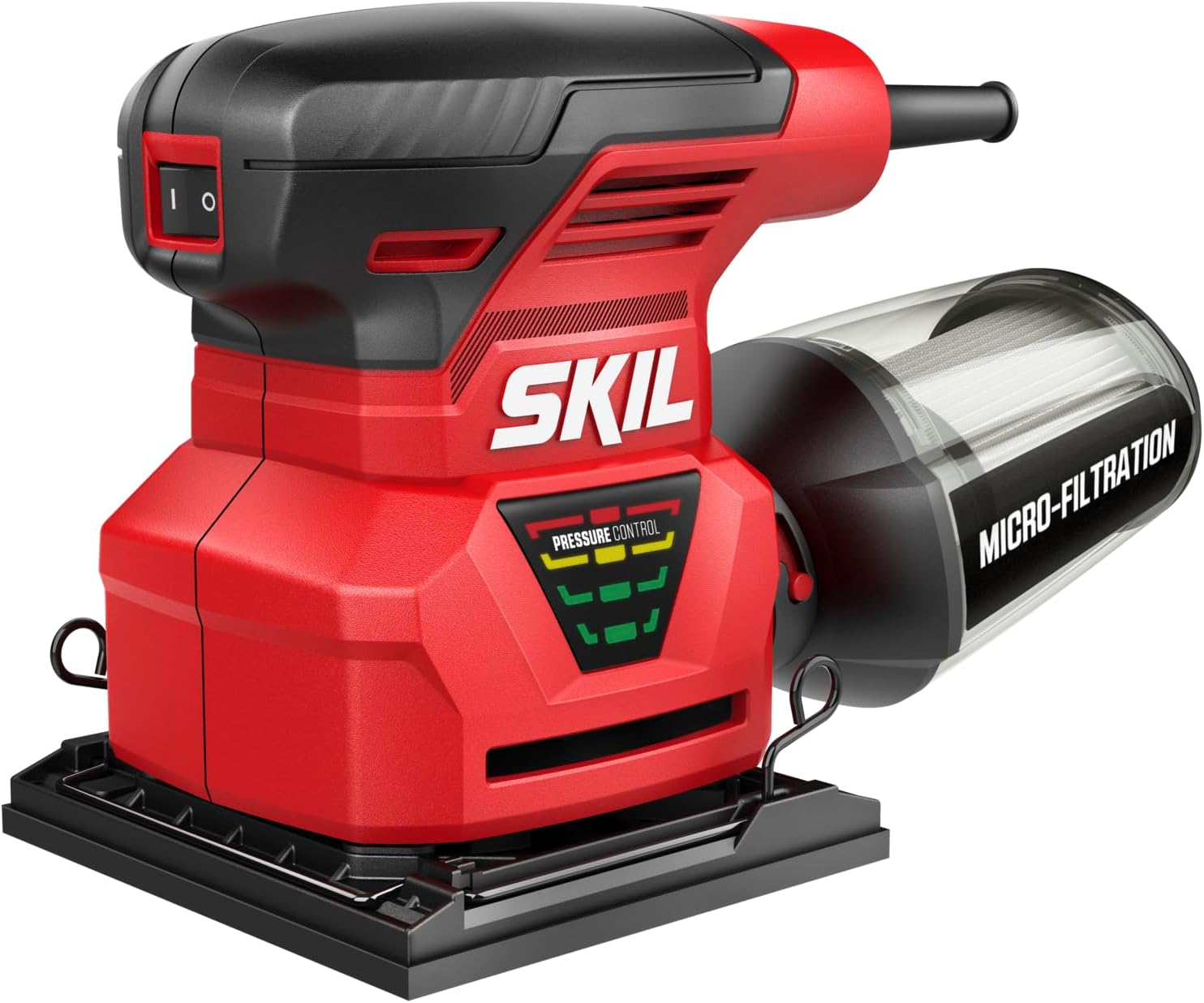
The SKIL 7292-02 is a 2 A, 14,000 OPM quarter-sheet sander at the lowest price tier, with one feature aimed squarely at beginners: pressure control technology that warns you when you press too hard, the most common cause of swirl marks. It also has micro-filtration and a clear dust canister so you can see when to empty it.
❌ Budget build, fewer refinements than DEWALT or Makita
Best For: A first sheet sander for occasional finish work and DIY projects.
The Best Random Orbital Sanders to Buy
All three are 5″ corded models with variable speed, the most useful size for a home shop.
Bosch ROS20VSC 5″ Random Orbital Sander
Best Random Orbital Sander for Most People
The Bosch ROS20VSC has a 2.5 A motor with a speed dial from 7,500 to 12,000 OPM, a pad dampening system that Bosch designs to minimize swirl marks, and a hook-and-loop pad with more than 35,000 hooks to keep discs firmly attached. The micro-filter dust canister twists off and shows how full it is.
Best For: A first random orbital for general woodworking and furniture.
DEWALT DWE6423K 5″ Random Orbital Sander
Best Low-Profile Random Orbital
The DEWALT DWE6423K runs a 3 A motor at 8,000 to 12,000 OPM in a shorter body that puts your hand closer to the work, which helps control. A separate counterweight reduces vibration, the switch is dust-sealed, and the dust port fits DEWALT’s DWV010 and DWV012 extractors directly. Like the sheet sander above, it has a 3-year limited warranty.
Best For: Anyone who already uses DEWALT tools or wants the most control in a compact random orbital.
Makita BO5041 5″ Random Orbital Sander
Widest Speed Range
The Makita BO5041 has a 3 A motor with the widest speed range here, 4,000 to 12,000 OPM. That low end is useful on veneer and when sanding between coats. Its adjustable front handle gives you a second grip for control and can be moved for sanding into corners and confined areas, and the large two-finger trigger has a lock-on button for long sessions.
Best For: Larger panels and tabletops, and work that needs a slow speed setting.
🏆 The Verdict
If you can only buy one sander, buy a 5″ random orbital: it does more of the work, faster, and hides scratches better. The Bosch ROS20VSC is the one I’d start with. If most of your projects are furniture, cabinets or anything boxy, the square pad of a 1/4-sheet sander like the DEWALT DWE6411K reaches the corners a round pad can’t. And once you sand regularly, you’ll want both. For corners tighter than a square pad, add one of the best detail sanders.
❓ Frequently Asked Questions
What is a sheet sander best used for?+
A sheet sander is best used for finish sanding and for reaching into inside corners. Its square pad and small fixed orbit make it ideal for the final 180 to 220 grit passes on furniture and cabinets, and for scuffing between coats of paint or varnish. It is not a good tool for removing a lot of material.
What are the 5 most common mistakes people make with a random orbital sander?+
The five most common are pressing down too hard, starting or stopping the sander off the surface, tilting the pad onto its edge, moving it too quickly, and skipping grits. Each one either stops the pad rotating freely or leaves coarse scratches behind, and the result is visible swirl marks under the finish.
Is a random orbital sander better than a 1/4 sheet sander?+
For general sanding a random orbital is better: it removes wood faster and leaves a less visible scratch pattern. A 1/4 sheet sander is better for inside corners, light finish work and cheap sandpaper. If you sand furniture often, the best answer is to own one of each and use them for different stages.
Which is better for sanding, a DEWALT sheet sander or an orbital sander?+
It depends on the job, not the brand. A DEWALT 1/4-sheet sander like the DWE6411K is better for corners, cabinets and final passes. A random orbital such as the DEWALT DWE6423K is better for leveling boards, tabletops and removing old finish. DEWALT makes both, with the same 3-year limited warranty.
Should I use an orbital or a sheet sander on walls?+
For small drywall patches, a sheet sander is usually easier because its flat square pad stays level on a vertical surface and doesn’t dig in. Use 120 to 150 grit and a vacuum attachment. For sanding whole walls or ceilings, a dedicated drywall sander with dust extraction is faster than either.
Still unsure which one fits your project? Tell me what you’re sanding in the comments and I’ll point you to the right tool.