
As an Amazon Associate I earn from qualifying purchases. All claims are strictly my personal opinion.
Best pocket hole jig

Clamps the board and sets the material thickness in one pull, with built-in dust collection and a docking station.

A pocket hole jig guides a stepped drill bit into a board at a shallow angle, so you can join it to another board with a screw hidden on the back. It’s the fastest way to build face frames, cabinets, shelves and tables without clamping glue joints for hours. The best pocket hole jig for most woodworkers is the Kreg 720PRO, because it clamps the board and sets the material thickness in one pull. The Kreg 520PRO is the best portable jig, the Kreg 320 is the best budget pick and the Kreg XL is the one to add for 2×4 and 4×4 builds.
Below are seven jigs from four makers, a comparison table, reviews from the makers’ specifications, a buying guide, and step-by-step instructions for drilling and joining your first pocket holes.
Best Pocket Hole Jigs: Comparison
Specs come from the makers’ product pages; Massca publishes its details only on its Amazon listing, so its column comes from there. I don’t print prices: each review gives a market tier, and the Amazon buttons show the live price.
| Product | ⭐ Kreg 720PRO 🏆 EDITOR’S CHOICE |
Kreg 520PRO | Kreg 320 | Kreg R3 | Massca M2 Pro | Milescraft PocketJig400 | Kreg Pocket-Hole Jig XL |
|---|---|---|---|---|---|---|---|
| Image | |
 |
 |
 |
 |
 |
 |
| Material thickness | 1/2″ to 1-1/2″ (automatic) | 1/2″, 3/4″, 1-1/2″ presets | 1/2″, 3/4″, 1-1/2″ presets | 1/2″ to 1-1/2″ (1/8″ steps) | 1/2″ to 1-1/2″ (knob) | 1/2″ to 1-1/2″ | 1-1/2″ to 3-1/2″ |
| Clamping | Built-in Automaxx | Built-in VersaGrip pump clamp | 2″ face clamp (in this kit) | Any clamp (pad adapter) | T-track for clamps | Built-in toggle clamp | Any clamp (pad adapter) |
| Dust port | Yes | No | No | No | Yes | No | No |
| Screws included | 160 | 60 | 40 samples | Sample pack | Yes | 60 + 10 plugs | No (XL screws sold separately) |
| Warranty | Lifetime (drill guides) | Lifetime (drill guides) | Lifetime (drill guides) | Lifetime (drill guides) | See listing | See listing | Lifetime (drill guides) |
| Availability | Shop Now at Amazon | Shop Now at Amazon | Shop Now at Amazon | Shop Now at Amazon | Shop Now at Amazon | Shop Now at Amazon | Shop Now at Amazon |
Best Pocket Hole Jigs: Reviews
Every pick could be ordered on Amazon when I checked it. Kreg still sells the older K4 benchtop jig, and the K5 is discontinued; the 720PRO does their job with automatic clamping and thickness setting, so I left both out.
Editor's ChoiceBenchtop pocket hole jig
Kreg 720PRO
Kreg Pocket-Hole Jig 720PRO
Clamps and sets material thickness in one pull, with dust collection and a docking station. The best benchtop jig.
Shop Now at AmazonSpecs: Kreg
Best for
Drilling lots of pocket holes on a bench with no setup mistakes.
- Clamps and sets thickness in one pull
- Dust port and onboard storage
- Docking station and screws included
Skip it if
You mostly drill a few holes on site: the 520PRO or 320 is easier to carry.
- Bulky for jobsite repairs
- Costs the most of the Kreg jigs
Read full review
Best Pocket Hole Jig Overall
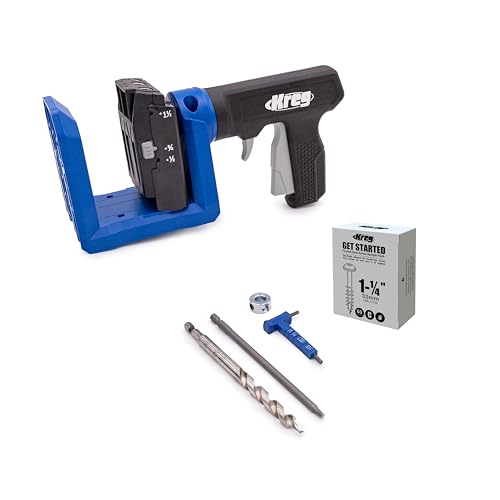
The 720PRO is Kreg’s top benchtop jig, and the one to buy if you’ll drill more than a handful of pocket holes a year. Its headline feature is Automaxx dual-action clamping: you slide the board in and pull the handle, and the jig clamps the piece and sets itself to the material thickness at the same time, anywhere from 1/2″ to 1-1/2″. There’s no thickness knob to forget, which is the most common reason beginners get blown-out or shallow holes. Kreg lists built-in dust collection with a chip ejection port and a vacuum adapter, a dual-position base that flips from horizontal to vertical, onboard storage for bits and screws, and a GripMaxx anti-slip surface. The PRO version ships with a docking station with material support wings, a jig clamp to hold the jig to your bench and 160 pocket-hole screws. The drill guides are hardened steel with a lifetime drill-guide warranty. It’s the largest jig here at about 9.5 lb and 13.6″ long, so it lives on a bench rather than in a tool bag. Upper price tier.
Portable pocket hole jig
Kreg 520PRO
Kreg Pocket-Hole Jig 520PRO
A pocket hole jig with its own pump-action clamp, so it drills on site or on large panels without extra clamps.
Shop Now at AmazonSpecs: Kreg
Best for
Drilling pocket holes on site or on large panels without a separate clamp.
- Built-in pump clamp, no extra clamps needed
- Rotating handle for awkward spots
- Steel frame
Skip it if
You drill in batches on a bench: the 720PRO is faster and collects dust.
- Three preset thicknesses only
- No dust collection
Read full review
Best Portable Pocket Hole Jig
The 520PRO is a pocket hole jig with its own clamp built in, so it works on the workpiece wherever the workpiece is: on a bench, across sawhorses or on a cabinet that’s already assembled. Kreg calls the clamp VersaGrip: a pump-action handle squeezes the jig onto the board and a 1:1 reverse trigger releases it. The handle rotates 360 degrees to stay out of the drill’s way, and the body is impact-resistant polymer on a steel frame. It has preset thickness settings for 1/2″, 3/4″ and 1-1/2″ material, which covers plywood, standard boards and 2x lumber. In the box you get the easy-set drill bit and stop collar, a material thickness gauge, a 6″ driver bit and 60 screws. Unlike the 720PRO, thickness is set by hand and there’s no dust port. For micro pocket holes in thin stock, Kreg sells a separate drill guide kit (KPHA530). Mid price tier.
Budget portable jig
Kreg 320
Kreg Pocket-Hole Jig 320 With 2″ Face Clamp
Two twist-apart Kreg drill guides with a face clamp in the box: the cheapest way to start with real Kreg results.
Shop Now at AmazonSpecs: Kreg
Best for
A first pocket hole jig for occasional projects and repairs.
- Twist-apart guides for any spacing
- Small enough for tight spaces
- Face clamp included in this kit
Skip it if
You build a lot of face frames: a benchtop jig like the 720PRO saves time.
- Slower: reposition for every pair of holes
- Three preset thicknesses
Read full review
Best Budget Pocket Hole Jig
The 320 is the jig most people should start with if they’re not sure how often they’ll use pocket holes. It’s two hardened-steel drill guides that twist apart, with removable spacers, so you can drill two holes at a set spacing or split the guides and place holes wherever you need them, including inside a cabinet or along a long rail. Thickness stops cover 1/2″, 3/4″ and 1-1/2″, and Kreg includes a material thickness gauge, the easy-set drill bit and stop collar and 40 sample screws. The 320 has no clamp of its own; this listing pairs it with Kreg’s classic 2″ face clamp, which is what you’d otherwise buy first. The trade-off against the 720PRO is speed: you move the jig and clamp for every pair of holes. The drill guides carry Kreg’s lifetime drill-guide warranty. Budget price tier.
Compact pocket hole jig
Kreg R3
Kreg Jig R3 Pocket-Hole System
A tiny Kreg jig with nine thickness settings. Add any clamp and it does what jigs three times the price do, only slower.
Shop Now at AmazonSpecs: Kreg
Best for
The lowest price into Kreg pocket holes, with fine thickness adjustment.
- Nine thickness settings in 1/8" steps
- Very compact
- Works with any bar or C-clamp
Skip it if
You don't own a clamp yet: the 320 kit includes one.
- No clamp included
- Fixed 7/8" hole spacing
Read full review
Best Cheap Pocket Hole Jig
The R3 has been Kreg’s small jig for years, and it’s still one of the cheapest ways into pocket holes from the brand that made them popular. It’s a compact body with two hardened-steel drill guides at 7/8″ spacing and independent positioning sliders that set material thickness from 1/2″ to 1-1/2″ in 1/8″ steps, nine settings in all. That finer adjustment is a real advantage over the 320’s three presets if you work with odd thicknesses. A clamp pad adapter lets you hold it with a Kreg face clamp, a bar clamp or a C-clamp; no clamp comes with it. The kit includes the stepped drill bit, stop collar and a screw and plug sample pack. It weighs about 1.3 lb. Budget price tier.
Aluminum benchtop jig
Massca M2 Pro
Massca Pro M2 Aluminum Pocket Hole Jig
An aluminum benchtop jig with a dust spout, T-track and long-board supports in the box. The main non-Kreg alternative.
Shop Now at AmazonSpecs: the maker's Amazon listing; no full maker spec page found
Best for
A sturdy metal benchtop jig with supports for long boards.
- All-aluminum body
- Dust spout and T-track
- Long-board support bars included
Skip it if
You want automatic thickness setting: that's the Kreg 720PRO.
- Specs only on the Amazon listing
- Needs a separate clamp for fast work
Read full review
Best Aluminum Pocket Hole Jig
Massca builds the M2 Pro from aluminum instead of the glass-reinforced nylon Kreg uses, and that’s its appeal: a heavier, stiffer benchtop jig (about 5.2 lb) that sits still while you drill. Massca doesn’t publish a full spec sheet outside its Amazon listing, so these details come from there. An adjustable depth knob matches the jig to board thickness from 1/2″ plywood up to thick stock, a dust spout connector takes a vacuum hose, and a T-track slot accepts clamps. The kit includes a stepped drill bit, stop collar, hex key, screws and support bars for long boards, which Kreg sells separately for its jigs. It uses standard pocket-hole bits and screws, so Kreg screws work in it. Mid price tier.
Self-clamping metal jig
Milescraft PocketJig400
Milescraft 1327 Pocket Jig 400
An all-metal benchtop jig with a built-in toggle clamp and adjustable hole spacing, for much less than a 720.
Shop Now at AmazonSpecs: Milescraft
Best for
A self-clamping benchtop jig on a budget.
- Built-in toggle clamp
- Adjustable hole spacing 3/4" to 3"
- Removable base for mobile use
Skip it if
You want dust collection: the 720PRO and Massca M2 have ports.
- Thickness is set by hand
- Ships with star-drive screws, not square
Read full review
Best Self-Clamping Budget Jig
The PocketJig400 is the budget answer to a clamp-equipped benchtop jig. Milescraft fits a steel toggle clamp with a micro-adjust head, so the jig holds the board itself, and the body is all metal. Two 3/8″ steel drill guides sit in height-adjustable bushing blocks for boards 1/2″ to 1-1/2″ thick, and they slide sideways to space holes 3/4″ to 3″ apart, with laser-etched inch and metric scales. A storage drawer holds the bit and driver, and the L-base comes off the main body for mobile work and repairs. The kit includes the pocket hole bit, a split-ring depth stop, a T20 magnetic driver, 60 screws and 10 plugs. Note the T20 star-drive screws: Kreg screws use a square drive, so keep the right bit with each brand’s screws. Budget to mid price tier.
XL jig for 2x and 4x lumber
Kreg Pocket-Hole Jig XL
Kreg Pocket-Hole Jig XL (KPHJ920)
Extra-large pocket holes for 1-1/2" to 3-1/2" lumber. The second jig to own if you build outdoor furniture.
Shop Now at AmazonSpecs: Kreg
Best for
Pocket holes in 2x4s and 4x4s for outdoor projects.
- Drills 2x and 4x lumber
- XL screws for stronger joints
- Works with most clamps
Skip it if
You build furniture from 3/4" boards and plywood: get a standard jig.
- Not for furniture-thickness stock
- Needs XL screws and a separate clamp
Read full review
Best Pocket Hole Jig for 2x4s and Outdoor Builds
Standard pocket holes top out at 1-1/2″ stock, and on a deck bench, a pergola or a garage shelf built from 2x4s and 4x4s they’re undersized. The XL jig drills extra-large pocket holes with a 1/2″ stepped drill bit for Kreg’s XL screws, in wood 1-1/2″ to 3-1/2″ thick with presets at both. Kreg says the XL screws and holes give joints about twice the strength of standard pocket holes. Like the 320, it’s a twist-apart, dual drill guide design with an anti-slip base and a clamp pad adapter, so it works with Kreg clamps and most others. It doesn’t replace a standard jig: it’s the second jig for outdoor furniture and framing. Budget price tier.
How I Chose These Pocket Hole Jigs
I started from the three ways people actually drill pocket holes: in batches on a bench, on site or on a big panel, and occasionally for a repair. Then I looked at the jigs sold on Amazon today from established makers and picked one for each job, plus a budget version and a jig for thick lumber. Kreg dominates the list because it pioneered pocket-hole joinery and still makes the widest range of jigs, with drill guides covered by a lifetime warranty; Massca and Milescraft are the alternatives with the longest ownership history. I compared thickness range, clamping, dust collection, what’s in the box and warranty from the makers’ specifications. I don’t show customer ratings or prices. For how I pick products across the site, see how I choose.
How to Choose a Pocket Hole Jig
Benchtop, Portable or Both
A benchtop jig (720PRO, Massca M2, Milescraft 400) sits on the bench with the board fed into it. It’s the fastest way to drill a stack of rails and stiles for face frames or cabinet boxes, because each hole takes a few seconds once it’s set up. A portable jig (520PRO, 320, R3) goes to the work instead: you clamp it onto a wide panel, an assembled cabinet or a table apron that won’t fit in a benchtop jig. If you build furniture regularly, you’ll end up wanting one of each. The 720PRO and 320 together cover almost everything.
Clamping Is Where the Time Goes
The drill does the cutting; the clamp decides how fast and how consistent you are. Jigs without a clamp (R3, 320, XL) need a face clamp, bar clamp or C-clamp, and you reposition both for every hole pair. A built-in clamp, whether Kreg’s Automaxx, the 520PRO’s pump action or Milescraft’s toggle, makes each hole a one-handed job. If you buy a jig without one, a woodworking clamp with a large pad, such as Kreg’s 3″ Wood Project Clamp, is the first accessory to get.
Material Thickness Range
Standard pocket holes cover 1/2″ to 1-1/2″ stock: plywood, 3/4″ boards and 2x lumber on its narrow face. That’s every furniture and cabinet job. The thickness setting matters because it controls where the screw tip exits: too shallow and the screw pokes through the face of the mating board, too deep and it barely bites. Automatic setting (720PRO) or a gauge with positive stops (520PRO, 320) is the easy way to get it right. For 2x4s and 4x4s used flat, standard holes are undersized: that’s what the Kreg XL jig and XL screws are for.
Dust Collection
A pocket hole bit throws a surprising amount of chips, and they pack into the drill guide and slow the bit. The 720PRO and Massca M2 have ports for a shop vac hose, which keeps the bit clear and the bench clean. On a portable jig, back the bit out once mid-hole to clear chips.
Screws, Bits and Drive
Pocket hole screws have a flat washer head that seats in the bottom of the pocket without splitting the wood, and a self-tapping tip. Use coarse-thread screws in softwood, plywood and MDF and fine-thread screws in hardwoods like oak and maple. Kreg screws use a square drive; keep the long #2 square bit in the drill. Kreg’s SK04 screw starter kit has 260 screws in six common sizes, enough to learn which ones your projects need.
💡 Pro Tip: Sand Before You Assemble
Pocket screws pull a joint flush, but they can’t fix boards of slightly different thickness. Sand faces and edges to your final grit before you drill, then level the assembled joint with a random orbital sander at 150 to 180 grit. Sanding inside a finished cabinet or around face-frame corners is far harder than sanding flat parts on the bench.
How to Use a Pocket Hole Jig
The steps are the same for every jig here; only the clamping changes. Practice on scrap of the same thickness as your project before you drill the real parts.
- Measure the thickness of your board with the gauge that came with the jig, or a ruler. Use the actual thickness: a “2×4″ is 1-1/2″ thick, and 3/4” plywood is often a little less.
- Set the jig to that thickness. On the 720PRO this happens when you clamp. On the 520PRO, 320 and XL, set the material-thickness stop. On the R3, slide the positioning sliders to the matching mark.
- Set the stop collar on the drill bit with the gauge, so the bit stops at the right depth. Lock it with the hex wrench. This is the step people forget, and it’s the cause of most blown-out holes.
- Clamp the board with the face you won’t see facing the jig, so the pockets end up on the hidden side.
- Drill at full speed, with the bit spinning before it touches the wood, until the stop collar meets the guide. Back out once halfway to clear chips if the jig has no dust port.
- Glue if you want (pocket screws hold on their own, but glue on long-grain joints makes them stronger), then clamp the two boards flush with a face clamp across the joint.
- Drive the screw with a long square bit and the drill’s clutch set low, so the screw seats without stripping the hole. Stop when the head is snug.
Which Screw Length to Use
Kreg’s chart is the standard most makers follow: 1″ screws for 1/2″ material, 1-1/4″ screws for 3/4″ material and 2-1/2″ screws for 1-1/2″ material. For 2x4s and 4x4s drilled with the XL jig, use Kreg’s XL screws. Outdoors, use coated screws rated for exterior use, such as Kreg’s Protec-Kote line.
Common Mistakes
- Screw tip breaks through the face: the thickness setting or stop collar is wrong, or the screw is too long.
- Joint slides out of flush as you drive: the boards weren’t clamped across the joint. A face clamp fixes it.
- Splitting near the end of a board: keep holes at least 3/4″ or so from the end, and use fine-thread screws in hardwood.
- Visible pockets: plan which faces show before you drill. On exposed spots, fill pockets with wooden plugs and sand them flush.
Pocket Holes vs Biscuits and Dowels
Pocket holes are the fastest joint to make and the only one of the three that doesn’t need clamps while the glue dries, because the screw is the clamp. Their weakness is appearance: the pocket shows on one face. Biscuits are invisible and excellent for aligning edge-glued panels and tabletops, but they add little strength on their own; my best biscuit joiner guide covers when they’re the better tool. Dowels are strong and hidden but need careful marking. For face frames, cabinet boxes and table aprons, pocket holes win on speed. If you’re still putting your first shop together, my guide to woodworking tools for beginners puts a pocket hole jig in the first tier for that reason.
🏆 The Verdict
The best pocket hole jig for most woodworkers is the Kreg 720PRO: it clamps and sets thickness in one pull, collects dust and comes with a docking station. The Kreg 520PRO is the portable pick with its own clamp, the Kreg 320 the budget way to start, and the Kreg R3 the cheapest Kreg. The Massca M2 Pro and Milescraft PocketJig400 are the metal alternatives, and the Kreg XL is the jig to add for 2×4 and 4×4 builds.
❓ Frequently Asked Questions
Are pocket hole jigs worth it?+
What is the difference between the Kreg 310 and 320?+
Which pocket hole jig is better, Kreg or VEVOR?+
What size pocket hole screws are needed for two-by-four lumber?+
What are some alternatives to using a Kreg pocket hole jig?+
What is the best pocket hole jig for beginners?+
Conclusion
Choose a pocket hole jig by where you’ll drill. For batches of rails, stiles and cabinet parts on a bench, the Kreg 720PRO is the one to own; for on-site work and big panels, the 520PRO brings its own clamp; and for a first jig, the 320 with a face clamp costs little and does the same joint. Set the thickness, set the collar, clamp across the joint, and sand the parts before you assemble. Questions about your project? Ask in the comments.
