
As an Amazon Associate I earn from qualifying purchases. All claims are strictly my personal opinion.
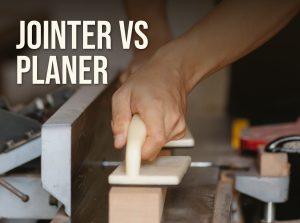
A jointer makes a board flat and straight: it flattens one face and squares one edge to it. A thickness planer makes a board an even thickness: it cuts the top face parallel to the bottom face. You need both to turn rough or warped lumber into square stock, because a planer copies whatever shape the bottom face has, and a jointer can’t make two faces parallel. If you buy only one, most hobby shops start with the planer and flatten the first face with a planer sled until a jointer fits the budget.
Below is how each machine works, a side-by-side comparison, the right order for milling lumber, which one to buy first, ways to get by without a jointer, and the jointers and planers I’d look at, with figures from the makers’ own manuals. For the other planer comparisons on the site, see my best thickness planer picks.
⚡ Quick Answer
Jointer: flattens one face and squares one edge. Example: the WEN JT630H 6″ benchtop jointer.
Planer: makes the opposite face parallel and brings boards to thickness. Example: the DEWALT DW735X.
Buy first: the planer if you buy surfaced or skip-planed lumber; both if you mill rough-sawn boards. The WEN jointer and planer bundle gets both at once.
Jointer vs Planer at a Glance
| Feature | Jointer | Thickness Planer |
|---|---|---|
| What it does | Flattens a face, straightens and squares an edge | Makes faces parallel, sets thickness |
| Cutterhead position | Below the board, between two tables | Above the board, over a flat bed |
| How the board moves | You push it by hand, with push blocks | Feed rollers pull it through |
| Removes cup, bow and twist | Yes, from one face | No: rollers press the warp flat and it springs back |
| Makes two faces parallel | No | Yes |
| Width capacity (benchtop) | 6″ or 8″ | 12″ to 13″ |
| Edges | Squares an edge against the fence | Not designed for edges |
| Minimum length (example manuals) | 8-1/8″ (WEN JT630H and JT833H) | 12″ (DEWALT DW735) |
| Typical price tier | $$$$, lower end for 6″ benchtop models | $$$$ for 13″ benchtop models |
How Each Machine Works
The Jointer
A jointer has a spinning cutterhead set between two flat cast or aluminum tables. The outfeed table is level with the top of the knives; the infeed table is set lower by the depth of cut. You slide the board across the infeed table, over the cutterhead and onto the outfeed table, and each pass shaves off the high spots. After a few passes the face is flat. Then you stand the board on that flat face against the fence, set at 90°, and joint one edge square to it. WEN’s manual for its JT630H and JT833H benchtop jointers puts it simply: the machine is designed for creating flat surfaces. It allows up to 1/8″ per pass and recommends 1/32″, because several light passes give a cleaner, flatter result on a warped board than one heavy one.
The Thickness Planer
A planer turns the jointer upside down. The cutterhead sits above a flat bed, and feed rollers pull the board under it. Everything above the height you set is cut off, so the top face comes out parallel to whatever the bottom face rests on. DEWALT’s DW735 manual spells out why this matters: the planer “will work best with material that has been run through a jointer to produce one flat surface,” and if a board is bowed, the feed rollers flatten it as it passes and the bow returns afterward. In DEWALT’s words, “To properly remove the bow, use a jointer.”
⚠️ A Planer Alone Won’t Fix a Warped Board
Feed a cupped or twisted board straight into a planer and you get a cupped or twisted board of even thickness. Flatten one face first, on a jointer, a planer sled or by hand, and only then plane the second face.
Milling Rough Lumber: The Right Order
- Cut to rough length, a few inches over final, so bowed boards have less to lose.
- Joint one face flat on the jointer, cupped side down.
- Joint one edge square to that face, flat face against the fence.
- Plane the second face parallel to the first, flat face down on the planer bed, taking light passes and flipping end for end between passes.
- Rip the second edge parallel on the table saw, jointed edge against the fence.
- Crosscut to final length, then sand: the planer leaves knife marks and sometimes snipe at the ends, so start a random orbital around 120 grit.
This sequence is known as “four-square” milling, and it’s why many woodworkers say the jointer and planer are a pair rather than an either-or choice.
Which Should You Buy First, a Jointer or a Planer?
It depends on the lumber you buy.
- You buy S4S (surfaced four sides) or S2S boards from a home center: they’re already flat enough. A planer lets you bring them to any thickness you want, and a jointer is not urgent.
- You buy rough-sawn lumber, or use reclaimed boards: you need a flat reference face. Get the planer first and use a planer sled for the first face, or buy both together.
- You mostly glue up panels and boxes from straight stock: a jointer for clean, square glue-line edges may matter more than a planer.
For most hobby shops, the planer is the machine you’ll use on every project, so it usually comes first. My thickness planer reviews compare the benchtop models worth buying.
Can a Planer Do a Jointer’s Job?
Use a Planer Sled for the First Face
A planer sled is a flat carrier board, usually melamine or MDF, longer than your stock. You set the warped board on it, fill the gaps underneath with shims or hot glue so it can’t rock, and send the whole sled through the planer. The top face comes out flat because the sled, not the board, rests on the bed. Then remove the board, flip it flat side down, and plane the other face normally. It’s slower than a jointer but costs almost nothing, and it handles boards wider than any benchtop jointer.
Edges Without a Jointer
A planer can’t straighten an edge, but a table saw can: run the board against a straight-line ripping jig or a straight sled, or rip one edge using a factory edge as the reference. A hand plane or a router with a straightedge also works for glue-line edges.
Do I Need a Jointer if I Have a Table Saw?
Not for edges, as long as you’re happy with saw-cut glue lines. The table saw can’t flatten a face, though, so with rough or cupped lumber you still need a jointer, a planer sled or a hand plane for the first face.
Why Can’t You Use a Jointer on Both Faces?
Because a jointer only makes a face flat, not parallel to anything. Joint both faces of a board and each one will be flat, but the board can end up thicker at one end or edge than the other. Making the second face parallel needs a reference on the opposite side, which is what the planer’s bed provides.
Width: The Jointer’s Limit
A 6″ jointer only flattens boards up to 6″ wide, and an 8″ model up to 8″; benchtop planers take 12″ to 13″. You’ll see advice online to remove the guard and joint a wider board in two passes; OSHA’s rules and the jointer manuals require the guard, so skip that trick. The safe options for wide boards are a planer sled, ripping the board, jointing the halves and gluing them back, or a bigger jointer. If you work with wide stock often, the extra capacity of an 8″ model like the WEN JT833H is worth the bench space.
Jointer and Planer Safety Basics
- Keep the guard on. OSHA’s woodworking machinery standard requires hand-fed jointers to have an automatic guard over the cutterhead on the working side of the fence, plus a guard behind it, and push sticks or push blocks at hand.
- Respect minimum sizes. WEN’s jointer manual says not to joint stock shorter than 8-1/8″, narrower than 3/4″ or thinner than 1/4″, and to use a push block on anything narrower or thinner than 3″. DEWALT says never to plane material shorter than 12″.
- Take light passes. 1/32″ per pass on the jointer, and no more than the planer’s rated depth (1/8″ on the DW735 for boards up to 6″ wide).
- Cut with the grain to avoid tear-out, and check every reclaimed board for nails and grit before it goes near the knives.
- Collect the chips. Both machines throw a lot of shavings, and a 4″ port on a dust collector handles them far better than a shop vacuum.
Jointers and Planers to Consider
WEN JT630H 6″ Spiral Benchtop Jointer
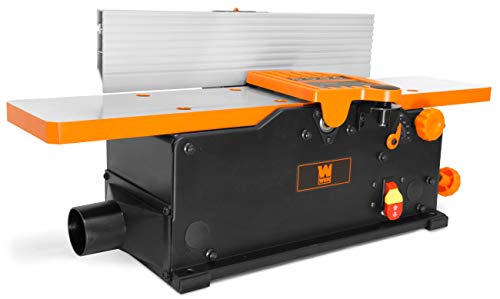
Best Benchtop Jointer for Most Shops
A compact 6″ jointer with a spiral cutterhead of 12 inserts instead of two long knives. WEN’s manual lists a 10 A motor, 12,000 RPM, up to 1/8″ per pass (1/32″ recommended), a 30″ x 6-3/16″ table, a fence that tilts from 90° to 135°, a 2-1/2″ dust port and a weight of 36.8 lb. It’s light enough to store on a shelf and covers most furniture boards. WEN gives it a 2-year warranty.
- ✅ Spiral head with replaceable inserts
- ✅ Fits on a bench
- ✅ Tilting fence
- ❌ 6″ width limit
- ❌ Short tables for long boards
Best For: A first jointer for flattening faces and squaring edges.
WEN JT833H 8″ Spiral Benchtop Jointer with Extendable Table
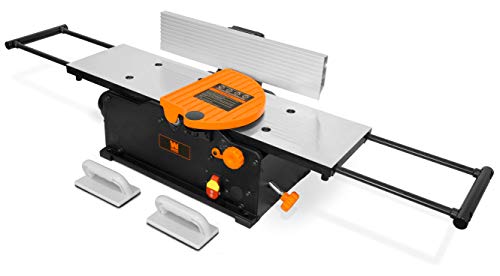
Best for Wider and Longer Boards
The 8″ version answers the two complaints about small jointers. Capacity goes up to 8″ wide, and the 33″ table extends to 51″ for long boards. It has a 16-insert spiral cutterhead, the same 10 A motor and 12,000 RPM, up to 1/8″ per pass (WEN says to reduce depth by 1/32″ per inch of width over 6″), and both 2-1/2″ and 4″ dust ports. It weighs 55.1 lb and carries WEN’s 2-year warranty.
- ✅ 8″ capacity
- ✅ Tables extend to 51″
- ✅ 4″ dust port option
- ❌ Heavier and longer to store
- ❌ Shallower cuts on wide boards
Best For: Tabletops, wide panels and long boards.
Cutech 40160HB 6″ Spiral Cutterhead Benchtop Jointer

Best 6″ Jointer with Carbide Inserts
Cutech’s 6″ benchtop jointer uses 12 two-sided tungsten carbide inserts on a spiral head at 11,000 RPM, driven by a 10 A motor. Cutech lists Teflon-coated aluminum tables of 30″ x 6-1/4″, a fence with stops at 90° and 135°, up to 1/8″ per pass, a 2-1/2″ port and a weight of 37.3 lb. Carbide inserts generally stay sharp longer than steel, and each one has two edges. Cutech backs it with a 3-year limited warranty.
- ✅ Carbide inserts
- ✅ 3-year warranty
- ✅ Coated tables for smooth feeding
- ❌ 6″ width limit
- ❌ Costs more than the WEN 6″
Best For: Hardwoods and anyone who hates changing knives.
DEWALT DW735X 13″ Two-Speed Thickness Planer

Best Thickness Planer Overall
The benchtop planer most others are compared to. The 15 A motor drives a three-knife cutterhead at 10,000 RPM, and two feed speeds give 96 or 179 cuts per inch. DEWALT’s manual lists boards from 1/8″ to 6″ thick and up to 13″ wide, and up to 1/8″ per pass on boards up to 6″ wide. The X package adds infeed and outfeed tables and a spare set of knives, and DEWALT backs it with a 3-year limited warranty.
- ✅ Two feed speeds
- ✅ 13″ x 6″ capacity
- ✅ Tables and spare knives included
- ❌ Straight knives can tear out figured wood
- ❌ Premium price tier
Best For: Milling rough lumber to thickness in a home shop.
WEN PL1326 13″ Spiral Benchtop Thickness Planer
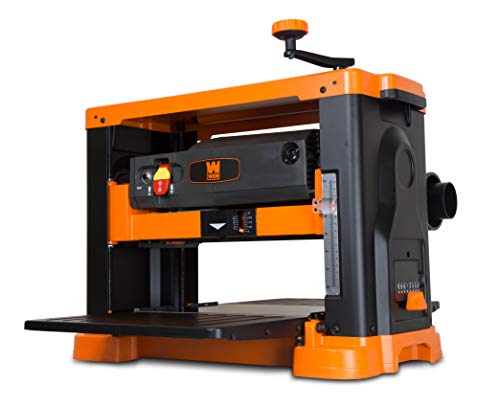
Best Value Spiral Planer
A spiral cutterhead with 26 staggered, rotatable inserts instead of long knives, on a 15 A motor. It planes boards up to 13″ wide and 6″ thick at a single 26 ft/min feed, and an onboard gauge shows how much each pass removes. When an insert dulls or chips, you rotate it to a fresh edge rather than replacing a whole knife.
- ✅ Spiral head reduces tear-out
- ✅ Rotatable inserts
- ✅ 13″ x 6″ capacity
- ❌ Single feed speed
Best For: A planer that handles some figured wood without a second machine.
WEN PL1337 Planer and JT630H Jointer Bundle

Best Way to Buy Both at Once
If you mill rough lumber, this bundle pairs the JT630H 6″ spiral jointer above with WEN’s PL1337, a 13″ planer with the same 26-insert spiral cutterhead as the PL1326 plus two feed speeds (26 and 16 ft/min), capacity of 13″ wide and 6″ thick, a combination 2-1/2″ and 4″ dust port and a 2-year warranty. Both machines use spiral heads with small inserts instead of long knives, which suits four-square milling of mixed or figured lumber.
- ✅ Both machines in one order
- ✅ Spiral heads on both
- ✅ Two-speed planer
- ❌ Jointer limited to 6″ width
- ❌ Two machines to find space for
Best For: Setting up a milling station for rough-sawn lumber.
🏆 The Verdict
The jointer makes one face flat and one edge square; the planer makes the other face parallel and the board an exact thickness. Together they turn rough lumber into square stock. If you buy one, start with the planer and a planer sled, unless most of your work is gluing up edges, and add a 6″ or 8″ benchtop jointer when you start buying rough lumber regularly.
❓ Frequently Asked Questions
Which should I buy first, a jointer or a planer?+
Can I use my planer as a jointer?+
Can I use my jointer as a planer?+
Can you run a 2×4 through a planer?+
What is the best jointer for a beginner?+
Planning your first milling setup? Tell me what lumber you buy and what you build in the comments, and I’ll help you decide which machine comes first.

