
As an Amazon Associate I earn from qualifying purchases. All claims are strictly my personal opinion.
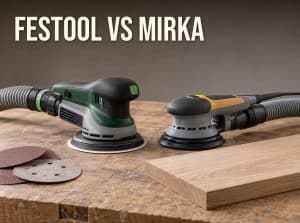
Festool vs Mirka comes down to what you sand and what you already own. Mirka’s DEROS II is the lighter, quieter-on-paper random orbital, with published noise and vibration figures, Bluetooth on every current model and a 2+1-year warranty. Festool sells the wider system: a gear-driven Rotex for coarse removal, finishing and delta sanders, cordless versions, the Planex drywall sander and CT extractors that click into Systainers, all under a 3-year warranty that covers wear. Pick Mirka if you want the best everyday 5″ or 6″ sander and don’t need anything else from the brand. Pick Festool if you want one family of tools, sanders and extractor included, that covers every sanding job in the shop.
Both brands sit in the premium price tier, and both are available on Amazon in the US. Below is the model-by-model match-up, the dust extraction systems behind each brand, warranties, and who should buy which. If you only want the DEROS in depth, read my Mirka DEROS review; if you’ve already decided on Festool, my guide to which Festool sander to buy goes through the whole lineup.
⚡ Quick Answer
Best everyday premium random orbital: the Mirka DEROS II 650X, 2.4 lb, 5 mm orbit, Bluetooth.
Best Festool for the same job: the Festool ETS EC 150/5, brushless, 5 mm stroke, pad brake.
Heavy stock removal and finishing in one tool: the Festool ROTEX RO 150 FEQ. Mirka has no gear-driven equivalent.
Dust extractor: Festool’s CT MIDI I for a mixed tool shop, Mirka’s DEXOS 1230X for all-day sanding.
Festool vs Mirka at a Glance
| Feature | Festool | Mirka |
|---|---|---|
| Company | German power tool maker, founded 1925 | Finnish abrasives and tool maker, part of the family-owned KWH Group |
| Flagship random orbital | ETS EC 150/3 and 150/5 (brushless) | DEROS II 550X and 650X (brushless) |
| Gear-driven (rotary) mode | Yes: ROTEX RO 150, RO 125, RO 90 DX | No |
| Sheet and delta sanders | RTS 400, DTS 400 (2 mm orbit) | DEOS II 343X, 353X, Delta 663X (3 mm orbit) |
| Cordless random orbital | ETSC 2 125 and 150 (18V) | DEROS II is corded (100-120 V) |
| Drywall sander | PLANEX LHS 2 225, PLANEX easy | LEROS 950XCV |
| Bluetooth | Extractor auto-start (CT MIDI I), light ring app control (ETSC 2) | On the sanders: myMirka app, vibration monitoring |
| Published noise and vibration | Not listed on Festool USA’s product pages | Listed for every model (DEROS II 650X: 71 dB, 3.4 m/s²) |
| Dust extractors | CT 15, CT MIDI I, CT 26/36/48 | DEXOS 1230X and others |
| Warranty (US) | 3 years, wear and tear included, authorized dealers only | 2 years, plus 1 free year if registered within 30 days |
| Price tier | $$$$, from the brushed ETS 125 up | $$$$, DEROS II and DEOS II close together |
Are Mirka and Festool the Same Company?
No. Mirka is Finnish: its own history page says it became part of the KWH Group, a family-owned company from Ostrobothnia, in 1984, set up its US arm, Mirka Abrasives Inc., in 1985, and introduced Abranet, its net abrasive for dust-free sanding, in 2001. Festool is a German company that dates its history to 1925. They compete head to head in premium sanders and dust extractors, and each sells abrasives built around its own pads, but there is no ownership link between them.
That history explains the difference in philosophy. Mirka started as an abrasives company and built sanders to get the most out of its abrasives, so its range is narrow and focused on random orbital and sheet sanding. Festool is a power tool company first, and its sanders are one part of a system that also includes saws, routers, extractors and Systainer storage.
Model by Model: Which Festool Matches Which Mirka
Comparing “Festool” to “Mirka” only makes sense tool against tool. Here is how the two lineups line up, using only the figures each maker publishes on its US site.
Everyday 6″ Random Orbital: ETS EC 150 vs DEROS II 650X
This is the fight most people mean. Both are brushless 6″ random orbitals for flat work, both run on a central vacuum hole pattern, and both come in a 5 mm orbit for faster stock removal. Festool also sells a 3 mm version, the ETS EC 150/3, for finer finishing; Mirka’s current DEROS II 650X is 5 mm only.
- Speed: Festool lists 6,000-10,000 rpm for the ETS EC 150; Mirka lists 4,000-10,000 rpm for the DEROS II, so the Mirka goes slower at the bottom of the dial, which helps with polishing and delicate veneers.
- Power: 400 W input for the Festool, 350 W for the Mirka. Neither figure tells you much about removal rate on its own: brushless motors at these sizes are rated by what they draw, not by what they deliver at the pad.
- Weight: Mirka lists 2.4 lb for the 650X. Festool’s ETS EC 150/5 page gives 2.5 lb in the description and 3.53 lb in the spec table, so I wouldn’t call a winner on weight from the paper alone; both are far lighter than a typical 6″ sander with a handle.
- Height: Festool states the ETS EC 150 is 4-1/2″ tall. Both are low enough to palm with one hand and keep your hand close to the work.
- Features: the Festool has a carbide-tipped pad brake, a vibration control system and constant speed under load. The Mirka has an LED speed lever, a separate on/off switch and Bluetooth, which lets the myMirka app track vibration exposure.
Compact 5″: ETS EC 125/3 or ETS 125 vs DEROS II 550X
The DEROS II 550X is the 5″ twin of the 650X: same 5 mm orbit, same 4,000-10,000 rpm, 350 W, and Mirka lists it at 2.2 lb, 71.0 dB and 3.2 m/s². Festool answers with two 5″ machines. The ETS EC 125/3 is the brushless one (3 mm stroke, 6,000-10,000 rpm, 3.31 lb in Festool’s table). The ETS 125 REQ is the entry ticket to Festool: a brushed 250 W motor, a fine 2 mm stroke and 6,000-12,000 rpm, made for finish sanding rather than removal. If you want a 5″ sander that both removes and finishes, the Mirka’s 5 mm orbit is the more versatile of the three.
Heavy Removal: ROTEX vs the Rest of the Mirka Range
This is where Festool has no rival from Mirka. A ROTEX switches between gear-driven rotary mode, which grinds through old finish, glue and paint like a small rotary sander, and normal random orbital mode for finishing, plus a polishing setting. The RO 150 FEQ runs 320-660 rpm in ROTEX mode and 3,300-6,800 rpm in random orbit mode on a 720 W motor, with a 5 mm stroke and a tool-free FastFix pad change. The price is weight: Festool lists 5.95 lb. Mirka’s answer for removal is simply its 5 mm orbit and a coarse Abranet disc, which works on flat stock but is not the same thing as forced rotation.
Sheet and Delta Sanders: RTS 400 and DTS 400 vs DEOS II
For flat panels into square corners, Festool sells the RTS 400 (80 x 133 mm pad) and the DTS 400 delta (100 x 150 mm), both orbital, 2 mm stroke, 250 W and 6,000-12,000 rpm. Mirka’s DEOS II family is the same idea in three shapes: the 343X (3″ x 4″), the 353X (3″ x 5″) and the Delta 663X (4″ x 6″), all 250 W, 3 mm orbit, 5,000-10,000 rpm and under 4″ tall. The DEOS II models publish 68 to 70 dB and 2.6 to 3.3 m/s² of vibration, and they have Bluetooth like the DEROS II. The Festools are the finer-cutting pair with their 2 mm stroke; the Mirkas cut a little faster and come in more pad shapes.
Cordless: Only Festool Has a Battery Option Here
Festool’s ETSC 2 125 and ETSC 2 150 are brushless 18V random orbitals with a 3.5 mm stroke, 6,000-10,000 rpm, an LED light ring and a pad brake, and Festool lists them at 2.65 lb as bare tools. The DEROS II is a corded 100-120 V tool, so if you sand on job sites without power, Festool is the brand in this comparison that covers it.
Drywall: PLANEX vs LEROS
For walls and ceilings, Festool’s PLANEX LHS 2 225 is a long-reach sander with an LED light ring around the head, adjustable suction, a brushless motor and a length of 47-1/4″ to 65″, at 11.02 lb. The newer PLANEX easy is a one-piece, 1.6 m version at 8.82 lb with a direct-drive motor over the pad. Mirka’s LEROS 950XCV takes a different route: a short, light 9″ sander (7.72 lb, 73.0 dB) with a head that flexes through 180°, used on a pole extension when you need reach. I compare these against the cheaper drywall sanders in my best drywall sanders guide.
Dust Extraction: The Systems Behind the Sanders
Both brands sell their sanders as “dust-free” systems, and both deliver on that only when the sander is connected to an extractor with auto-start. Bought alone, either sander is just an expensive sander.
Festool CT Extractors
Every Festool sander here has the same 27 mm dust port, and the CT extractors are built around them. The CT MIDI I is the one I’d look at for a sanding setup: 130 CFM of airflow, 96″ of water lift, a HEPA filter, a 15-liter container, a built-in power outlet that starts the extractor when a corded tool starts, and Bluetooth auto-start for cordless tools through a battery pack or remote. The cheaper CT 15 has the same airflow and HEPA filter, but Festool positions it as its cleaning extractor. The other advantage is storage: the CT MIDI I has a T-LOC coupling, so a Systainer case with the sander and abrasives locks onto the top.
Mirka DEXOS and Abranet
Mirka’s extractors are built for long sanding shifts. The DEXOS 1230X M AFC is an M-class, 30-liter wet and dry extractor with a 1,100 W brushless motor, 2,520 liters per minute of airflow, 250 mbar of vacuum, automatic filter cleaning, a HEPA filter, a low-airflow warning, two tool outlets with optional auto-start and Bluetooth. Pair any Mirka sander with Abranet, Mirka’s net abrasive, and the dust is pulled through the whole surface of the disc instead of a set of holes. That matters most on paint, primer and drywall compound, where fine dust clogs an ordinary disc quickly.
Can You Mix Brands?
Yes, with limits. Any corded sander can plug into the power outlet of either brand’s auto-start extractor, and hoses can be adapted between the two. What you lose by mixing is the convenience the systems are designed around: matching hose ends, Bluetooth pairing within the same brand, and in Festool’s case, the Systainer stacking. A DEROS running on a Festool extractor is a setup you’ll see discussed often on woodworking forums, and the reverse works too.
Price and Warranty
Both brands are firmly in the premium price tier, and on Amazon the current DEROS II and the brushless Festool ETS EC sit close to each other. Festool’s brushed ETS 125 REQ is the cheapest way into either brand. The ROTEX RO 150 and the PLANEX are at the top of their ranges. The buttons below show today’s price on Amazon.
Festool warranty: Festool USA’s terms cover new power tools “purchased from authorized dealers in the United States” for 3 years from the date of purchase, with proof of purchase, and its Warranty all-inclusive program includes wear and tear and lets you return a tool to the dealer within 30 days. Register the tool in your MyFestool account. Buying from an authorized dealer matters. When I checked, the Festool listings linked here were sold by Hartville Hardware, which appears on Festool’s own list of authorized online dealers, but sellers change, so check the seller on the listing before you buy.
Mirka warranty: Mirka gives every power tool a standard 2-year warranty and adds a third year free if you register the tool within 30 days of purchase. Keep the receipt and the extended warranty certificate.
On paper Festool’s warranty is the stronger one, because it is a year longer by default and explicitly covers wear parts.
Who Should Buy Which
- Buy Mirka if you mainly need one excellent random orbital, you sand for long stretches and care about weight, noise and vibration, you paint or finish drywall and want Abranet’s dust pickup, or you want the lowest-profile sheet sanders (DEOS II).
- Buy Festool if you want one system for every sanding job, from coarse removal (ROTEX) to corners (DTS 400) to walls (PLANEX), you want a cordless option, you already own Festool tools or Systainers, or you value the 3-year wear-and-tear warranty.
- Buy neither if you sand a few weekends a year. A good corded random orbital in the $$ tier does most of the same work; compare options in my best random orbital sanders roundup.
Festool and Mirka Sanders to Consider
Mirka DEROS II 650X 6″ Random Orbital Sander

Best Premium Random Orbital
The current 6″ DEROS: a brushless 350 W random orbital with a 5 mm orbit and 4,000-10,000 rpm. Mirka lists it at 2.4 lb, 71.0 dB and 3.4 m/s² of vibration. The speed lever has LED indicators, the on/off switch is separate, and Bluetooth connects it to the myMirka app for vibration monitoring. It is central vacuum ready and sold as a tool only, so budget for an extractor and discs. Warranty is 2 years, plus 1 free year when you register it within 30 days.
- ✅ Light for a 6″ sander
- ✅ Noise and vibration published
- ✅ Low 4,000 rpm bottom speed
- ❌ 5 mm orbit only, no 3 mm version
- ❌ Corded only
Best For: Long sanding sessions on flat work, painting and finishing.
Festool ETS EC 150/5 EQ-Plus 6″ Random Orbital Sander

Best Festool Random Orbital
Festool’s direct answer to the DEROS: an EC-TEC brushless 6″ random orbital with a 5 mm stroke, 6,000-10,000 rpm and 400 W input. Festool states it is 4-1/2″ tall and lists a carbide-tipped pad brake, a vibration control system and constant speed under load. It ships with the MULTI-JETSTREAM 2 pad and a Systainer, and the 27 mm port fits every CT extractor hose. Want a finer scratch pattern? The ETS EC 150/3 is the same sander with a 3 mm stroke. 3-year Festool warranty from an authorized dealer.
- ✅ Brushless, with pad brake
- ✅ 3 mm and 5 mm versions
- ✅ Systainer and CT system
- ❌ No published noise or vibration figures
- ❌ Premium price tier
Best For: Shops already on Festool extractors and Systainers.
Festool ROTEX RO 150 FEQ-Plus 6″ Multi-Mode Sander

Best for Removal and Finishing in One Tool
The tool Mirka doesn’t make. The RO 150 has three modes: gear-driven rotary at 320-660 rpm for coarse removal, random orbit at 3,300-6,800 rpm for finishing, and a polishing mode. A 720 W motor drives a 5 mm stroke, the FastFix system changes pads without tools, and a protector ring guards the edge of the pad against walls and edges. Festool lists it at 5.95 lb, so it is a two-handed tool rather than a palm sander.
- ✅ Strips old finish in rotary mode
- ✅ Also finishes and polishes
- ✅ Tool-free pad change
- ❌ Heavy for overhead or vertical work
- ❌ Top of the price range
Best For: Refinishing furniture, doors and decks where old finish has to go first.
Mirka DEOS II 353X 3″ x 5″ Orbital Sheet Sander

Best Low-Profile Sheet Sander
A rectangular pad gets into square inside corners where a round disc can’t. The DEOS II 353X is a brushless 250 W orbital sander with a 3″ x 5″ pad, a 3 mm orbit and 5,000-10,000 rpm, under 4″ tall, with an LED speed lever and Bluetooth. Mirka publishes 69.0 dB and 2.6 m/s². Its Festool counterpart is the RTS 400, which has a slightly bigger 80 x 133 mm pad and a finer 2 mm stroke. For corners and edges, Mirka’s DEOS Delta II 663X is the triangular version.
- ✅ Square corners and edges
- ✅ Low vibration figure
- ✅ Brushless and Bluetooth
- ❌ Small pad for large panels
- ❌ Premium price for a sheet sander
Best For: Cabinet doors, face frames and inside corners.
Festool CT MIDI I HEPA Dust Extractor

Best Extractor for a Mixed Tool Shop
The compact Festool extractor with everything a sanding setup needs: 130 CFM, 96″ of water lift, a HEPA filter, a 15-liter container, a power outlet with auto-start for corded tools, and Bluetooth auto-start for cordless tools through a battery or remote. A T-LOC coupling locks a Systainer onto the top, and the cable is 24.6 ft long. If you only need a HEPA extractor and can do without the outlet and Bluetooth, the CT 15 has the same airflow for less.
- ✅ Auto-start outlet and Bluetooth
- ✅ HEPA filter
- ✅ Systainer stacks on top
- ❌ 15-liter container fills fast on big jobs
- ❌ Premium price tier
Best For: One extractor shared by sanders, saws and routers.
Mirka DEXOS 1230X M-Class HEPA Dust Extractor

Best Extractor for All-Day Sanding
Mirka’s big extractor is an M-class, 30-liter (8 gal) wet and dry unit with a 1,100 W brushless motor, 2,520 l/min of airflow and 250 mbar of vacuum. Automatic filter cleaning keeps suction up during long sanding runs, a HEPA filter handles the fine dust, a warning tells you when airflow drops, and two tool outlets offer optional auto-start. It also has Bluetooth. Mirka lists 77.0 dB.
- ✅ Automatic filter cleaning
- ✅ Large 30-liter capacity
- ✅ Two tool outlets
- ❌ Bigger and heavier to move than a CT MIDI
- ❌ Top of the price range
Best For: Painters and finishers sanding for hours with Abranet.
The 5″ DEROS II 550X and the original DEROS 650CV are covered in detail in my Mirka DEROS review.
🏆 The Verdict
For one premium random orbital, the Mirka DEROS II is the one I’d pick: lighter on paper, with published noise and vibration figures, a slower bottom speed and Bluetooth. For a complete sanding system, Festool wins: the ROTEX for removal, the ETS EC for finishing, the RTS and DTS for corners, cordless options and an extractor that stacks your cases, all on a 3-year warranty that covers wear. Either way, budget for the extractor, because that is what makes these sanders worth the money.
❓ Frequently Asked Questions
Is Festool better than Mirka?+
Are Mirka and Festool the same company?+
Which brand of dust extractor is better, Mirka or Festool?+
Is Mirka a good brand?+
Are Festool tools considered the best?+
Still torn between the two? Tell me what you sand most and what you already own in the comments, and I’ll give you my take.

