


As an Amazon Associate I earn from qualifying purchases. All claims are strictly my personal opinion.
Editor’s Choice
Short on time? Of the 8 dust separator I tested for shop vacs and dust collectors, this is the one I'd buy.
- Also recommended Dust Deputy Low-Pro Plus
- Budget pick Dust Deputy DIY

A shop vac’s filter clogs long before the tank is full, and once it does, suction drops and your sander starts throwing dust into the air again. A dust separator fixes that by catching dust and chips in a bucket before they reach the vac. For most woodworkers, the best dust separator is a cyclone on a 5-gallon bucket, such as the Oneida Dust Deputy, sitting between the hose and the shop vac.
Below are my picks for shop vacs and for stationary dust collectors, a comparison table, short reviews, and a guide to choosing between cyclone, lid-style and low-profile designs.
⚡ Quick Pick
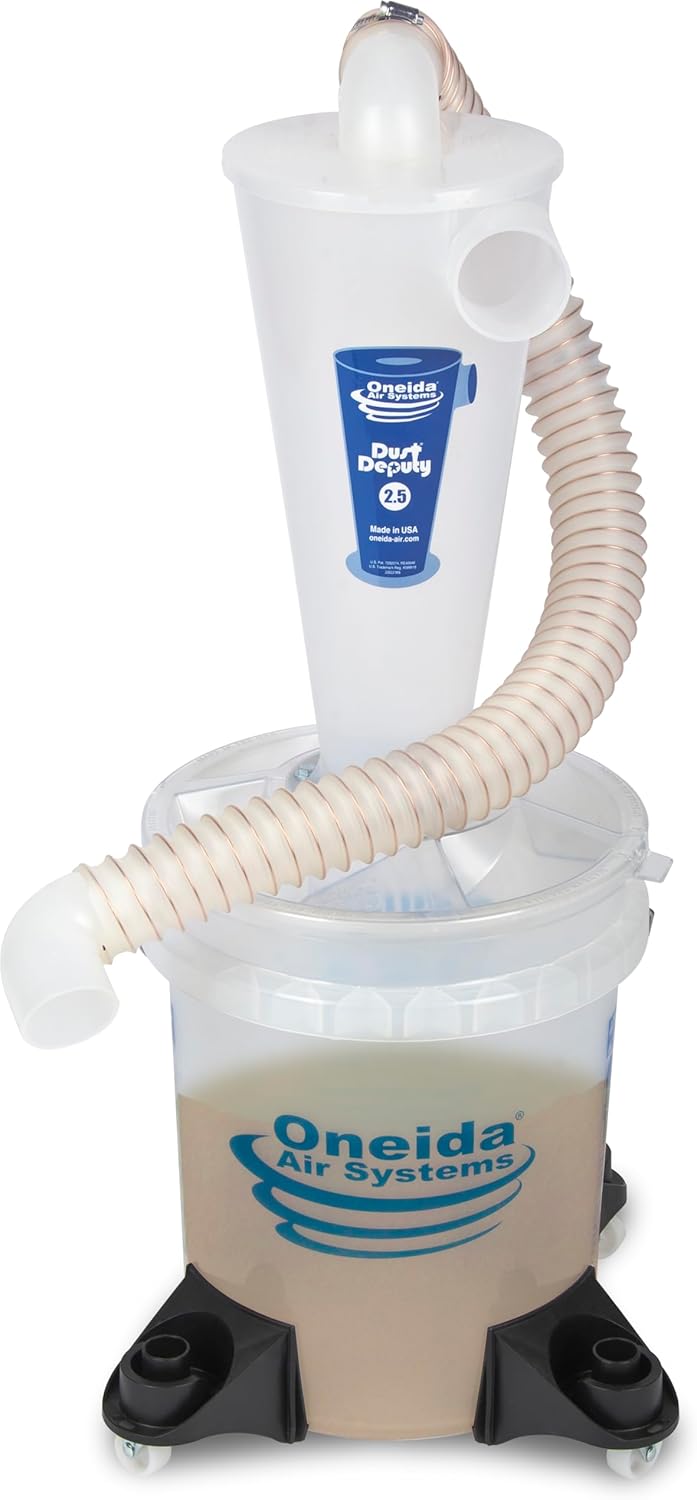
For a complete, ready-to-roll setup, get the Oneida Dust Deputy Deluxe 5-Gallon Kit: cyclone, clear bucket, casters and hose in one box.
If you already have a 5-gallon bucket, the Dust Deputy Low-Pro Plus turns it into a separator at a lower cost.
On the tightest budget, the Dust Deputy DIY is just the cyclone: you supply the bucket and fittings.
Best Dust Separators: Comparison
The table compares what you get in the box, which hoses each separator fits, and what setup it suits. The efficiency figures are the makers’ own claims, listed so you can see how each brand describes its product.
| Product | ⭐ Dust Deputy Deluxe 🏆 EDITOR’S CHOICE |
Dust Deputy 2.5 Deluxe | Dust Deputy Low-Pro Plus | Dustopper PRO | DEWALT DXVCS002 | Dust Deputy DIY | Shop-Vac 5430050 | Super Dust Deputy 4/5 DIY |
|---|---|---|---|---|---|---|---|---|
| Image |  |
 |
 |
 |
 |
 |
 |
 |
| Price | $$$ | $$$ | $$ | $$ | $$ | $ | $ | $$$ |
| Design | Tall cyclone on bucket | Tall cyclone on bucket | Low-profile lid | Low-profile lid | Cyclone on 6-gal bin | Cyclone only | Lid with metal filter | Large cyclone |
| Bucket included | ✅ 5-gal, clear | ✅ 5-gal | ❌ | ❌ | ✅ 6-gal | ❌ | ❌ | ❌ |
| Casters | ✅ 4 | ✅ 4 | ❌ | ❌ | ✅ 4 | ❌ | ❌ | ❌ |
| Hose / port fit | 2″ tapered ports, fits 1.5 to 2.5″ hoses; 3 ft hose | 2.5″ hoses; 4.5 ft swivel hose | 2.5″ hoses, 2.25″ ID ports; 3 ft hose | 2 sweep elbows; your hose | 1-7/8″ or 2-1/2″ hoses; hose included | 2″ tapered ports | 2 ft x 2-1/2″ hose, 2 elbows | 4 or 5″ inlet, 4 or 6″ outlet |
| Maker’s efficiency claim | 99% | 99% | Over 99.9% | 99.9% | Not stated | Up to 99.9% | “The majority” | Over 99% |
| Best For | Complete shop vac setup | Vacs with 2-1/2″ hoses | Using a bucket you own | Low-profile alternative | Bigger bin, rolling base | Custom or budget builds | Cheapest start | 1 to 3 HP dust collectors |
| Availability | Shop Now | Shop Now | Shop Now | Shop Now | Shop Now | Shop Now | Shop Now | Shop Now |
⭐ Dust Deputy Deluxe
🏆 EDITOR’S CHOICE
- Price
- $$$
- Design
- Tall cyclone on bucket
- Bucket included
- ✅ 5-gal, clear
- Casters
- ✅ 4
- Hose / port fit
- 2″ tapered ports, fits 1.5 to 2.5″ hoses; 3 ft hose
- Maker’s efficiency claim
- 99%
- Best For
- Complete shop vac setup
Dust Deputy 2.5 Deluxe
- Price
- $$$
- Design
- Tall cyclone on bucket
- Bucket included
- ✅ 5-gal
- Casters
- ✅ 4
- Hose / port fit
- 2.5″ hoses; 4.5 ft swivel hose
- Maker’s efficiency claim
- 99%
- Best For
- Vacs with 2-1/2″ hoses
Dust Deputy Low-Pro Plus
- Price
- $$
- Design
- Low-profile lid
- Bucket included
- ❌
- Casters
- ❌
- Hose / port fit
- 2.5″ hoses, 2.25″ ID ports; 3 ft hose
- Maker’s efficiency claim
- Over 99.9%
- Best For
- Using a bucket you own
Dustopper PRO
- Price
- $$
- Design
- Low-profile lid
- Bucket included
- ❌
- Casters
- ❌
- Hose / port fit
- 2 sweep elbows; your hose
- Maker’s efficiency claim
- 99.9%
- Best For
- Low-profile alternative
DEWALT DXVCS002
- Price
- $$
- Design
- Cyclone on 6-gal bin
- Bucket included
- ✅ 6-gal
- Casters
- ✅ 4
- Hose / port fit
- 1-7/8″ or 2-1/2″ hoses; hose included
- Maker’s efficiency claim
- Not stated
- Best For
- Bigger bin, rolling base
Dust Deputy DIY
- Price
- $
- Design
- Cyclone only
- Bucket included
- ❌
- Casters
- ❌
- Hose / port fit
- 2″ tapered ports
- Maker’s efficiency claim
- Up to 99.9%
- Best For
- Custom or budget builds
Shop-Vac 5430050
- Price
- $
- Design
- Lid with metal filter
- Bucket included
- ❌
- Casters
- ❌
- Hose / port fit
- 2 ft x 2-1/2″ hose, 2 elbows
- Maker’s efficiency claim
- “The majority”
- Best For
- Cheapest start
Super Dust Deputy 4/5 DIY
- Price
- $$$
- Design
- Large cyclone
- Bucket included
- ❌
- Casters
- ❌
- Hose / port fit
- 4 or 5″ inlet, 4 or 6″ outlet
- Maker’s efficiency claim
- Over 99%
- Best For
- 1 to 3 HP dust collectors
⚡ Key Takeaways
- A separator protects your vac’s filter, so suction stays up and you buy fewer filters and bags. The Dust Deputy Deluxe kit is the easiest way to get there.
- Tall cyclones on a bucket are the classic design; low-profile lids like the Low-Pro Plus and Dustopper PRO are shorter and more stable.
- Match the separator to your hose: 2-1/2″ floor hoses and smaller tool hoses need different fittings.
- Stationary dust collectors need a bigger cyclone, such as the Super Dust Deputy 4/5, not a shop vac separator.
- A separator doesn’t replace a fine filter: the dust that gets through is the finest, so keep a good filter or bag in the vac.
What a Dust Separator Does (and Why It’s Worth It)
Everything your vac picks up normally lands on the filter first. Chips pile up in the tank, but fine sanding dust coats the filter and blocks airflow, which is why a shop vac feels strong for the first minute and weak after ten. A separator puts a stage in front of the vac that drops most of that material into a bucket, so the vac only sees what’s left.
How a Cyclone Separates Dust
In a cyclone, the dirty air enters the cone from the side and spins around the wall. Heavier particles are flung outward, slow down against the wall and fall into the bucket below; the air turns and leaves up through the center to the vac. There’s no filter in the cyclone itself to clog, which is why suction holds steady as the bucket fills.
Lid-Style and Low-Profile Separators
Simpler lids, like the Shop-Vac 5430050, sit on a bucket and slow the air down so debris drops out, with a filter or screen before the outlet. They catch chips and coarse dust well and are cheap. Newer low-profile cyclones, such as the Dust Deputy Low-Pro Plus and the Dustopper PRO, build the spinning action into a short lid, which keeps the setup low and harder to tip over.
What a Separator Catches, and What It Doesn’t
Chips, shavings and most sanding dust end up in the bucket, which is the bulk of what you clean up in a woodshop. The very finest particles are the hardest to spin out, so some always continue to the vac. That is why the vac still needs a fine-dust or HEPA filter, and why a separator pairs with good extraction rather than replacing it.

Best Dust Separators: Reviews
Each pick below is here for a specific setup. The specs come from each maker’s listing, and I’ve kept each maker’s efficiency claim in their own words rather than presenting it as a measurement.
Oneida Dust Deputy Deluxe 5-Gallon Kit
Best Overall Dust Separator for Shop Vacs
The Dust Deputy Deluxe is the complete package: the anti-static cyclone, a clear 5-gallon bucket so you can see when it’s full, a quick-release lid, four caster wheels, a 3-foot hose, two elbow adapters, a clamp, a gasket and the hardware. Oneida says the cyclone captures 99% of dust and debris before it reaches your vac’s filter, and credits its neutral-vane inlet for the efficiency.
Its 2-inch tapered ports accept standard 1.5″ to 2.5″ vacuum hose fittings, so it works with almost any shop vac without extra adapters. Oneida lists drywall dust, wood dust and metal shavings among the materials it handles. The clear bucket is the detail that makes daily use easy: you empty it before it overfills, not after dust starts reaching the vac.
- ✅ Everything included: cyclone, clear bucket, lid, casters, hose
- ✅ Fits most shop vac hoses from 1.5″ to 2.5″
- ✅ Anti-static cyclone
- ✅ Rolls with the vac
- ❌ Tall: the cyclone on a bucket takes vertical space
- ❌ Costs more than buying the cyclone alone
Best For: Anyone who wants to add a separator to an existing shop vac in one purchase, with no DIY and nothing else to buy.
Oneida Dust Deputy 2.5 Deluxe 5-Gallon Kit
Best for Shop Vacs with 2-1/2″ Hoses
The Dust Deputy 2.5 Deluxe is built around the larger 2-1/2″ hoses that come with most full-size wet/dry vacs. It includes the cyclone, a 5-gallon bucket and lid, four casters, a 4.5-foot hose with swivel cuffs, on-board accessory storage and a tether kit to connect it to your vac. Oneida says it captures 99% of dust and debris and that the neutral-vane design improves separation by 20 percent.
A backwards-compatible 3-inch ID flange makes upgrades from older Dust Deputy setups straightforward, and the heavy-duty bucket is described as collapse-proof, which matters because a strong vac can pull a thin bucket inward. The tether kit keeps the separator and vac moving together.
- ✅ Sized for 2-1/2″ shop vac hoses
- ✅ Longer 4.5 ft swivel hose
- ✅ Tether kit links it to the vac
- ✅ Collapse-resistant bucket
- ❌ Needs a reducer for small tool hoses
- ❌ Highest-priced shop vac separator here
Best For: Owners of 12 to 16 gallon wet/dry vacs with 2-1/2″ hoses who mostly vacuum chips and floor debris.
Oneida Dust Deputy Low-Pro Plus
Best Lid-Style Separator for a Bucket You Already Own
The Low-Pro Plus is Oneida’s low-profile design: a cyclone built into a lid that fits a standard 5-gallon bucket. Oneida says it delivers more airflow than standard lid-style separators and captures over 99.9% of dust before the filter. The kit includes the lid separator, locking bucket latches, a neoprene foam gasket, a flexible 3-foot hose with swivel cuffs and a 2.5″ elbow adapter.
It fits standard 2.5″ hoses through 2.25″ ID ports. Because the whole unit is only as tall as a bucket and a lid, it’s more stable than a tall cyclone and easier to fit under a bench. Use a sturdy bucket: a thin paint bucket can flex under a strong vac.
- ✅ Low profile and stable
- ✅ Locking latches and gasket included
- ✅ Mid-range price tier
- ❌ Bucket not included
- ❌ Built for 2.5″ hoses
Best For: Woodworkers with a spare 5-gallon bucket who want Oneida’s cyclone in a compact, tip-resistant form.
Dustopper PRO
Best Low-Profile Alternative
The Dustopper PRO is the main alternative to Oneida’s lids. It fits all standard 5-gallon pails with a pre-installed hollow-core EPDM gasket, so there’s no setup, and it comes with two sweep elbows that Dustopper designed to lower flow restriction. It’s made in the USA.
Dustopper’s pitch is separation over raw airflow: the company argues that too much CFM creates turbulence inside a separator, and says third-party testing by Aerodyne Environmental found the PRO achieved higher dust collection efficiency than other low-profile separators with fine sawdust. That is the maker’s claim, not a measurement of ours. It connects with your existing vac hose through the included elbows.
- ✅ Pre-installed gasket fits standard pails
- ✅ Two sweep elbows included
- ✅ Made in the USA
- ❌ Bucket and hose not included
- ❌ Efficiency claims come from the maker’s own commissioned test
Best For: Woodworkers who want a low, stable separator for fine sanding dust and already have a bucket and hoses.
DEWALT DXVCS002 6-Gallon Dust Separator
Best Rolling Separator with a Bigger Bin
The DEWALT DXVCS002 pairs a cyclonic separator with a 6-gallon poly bucket, a bit more room than the usual 5-gallon pail, on a four-caster base. It accepts 1-7/8″ or 2-1/2″ hoses, which covers most shop vacs, and includes a 1-7/8″ hose, lid, latches, handles and two hose holders.
The listing describes an anti-clogging, heat-resistant design and a 3-year limited warranty. It doesn’t publish an efficiency figure, so it’s in this list for its format rather than a claimed number: a rolling bin that’s easy to empty and fits both common hose sizes.
- ✅ 6-gallon bin on four casters
- ✅ Works with 1-7/8″ and 2-1/2″ hoses
- ✅ 3-year limited warranty
- ❌ No published efficiency figure
- ❌ Bulkier than a lid on a bucket
Best For: Shops that want a larger rolling bin and have a vac with either 1-7/8″ or 2-1/2″ hose.
Oneida Dust Deputy DIY
Best Budget Cyclone
The Dust Deputy DIY is the same cyclone idea with nothing extra: the cyclone, a gasket and mounting hardware. You supply the bucket, lid and hoses. Oneida says it removes up to 99.9% of dust and debris, and the tapered 2.0″ ports accept a range of hose sizes. It’s made in America.
It’s the right choice when you want to build a cart around your vac, mount the cyclone on a sturdier container, or just spend the least. The cyclone is anti-static, which helps with dry wood dust clinging to the walls.
- ✅ Lowest price tier from Oneida
- ✅ Fits your own bucket, bin or cart
- ✅ Tapered ports for different hose sizes
- ❌ You buy and assemble the rest
- ❌ A flimsy bucket can collapse under strong suction
Best For: Budget builds and woodworkers who like to design their own vac cart around a cyclone.
Shop-Vac 5430050 Dust Collector Lid
Cheapest Way to Start
The Shop-Vac 5430050 is a lid for a standard 5-gallon bucket (sold separately) with a metal filter for the smaller particles, two 90-degree elbows and a 2 ft x 2-1/2″ hose. Shop-Vac says it captures the majority of sawdust and debris in the bucket before it reaches your vacuum, which cuts filter clogging.
It’s not a true cyclone, and the maker doesn’t claim a percentage, but it’s a simple, low-cost way to see how much a pre-separator changes your vac. The listing mentions a lifetime warranty that excludes abuse.
- ✅ Lowest price tier on this list
- ✅ Hose and elbows included
- ✅ Handles wet and dry debris
- ❌ Not a cyclone; no efficiency figure
- ❌ Bucket sold separately
Best For: Occasional DIYers who want to try a pre-separator on a 2-1/2″ shop vac for the least money.
Oneida Super Dust Deputy 4/5 DIY (for Dust Collectors)
Best Separator for Single-Stage Dust Collectors
If you run a stationary dust collector rather than a shop vac, you need a bigger cyclone. The Super Dust Deputy 4/5 DIY retrofits 1 HP to 3 HP single-stage dust collectors, with a 4″ or 5″ inlet to your tools and a 4″ or 6″ outlet to the collector, adapters included. Oneida says it captures over 99% of fine dust and large debris before the collector, which keeps the collector’s bag or canister from clogging.
Adding one effectively turns a single-stage collector into a two-stage system. You’ll need a drum or large bin below it; the DIY version doesn’t include one. If you’re still choosing the collector itself, my dust collector reviews and the budget dust collector picks cover the machines this pairs with.
- ✅ Sized for 1 to 3 HP collectors
- ✅ 4/5″ inlet and 4/6″ outlet options with adapters
- ✅ Made in the USA
- ❌ Drum or bin not included
- ❌ Not for shop vacs
Best For: Owners of 1 to 3 HP single-stage dust collectors who want cyclone separation without buying a whole new collector.
How I Chose These Dust Separators
I looked for separators sold on Amazon today from makers that publish clear specs, and grouped them by the setup they suit rather than ranking them on a single number. My criteria:
- Fit: which hose sizes and vacs or collectors each one connects to without improvising.
- What’s in the box: a complete kit versus a lid or cyclone you build around.
- Stability and capacity: casters, bucket size and how tall the setup stands.
- Honest claims: I report each maker’s efficiency figure in their own words and flag where there isn’t one.
I don’t show star ratings or prices: prices change daily, so each pick has a price tier and the Amazon button shows the live price.
How to Choose the Best Dust Separator
Shop Vac or Dust Collector?
Shop vac separators are built for high suction through 1-1/4″ to 2-1/2″ hoses. Dust collector cyclones are built for high airflow through 4″ to 6″ ducts. They are not interchangeable: a shop vac can’t drive a big cyclone, and a small cyclone will choke a dust collector. Decide which machine the separator serves first. If you haven’t picked the vac yet, see my guide to the best shop vac for dust collection.
Tall Cyclone vs. Low-Profile Lid
Tall cyclones on a bucket, like the Dust Deputy Deluxe kits, are the proven design and easy to see into when the bucket is clear. Low-profile lids like the Low-Pro Plus and Dustopper PRO keep everything at bucket height, so they tip less and fit under a bench. For a vac that follows a sander around, low and stable is worth a lot.
Hose Size and Fittings
Check your vac’s hose before you buy. Full-size wet/dry vacs usually use 2-1/2″ hoses; smaller vacs and extractors use 1-7/8″ or 1-1/4″. Tapered ports, like those on the Dust Deputy Deluxe and DIY, cover more sizes. Every extra adapter and sharp bend costs suction, so keep the hose from the separator to the vac short.
Bucket Strength and Capacity
A strong vac can pull a thin bucket inward, especially when the hose gets blocked. Use a heavy-duty bucket or buy a kit that includes one. A 5-gallon bucket suits most sanding and small-shop cleanup; if you empty it several times a day, a 6-gallon bin like DEWALT’s or a larger drum helps.
Static and Fine Dust
Dry dust rushing through plastic builds static, which gives you small shocks and makes dust cling to hoses. Anti-static cyclones and hoses reduce it. For drywall and very fine sanding dust, pair any separator with a fine-dust or HEPA filter in the vac; see my notes on sanding drywall for keeping that dust down at the source.
💡 Pro Tip
Empty the bucket before it’s more than about two-thirds full. Once debris reaches the bottom of the cyclone, it gets pulled back up into the airflow and goes straight to your vac filter, which defeats the point.
How to Set Up a Dust Separator with a Shop Vac
Step 1: Connect in the Right Order
The tool or floor hose goes into the separator’s side inlet. A short hose runs from the separator’s top outlet to the vac’s intake. Reversing them sends everything straight to the vac.
Step 2: Seal Every Joint
Any air leak at the lid or fittings lets the cyclone lose its spin and lets dust bypass the bucket. Use the gasket, clamp the fittings, and check the lid seats flat all the way around.
Step 3: Keep the Setup Together
Tether the separator to the vac or put both on a cart so they move as one. That stops the bucket tipping when you drag the hose across the shop.
Step 4: Finish the Air
A separator and vac capture dust at the tool. What escapes still hangs in the air, which is where a shop air filtration system comes in.
🏆 The Verdict
For most shop vac owners, the Oneida Dust Deputy Deluxe 5-Gallon Kit is the simplest complete answer: cyclone, clear bucket, casters and hose, fitting almost any vac. If you already own a sturdy bucket, the Dust Deputy Low-Pro Plus or the Dustopper PRO gets you a low, stable separator for less. Build your own around the Dust Deputy DIY, and if you run a 1 to 3 HP dust collector, step up to the Super Dust Deputy 4/5.
❓ Frequently Asked Questions
Which dust separator is better, Oneida or DeWalt?+
Are dust separators worth it?+
Does a dust separator reduce suction?+
Do I still need a filter in my shop vac with a separator?+
Can I use a shop vac separator on a dust collector?+
What size bucket do I need for a dust separator?+
Conclusion
A dust separator is one of the cheapest upgrades you can make to a shop vac, and one of the few that improves suction, filter life and cleanup at once. Pick the design that fits your vac and space, match it to your hose, keep a good filter behind it, and your sander dust ends up in a bucket instead of on the bench. If dust still escapes at the sander itself, the fix is at the tool: see my dustless sander picks.
Have a setup question about your vac or collector? Leave a comment below and I’ll help you match the right separator.
