
As an Amazon Associate I earn from qualifying purchases. All claims are strictly my personal opinion.
My top pick

3M Pro Grade Precision 220-Grit Sanding Sheets
Fine 220-grit sheets with a no-slip grip backing that holds on a sanding block, for the last pass on bare wood and between coats.

220 grit sandpaper is a very fine grit used for the last pass on bare wood before stain or clear finish, for scuffing between coats of finish, and for the final smoothing of filled or primed surfaces. It is not a stock-removal grit: it won’t flatten a rough board, strip paint or fix tool marks. It finishes work that coarser grits (80 to 150) have already shaped, and past that point you either stop or, for some jobs, move to 320 or finer.
Below is what 220 grit is used for, how it compares with 120, 180 and 240, why it is the usual stop on bare wood and the usual choice between coats, what CAMI 220 and P220 mean, and the sheets, discs and sponges I’d pick up.
⚡ Quick Answer
Use 220 for: the last pass on bare wood before stain or clear finish, scuffing between coats of oil-based polyurethane, and a final smoothing pass on primed or filled surfaces. For sheets, start with the 3M Pro Grade Precision; for a random orbital sander, the Mirka Gold Multifit discs.
Don’t use it for: removing paint, leveling rough wood or taking out deep scratches. Go back to 80 to 120 for that.
Go finer: 320 when the finish maker asks for it, or when you are only scuffing a cured topcoat to let the next coat bond.
What 220 Grit Is Used For
Grit numbers describe the size of the abrasive particles on the paper: the higher the number, the smaller the particles and the finer the scratches. According to Klingspor’s grading table, a 220 particle averages about 66 microns on the CAMI scale, against 192 microns for 80 grit and 116 microns for 120 grit. That is roughly a third of the size of the particles on an 80-grit sheet, which is why 220 leaves a surface that looks and feels smooth rather than cut.
Because the scratches are that small, 220 does finishing jobs. The table below lists the jobs where it is the normal choice and the ones where it isn’t.
| Job or material | Is 220 right? | Notes |
|---|---|---|
| Bare wood before stain or clear finish | Yes, usual last grit | Stain needs to soak in; going much finer can close the pores on some woods |
| Between coats of polyurethane or varnish | Yes, once the coat is dry | Minwax names 220 for its fast-drying polyurethane; follow your own can |
| Primed trim, doors and furniture | Yes | Knocks down grain and dust nibs before the topcoat |
| Drywall after the last coat of compound | Yes, light pass | Most guides use it for the final pass; keep pressure light so the paper doesn’t gouge |
| Rough lumber, mill marks, old finish | No | It will clog and burnish without cutting; start at 80 to 120 |
| Paint stripping or rust removal | No | Too fine to remove material at a useful rate |
Bare Wood
On bare wood, 220 is the grit most guides stop at. Our sandpaper grit chart uses 220 as the last bare-wood grit and saves 320 for scuffing between finish coats. The reason is practical: stain and oil-based finishes need open pores to soak into, and a surface sanded much finer than 220 can take them unevenly.
Finish Coats and Paint
Between coats, you are not trying to remove anything. You are putting a uniform scratch pattern on a cured coat so the next one has something to grip, and flattening dust nibs. That is a light job for a very fine grit.
Drywall
The retailer and DIY guides I looked at mostly name 220 for the final pass on dried joint compound, after 120 to 150 has done the leveling. No drywall manufacturer page I could open gave a grit, so treat it as common practice rather than a rule. The 220-grit Gator drywall sheets below are made for exactly that pass.
220 vs 120, 180 and 240
The easiest way to place 220 is to look at the neighbors on the CAMI scale. The particle sizes below are from Klingspor’s grading table.
| Grit (CAMI) | Avg. particle size | Typical role |
|---|---|---|
| 120 | 116 microns | Smoothing after coarse sanding |
| 180 | 78 microns | Last grit before stain on open-grain wood, per our chart |
| 220 | 66 microns | Last grit before a clear finish; between coats |
| 240 | 53.5 microns | Same band as 220, slightly finer |
220 vs 120
120 is the rougher of the two. Its particles are close to twice the size of 220’s, so it cuts faster and leaves scratches you can still feel and may see under stain. Use 120 to remove the marks from 80 grit, then 180 or 220 to remove the marks from 120. Skipping straight from 80 to 220 usually leaves the 80-grit scratches behind, because 220 is too fine to cut them out.
220 vs 180
The step is small. Mirka says ordinary paints cover P180 scratches, so for a painted surface 180 is often enough and 220 is a refinement. Under a clear finish or a stain, where scratches show, 220 is the safer last grit.
220 vs 240
CAMI 240 at 53.5 microns is smaller than CAMI 220 at 66 microns, but both fall in the same very fine band, and I wouldn’t expect most people to see or feel a difference on wood. If you only have 240 on hand and the finish asks for 220, it will do the job. The one place to be careful is the scale: a P240 sheet and a CAMI 240 sheet are not the same size, as the next section explains.
220 on Bare Wood Before Stain
Work up through the grits in order (for example 80, 120, then 180 or 220) and stop at 220 for most woods. Sand with the grain, then wipe the dust off with a damp cloth or a tack cloth before staining. If the wood is soft and blotchy, such as pine or maple, a pre-stain step does more for even color than a finer grit. Our full walkthrough, how to stain wood, covers the order of the steps. For choosing grits by wood type, see what grit sandpaper to use for wood.
220 Between Coats
Minwax’s page for its Fast-Drying Polyurethane says to let the coat dry 4 to 6 hours, then lightly sand the entire surface with fine sandpaper (220-grit) to ensure an even finish and proper adhesion. Recoat time on the same page is 3 to 4 hours. That is the maker’s instruction for that product, and it is why 220 is the default for oil-based poly.
Not every finish says the same thing. Our grit chart notes that General Finishes uses pads in the 220 to 320 range for its topcoats, so read your own can. If the instructions give a grit, use it. If they don’t, 220 is the safe starting point and 320 is the finer option. How to do it without cutting through the coat is in my guide on sanding between coats of polyurethane.
CAMI 220 vs P220
There are two grit scales on sandpaper in the US. A bare number (220) is usually the CAMI scale, and a number with a P in front (P220) is the European FEPA scale. Klingspor’s table lists CAMI 220 at 66 microns and P220 at 65 microns, so at 220 the two are effectively the same and you can swap them. Klingspor also lists 180 at 78 microns on both scales.
They drift apart above 220. In the same table CAMI 320 is 36 microns while P320 is 46.2 microns, and our chart pairs CAMI 320 closer to P400. So if you buy a finer grit than 220, check which scale the sheet uses before you compare it with another brand. The full conversion lives on the sandpaper grit chart, and I’ve kept it out of this page on purpose.
Sheets, Discs and Sponges
220 comes in four forms: loose sheets for hand sanding or a block, round discs for a random orbital sander, flexible sponges and pads for curves, and drywall sheets. For wood-specific choices across all grits, my best sandpaper for wood page compares more brands. I haven’t stated prices or specifications below beyond what I could confirm from a maker or retailer page; where I couldn’t confirm a detail it is marked not stated.
3M Pro Grade Precision Sanding Sheets
Best Sheets for Hand Sanding and Between Coats
3M’s Pro Grade Precision line includes 220-grit sheets that the Home Depot listing describes as fine-grit sandpaper for sanding between coats, with a no-slip grip backing that holds on a sanding block. The listing linked here is the 220-grit pack of 20 sheets with the no-slip grip backing. This is the one I’d put in a drawer for finishing work. The abrasive mineral: not stated.
- ✅ Fine-grit sheets sold for sanding between coats
- ✅ Grip backing suits a sanding block
- ❌ Abrasive type: not stated, check the listing
Best For: Hand sanding bare wood and cured finish coats.
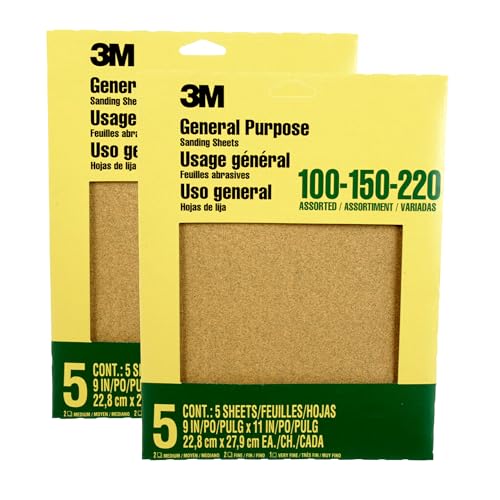
3M Assorted Grit Sheets, 100, 150 and 220
Best Assortment for a First Project
If you don’t own any sandpaper yet, an assortment that runs 100, 150 and 220 covers the progression for a small bare-wood project in one pack, and the 220 sheets are the finishing pass. It’s a sensible way to try the sequence before you commit to a full pack of one grit. The listing linked here is a 2-pack of the 3M 9005NA assortment, each pack holding five 9 by 11 inch sheets across the three grits, with an aluminum oxide abrasive.
- ✅ Three grits in one pack for a full progression
- ❌ Fewer 220 sheets than a pack of one grit
Best For: Beginners and one-off projects.
Mirka Gold Multifit Discs

Best Discs for a Random Orbital Sander
Multifit is Mirka’s multi-hole disc format, meant to fit sanders with different hole patterns, and retailer listings describe the Gold line as made for wood finishing, automotive and marine work. The listing linked here is the 5-inch, 220-grit hook and loop box of 50, so check that your sander takes 5-inch hook and loop discs before you order. At 220 the CAMI and P scales are close enough that the scale doesn’t matter.
- ✅ Multi-hole pattern for several sander models
- ✅ Made for finishing work, per retailer listings
- ❌ 5-inch only in this listing; 6-inch sanders need another size
Best For: Final passes with a random orbital sander.
Mirka Goldflex Soft Pads

Best for Curves and Profiles
Goldflex Soft is Mirka’s soft-backed pad format for shaped surfaces, where a flat sheet would flatten edges or skip hollows. It is the one I’d choose for moldings, spindles and table edges when you are cleaning up a coat of finish. I couldn’t find a 220 roll on Amazon, so the listing linked here is the 240-grit roll of 200 pads, one step finer than 220 and close enough for scuffing between coats. On bare wood before stain, stay with 220 sheets.
- ✅ Soft backing follows curves
- ❌ Sold here in 240 grit, not 220
Best For: Shaped edges, moldings and turned parts.
3M Sanding Sponges

Best Sponge for Scuffing Between Coats
A sanding sponge is a foam block coated with abrasive, and it conforms to edges and contours by hand. Many sponges are sold in grades such as fine and very fine rather than by number; 3M’s Pro Grade Precision 3-in-1 sponge linked here is sold as 220 grit, fine, in a 4-pack.
- ✅ Conforms to edges and profiles
- ❌ Too soft to keep a flat surface flat; use a sheet on a block there
Best For: Quick hand scuffing of cured finish.
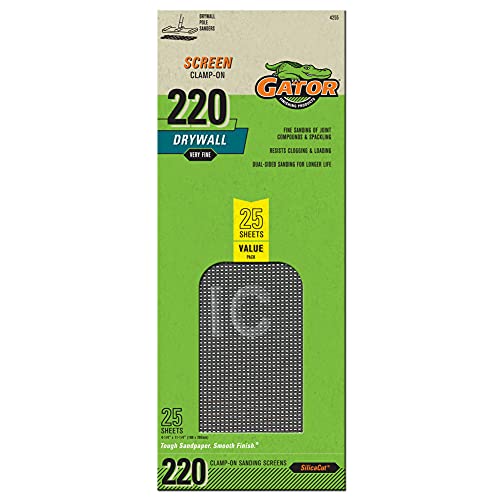
Gator Drywall Sandpaper, 220 Grit
Best for the Final Pass on Drywall
This is the pick if your 220 is going on a wall rather than a table. Use it after the leveling grits have done their work, with light pressure and a vacuum or damp wipe afterward. The listing linked here is a 25-pack of 220-grit sanding screens, 4.5 by 10.5 inches.
- ✅ Sold in 220 grit for drywall
- ❌ Not what you want for bare wood or paint removal
Best For: Smoothing dried joint compound before primer.
🏆 The Verdict
220 grit is the finishing grit: the last pass on bare wood before stain or clear finish, and the light scuff between coats when the finish maker asks for it. It won’t shape, strip or level, so run the coarser grits first and stop at 220 unless your finish says otherwise. For hand work I’d keep a pack of the 3M Pro Grade Precision sheets, and for a random orbital sander the Mirka Gold Multifit discs. I don’t show customer ratings or prices. More on how I choose the products I recommend.

