
As an Amazon Associate I earn from qualifying purchases. All claims are strictly my personal opinion.
My top pick

Meguiar's M105 Ultra Cut Compound
Meguiar's states it removes 1200 grit or finer sanding marks, works by hand, DA or rotary, and pairs with its M205 finishing polish.

Rubbing compound vs polishing compound comes down to how hard each one cuts: rubbing compound is the coarser product that removes sanding scratches and heavy defects; polishing compound is the finer product that removes the haze the rubbing compound leaves and brings up the gloss. You use them in that order: rubbing compound first, polishing compound second, wax or sealant last. Which one you start with depends on the last sandpaper grit you used.
If you finished wet sanding at 1500 grit, start with a rubbing compound. If you finished at 2000 or 3000 grit, you can often start with a polishing compound. Below is a side-by-side table, a grit-to-compound chart, whether to work by hand or with a DA polisher, and the compounds and polisher I’d pick.
Rubbing Compound vs Polishing Compound at a Glance
| Feature | Rubbing Compound | Polishing Compound |
|---|---|---|
| Abrasion | Coarser, cuts fast | Finer, cuts lightly |
| Job | Removes sanding scratches, heavy swirls, oxidation | Removes haze and light swirls, raises gloss |
| Use it after | 1500 grit, or 2000 grit if the scratches are still visible | A rubbing compound, or 2000 to 3000 grit |
| Order | First | Second |
| By hand | ✅ Small spots only, slow | ✅ Works well on small areas |
| With a DA polisher | ✅ Best way, with a cutting pad | ✅ Best way, with a finishing pad |
| Leaves behind | Fine haze that needs a second step | A clear, glossy surface ready for wax or sealant |
⚡ Quick Answer
Finished wet sanding at 1500 grit? Start with a rubbing compound like the Meguiar’s M105 Ultra Cut.
Need the finishing step after it? A fine polish like the Meguiar’s M205 Ultra Finishing Polish.
Working on a boat or fiberglass gelcoat? TotalBoat TotalBuff.
What Rubbing Compound Does
A rubbing compound is a paste or liquid with relatively coarse abrasives. Its job is to level the paint surface: it cuts away a thin layer of clear coat until the sanding scratches, deep swirls or oxidation are gone. That cutting action is also why it leaves a fine haze behind. The surface is flat, but not yet glossy.
Which Scratches It Can Remove
Manufacturers state this as the finest sandpaper grit the product will erase. Meguiar’s says its M105 Ultra Cut Compound can remove 1200 grit or finer sanding marks, and 3M says the same of its Perfect-It EX AC Rubbing Compound (P1200 or finer). That is why a rubbing compound is the normal next step after wet sanding clear coat at 1500 grit, covered in my guide to wet sanding clear coat.
When Not to Use It
Skip it on paint that only has light swirls or a dull look. It removes more clear coat than it needs to, and clear coat is a thin layer you can’t put back. A polishing compound is the safer first try on a surface that was never sanded.
What Polishing Compound Does
A polishing compound uses finer abrasives. It removes the haze from the rubbing compound step, light swirls and fine scratches, and it brings up depth and gloss. Meguiar’s describes its M205 Ultra Finishing Polish as a fine finishing polish meant to follow a compounding step, with a non-gumming formula that gives a long working time.
Compound, Polish and Rubbing Compound: Are They the Same?
The names overlap, and brands use them loosely. In general, “compound” means a cutting product, “rubbing compound” is the heavy end of that range, and “polish” is the fine end. A box that says “polishing compound” can sit anywhere between the two, so read the product’s own description of what it removes rather than relying on the word on the front.
What Comes After Polishing
Once the gloss is back, protect it with a wax or sealant. Meguiar’s recommends exactly that after its compound and polish pair: a car wax or sealant to finish.
Which Compound After Which Grit
This chart is my working rule of thumb for automotive clear coat, built from the manufacturer limits above. It is a starting point, not a guarantee: always test a small area first and step up to the next coarser product if scratches remain.
| Last sandpaper grit | First product | Then |
|---|---|---|
| 1500 | Rubbing compound, cutting pad | Polishing compound, finishing pad |
| 2000 | Rubbing compound if marks show, otherwise a polishing compound with a medium pad | Polishing compound, finishing pad |
| 3000 | Polishing compound, finishing pad | Wax or sealant |
If You Sanded Coarser Than 1500
A rubbing compound is not meant to erase 800 or 1000 grit scratches on clear coat. Meguiar’s and 3M both quote 1200 as the coarsest mark their compounds remove, so go back and sand finer first. The full grit sequence for paint is in what grit sandpaper for car paint.
If You Are Working on Gelcoat
Boat gelcoat follows a different scale. TotalBoat says its TotalBuff rubbing compound removes 600 and 800 grit wet sanding scratches from fiberglass gelcoat and painted surfaces, and it pairs it with its TotalShine finishing material as the follow-up. For resin pours, see how to sand epoxy resin.
By Hand or With a DA Polisher?
Both products say they work by hand or with a machine. Meguiar’s lists hand, dual action and rotary for M105 and M205, and TotalBoat says TotalBuff goes on by hand and is buffed with a variable-speed buffer and a wool compounding pad.
By Hand
Fine for a single scratch, a door edge or a small repair spot. It is slow and the result is uneven over a larger area, because a hand can’t keep a steady pressure and speed. Use a foam applicator pad and work in small sections.
With a DA Polisher
For a hood, a roof or a full panel after wet sanding, a dual action polisher is the better choice: it holds an even speed, and its oscillating motion makes it much harder to burn through paint than a rotary buffer. If you are deciding between the two types, read my DA vs rotary polisher comparison, and see my best car polisher picks for specific machines.
One-Step Products
One-step products combine a compound and a polish in one bottle. Their abrasives break down as you work, so they cut at the start and finish fine. Chemical Guys describes its VSS One-Step Scratch and Swirl Remover this way, and Meguiar’s markets its Ultimate Compound as a clear-coat-safe compound for scratches, swirls and oxidation that works by hand or with a DA polisher.
They are a good fit for light swirls and for paint that has not been wet sanded. After 1500 grit, a one-step product is likely to leave you short of the finish you want, so use the two-step order above.
The Compounds and Polisher I’d Pick
Two compounds and a polish from the brands whose own pages give the grit limits above, and the machine I’d pair them with.
Meguiar’s M105 Ultra Cut Compound
Best Rubbing Compound After 1500 Grit
Meguiar’s says its super micro-abrasives remove 1200 grit or finer sanding marks, and that it is safe on all glossy paint finishes including clear coats. It works by hand, with a DA polisher or with a rotary buffer, and Meguiar’s suggests following it with M205 Ultra Finishing Polish.
- ✅ Removes 1200 grit or finer marks, per Meguiar’s
- ✅ Hand, DA or rotary
- ❌ Leaves haze that needs the polishing step
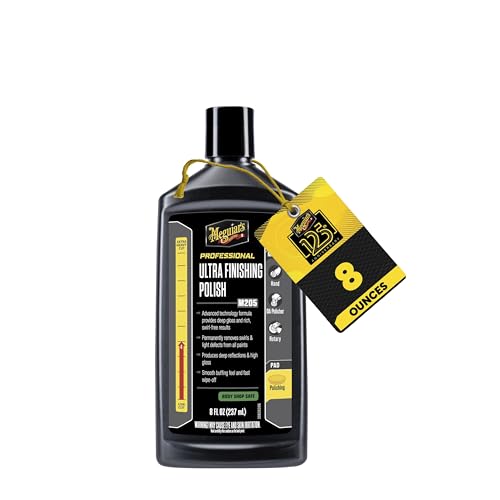
Meguiar’s M205 Ultra Finishing Polish
Best Finishing Polish
A fine polish made to follow a compounding step. Meguiar’s describes a micro-abrasive, non-gumming formula with a long working time that removes swirls and light defects and maximizes gloss and clarity. It is the polishing step that follows M105 in Meguiar’s own system, by hand, DA or rotary.
- ✅ Non-gumming, long working time
- ✅ Made to follow M105
- ❌ Not a rubbing compound: it won’t level sanding scratches
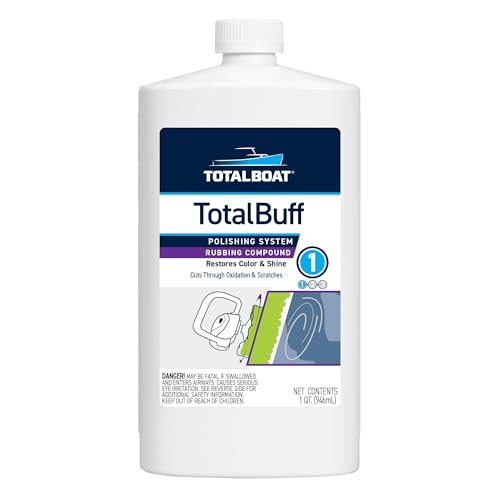
TotalBoat TotalBuff Rubbing Compound
Best Rubbing Compound for Gelcoat
TotalBoat says TotalBuff removes heavy oxidation and 600 and 800 grit wet sanding scratches from fiberglass gelcoat and painted surfaces, on boats, RVs, cars and trailers. It goes on by hand and is buffed with a variable-speed buffer and a wool compounding pad, and TotalShine is the finishing step TotalBoat pairs with it.
- ✅ Handles coarser 600 and 800 grit marks
- ✅ Works on gelcoat and painted surfaces
- ❌ Needs a finishing compound after it
The Polisher: Griot’s Garage G9

Best Machine for Both Steps
A dual action polisher does both jobs: a cutting pad with the rubbing compound, then a finishing pad with the polishing compound. The Griot’s Garage G9 is my top pick in the best car polisher guide: a 1,000 W motor, a 9 mm orbit, a 6″ backing plate and six speed settings from 2,000 to 6,400 OPM, per its listing.
Also worth a look: 3M’s Perfect-It EX AC Rubbing Compound, which 3M positions as its best-performing rubbing compound for P1200 or finer sand scratches, and the Meguiar’s Ultimate Compound or the Chemical Guys V-series if you prefer a one-step or a heavier cut.
🏆 The Verdict
After wet sanding at 1500 grit, use a rubbing compound first and a polishing compound second. The Meguiar’s M105 Ultra Cut followed by the M205 Ultra Finishing Polish is the pairing I’d choose for automotive clear coat, applied with a DA polisher such as the Griot’s Garage G9 on anything larger than a spot. On gelcoat or epoxy, reach for TotalBoat TotalBuff.
❓ Frequently Asked Questions
Are compound and polish the same thing?+
What goes first, polish or compound?+
Should I use rubbing compound or polishing compound?+
When should I use polishing compound?+
How do detailers get cars so shiny?+
Not sure which step your paint needs? Tell me your last sandpaper grit in the comments and I’ll tell you where I’d start.

