
As an Amazon Associate I earn from qualifying purchases. All claims are strictly my personal opinion.
My top pick

Makita 9557PBX1 4-1/2" Angle Grinder
A 4-1/2" grinder kit with guards and case whose 5/8"-11 spindle matches the Makita concrete cup wheel.

A concrete grinder is a machine with a diamond wheel that scrapes the top layer off a slab: old paint, glue, thinset, sealer, a rough lip between two pours. For a small job, edges, steps or a few high spots, the best concrete grinder is a 4-1/2″ angle grinder with a diamond cup wheel, a dust shroud and a HEPA extractor. For a whole garage or basement floor, rent a walk-behind floor grinder instead. The grinder is the cheap part. The dust control is what makes the job safe, because concrete dust carries respirable crystalline silica.
Below I sort the choice by floor size, compare the handheld pieces, review each one, explain cup wheel segments and grits, spell out what OSHA’s silica rule asks for, and say what to expect when you rent a floor grinder. If you are still deciding whether concrete can be sanded at all, my guide on how to sand concrete covers the method; this page is about which machine to put in your hands.
Handheld or Walk-Behind? Pick by Floor Size
The question that matters most is not which brand, but how much floor you have. A handheld grinder with a 4-1/2″ wheel covers a strip a few inches wide per pass, so it is perfect for edges and spots and tiring on an open slab. A walk-behind machine has a wide head and its own weight, so it moves across a floor the way a floor sander does. The sizes in the table are my own rule of thumb, not a maker figure.
| Job | Better tool | Why |
|---|---|---|
| Edges, along walls and steps | Handheld | A big machine cannot reach into the corner. Even when you rent, the edges stay a handheld job. |
| High spots and ridges, a few square feet | Handheld | You only touch the spot you want to take down. |
| Small pad, landing or workbench corner | Handheld | Renting, hauling and returning a machine costs more time than the job. |
| Garage or basement floor, a few hundred square feet | Walk-behind rental | An even scratch pattern across the whole floor is much easier with a wide head than with a hand tool. |
| Thick coating, mastic or glue over a whole room | Walk-behind rental | Heavy removal over a large area is what the heavier machine is for. |
Most big jobs end up using both: the rented machine for the field of the floor and the handheld kit for the edges it cannot reach. If you are leaning toward renting, skip to the section on renting a floor grinder. If you are doing wood floors rather than concrete, that is a different machine entirely: see my page on floor sander rental.
Concrete Grinder Setups: Comparison
A handheld concrete grinder is really a small system: a grinder, a diamond cup wheel, a shroud and an extractor. The table compares what each maker publishes for the six pieces I picked. “Not stated” means the maker’s page does not give the figure.
| Product | ⭐ Makita 9557PBX1 🏆 EDITOR’S CHOICE |
Makita A-96403 | DeWalt DWE46152 | Makita PC5001C | Makita VC4210L |
|---|---|---|---|---|---|
| Image | |
 |
 |
 |
 |
| Role | Angle grinder | Cup wheel | Dust shroud | Concrete planer | Extractor |
| Price | $$ | Check Amazon | $$ | $$$$ | $$$$ |
| Key figure | 7.5 amp, 11,000 RPM | 4-1/2″, 8 segments | Flush grinding door | 10 amps, 5″ wheel | 11 gal, 148 CFM |
| Dust control | Needs a shroud | Needs a shroud | Universal hose connection | Shroud cap, bag and vacuum port | HEPA 99.97%, auto filter cleaning |
| Best For | Edges and spots | Concrete leveling and prep | Capturing grinder dust | Smoothing joints | HEPA dust capture |
| Availability | Shop Now | Shop Now | Shop Now | Shop Now | Shop Now |
Key takeaways
- A handheld kit is for edges, spots and small areas. A whole floor is a rental job.
- The wheel decides how the job goes: match its diameter, its spindle thread and its maximum RPM to your grinder.
- OSHA’s silica table asks for a shroud plus an extractor with at least 25 cfm per inch of wheel diameter. The extractor here, at 148 CFM, clears that figure for a 4-1/2″ or 5″ wheel.
- Never dry grind concrete without a shroud and a HEPA extractor, and wear the respirator the table calls for.
Concrete Grinder Reviews
Figures come from the makers’ product pages, read on November 20, 2026. I show a price tier instead of a price because prices change daily and the Amazon button shows the live one. Several of these listings are sold by third-party sellers, so check the seller before you buy.
Editor's Choice4-1/2" angle grinder kit
Makita 9557PBX1
Makita 9557PBX1 4-1/2″ Angle Grinder
A 7.5 amp, 11,000 RPM 4-1/2" grinder kit with a 5/8"-11 spindle that matches the Makita cup wheel.
Check price on AmazonSpecs: Makita
Best for
Edges, steps and spot grinding with a shroud and extractor.
- Thread matches the A-96403 cup wheel
- Kit with two guards, side handle and case
- 4.5 lb
Skip it if
You grind for hours: the PC5001C is built for it.
- 7.5 amps, lighter duty
- Shroud fit not stated by Makita
Read full review
Best Handheld Grinder to Start a Concrete Kit
The Makita 9557PBX1 is a corded 4-1/2″ angle grinder with a 7.5 amp motor, an 11,000 RPM no-load speed, a paddle switch and a 5/8″-11 UNC spindle, at 4.5 lb, per Makita. That thread matches the Makita A-96403 cup wheel below, so the two go together without an adapter. The kit adds a turbo diamond blade, five grinding wheels, a grinding guard, a cut-off guard, a side handle and a metal case. 4-1/2″ is a common base for a concrete kit, because cup wheels and dust shrouds are made for this class of grinder in many brands.
Makita’s page does not say which dust shrouds fit, so check the fit notes on the shroud you choose before you order. At 7.5 amps it is lighter duty than the 10 amp concrete planer further down, which suits edges and spots rather than hours of grinding. Remember that a cup wheel replaces the guard, which is why the shroud matters so much.
Best cup wheel4-1/2" diamond cup wheel
Makita A-96403
Makita A-96403 4-1/2″ Low-Vibration Diamond Cup Wheel
A low-vibration, 8-segment turbo cup wheel that Makita lists for concrete, with a 5/8"-11 arbor.
Check price on AmazonSpecs: Makita
Best for
Leveling high spots and prepping edges with a 4-1/2" grinder.
- Made for concrete
- Low-vibration design
- Fits 5/8"-11 grinders
Skip it if
You are removing thick coatings: pick a wheel made for coatings.
- Maximum RPM and grit not stated on the maker's page
Read full review
Best Diamond Cup Wheel for Concrete Prep
Makita’s title for the A-96403 is “4-1/2″ Low-Vibration Diamond Cup Wheel, 8 Segment Turbo.” The page lists a 4-1/2″ diameter, 8 segments and a 5/8″-11 arbor, marks it as low vibration and gives its use as concrete. The maximum RPM is not stated on the page; it is printed on the wheel itself.
A 5/8″-11 arbor is the thread used on American-market angle grinders, so check that the grinder you own has it. A turbo pattern, with angled or wavy segments, is generally described as balancing cooling and removal speed. For the finer points of segments and grit, see the section on cup wheels below.
Best shroudSurface grinding dust shroud
DeWalt DWE46152
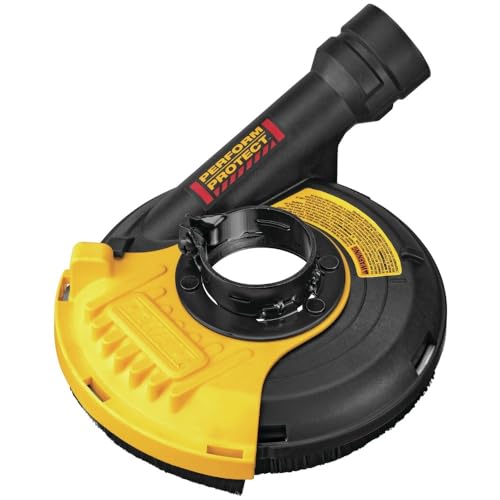
DeWalt DWE46152 5″ Surface Grinding Dust Shroud
A dust shroud with a flush grinding door for edges and a twist-and-click universal hose connection.
Check price on AmazonSpecs: DeWalt
Best for
Grinding concrete with a hand grinder and a vacuum, especially along walls.
- Flush door for grinding at the wall
- No tape needed for the hose
Skip it if
You cannot confirm it fits your grinder and wheel.
- Grinder and wheel fit not stated on the maker's page
- DWV9000 connector sold separately
Read full review
Best Dust Shroud for Edge Work
DeWalt describes the DWE46152 as a dust collection shroud with a flush grinding door, which lets you collect dust while grinding right up against a wall, and a universal vacuum hose connection that locks on with a twist and a click, so you do not tape the hose. DeWalt says it is designed for use with angle grinders. The assembled size is about 6.5″ tall and 8.9″ long.
DeWalt’s page for this shroud lists neither specific grinder models nor wheel sizes, and it does not mention concrete, so confirm that it fits your grinder and wheel before you order. The universal connector for the hose, the DWV9000, is sold separately. This is the OSHA “commercially available shroud” piece of a handheld concrete setup, and without it the extractor has nowhere to pull from.
5" concrete planer
Makita PC5001C
Makita PC5001C 5″ Concrete Planer
A purpose-built 5" concrete planer with a shroud cap, dust bag and vacuum port, for smoothing concrete and joints.
Check price on AmazonSpecs: Makita
Best for
Contractors and serious DIYers who smooth concrete joints often.
- Dust control built in
- Made for smoothing concrete and joints
Skip it if
You grind concrete once: a grinder kit costs less.
- Single-purpose tool at the top price tier
- Weight listed inconsistently on the maker's page
Read full review
Best Handheld Option for Smoothing Concrete Joints
The Makita PC5001C is not an angle grinder but a purpose-built tool for the same job. Makita lists it as a 5″ concrete planer with 10 amps, a 10,000 RPM no-load speed, a removable dust shroud cap, a dust bag and a dust collecting vacuum port. The page says it is for smoothing concrete and leveling concrete joints, and names masons, concrete finishers and city maintenance crews as users.
It comes with its own shroud, which is the advantage over building a setup from a grinder: the dust control is part of the tool. Makita’s page gives two different weights and two different speeds in different places, so I do not quote a weight. The listing I found is from a third-party seller and the older PC5010C sibling shows as discontinued on Makita’s site, so look at what is actually in stock before you plan around this tool.
11-gallon HEPA dust extractor
Makita VC4210L
Makita VC4210L 11-Gallon HEPA Dust Extractor
An 11-gallon extractor with 148 CFM, a HEPA filter rated 99.97% at 0.3 microns and automatic filter cleaning.
Check price on AmazonSpecs: Makita
Best for
Garage-sized jobs where emptying often is a nuisance.
- Large tank
- HEPA rated by Makita
- Automatic filter cleaning
Skip it if
You want a light extractor to carry.
- 35 lb dry
- Top price tier
Read full review
Best HEPA Extractor for Concrete Dust
Makita lists the VC4210L with an 11-gallon gross container (9 gallons for wet pickup), 148 CFM airflow, a HEPA filter rated 99.97% efficient at 0.3 microns and an automatic filter-cleaning system. It includes a 1-1/4″ by 13 ft anti-static hose and weighs 35 lb dry. Makita says it “complies with the OSHA standard for Exposure to Respirable Crystalline Silica” (1926.1153) for select applications and only when used as Makita specifies.
A big container means fewer stops to empty it, and concrete dust fills a tank quickly. For other extractors, see my guide to the best dust extractor. That caveat about “select applications” is worth reading in Makita’s own documents before you rely on the claim for a particular tool and wheel combination.
Cup Wheels: Segment Types and Grits
The wheel does the work, and it is where most mistakes happen. A buying guide from a concrete tool seller, Concrete Cutting Pro, breaks the choice into three parts: the segment pattern, the grit and the size.
Segment Patterns
That guide describes the common patterns like this. A single row wheel has one ring of segments on the outer edge and is the most aggressive, with more vibration and a rougher finish. A double row wheel has two rings, a smoother finish and less aggressive removal, and the guide calls it the most versatile pattern. A turbo wheel has angled or wavy segments that improve cooling and balance removal speed with finish quality. A full-face segmented wheel is the smoothest and slowest, for finish grinding.
Treat these rankings as one seller’s view and judge a wheel by its maker’s stated use. The Makita A-96403 above says concrete on its page, and that is a better guide than a general ranking.
Grit
The same guide pairs lower numbers with aggressive removal and higher numbers with surface prep. It gives 30 grit as maximum aggression for leveling high spots, 30 to 60 grit for removing thin paint or stain, and 60 to 120 grit for surface prep for new epoxy, where the wheel creates a profile the coating can bond to. The numbers are one seller’s guidance, and the paint or coating maker’s instructions come first. If a coating system asks for a specific surface profile, follow it.
Size, Thread and Speed
For small grinders, 4″ and 4-1/2″ wheels are the standard, suited to detail and edge work, and 5″ wheels fit 5″ grinders. The thread matters: the same guide says 5/8″-11 is standard for American-market grinders and M14 for European-market ones, and that they are not interchangeable without an adapter. Beyond that, read the maximum RPM printed on the wheel and make sure it is not lower than your grinder’s speed. Makita lists the 9557PBX1 at 11,000 RPM, so a wheel rated below that does not belong on it.
Dry grinding generates heat as well as dust. The guide warns about overheating and says to take breaks during dry grinding. Wet grinding keeps dust down but makes slurry, which is why most home setups use a shroud and extractor instead.
Silica Dust: Shroud, HEPA Extractor and Respirator
Concrete contains crystalline silica. Grinding it releases fine dust that you can breathe deep into your lungs, and the people who work in construction face a federal rule about it. The rule is OSHA’s respirable crystalline silica standard for construction, 29 CFR 1926.1153, and its Table 1 lists the control methods for common tools, including handheld grinders for uses other than mortar removal. I read Table 1 on the eCFR on November 20, 2026.
What Table 1 Asks For
For a handheld grinder on concrete, the table gives two ways to control dust. One is a grinder with an integrated water delivery system that continuously feeds water to the grinding surface. The other is a commercially available shroud and dust collection system, where the collector provides 25 cubic feet per minute (cfm) or greater of airflow per inch of wheel diameter, uses a filter with 99% or greater efficiency and has a cyclonic pre-separator or a filter-cleaning mechanism.
With the shroud option, the table calls for no respirator outdoors. Indoors or in an enclosed area it calls for none for 4 hours per shift or less, and a respirator with an assigned protection factor of 10 for more than 4 hours per shift. That is the rule for construction work, not a statement about every home setting, but it is a good yardstick for any grinder job.
Doing the Math for Your Wheel
Multiply the wheel diameter by 25. A 4-1/2″ wheel needs an extractor delivering at least 112.5 cfm, and a 5″ wheel needs at least 125 cfm. Makita’s VC4210L is listed at 148 CFM with automatic filter cleaning, so it clears the number on paper for these wheel sizes. A hose that is long, kinked or clogged with dust cuts the real airflow, so keep it short and straight.
A household shop vac usually has neither the HEPA filter nor the filter cleaning, and concrete dust clogs its filter fast. My guide on dust extractor vs shop vac explains the difference. For breathing protection when you do need it, see my picks for the best respirator for woodworking and sanding and check the filter class against the dust you are making.
⚠️ Never Dry Grind Concrete Without Dust Control
A shroud on the grinder and a HEPA extractor on the hose are not accessories. They are what makes the job reasonable. Keep other people out of the room, and do not sweep the dust dry afterwards: vacuum it with the extractor.
Renting a Floor Grinder
A walk-behind concrete floor grinder is a heavier, wider machine, and for a floor-sized job it is the right call. Big-box rental counters and equipment rental shops carry them, and prices vary by shop, region and machine size, so I give no figure here. The price you will see is a daily or half-day rate, plus a deposit or damage waiver, plus consumables.
What to Ask at the Counter
Before you rent, ask four things. What diamond segments are on the machine, and what are they meant for: coatings, glue or bare concrete? Is the machine dust-ready, with a shroud and a hose port for an extractor? Does the rental include the extractor, or must you bring your own? And is the wheel head already worn? The segments on a rental machine are consumables, and a worn set will take far longer than a fresh one.
Rent Plus Handheld
The rented machine cannot reach the last few inches at the wall. Plan to finish the edges with a 4-1/2″ grinder, a cup wheel and a shroud, the same kit reviewed above. That means the kit from this page still earns its place on a rental job, and your extractor works for both machines if the hose port fits. If the job is wood rather than concrete, the rental to look at is a drum or orbital floor sander, covered in my guide to floor sander rental.
Hire a Pro Instead
If the floor is large, the coating is thick, the concrete is old and may contain a coating you cannot identify, or you cannot manage the dust indoors, a flooring contractor with a truck-mounted extractor is the safer answer. A grinder that removes a coating can also release whatever was in it. Ask what the coating is before you start.
How I Chose These Concrete Grinder Picks
I looked at what people ask when they search for a concrete grinder: what it is for, whether you can do it yourself, whether you can rent one and what it costs. Then I kept pieces from established makers that Amazon sells, with figures that the maker’s own page publishes. The criteria, in order:
- Dust control first: every setup here has a shroud route and an extractor that meets OSHA’s airflow figure on paper.
- Maker figures only: where a maker’s page did not state a figure, such as the weight of the grinder or the maximum RPM of the wheel, I say so rather than guess.
- Standard sizes: 4-1/2″ and 5″ tools, the sizes most home grinders and wheels are made for.
- Honest scope: Amazon does not sell walk-behind floor grinders in any useful way, so that machine appears as a rental, not as a pick.
I do not show star ratings or prices: prices change daily, so each pick carries a price tier and the Amazon button shows the live price. The figures come from the makers, not from my own use of the tools, and the review cards say so.
🏆 The Verdict
For edges, steps and spots, I’d start with the Makita 9557PBX1, the Makita A-96403 cup wheel and the DeWalt DWE46152 shroud, run into a HEPA extractor such as the Makita VC4210L. For smoothing joints often, the Makita PC5001C has its dust control built in. For a whole floor, rent a walk-behind machine and keep the handheld kit for the edges.
❓ Frequently Asked Questions
What do you use a concrete grinder for?+
Can you grind concrete yourself?+
Can I rent a concrete grinder?+
How much does it cost to grind concrete?+
Conclusion
For a small concrete job, the grinder is the cheap part: a 4-1/2″ angle grinder, a diamond cup wheel with the right thread and speed rating, and a shroud. The real investment is a HEPA extractor with enough airflow for your wheel. For a whole floor, rent the walk-behind machine and use the handheld kit on the edges.
For the step-by-step method, see my guide on how to sand concrete. If you also grind metal with the same angle grinder, my page on flap discs explained covers the discs for that. Questions about your floor? Leave a comment below.
