
As an Amazon Associate I earn from qualifying purchases. All claims are strictly my personal opinion.
My top pick

A water-based filler its maker calls ideal for cracks, gaps and nail holes in floors, that takes stain before or after filling.

Hardwood floors need two different fillers, because the job changes once the finish goes on. The best wood filler for hardwood floors is a stainable, sandable filler for the raw-wood stage, before the final sanding, and a color-matched touch-up putty for nail holes in a floor that is already finished. Timbermate is the one I’d start with for the first job, and a Minwax Wood Putty in the right color for the second.
Below are four fillers for floors, a comparison table, short reviews, and a plain guide to filling nail holes, cracks and gaps, including the gaps you should not fill with filler at all. I lean on the National Wood Flooring Association’s (NWFA) published sand and finish guidelines for the process, and on the makers’ own pages for each product.
Best Wood Fillers for Hardwood Floors: Comparison
The table lists what each maker or listing states. Always test the filler with your stain and finish on a spare board or a hidden corner, because color and compatibility are where floor repairs go wrong.
| Product | ⭐ Timbermate Wood Filler 🏆 EDITOR’S CHOICE |
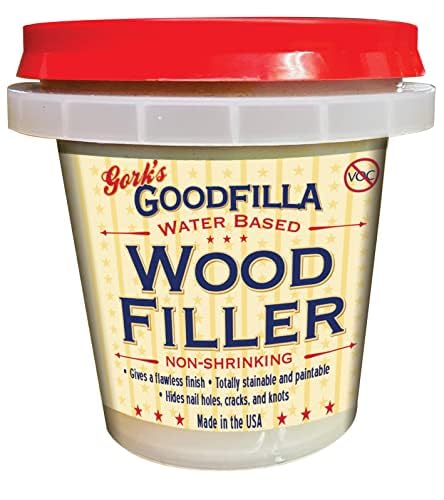
Goodfilla | Minwax Wood Putty | Minwax Stainable Wood Filler |
|---|---|---|---|---|
| Image | |
 |
 |
 |
| Price | $$ | $$ | $ | $ |
| Type | Water-based paste | Water-based filler | Non-hardening putty | Latex filler |
| Use on | Cracks, gaps and nail holes in floors | Furniture, floors, crafts | Painted, stained and finished wood | Unfinished wood, indoors and out |
| Stain | Stain before or after, per maker | Accepts any finish or stain, tintable (listing) | Color-matched to Minwax stains | Accepts Minwax oil and water-based stains |
| Sandable | Not stated in the FAQ | Yes, easy to sand (listing) | No sanding needed (listing) | Yes |
| Dry time | Depends on weather and depth | Not stated | Non-hardening | 2 to 6 hours |
| Buy | Shop Now | Shop Now | Shop Now | Shop Now |
Key takeaways
- Use a stainable, sandable filler before the final sanding, and a color-matched touch-up putty only after the finish is on.
- Match the filler to your stain and finish, and test it on a spare board first.
- Do not fill seasonal gaps in the dry season: the NWFA says filler used then will likely damage the floor when the wood expands again.
- Big gaps are a job for wood slivers, not for more filler.
Editor's ChoiceWater-based wood filler
Timbermate Wood Filler
Timbermate Wood Filler
A water-based filler its maker calls ideal for cracks, gaps and nail holes in floors, stainable before or after.
Check price on AmazonSpecs: Timbermate FAQ (maker), opened November 2026
Best for
Filling nail holes, cracks and gaps before the final sanding.
- Maker names floors: cracks, gaps and nail holes
- Stain before or after filling
- Maker says it does not shrink, sink or crack
Skip it if
The floor is already finished: use a touch-up putty.
- Interior use only
- Deep holes need several 1/4 in layers
Read full review
Best Wood Filler for Hardwood Floors Before Finishing
Timbermate is a water-based wood filler that also works as a grain filler. Timbermate’s own FAQ says it is ideal for filling cracks, gaps and nail holes in floors, and tells you not to fill deeper than 1/4″ at a time: build deeper holes in layers and let each dry thoroughly. It is sold in wood-tone jars such as red oak, white oak, walnut and cherry; the one linked here is the 4 lb Maple/Pine tub, a size that suits a whole floor, so pick the shade nearest your boards.
The FAQ says drying time depends on the weather and the depth of the fill, that you can stain before or after applying it, and that it does not shrink, sink, crack or fall out. It also notes that it dries lighter than its wet color and comes back to the wet color once a clear topcoat goes on, which is the reason to test it on a spare board first. Because it dissolves in water, Timbermate advises against using it outdoors, which is no problem on an interior floor.
Best for color matchingWater-based wood and grain filler
Goodfilla Neutral Base
Goodfilla
A tintable water-based filler that the listing says accepts any finish or stain and does not shrink, sink or crack.
Check price on AmazonSpecs: Amazon listing (Goodfilla Neutral Base 8 oz, Creators API, November 2026)
Best for
Floors in a species or stain color no ready-made filler matches.
- Tint it to the exact floor tone
- Reconstitutes with water
Skip it if
You want a ready-colored jar you can use straight away.
- Dry time and gap limit not stated
- Needs tinting work to match
Read full review
Best Tintable Wood Filler for Hard-to-Match Floors
Goodfilla is a water-based wood and grain filler sold in wood colors such as Red Oak, Cherry and White Oak, plus the Neutral Base linked here. The 8 oz Neutral Base listing says it does not shrink, sink or crack, accepts any finish or stain, and can be mixed with any pigment, tint, stain or dye, and it names “a floor to finish” among its uses. It is sold as zero VOC and non-toxic.
A neutral base you tint yourself is the closest thing in a jar to the NWFA’s mix-your-own idea below: you can work it toward the exact tone of your boards, test it on a spare piece with your stain, and adjust. The listing also says it reconstitutes with water, so a jar that dries out is not wasted. Those are listing claims, and I did not find drying times or gap limits for it, so those are not stated here.
Best for finished floorsNon-hardening putty
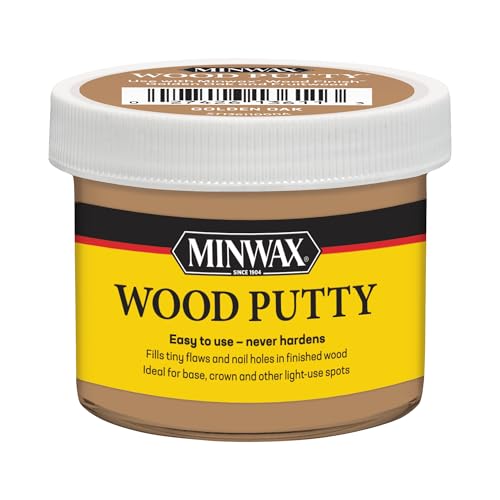
Minwax Wood Putty
Minwax Wood Putty
A pre-mixed, non-hardening putty color-matched to Minwax stains for nail holes in finished wood.
Check price on AmazonSpecs: Amazon listing (Minwax Wood Putty Golden Oak 3.75 oz, Creators API, November 2026)
Best for
Hiding a nail hole in a floor that is already finished.
- Color-matched to Minwax stains
- No sanding needed
Skip it if
The floor is still raw wood.
- Not for raw floors (NWFA note on touch-up putties)
- Non-hardening, small holes only
Read full review
Best Wood Putty for Nail Holes in a Finished Floor
Minwax Wood Putty is a non-hardening, pre-mixed putty that its listing describes for nail holes, minor scratches and gouges in bare, painted, stained and finished wood. It is color-matched to Minwax Wood Finish stains (the Golden Oak jar linked here matches Fruitwood, Golden Oak, Puritan Pine and Weathered Oak), so you pick the shade closest to your floor rather than staining it afterward. That is how a touch-up putty is meant to be used, and the NWFA describes the category as typically used on factory-finished floors or after all coats on a site-finished floor.
The same NWFA note adds a warning: touch-up putties should never be used on raw wood, and you should check with the maker for compatibility with your floor finish. The Minwax listing allows bare wood in general, but on a floor I’d follow the NWFA and keep the putty for after the finish is on. The listing, not Minwax’s own page, is my source for the product description.
Latex wood filler
Minwax Stainable Wood Filler
Minwax Stainable Wood Filler
A stainable, sandable latex filler for spot repairs in unfinished wood; the maker does not mention floors.
Check price on AmazonSpecs: Minwax product page and Amazon listing B000KKMZRG
Best for
Nail holes and small cracks in bare wood you plan to stain.
- Accepts Minwax oil and water-based stains
- Sandable, paintable, can take a clear topcoat
Skip it if
You need a floor-specific filler for large areas.
- Minwax does not mention floors for it
Read full review
Best Stainable Wood Filler for Spot Repairs in Bare Wood
Minwax Stainable Wood Filler is a latex formula that Minwax lists for interior and exterior use on unfinished wood, for cracks, small gouges, nail holes and knot holes. It is made to accept Minwax penetrating wood stains, can be sanded smooth and flush, and can be topcoated with a clear finish or painted. Minwax says most shallow repairs dry within 2 hours, and gives a range of 2 to 6 hours.
Minwax’s page does not mention floors for this product, so I treat it as a general stainable spot filler and not a floor-specific one. By the NWFA’s own description, a spot filler is a product that usually dries hard, can be sanded and stained, and is used for larger cracks, holes and spot filling during the sanding process, which is where this one fits. Check that it works with your floor’s stain and finish before you commit to a whole room.
Before Sanding vs on a Finished Floor
The NWFA’s guidelines say a floor should be filled before the final straight cut in the sanding process, and they name several kinds of filler by job. The table below shows the ones that matter for a home floor.
| Filler type (NWFA) | When it is used | What to know |
|---|---|---|
| Trowel filler | During sanding | A thinner version of spot filler, spread across the whole floor with the excess removed as you go |
| Spot filler (wood patch) | Before final sanding | For larger cracks, nail holes, gouges and broken edges; usually dries hard and can be sanded and stained |
| Touch-up putty | After finishing | For factory-finished floors or after all coats; check compatibility; never on raw wood |
| Hard wax stick | After finishing | Rubbed or melted into holes; check compatibility; never on raw wood |
In plain terms: fill before the finish with something that sands and stains, and fill after the finish with something color-matched that never needs either. The NWFA is clear that touch-up putties and hard wax sticks should never go on raw wood.
⚠️ Make Sure the Floor Is Stable First
The NWFA notes that loose floors will not hold floor filling compounds. If boards move underfoot, filler will crack or pop out no matter which product you choose.
How to Fill Gaps in Hardwood Floors
How you fill depends on how big the defect is and whether it moves with the seasons. Whichever method you use, the NWFA says to vacuum the floor thoroughly first, removing dust and debris from nail holes, knots and between boards, and to use a filler that is compatible with the stain and the finish.
Nail Holes
Press the filler in with a putty knife and leave it flat with the surface, not sunk and not raised. The NWFA’s standard is that nail hole filler be flat with the floor and reasonably consistent in color with the flooring. On a raw floor, use a stainable filler before the final sanding. On a finished floor, use a color-matched putty such as Minwax Wood Putty, and see the NWFA caveat above about raw wood.
Small Cracks and Gouges
Work the filler into the crack so it fills the void and does not just bridge it. The NWFA says filler must be pushed into the gaps and voids, not simply laid over them. Build deeper repairs in layers, as Timbermate suggests, and let each layer dry before the next. For a small spot, a color from the same wood family is fine, but light-sensitive species will change color over time, so the filler may stop matching.
The NWFA also describes a mix-your-own option: fine dust from the sanding process combined with a compatible mixing agent into a thick paste. It is ideal for color-sensitive species and hard-to-match colors because it is the same wood. If the floor will be colored, test that your mix can take color before you apply it.
Seasonal Gaps
Gaps between boards that open in winter and close in summer are seasonal movement, and they are not a defect to fill. The NWFA’s guideline is explicit: in areas with humidity swings, do not fill seasonal gaps during the dry seasons (the winter months), because filler used then will likely cause damage to the flooring when the wood expands again in the humid season. The NWFA also describes popped filler, where filler pops and sinks in cracks as conditions change from season to season, and says it can happen on older floors that are refinished.
If a gap bothers you, the time to deal with it is when the floor is at its widest, and with a flexible material, not a rigid filler. I could not find an NWFA statement about rope or flexible fillers, so I am not recommending any here. Ask a flooring professional about your situation.
Large Gaps
For larger gaps the NWFA says wood slivers, also called dutchmen, may be used instead of filler. Its steps describe cutting thin slivers from flooring or dimensional lumber, around 3/8″ thick, choosing one that matches the boards in color and grain, gluing one side, inserting it narrow side down, and shaving it flush with a sharp blade or block plane. Let the repair dry completely before sanding. This is slower than troweling filler, and it keeps working as the floor moves.
Sanding and Finishing Over Filler
The NWFA’s rule is simple: do not begin the final sanding until all the filler has thoroughly dried. Sand it flush with the same grit sequence as the rest of the floor so the repair does not show as a flat or shiny patch, and make sure no filler is left on the board surface, which the NWFA treats as unacceptable.
That sequence is covered in my guide on how to refinish hardwood floors, and my page on the floor sander rental options covers the machines. For the edges, see my page on the floor edger. If your floor only needs a refresh and not a full sand, read my page on refinishing hardwood floors without sanding, and when you are choosing the topcoat, my picks for the best wood floor finish. For general filler picks beyond floors, see the best wood filler roundup.
🏆 The Verdict
Before the final sanding, I’d pick Timbermate, the one whose maker speaks directly to wood floors. For a color nothing else matches, Goodfilla is worth a look. After the finish is on, Minwax Wood Putty in a matching shade handles nail holes, and Minwax Stainable Wood Filler covers small bare-wood spots. Do not fill seasonal gaps in winter, and use slivers for big ones.
