
As an Amazon Associate I earn from qualifying purchases. All claims are strictly my personal opinion.
My top pick
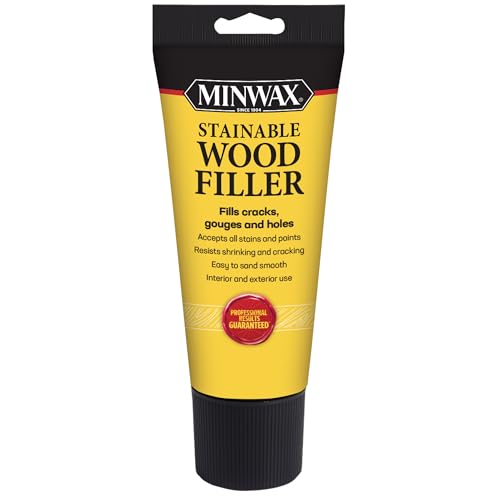
A latex filler Minwax rates for interior and exterior wood, with clear steps: test the stain on scrap, sand flush, remove residue, then stain.

The best stainable wood filler is one the maker labels stainable and that you have tried on a scrap of your own wood first: for most jobs I’d start with Minwax Stainable Wood Filler. “Stainable” on a label means the filler will take stain. It does not promise the patch will take stain the way the board around it does, which is why every maker below tells you to test or to match the color before you commit.
Below are four stainable fillers worth buying, a comparison of what each maker publishes, an honest answer to whether you can stain wood filler, how to get a patch to match, and whether to fill before or after you stain.
Best Stainable Wood Filler: Comparison
The table shows what each maker publishes about its own filler, read on November 20, 2026, with a few gaps filled from the product’s Amazon listing (marked “listing”). Where neither gives a figure, the cell says so.
| Product | Minwax Stainable Wood Filler | Famowood Original | Timbermate Wood Filler | DAP Plastic Wood-X |
|---|---|---|---|---|
| Image | |
 |
 |
 |
| Base | Latex | Solvent-based, with wood fibers (listing) | Non-solvent, dissolves in water | Latex-based (listing) |
| Interior or exterior | Interior/exterior | Interior/exterior | Not advised outdoors | Interior/exterior, coat exterior repairs |
| Dry time (maker) | 2 to 6 hours | Page gives 15 and 30 minutes | Varies with weather and depth | 2 to 6 hours shallow (page), about 36 hours deep |
| Maker’s stain advice | Test stain on scrap wood with filler | Test stain compatibility before use | Light, quick coat of stain; match color wet | Stain the wood before filling |
| Buy | Shop Now | Shop Now | Shop Now | Shop Now |
Key takeaways
- Only buy a filler whose label or product page says stainable, and read what the maker says to do before staining.
- Every maker here says to test: on scrap wood, in a small area, or by matching the color while the filler is wet.
- The makers disagree on order: DAP says stain before filling, Minwax’s steps have you fill, sand and then stain.
- Exterior repairs need a protective coat over the filler; Timbermate is not advised outdoors at all.
What “Stainable” Really Means on the Label
Stain colors wood by soaking into the fibers, and a filler is not wood, so it can only take stain as well as its formula allows. A filler sold as stainable is built to accept stain, and the makers are careful about the wording.
Minwax calls its product “a stainable and paintable latex formula” and tells you to test the stain on scrap wood with filler before filling. Eclectic, the maker of Famowood, says it “takes stains and paints evenly” and still says to test stain compatibility before use. Timbermate says its filler “will take all types of known stains, coatings and colorants” and adds that it dries lighter than it looks wet. Read together, the labels say the same thing: the filler will take stain, and you should check the color before it goes on the real piece.
If your project is a large patch on a visible face, my advice is to treat a stained filler as a repair you are hiding, not erasing. For tiny nail holes the match is easy. For a knot hole or a gouge on a light stain, expect to see the patch a little.
Best Stainable Wood Fillers: Reviews
Everything here comes from the makers’ product pages and the Amazon listings for the exact jar or can linked, read on November 20, 2026. I don’t show customer ratings or prices, which change daily.
Editor's ChoiceLatex stainable filler
Minwax Stainable Wood Filler
Minwax Stainable Wood Filler
A stainable and paintable latex filler for interior and exterior wood, with maker steps for testing, sanding and staining.
Check price on AmazonSpecs: Minwax product page and Amazon listing B000BPLXEQ
Best for
Nail holes, small gouges and cracks in trim and furniture you will stain.
- Clear fill, sand, clean, stain steps
- Interior and exterior
- Small sizes for nail holes
Skip it if
You need a filler you can tint to the wood in the pot.
- Deep holes need layers and up to 6 hours
Read full review
Best Stainable Wood Filler for Most Repairs
Minwax is the one I’d pick up first because the maker’s instructions are specific and they match how stain is actually used. It calls the filler a stainable and paintable latex formula for interior and exterior use. Most shallow repairs dry within about 2 hours, and deeper holes should be filled in layers of 1/4″ at a time, which Minwax says may need 2 to 6 hours. After filling, sand the patch smooth and flush, remove all the sanding residue, then stain with a Minwax penetrating stain, water-based stain or gel stain.
Solvent-based wood filler
Famowood Original Wood Filler
Famowood Original Wood Filler
Eclectic says it takes stains and paints evenly, accepts most water-based and oil-based stains, and works indoors and outdoors.
Check price on AmazonSpecs: Eclectic Products page and Amazon listing B001AHC5HI
Best for
Stained furniture, trim and exterior doors.
- Takes most water-based and oil-based stains
- Can be sanded, drilled or planed
- Interior and exterior
Skip it if
You want a clear dry time and color count before buying: check the label.
- Maker page conflicts on dry time and number of colors
- Page carries a crystalline silica warning
Read full review
Best for Stained Interior and Exterior Work
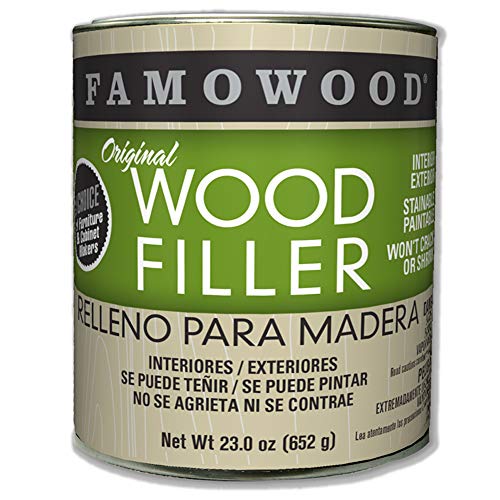
Famowood is made by Eclectic Products. Eclectic lists it as stainable and paintable, for interior and exterior use, with “a high solid content of wood flour,” and says it “takes stains and paints evenly” and accepts most water-based and oil-based stains. It can be sanded, drilled or planed once dry. The page also says to test stain compatibility on a small area before use. The pint linked here is the Maple color, and its listing describes Famowood Original as a solvent-based filler made with actual wood fibers that won’t crack or shrink.
Two things the page doesn’t settle: it gives both 15 minutes and 30 minutes as the dry time, and it says both 13 and 18 colors, so check the label on the can you buy. Eclectic’s page also carries a warning that sanding the product can expose you to wood dust and crystalline silica, so wear a respirator and extract the dust.
Best for color matchingWater-soluble tintable filler
Timbermate Wood Filler
Timbermate Wood Filler
A non-solvent filler you tint while wet to match the wood; it dries lighter and is not advised outdoors.
Best for
Indoor projects where the patch must vanish under a clear finish.
- Tint it in the pot
- Takes water, oil or solvent based stains and coatings, per the maker
- Maker says it does not shrink, sink or crack
Skip it if
The repair is outdoors.
- Not for outdoor use
- Stain in a quick, light coat
Read full review
Best for Color Matching a Stain
Timbermate works differently from the latex fillers: it is a non-solvent filler that dissolves in water, and the maker has you mix colorant into the putty. The maker’s advice is to add colorant and match the exact color you see while the filler is wet, because it dries lighter. If you are using a clear coat, it says you must match the putty color, since the filler returns to its original color under a clear topcoat.
You can stain it, but Timbermate warns that stain adds moisture and rubbing hard can disturb the filler, so apply stain in a quick, light coat. Because it dissolves in water, it says not to use it outdoors. That makes it the one pick here for indoor furniture, trim and cabinets only. The one linked is the 4 lb Maple/Pine tub; Timbermate also sells oak, walnut, cherry and other wood tones.
Stainable filler with dry indicator
DAP Plastic Wood-X Wood Filler with DryDex
DAP Plastic Wood-X Wood Filler with DryDex
Goes on pink and turns natural when dry; DAP says to stain the wood before filling and to coat exterior repairs.
Check price on AmazonSpecs: DAP product page and Amazon listing B01IY7RGBQ
Best for
Exterior trim and doors you will stain and coat.
- Pink-to-natural dry indicator
- Interior and exterior repairs
- Clear 40F temperature limit
Skip it if
You want to fill first and stain after: DAP advises staining first.
- Deep fills take about 36 hours
Read full review
Best for Knowing When It Is Dry
DAP lists a “stainable and paintable formula” and says the filler goes on pink and turns natural as it dries, so you know when to sand: the repair is dry once it is fully natural with no pink tones. Shallow repairs take about 2 to 6 hours and deeper fills about 36 hours. DAP says it can be used for interior and exterior wood repairs, and to paint or coat exterior repairs for long-term durability. The 5.5 oz tube’s Amazon listing calls it a latex-based, knife grade formula for corners and vertical surfaces, and words the dry time a little differently: 3 to 6 hours for repairs up to 1/8″ deep and 36 hours for fills of 1/4″ and over.
The part that surprises people is the order of work. DAP says: “If wood is to be stained, stain before filling with wood filler.” Keep the surface, filler and air above 40°F while you work. If you prefer to fill first, test the stain on a scrap with the filler as the other makers advise.
Can You Stain Wood Filler?
Yes, if the filler is sold as stainable, and expect the patch to look different from the wood. A filler that says only paintable gives you no stated stain compatibility, so I’d not count on it. A stainable one accepts stain, but it is not wood, so the color is rarely identical.
Three habits make the difference:
- Test first. Minwax says “test stain on scrap wood with filler” before filling. Do that with the stain you will actually use.
- Sand and clean the patch. Minwax says to sand the filler smooth and flush, then remove all sanding residue before staining.
- Work with the filler, not against it. A thin patch on dark stain hides easily. A big patch on a pale stain does not, and there a tinted filler matched to the wood before it dries is a better plan than hoping the stain will do it.
Getting Filler to Match the Stain
Cut a scrap of the same wood, fill a few holes, sand, and stain it with the exact stain and number of coats you plan to use. Let it dry, add your finish, then judge the color in daylight. If the patch is lighter, tint the filler. Timbermate’s maker says to match the color you see while the filler is wet, and Famowood comes in a range of colors, so you can start closer to the wood. For the full fill-and-sand routine, see my guide on how to use wood filler.
If the wood is blotchy, a pre-stain wood conditioner evens out the board, but it does nothing for the filler itself. For the stain step, see my guide to how to stain wood. Filler is not the only way to patch: wood filler vs wood putty explains when putty is the better choice, and for open pores rather than holes, see my wood grain filler guide.
Fill Before or After Staining?
The makers don’t agree, so I’d pick by what you care about. DAP says to stain before filling. Aqua Coat, a grain filler, says to apply it after stain and sealer. Minwax’s steps have you fill and sand first, then stain. Timbermate says “You can apply stain either way,” as long as you use a quick, light coat.
- Stain first, fill after: the filler doesn’t have to take stain at all, and you can tint it to match the finished color. This is how I’d approach a visible face where color is critical.
- Fill first, stain after: the stain goes on once and the patch is colored by the same coat. It is faster, and fine for small holes in dark stains or paint grade work.
Whichever order you choose, test the combination on a scrap and let the filler dry for the time its maker gives before you sand or stain.
⚠️ Outdoors, Coat the Repair
Minwax names Helmsman Spar Urethane as the protective finish for exterior use, and DAP says to paint or coat exterior wood repairs. A stainable filler outdoors still needs a finish over it.
How I Chose These Fillers
I looked for fillers whose own product page says stainable, then kept the ones with clear instructions I could read: Minwax, Eclectic’s Famowood, Timbermate and DAP. I left out any filler where the maker doesn’t say it takes stain, and I did not use a maker claim I could not read myself. Retailers list a stainable Elmer’s Carpenter’s Wood Filler, but I could not open the maker’s page, so I haven’t included it.
🏆 The Verdict
For most repairs, the Minwax Stainable Wood Filler is the one I’d start with. For color matching indoors, the Timbermate is easy to tint, and for exterior work that you will stain and coat, the DAP Plastic Wood-X shows you when it is dry. The Famowood is the solvent-based choice that takes both water-based and oil-based stains. Whichever you choose, test the stain on a scrap first.
❓ Frequently Asked Questions
Is there a wood filler that can be stained?+
Is stainable wood filler really stainable?+
How to fill gaps in wood that will be stained?+
Should I use wood filler before or after staining?+
Conclusion
A stainable filler takes stain, but it won’t always look like the wood, so the choice that matters is the one you test. For most work I’d go with the Minwax Stainable Wood Filler, tint a Timbermate for indoor color matching, and use DAP for exterior trim you plan to coat. If your problem is open pores rather than holes, see my guide to wood grain filler, and for the full comparison of fillers for every job, see my best wood filler roundup.
