
As an Amazon Associate I earn from qualifying purchases. All claims are strictly my personal opinion.
My top pick
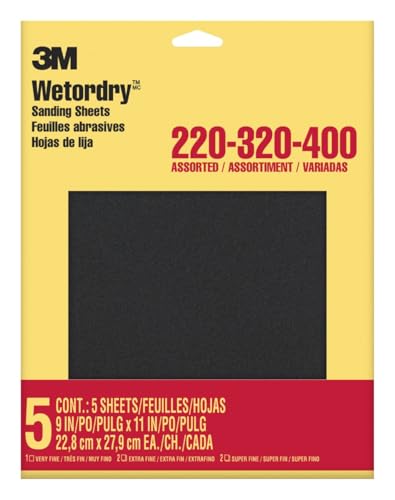
3M Wetordry Assorted Grit Sheets, 5 Sheets, 9 x 11 in
A small multi-grit pack of silicon carbide on waterproof paper, sold for wet and dry sanding and between coats.

Wet dry sandpaper (sold as wet/dry or wet-or-dry) is sandpaper built to survive water: a waterproof backing and bond, usually carrying silicon carbide grain, so you can sand with water or oil to carry away dust or use it dry like any other sheet. It is the paper people reach for between coats of finish, on paint and clear coat, and for fine scratch work, and it is sold both as multi-grit kits and as packs of one grit.
Below is what makes a sheet wet/dry, how it differs from regular sandpaper, whether a kit or a single-grit pack is the better buy, how wet and dry use differ, which jobs it suits, and the packs I’d pick. A few maker pages wouldn’t open for me, so anything I couldn’t confirm from a maker or a listing is marked not stated.
⚡ Quick Answer
Want a mix of grits: the 3M Wetordry assorted pack covers a small project in one buy.
Know your grit: a single-grit pack like the 3M Wetordry 400 gives you more sheets of the one you will use most.
Paint correction finishing: Meguiar’s Unigrit 2000.
Curves and contours: a 3M Wetordry sponge pad.
What Makes Sandpaper Wet/Dry
Regular sandpaper uses a backing and glue that soften when wet. A wet/dry sheet changes that: the backing is waterproof and the bond holds the grain on when the sheet is soaked. Fine Homebuilding makes the point about silicon carbide specifically: waterproof versions won’t degrade when used with water or oil. The listings describe the construction in similar terms. Norton’s Sandwet listing describes waterproof silicon carbide sheets on a paper backing with a full resin bond, for use wet or dry with water, oil or other lubricants, and the 3M assorted pack below lists silicon carbide on waterproof paper.
Silicon carbide is the usual grain because it is sharp and hard. Woodshop News notes it is frequently used in wet sanding applications, and a Hardwood Floors magazine article puts it at 9.5 on the Mohs scale against 9 for aluminum oxide. The same sources agree that the grain is brittle and wears fast, which is not a problem for fine finishing work. If you want the grain compared in detail, see silicon carbide sandpaper.
One caution: I couldn’t open 3M’s or Norton’s own pages for this guide, so I’m not quoting a maker page. What I say about each pack comes from its Amazon listing.
Wet/Dry vs Regular Sandpaper
The names don’t tell you everything, because plenty of regular sandpaper is sold for dry use only so the label on the listing is what counts. These are the differences that matter when you shop.
- Water. A wet/dry sheet can be soaked. A regular sheet will weaken, so keep it dry.
- Dust. Sanding wet keeps the dust down and flushes it out of the scratches. Dry sanding makes dust you have to catch or breathe less of.
- Clogging. Water rinses debris off the face of the sheet. Dry paper loads up with paint and finish faster on fine grits.
- Grain. The wet/dry packs I list are mostly silicon carbide, which is better on paint and finishes than on bare wood. Fine Homebuilding calls it too friable for bare-wood sanding.
- Grit range. Wet/dry sheets are the main source of the very fine grits used for paint correction, up into the thousands. 3M’s 03006 assortment, which I cover in the silicon carbide guide, runs from 1000 to 2500 grit.
For emery cloth, which is a different abrasive on a cloth backing, see emery cloth vs sandpaper.
Grit Kits vs Single-Grit Packs
This is the real buying decision, and it comes down to how well you know the job.
| Pack type | Good for | Watch for |
|---|---|---|
| Multi-grit kit | One project with several steps; first-time buyers; trying a progression | Only a few sheets of each grit; the grit you need most can run out first |
| Single-grit pack | A grit you use often, such as the one you scuff between coats with | You need one pack per grit, so a full progression costs more |
My rule: if you are doing a progression once, buy the kit. If you know the grit your finish asks for and will use it up, buy the single-grit pack. Either way, grit numbers are only half the story. Check that the packs you compare use the same grit scale, as the finer numbers can mean different things on different scales; the sandpaper grit chart has the conversions.
Using It Wet or Dry
Wet is the default for paint, clear coat and fine finishing, where you want a fine, even scratch and little dust. Dry is fine for scuffing between coats or any job where water would get in the way. Fine Homebuilding says waterproof silicon carbide won’t degrade with water or oil, so the liquid is your choice. The step-by-step on keeping the surface wet, how much pressure to use and how to rinse belongs to my wet sanding guide, so I’ll leave it there.
Wet/Dry Sandpaper by Job
Car Paint and Clear Coat
Fine wet/dry grits are the standard stock for paint correction. The 3M Wetordry assortment I list in the silicon carbide guide is a 1000 to 2500 grit pack sold for clear coat polishing and paint defect removal, per its listing, and Meguiar’s lists its Unigrit finishing paper in 2000 grit as leaving a smooth, even sanding pattern that buffs out quickly. Which grit to start with depends on the defect, and I’ve set it out on what grit sandpaper to use for car paint.
Plastic and Metal
3M’s listing for its 400 grit Wetordry sheets says its silicon carbide range, from 400 to 2500 grit, is for non-aggressive sanding and polishing on clear coat, plastic and metal. No maker page I could open ties a single grit to plastic, so use the finer end of the pack, keep the surface wet and check often.
Between Coats
Fine Homebuilding calls silicon carbide an excellent choice for smoothing a finish between coats. The 3M assortment’s listing says the same: use for wet and dry sanding and for sanding between coats of varnish, lacquer, paint and other finishes. Your finish’s can has the last word on grit.
Final Finishing
The very fine packs, from about 1000 up, are the last step before polish. They are finishing papers, not material removers, so they follow coarser grits rather than replace them.
The Packs I’d Buy
These are the packs I’d put on a shopping list from what’s sold on Amazon. I haven’t stated prices, and the specifications come from each Amazon listing.
3M Wetordry Assorted Grit Sheets
Best Multi-Grit Kit for One Project
The listing is a pack of five 3M Wetordry sheets, 9 by 11 inches, in assorted grits, silicon carbide on waterproof paper, sold for wet and dry sanding and for sanding between coats of varnish, lacquer, paint and other finishes. The listing doesn’t say which grits are in the pack, so check the sheets when they arrive. It is a good first buy if you want to try wet sanding without committing to a stack of single-grit packs.
- ✅ Several grits in one small pack
- ✅ Sold for wet, dry and between-coat sanding
- ❌ Five sheets in total, so few of each grit
Best For: A first wet sanding project.
3M Wetordry 400 Grit Sheets
Best Single-Grit Pack for Everyday Use
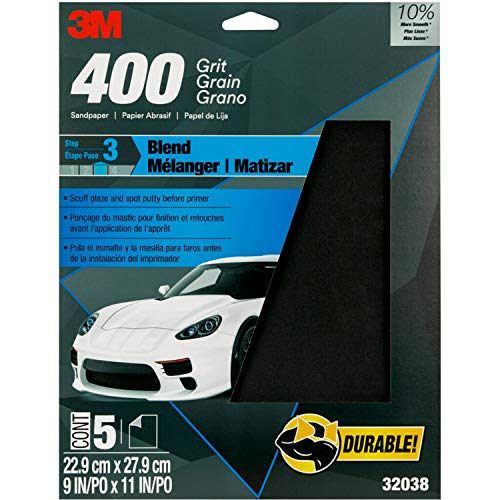
The listing is a pack of five 3M Wetordry 32038 sheets in 400 grit, 9 by 11 inches, silicon carbide that self-fractures for longer life, for wet or dry sanding. 3M pitches it for scuffing glaze and spot putty before primer. It is the kind of grit you reach for repeatedly, so buying it on its own makes sense once you know that.
- ✅ Standard 9 by 11 inch sheets
- ✅ One grit, so no unused sheets of the wrong number
- ❌ Only five sheets in the pack
Best For: Repeat use at one grit.
Meguiar’s Unigrit Finishing Paper, 2000 Grit
Best for the Last Step Before Polish
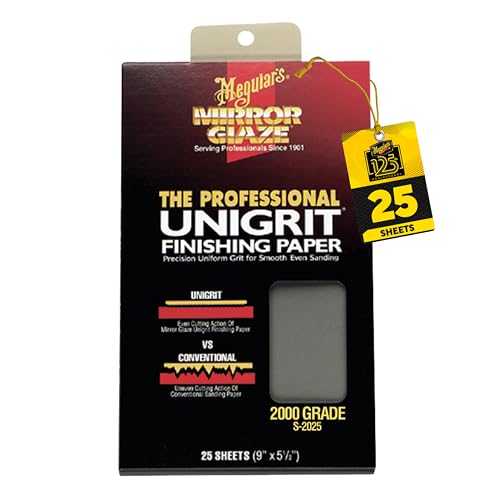
The listing calls this Meguiar’s Professional Unigrit finishing paper in 2000 grit and says it leaves a smooth, even sanding pattern that buffs out in seconds. That is the point of a finishing paper: one fine, uniform scratch that polish can remove. The listing gives 25 sheets of 5.5 by 9 inches, waterproof and safe on all paint finishes and clear coats; the abrasive mineral is not stated.
- ✅ Made for paint correction finishing
- ✅ Uniform scratch pattern, per the listing
- ❌ One grit only, and the finest step at that
Best For: Final wet sanding before polishing.
3M Wetordry Sponge Pad

Best Foam Backer for Curves
The listing is a single 3M Wetordry sponge pad, 5 1/2 by 2 3/4 by 3/8 inch, described as flexible and dual sided, made to accept a variety of abrasive sheets and hold up during wet or dry sanding. A soft pad backs the paper around curves and edges where a flat block would dig in. It is a backer rather than an abrasive, so you still need paper. 3M’s listing marks it for industrial and occupational use.
- ✅ Flexible, follows curves and edges
- ✅ Two working sides
- ❌ No abrasive included: add your own sheets
Best For: Contours and edges.
🏆 The Verdict
Wet/dry sandpaper is waterproof paper for fine finishing, paint and wet work. Buy a multi-grit kit like the 3M Wetordry assortment if you need a progression once, and a single-grit pack like the 3M Wetordry 400 once you know the grit you will keep reaching for. Keep it off bare wood and on finishes. I don’t show customer ratings or prices. More on how I choose the products I recommend.

