
As an Amazon Associate I earn from qualifying purchases. All claims are strictly my personal opinion.
My top pick

Norton Sandwet Job Pack, Silicon Carbide, 600 Grit
25 waterproof silicon carbide sheets, closed coat on paper, for leveling top coats wet or dry before compounding.

Silicon carbide sandpaper is sandpaper made with silicon carbide grain, a harder and sharper abrasive than aluminum oxide that cuts fast on hard, brittle and coated surfaces and leaves a fine, even scratch pattern. The trade-off is that the grain is brittle, so it wears out faster, which is why most woodworkers keep it for finishing work, wet sanding and materials like glass, stone, plastic and paint, and leave bare wood to aluminum oxide.
Below is what silicon carbide is, how it compares with aluminum oxide, what it is used for, how grits and backings work on it, and the sheets I’d pick up. Wherever a maker page wouldn’t open for me, the detail is marked not stated rather than guessed.
What Silicon Carbide Sandpaper Is
Every sheet of sandpaper has three parts: a backing (paper, cloth or film), an adhesive layer, and the abrasive grain glued to it. Silicon carbide is one of the grains. It shows up as a dark gray to black coating, which is why people call it black sandpaper, and it is the grain named in the waterproof wet/dry packs I list below.
Two properties explain how it behaves. First, hardness. A Hardwood Floors magazine article on abrasive grain technology puts silicon carbide at 9.5 on the Mohs scale against 9 for aluminum oxide, so it is slightly harder. Second, brittleness. Woodshop News says silicon carbide abrasives are sharper than aluminum oxide but more brittle, and that they fracture easily and wear faster when sanding wood. Fine Homebuilding describes the grain’s elongated shape as one that shears off easily and calls it too friable for bare-wood sanding.
In practice that means each grain starts sharp and keeps breaking into new sharp edges, but it does so quickly, so a sheet loses bite sooner than a comparable aluminum oxide sheet on tough work. That is a good trade when you want a clean, fine scratch on something hard, and a poor one when you are removing a lot of wood.
One caution on sources: the 3M and Norton product pages I tried to open for this guide would not load for me, so I have not quoted a maker page for any sheet below. What I say about a specific pack comes from its Amazon listing.
Silicon Carbide vs Aluminum Oxide
The two grains are the ones you will actually choose between at the store. Here is how they line up, using the sources named above.
| Question | Silicon carbide | Aluminum oxide |
|---|---|---|
| Hardness (Mohs) | 9.5 | 9 |
| How it wears | Sharper but more brittle; fractures easily and wears faster on wood | Most widely used abrasive in woodworking; balance of cutting speed, durability and cost |
| Bare wood | Too friable, per Fine Homebuilding | Works well, per Fine Homebuilding |
| Between finish coats | An excellent choice, per Fine Homebuilding | Common too; follow your finish’s can |
| Water and oil | Waterproof versions don’t degrade with water or oil | Depends on the backing; check the listing |
| Metal | Wet/dry sheets are sold for it; see the listing for each pack | Works well, per Fine Homebuilding |
The short version: aluminum oxide is the all-rounder and the one I’d reach for first on wood. Silicon carbide is the specialist for finishing, wet work and hard materials. Not every source agrees on every detail. The Hardwood Floors article, for instance, says silicon carbide works well on raw wood, while Fine Homebuilding and Woodshop News say the opposite. I side with the two that agree, and for wood I’d start with aluminum oxide anyway. If you want the full list of abrasive minerals rather than this one comparison, my guide to the types of sandpaper covers them.
What It’s Used For
Between Coats of Finish
This is where silicon carbide earns its place in a woodworking shop. Fine Homebuilding calls it an excellent choice for smoothing a finish between coats, and the reason is the fine, even scratch it leaves on a cured coat. You are not removing wood, so the fast wear matters less. Keep the pressure light, sand only until the surface is dull and even, and wipe the dust off before the next coat. Your finish’s can has the final say on grit. For the full routine on polyurethane see sanding between coats of polyurethane.
Glass and Stone
Glass and stone are hard, and silicon carbide, the harder of the two common grains, is the sensible match. I haven’t stated a grit for glass here, because I don’t have a maker source for one, and glass is easy to scratch the wrong way. My step-by-step is in how to sand glass.
Plastic and Fiberglass
Plastics and cured fiberglass resin are another place the fine, even scratch helps, and waterproof sheets let you keep the surface wet, which carries away dust from a material you don’t want to breathe. I don’t have a maker page that gives a grit for either, so I leave numbers out. Fiberglass has its own dust hazards and a process of its own, which I walk through in how to sand fiberglass.
Metal and Paint
For wet sanding paint, primer and metal, silicon carbide wet/dry sheets are what the listings point to. Both Starcke and 3M list silicon carbide packs for auto body and paint work. If metal is the whole job, you may be better served by a page that compares sheets for it: best sandpaper for metal.
Wet Sanding
Waterproof silicon carbide paper is the default for wet sanding. Fine Homebuilding says waterproof versions won’t degrade when used with water or oil, and Woodshop News notes silicon carbide is frequently used in wet sanding. The technique, water choice and what to do with the slurry belong on the wet sanding guide; the paper itself is covered in wet/dry sandpaper.
Grits and Backings
Silicon carbide sandpaper is sold across a very wide range of grits, from coarse sheets and rolls up to very fine finishing papers. A rule of thumb that holds on any abrasive: the bigger the number, the finer the scratch. The packs below show the range: the Starcke sheets are 220, the Norton Sandwet pack is 600, and 3M’s assortment is 1000 to 2500. 3M’s 400 grit listing says its silicon carbide sheets run from 400 to 2500 grit for non-aggressive sanding and polishing on clear coat, plastic and metal.
Backings matter as much as grit on silicon carbide:
- Paper backing is the standard for sheets. The Norton Sandwet listing says paper backing and waterproof; the Starcke listing says a latex paper backing with an anti-slip coating, for a sheet sander or hand sanding.
- Waterproof is the word to look for if you plan to wet sand. A sheet that isn’t waterproof will break down in water.
- Sheet size is usually 9 by 11 inches, which you cut or fold for a block. 3M’s finishing assortment is a smaller 3 2/3 by 9 inch strip, per its listing.
For where the finest grits sit on the scale, see my sandpaper grit chart. A pack with several grits in it is explained in wet/dry sandpaper.
The Sheets I’d Buy
These are the silicon carbide packs I’d put on a shopping list, picked from what’s sold on Amazon. I haven’t stated prices, and the specifications come from each Amazon listing.
Norton Sandwet Job Pack
Best for Wet Finishing Between Coats
The listing calls this a Norton Sandwet job pack of 25 waterproof silicon carbide sheets in 600 grit, closed coat on a flexible paper backing, for use wet or dry with water, oil or other lubricants. Norton’s own listing line is “for sanding and leveling final top coats prior to compounding,” which is exactly the between-coats and finish-leveling job silicon carbide suits.
- ✅ Silicon carbide, waterproof, paper backing, per the listing
- ✅ A pack of 25 sheets
- ❌ This listing is one grit only: 600
Best For: Wet sanding and smoothing between coats.
Starcke 220 Grit Wet/Dry Silicon Carbide Sheets

Best for First Passes
The listing describes a 25 pack of 9 by 11 inch silicon carbide sheets in 220 grit, waterproof for wet or dry sanding, on a latex paper backing with an anti-slip coating for a sheet sander or hand sanding. It names wood, metal, plastic, paint and automotive work. 220 is the coarser end of silicon carbide, which makes this the pack for the first passes before the finer sheets below.
- ✅ Waterproof silicon carbide on a latex paper backing
- ✅ Named for wood and metal as well as paint and automotive work
- ❌ One grit only, so you need finer sheets for leveling and polishing
Best For: First passes before the finer grits, wet or dry.
3M Wetordry Assorted 1000 to 2500 Grit

Best Fine Assortment for Clear Coat and Paint
This is the fine-finishing pick. The listing names 3M Wetordry sandpaper 03006, a 20-pack of 100 sheets in assorted 1000 to 2500 grit, 3 2/3 by 9 inches, silicon carbide, for automotive clear coat polishing and paint defect removal. Those are very fine grits, so they are a finishing step after coarser work rather than a starting point. The wet sanding steps are on the wet sanding guide.
- ✅ Silicon carbide, several fine grits in one pack
- ✅ Sold for clear coat and paint defect work
- ❌ Too fine for any real material removal
Best For: Final wet sanding before polishing.
3M Wetordry 400 Grit Sheets
Best Single-Grit Pack for Everyday Smoothing
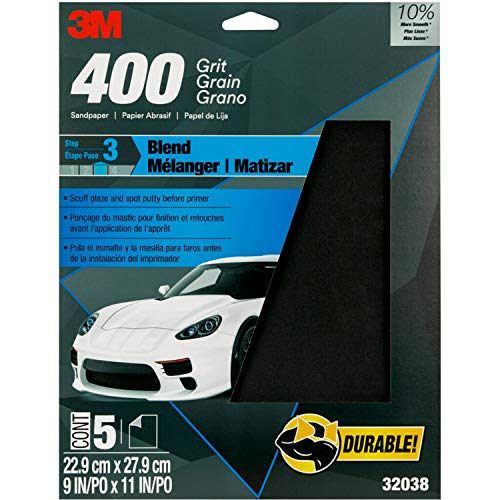
The listing is a pack of five 3M Wetordry 32038 sheets in 400 grit, 9 by 11 inches, with a silicon carbide abrasive that self-fractures for longer life, for wet or dry sanding. 3M pitches 400 for scuffing glaze and spot putty before primer, and the same grit works for light smoothing on a cured finish. It’s the small pack to buy if you only need one grit.
- ✅ Familiar 9 by 11 inch sheets that cut to fit a block
- ✅ Small pack, easy to try
- ❌ One grit and only five sheets
Best For: A first pack for light smoothing.
🏆 The Verdict
Silicon carbide is the finishing and wet-work abrasive: sharper and harder than aluminum oxide, more brittle, and a good match for finish coats, paint, primer and hard materials. It is the wrong first choice for bare wood. For waterproof work I’d start with the Norton Sandwet pack, and for very fine wet sanding the 3M Wetordry assortment. I don’t show customer ratings or prices. More on how I choose the products I recommend.

