
As an Amazon Associate I earn from qualifying purchases. All claims are strictly my personal opinion.
My top pick

3M Pro Grade Precision 3-in-1 Sanding Sponge, 120 Grit
Flat, angled and contoured sides in 120 grit: one sponge for taped joints, inside corners and gentle curves.

A drywall sanding sponge is a foam block coated with abrasive grit, and it is the tool for the last, gentle pass on taped joints, corners and small patches. For most homeowners the best drywall sanding sponge is one with an angled edge in a fine or medium grade, because the angle reaches inside corners that a flat block gouges. Add a wet-sanding sponge when dust is the bigger worry, and keep sandpaper or a screen for the heavy leveling work.
Below are four sponges that suit drywall, a comparison table, short write-ups, and a guide to the choices that matter: dry or wet, which grit, and when a sponge beats sandpaper. This page is only about drywall. For sponges and blocks across every material, see my best sanding blocks and sponges.
Best Drywall Sanding Sponges: Comparison
The table compares what each product is for, using what each Amazon listing states.
| Product | ⭐ 3M Pro Grade 3-in-1 🏆 EDITOR’S CHOICE |
3M Small Area Drywall | Marshalltown QLT Wet | 3M Angled 6 Pack |
|---|---|---|---|---|
| Image | |
 |
 |
 |
| Price | $$ | $ | $$ | $$$ |
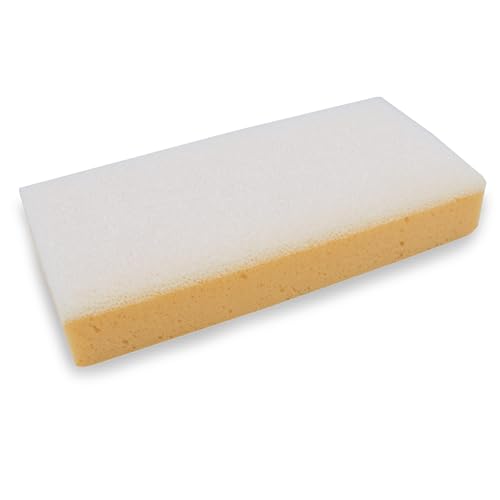
| Shape | Flat, angled and contoured sides | Block, 3.75 x 2.63 x 1 in | Two-sided block | Angled, 4 7/8 x 2 7/8 x 1 in |
| Used | Dry; washable | Wet or dry | Wet | Wet or dry |
| Grit | 120 (medium) | Medium and fine sides | Not stated | Fine |
| Best For | Joints and corners | Patches and flat touch-ups | Low-dust blending | Inside corners |
| Availability | Shop Now | Shop Now | Shop Now | Shop Now |
Key takeaways
- Sponges are for finishing: National Gypsum describes them as flexible and ideal for corners, curves and detailed areas, and says they help you avoid gouging corners.
- A sponge blends and rounds over compound. It does not cut down ridges the way sandpaper or a screen does.
- A damp sponge traps particles before they become airborne, but it is slower and needs a good taping job underneath.
- An angled side is the feature to buy for corners: see the 3M 3-in-1 sponge.
- Don’t go coarser than 100 grit by hand, per National Gypsum: it is too aggressive and can damage drywall.
Best Drywall Sanding Sponges: Reviews
I haven’t handled any of these sponges, so the notes below describe what each one is designed for, from its Amazon listing, and what the sources I read say about sponge sanding.
Editor's ChoiceFlat, angled and contoured sponge
3M Pro Grade Precision 3-in-1 Sanding Sponge, 120 Grit
3M Pro Grade Precision 3-in-1 Sanding Sponge, 120 Grit
Flat, angled and contoured sides in 120 grit: one sponge for joints, inside corners and gentle curves.
Check price on AmazonSpecs: Amazon listing sold as 3M Pro Grade Precision 3-in-1, 120 grit (Creators API, November 2026)
Best for
Joints, corners and edges in a room you are finishing for paint.
- Three working shapes in one sponge
- 120 grit suits the finishing pass
- Two in the pack
Skip it if
You need to level ridges: use sandpaper or a screen.
- Slow on ridges and heavy compound
- Wet use not stated
Read full review
Best Drywall Sanding Sponge for Joints and Corners
This is the sponge I’d pick first for a typical room. The listing describes contoured, angled and flat sides on one sponge, in 120 grit medium, two sponges to a pack, for wood, metal, drywall and paint prep. The angled side runs down an inside corner or along a taped seam without the flat face digging into the neighboring wall, and the flat side handles the joint itself. 120 is also the grit Fine Homebuilding calls a good universal choice for drywall.
Because it is foam, it follows slight curves, which matters on a skim-coated joint where a rigid block would only touch the high points. The listing calls it washable and reusable, keeping its grit and shape across projects. Work lightly: a sponge removes material slowly, which is the point at the finishing stage.
Dual-grit drywall block
3M Small Area Drywall Sanding Sponge, Fine/Medium
3M Small Area Drywall Sanding Sponge, Fine/Medium
A small dual-grit block made for joint compound: medium side to remove, fine side to smooth, wet or dry.
Check price on AmazonSpecs: Amazon listing (3M Small Area Drywall Sanding Sponge, Creators API, November 2026)
Best for
Screw holes, small patches and blending on flat walls.
- Two grits on one block
- Made for joint compound
- Rinse and reuse
Skip it if
You have inside corners or a whole room of fresh compound.
- Square edges are poor in corners
- Small, so slow on a whole wall
Read full review
Best for Patches and Flat Wall Touch-Ups
A plain block sponge is the cheapest way into sponge sanding and the right shape for flat areas: a screw dimple you filled, a hairline you skimmed, a patch that needs blending into the wall. This 3M block is 3.75 by 2.63 by 1 inch, with a medium side to remove and a fine side to smooth, and the listing names joint compound as its job, wet or dry, rinsed and reused. Fine Homebuilding describes the drywall sanding sponge as a small, dense, grit-coated sponge about 1 in. thick that suits finer work after pole or hand sanding, which is exactly this.
It is not the tool for a whole room of fresh joint compound. For that, a pole sander or a pole with a sanding screen covers more wall; see my best pole sanders.
Less dustTwo-sided wet sanding sponge
Marshalltown QLT Drywall Wet Sanding Sponge
Marshalltown QLT Drywall Wet Sanding Sponge
An abrasive side to wet sand and a soft side to wipe the residue, sold as virtually dustless.
Check price on AmazonSpecs: Amazon listing (Marshalltown QLT DWS467-3, Creators API, November 2026)
Best for
Occupied rooms and small repairs where dust is the main concern.
- Far less airborne dust
- Wipes its own residue
- Reusable
Skip it if
You have ridges or heavy compound to level.
- Slower than dry sanding
- Poor on ridges and thick compound
Read full review
Best Drywall Sanding Sponge With Less Dust
Marshalltown is a trowel and drywall-tool maker, and its QLT block is a two-sided wet sponge: the listing describes an abrasive side for wet sanding and a soft sponge side for wiping off the residue, sold as virtually dustless and reusable. You dampen it, wring it out and work it over fully dried joint compound. National Gypsum says a damp sponge traps particles before they become airborne, and calls wet sanding gentler on surfaces and ideal for touch-ups in tight corners and along edges. The trade-off, in the same source, is that it takes more time and effort.
Fine Homebuilding adds two cautions: wet sponges are less effective on ridges and built-up areas, and if you intend to finish-sand with one you really must do a good taping job. Use it to blend a smooth joint, not to rescue a rough one.
Angled sanding sponge
3M Angled Sanding Sponges, Fine, 6 Pack
3M Angled Sanding Sponges, Fine, 6 Pack
Six fine angled sponges for corner and detail work, usable wet or dry.
Check price on AmazonSpecs: Amazon listing (3M CP040-6P, Creators API, November 2026)
Best for
Inside corners where taped seams meet.
- Angled edge sits in an inside corner
- Six to a pack
Skip it if
You already own an angled sponge.
- Overlaps the 3-in-1 if you own that
- All-purpose, not drywall-specific
Read full review
Best for Inside Corners
An angled sponge is made for the spot that causes the most grief: the inside corner where two walls meet. A flat block rounds the corner over or scuffs the opposite wall; an angled sponge sits in the corner and sands one side at a time. This 3M pack has six angled sponges in fine grit, 4 7/8 by 2 7/8 by 1 inch, listed as angled for corner and detail work, wet or dry, washable and reusable. The listing also offers extra fine, medium and coarse grades.
Dry Sponge vs Wet Sponge vs Sanding Screen
Three finishing tools compete for the same job. Fine Homebuilding’s guide to drywall sanding tools gives the cleanest comparison: a screen cuts through joint compound faster than sandpaper, can be flipped when one side dulls and costs more but lasts longer; a dry sponge is for finer work after pole or hand sanding; and a wet sponge suits jobs where dust is a problem but is less effective on ridges.
| Tool | Strength | Weakness | Use it for |
|---|---|---|---|
| Dry sponge | Flexible, reaches corners and curves | Slow cutting, makes dust | Final pass, corners, small patches |
| Wet sponge | Traps dust, gentle | Slow, weak on ridges | Blending smooth joints with little dust |
| Sanding screen | Cuts fast, holes limit clogging | Costs more, stiffer | Leveling joints on a pole or hand block |
| Sandpaper | Best control | Clogs, tears on corners | Tight spots and all-round work |
Wet Sponge Rules
Let the compound dry completely before you wet-sand it. Keep the sponge damp, not dripping, and rinse it often so you are not wiping slurry back onto the wall. Wet sanding makes the wall look smooth, but it won’t flatten a ridge, so scrape or dry-sand high spots first. Afterward, let the wall dry fully before you prime.
Which Grit for a Drywall Sanding Sponge
Sponges are graded by words (medium, fine, extra fine) as often as by grit number, and the grade you want depends on the stage. Fine Homebuilding calls 120 grit a good universal sandpaper and says 150 and finer grits work well for finish sanding. National Gypsum warns against going coarser than 100 grit by hand. As a rule, use a medium sponge to knock down small nibs and a fine one for the final blend. My full guide, what grit to sand drywall, covers the whole sequence from joint compound to primer.
⚠️ Dust Still Counts
Dry sanding produces far more dust than wet sanding, according to National Gypsum. Even with a sponge, wear a dust mask and keep dust out of the rest of the house. For extraction, see my best vacuum for drywall dust.
How to Sand Drywall With a Sponge
- Let the compound dry fully. Sanding damp compound smears and clogs the sponge.
- Knock down ridges first. A sponge won’t cut them. Use a drywall knife, sandpaper or a screen.
- Start with the grade you need. A fine sponge is plenty for a smooth skim. Use a medium only on slight roughness.
- Use light, even pressure and long strokes along the joint, so you don’t dig a trough beside it.
- Use the angled edge in corners and sand one side of the corner at a time.
- Wipe the wall with a dry or barely damp cloth, then check it with a raking light before priming.
For the full process, see my guides on how to sand drywall and how to sand a drywall patch.
Sanding Sponge vs Sandpaper
National Gypsum says sponges are durable and long-lasting compared with sandpaper, which is a real advantage if you are sanding corners and curves, where paper tears or loads up. Fine Homebuilding takes the other side on control: it says sandpaper allows the best control of any sanding method, which makes it the choice for tight spots such as inside corners. Both can be right. Sponges win on comfort, curves and not gouging; paper wins on leveling and precision.
My rule: use paper or a screen for leveling, and a sponge for blending and edges. If you want more than a sponge, a pole sander handles walls and ceilings without a ladder; see my best pole sanders.
How I Chose These Sponges
I looked for drywall-capable sponges from tool makers that sell on Amazon, covering the roles that matter: an angled all-rounder, a flat block, a wet option and a corner sponge. I don’t show prices or ratings: each pick carries a price tier, and the Amazon button shows the live price. The specs come from each Amazon listing, because the maker pages would not open for me; where a listing leaves a detail out, I say so.
🏆 The Verdict
For most drywall work, the 3M Pro Grade Precision 3-in-1 sponge is the one to buy: an angled side for corners, a flat side for joints and 120 grit for the finishing pass. Add the Marshalltown QLT wet sponge when dust matters, and keep sandpaper or a screen for leveling.
❓ Frequently Asked Questions
Is it better to sand or sponge drywall?+
What is the best sponge for wet sanding drywall?+
What do professional drywallers use to sand?+
How to sand drywall with little dust?+
Conclusion
Pick an angled sponge for corners and joints, a block for flat touch-ups and a wet sponge when dust is the problem. Leave the heavy leveling to paper or a screen, and finish with the grit advice in my guide on what grit to sand drywall. Questions about your wall? Leave a comment below.
