
As an Amazon Associate I earn from qualifying purchases. All claims are strictly my personal opinion.
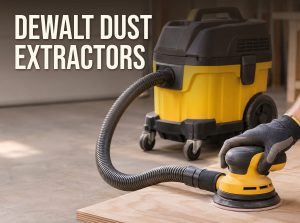
Every DeWalt dust extractor comes in one of three shapes: the corded 8-gallon DWV010, the corded 10-gallon class led by the DWV012 and DWV015, and the cordless FLEXVOLT DCV585B. For a sanding bench, the DWV010 is the one I’d look at first, because DeWalt’s own spec page lists automatic filter cleaning, tool-triggered start and a 15-foot hose in a unit that weighs 21 pounds. The cordless DCV585B is a small 2-gallon unit for people already on the FLEXVOLT battery system. The 10-gallon corded models are for a bigger shop.
Below is every DeWalt extractor side by side, what each one is built for, which hoses and adapters matter when you connect a sander, how DeWalt compares with Festool and Bosch, and when a shop vac is enough. Every number in this guide comes from a page I opened on November 20, 2026, and where I couldn’t open one, I say “not stated”.
⚡ Quick Answer
Most sanding jobs: the corded DWV010 8-gallon extractor, with automatic filter cleaning and tool-triggered start.
Bigger shop or concrete work: the DWV012 or the 10-gallon DWV015, both corded.
No outlet nearby: the cordless DCV585B, sold as a bare tool, so you need a FLEXVOLT battery.
Every DeWalt Extractor at a Glance
This table uses the DeWalt product pages I could open. The DWV012 is the gap: DeWalt’s own page for it didn’t open for me, so its row says “not stated” wherever I have no page to cite. Check the current DeWalt page before you buy, because the range changes.
| Model | Tank | Power | Filter and cleaning | Hose |
|---|---|---|---|---|
| DWV010 | 8 gal | 120V corded, 15 amp | Two DWV9330 HEPA filters, auto clean every 30 seconds | 15 ft anti-static (DWV9316) |
| DWV012 | Not stated | Not stated | Two HEPA filters, auto clean every 30 seconds (trade review) | Twist-lock end, size not stated |
| DWV015 | 10 gal | 120V corded, 15 amp | Two DWV9330 HEPA filters, auto clean every 30 seconds | 15 ft, 36mm antistatic (DWV9336) |
| DCV585B | 2 gal | FLEXVOLT 20V/60V MAX battery, sold separately | Dual filters with auto cleaning, plus HEPA | 8 ft anti-static, AIRLOCK system |
One pattern runs through the corded models: a pulse that cleans the filter every 30 seconds, tool actuation that starts the extractor when your sander starts, and HEPA filtration that DeWalt ties to the EPA’s lead paint rule. Sanding is the job where fine dust clogs a filter fastest, so the auto-clean pulse is the feature that matters most here.
DeWalt DWV012: The Corded Extractor With Automatic Filter Cleaning
What the Trade Review Says
DeWalt’s own DWV012 page wouldn’t open for me, so I’m relying on the Journal of Light Construction’s review of the machine. It describes two HEPA filters cleaned by a solenoid-operated butterfly valve that reverses the airflow through one filter at a time. The first cleaning happens a few seconds after startup and then repeats at 30-second intervals, so each filter is cleaned about every 60 seconds. Suction drops briefly during each cleaning.
Bags, Hose and Speed Control
The same review says the machine takes paper bags, fleece bags and open-top plastic liners, and can run without a bag at all. A speed-control knob lowers suction, or lowers the combined amp draw of the tool and the extractor so you don’t trip a breaker. The hose end is a twist-lock fitting made for the dust ports and shrouds on DeWalt’s Perform and Protect tools, and the review says adapters exist for older DeWalt models and other brands.
Is It Still Sold?
I couldn’t confirm the current status of the DWV012 from DeWalt, and capacity, airflow and weight are not stated on any page I could open. That is why the DWV010 is my lead pick here: it has a live DeWalt page with a full spec list. If you find a DWV012 for sale, check the tank size, hose and filter numbers against the listing before you pay.
DeWalt DWV012 Wet/Dry HEPA Dust Extractor
Best for a Bigger Corded Shop Setup
The DWV012 is the corded DeWalt with a bag choice and a speed knob, which makes it the flexible one if you switch between sanding and messier jobs. Look for the current model at a DeWalt dealer before you commit.
- ✅ Two HEPA filters, cleaned in turn every 30 seconds
- ✅ Takes paper, fleece or plastic liner bags, or none
- ✅ Speed control to share a circuit with the tool
- ❌ Capacity, airflow and weight not stated on a page I could open
Best For: A shop that wants a bagged or bagless corded DeWalt with adjustable suction.
DeWalt DWV010: The 8-Gallon Extractor I’d Start With
Specs From DeWalt’s Page
DeWalt lists the DWV010 as an 8-gallon, 120V, corded wet/dry HEPA extractor with a 15 amp motor. The overview gives 155 CFM and the feature list gives 150 CFM, so the page disagrees with itself by a few CFM. It weighs 21 pounds and has heavy-duty wheels and casters. Automatic filter cleaning pulses every 30 seconds, and Power Tool Actuation turns the extractor on and off when a connected power tool runs.
What Comes in the Box
DeWalt’s page lists the extractor, two DWV9330 HEPA filters, a DWV9316 15-foot anti-static hose and a DWV9402 fleece bag. The hose has a universal connector with a swivel. DeWalt says the unit meets the EPA’s RRP rule for HEPA vacuums only when the DWV9330 filters are used, and it lists the extractor as part of an OSHA-compliant system under 1926.1153. If you buy spare filters, those are the numbers to match. The hose diameter isn’t given on the page, which matters for sander adapters, so see the fit section below.
Who Should Step Up to the DWV015
The DWV015 is DeWalt’s 10-gallon corded unit. DeWalt lists 155 CFM, a 73-inch static water lift, a 15-foot 36mm antistatic hose and a 36mm Air Lock adapter, with two DWV9330 filters. Its assembled footprint is 23 inches long and 19.45 inches wide, and it carries a 3-year limited warranty. Weight isn’t listed. For a sanding bench you don’t need the extra tank, but if you run a floor sander or a concrete grinder it earns the space.
DeWalt DWV010 8-Gallon HEPA/RRP Dust Extractor
Best DeWalt Extractor for Sanding
The DWV010 is the one I’d pick for a sander because DeWalt documents every part that matters: HEPA filters, a self-cleaning cycle every 30 seconds, tool-triggered start and a 21-pound body you can move around a workshop. I don’t have a single Amazon listing for the machine that I’m happy to send you to, so below is a plain Amazon search for DeWalt dust extractors instead; match the model number in the listing title to the one you want before you buy.
- ✅ Automatic filter cleaning every 30 seconds
- ✅ Power Tool Actuation for sander-triggered start
- ✅ 21 pounds, with heavy-duty wheels and casters
- ❌ Hose diameter and dimensions not listed on DeWalt’s page
Best For: Workshop sanding with a random orbital or detail sander.
DeWalt Cordless Dust Extractor: The FLEXVOLT DCV585B
What It Is
The DCV585B is a 60V MAX FLEXVOLT cordless extractor. DeWalt lists 125 CFM, a 2-gallon capacity, an 8-foot anti-static hose with the AIRLOCK system, dual filters with automatic cleaning and a HEPA filter. It runs on a FLEXVOLT 20V/60V MAX battery that is sold separately, and DeWalt says it works with 20V MAX tools too. Runtime and weight aren’t listed on the page I opened.
Wireless Tool Control and Compliance
The unit comes with a wireless tool control remote that switches it on and off, and it also pairs with compatible tools. DeWalt rates it for OSHA Table 1 compliance with tuckpointing and surfacing up to 5 inches when you pair it with an appropriate dust shroud, and for the EPA RRP rule when you use the included HEPA filter. It has a 3-year limited warranty on the Canadian page.
Cordless or Corded for Sanding?
The small tank fills fast on drywall or paint removal, so I wouldn’t pick it as a main shop extractor. It makes sense on a ladder, in a room without a convenient outlet, or when you’re already carrying FLEXVOLT batteries. A cord and a bigger bin are simpler for a day of sanding at a bench.
DeWalt FLEXVOLT 60V MAX Cordless Dust Extractor DCV585B
Best for Cordless Jobsite Work
The DCV585B is the cordless pick when there is no outlet or you move between rooms. It is sold as a tool only, so budget for a FLEXVOLT battery and charger if you don’t own them, and buy it new from a DeWalt dealer.
- ✅ No cord, runs on FLEXVOLT batteries
- ✅ Wireless Tool Control remote included
- ✅ HEPA filter and auto filter cleaning
- ❌ 2-gallon tank, battery and charger not included
Best For: Cordless jobsite sanding and cleanup where a power outlet is a hassle.
Hoses, Adapters and Fit With Other Sanders
Hose Sizes and Connectors by Model
The DWV010 ships with a 15-foot hose that has a universal connector and a swivel, but DeWalt’s page doesn’t give its diameter. The DWV015 uses a 36mm hose and a 36mm Air Lock adapter. The DCV585B uses an 8-foot hose with the AIRLOCK system. That means extractors from the same brand can need different adapters, so read the part number on your hose before you buy a reducer. For DeWalt tools and shrouds on a 1-1/4 inch vacuum hose, DeWalt’s DWV9000 universal tool connector is the part the listing describes for that job, with a positive lock on the dust port and a swivel.
Connecting a DeWalt Extractor to Your Sander
The trade review of the DWV012 says its hose end is a twist-lock fitting for DeWalt dust ports and that adapters cover older DeWalt tools and other brands. Beyond that, I can’t promise a given sander fits a given hose, because the dust port size on a sander differs by model. The port on your sander and the hose end on the extractor decide the adapter you need, and my guide on how to connect a sander to a shop vac or extractor goes through them brand by brand. If you’re still choosing a sander, the DeWalt sanders guide covers which models to look at.
Filters and Bags to Keep on Hand
For the DWV010 and DWV015, DeWalt names the DWV9330 HEPA filter, and the DWV9402 fleece bag is listed for the DWV010. Fine sanding dust fills a filter quickly, so the auto-clean pulse helps, but a fleece bag keeps the filter from loading in the first place. Buy the spare filter before you need it, since RRP compliance depends on the DWV9330.
- DeWalt DWV9330 HEPA filter, 2-pack: the replacement filter DeWalt names for the DWV010 and DWV015.
- DeWalt DWV9402 fleece bags, 5-pack: DeWalt’s page lists the bag for the DWV010, and the Amazon listing names the DWV012.
DeWalt vs Festool vs Bosch Extractors
This page is about the brand, so I’m keeping the comparison to what a DeWalt buyer needs to know. Brands that sell both sanders and extractors tend to design the hose and dust port to work together, and the best fit is usually the one whose hose and port match your sander without an adapter. DeWalt’s corded range runs on a standard 120V outlet and uses automatic filter cleaning on the models above. For Festool’s range, see my guide to Festool dust extractors.
If you’re comparing brands for a particular sander rather than reading about DeWalt, my ranking of the best dust extractors sets them against each other, and the best dustless sander guide shows the sander side of the pairing. I haven’t compared Bosch’s current range against these DeWalt models, so I won’t rank them here.
Dust Extractor or Shop Vac?
A dust extractor is built for fine dust: it filters it through HEPA, cleans the filter by itself and starts when the tool does. A shop vac is built to pick up debris and liquids, and its filter loads up quickly on sanding dust. The extractors above are the sanding-grade DeWalt options. For a deeper look, read dust extractor vs shop vac.
If you only sand a few times a year, a shop vac with a fine-dust filter works, and you can connect your sander to it. If you sand most weeks, or you work with old paint, the self-cleaning filter and HEPA rating on the DWV010 pay for themselves in time and cleanup.
🏆 The Verdict
For sanding at a bench, I’d choose the DeWalt DWV010: 8 gallons, HEPA, auto filter cleaning and tool-triggered start in a 21-pound body. Go to the DWV015 only if you need the bigger tank. Pick the cordless DCV585B when an outlet isn’t practical and you already own FLEXVOLT batteries.
❓ Frequently Asked Questions
What is a DeWalt dust extractor used for?+
Is the DeWalt vacuum any good?+
Can I use a shop vac as a dust extractor?+
Is a dust extractor more powerful than a shop vac?+
Conclusion
The DeWalt choice comes down to where you work. The DWV010 is the sanding-bench extractor, the DWV015 is the bigger corded step up, and the cordless DCV585B is for places without an outlet. Match the hose and adapter to your sander before you buy, and keep a spare DWV9330 filter on the shelf. If you’re building a dust-free setup from scratch, start with the best dustless sander guide and then pair it with an extractor from this page.

