
As an Amazon Associate I earn from qualifying purchases. All claims are strictly my personal opinion.
My top pick

Griot's Garage G9 Random Orbital Polisher
A free-spinning 6" DA with a 9 mm orbit that is forgiving on a first paint correction.

Dual action polisher vs rotary, for a first paint correction: buy the dual action (DA) polisher, not the rotary. A rotary cuts faster, but it puts heat into one spot and leaves its own fine scratches if your technique slips. A DA cuts more slowly and forgives almost everything a beginner does, which is exactly what you want on paint you can’t repaint.
The short version is below, then how each machine actually moves the pad, why that decides the risk, when a rotary earns its place, and the machines I’d pick if you are starting out.
⚡ Quick Answer
First correction on your own car? A corded 6″ DA like the Griot’s Garage G9.
Want to work away from an outlet? The cordless Milwaukee M18 FUEL 2684-20.
Already confident, with heavy sanding marks to remove? A rotary such as the Makita 9237CX3, after you have learned on a DA.
DA vs Rotary Polisher at a Glance
| Feature | Dual Action (DA) | Rotary |
|---|---|---|
| Pad motion | Spins and orbits at the same time | Spins in one direction only |
| Cutting speed | Moderate | Faster |
| Heat build-up | Slow and spread out | Fast, and concentrated |
| Risk of holograms | ✅ Low | ❌ Higher, follows the spin direction |
| Edges and body lines | More forgiving | Where most rotary damage happens |
| Learning curve | Gentle | Steep, needs practice |
| Wax and sealant | ✅ Works well at low speed | Possible, but no advantage |
| Best for | First correction, finishing, waxing | Heavy defects and sanding marks, in experienced hands |
| Typical price tier | $$ to $$$$ | $$ to $$$ |
How Each One Moves the Pad
Everything else in this comparison follows from one question: what path does the pad take across the paint?
The Rotary Polisher
A rotary polisher spins the pad in a single direction on one axis, like a drill. The motion is fixed and continuous, so all the friction goes into the same circular path. That is why it cuts quickly, and also why it needs a steady hand: the machine does exactly what the spindle does, whatever your arm does.
The Free-Spinning DA
A dual action polisher combines two movements at once, a rotation and an orbit, so the pad spins while it also travels around a central point. The pattern never repeats exactly. That is the “dual action.” If you press hard or tilt the machine, the pad slows or stops spinning, and it loses most of its cutting ability. Beginners often read that as a flaw. It is also a safety valve.
Forced-Rotation and Gear-Driven Machines
Some DAs are forced-rotation: a gear makes the pad turn even under pressure. One detailing guide describes forced-rotation DAs as generally more aggressive than the free-spinning type, so they suit tougher defects but ask for more skill (CarWashWiz). The Festool ROTEX is a good example of a gear-driven tool that does both jobs: its page lists a gear-driven rotary mode, a random orbit mode and a polishing mode in one 6″ machine (more in my guide to Festool sanders).
Long-Throw and Short-Throw DAs
The size of the orbit is called the throw. Smaller-throw machines are easier to control; bigger-throw ones cover a flat panel faster. Milwaukee’s cordless polisher, for example, is named for its 15 mm orbit. Whichever you choose, check the orbit figure on the maker’s page before you buy, because the same word “DA” covers a wide range of machines.
Cut Speed vs Risk
If you only remember one thing from this page: a rotary buys you speed by spending safety margin.
Heat and Burn-Through
One detailing source says that on a rotary, heat builds fast across the whole area you are working, and that machine speed is the main control on it (OCD Detailing). On a DA, friction is spread over a constantly changing pattern, so heat builds slowly and evenly. Clear coat is thin. Heat plus pressure in one spot is how paint gets burned through, and a burn-through means a repaint, not a re-polish.
Holograms and Swirl
Holograms are fine, directional scratches. They are hard to see in shade and show up under direct light. A rotary’s fixed rotation makes marks that follow one direction, and according to the same source, heat usually tips it over: the compound dries and hardens, and the result is fine scratches in line with the spin. A DA’s random movement makes holograms much harder to create. If a rotary leaves them, the usual fix is a finishing pass with a DA and a fine polish.
Edges and Body Lines
On edges, sharp body lines and angled surfaces, pad contact shrinks to a small point, so heat builds faster. OCD Detailing says this is where most paint damage from a rotary happens. A DA is more forgiving here, though you should still go gently, and keep the pad off sharp edges where you can.
Wet-Sanded Paint Is a Different Case
If you have wet-sanded a defect, you have already removed some clear coat, so there is less to lose. That is one more reason to start with a DA: it removes the sanding haze without taking much more. My guide to wet sanding clear coat covers the sanding side, and rubbing compound vs polishing compound explains which product goes on the pad.
Takeaway: a DA trades some cutting speed for a very wide safety margin. For a first correction, that trade is nearly always worth it.
When a Rotary Is Worth It
Heavy Defects and Sanding Marks
A rotary’s one-direction spin concentrates cut, which is why detailing sources say it is faster and more powerful for severe defects and sanding-mark removal. If a DA is crawling through deep marks after you have already tried a more aggressive pad and compound combination, a rotary is the next step, for someone who has already practiced.
Large Panels and Frequent Work
A rotary saves time if you correct paint often or work on a lot of panels. A hobbyist doing one car once a year rarely gets enough benefit to justify the risk.
How to Use a Rotary Polisher Safely
This is not a full tutorial, but the habits that matter are consistent across the sources I read. Start at a low speed and keep the pad flat on the panel. Keep the machine moving. Take extra care on edges and body lines. Check the panel temperature with the back of your hand often, and let it cool if it feels warm. Practice on a scrap panel or an old hood first, never on the car you care about. Finish with a DA and a fine polish to clear any holograms.
Can You Wax With Either?
Yes, and a DA is the better one. At low speed, a DA is well suited to working wax into paint, and CarWashWiz calls this use “perfect” for the job. A rotary can apply wax too, but you get no benefit from its extra cut at that stage, and you carry all the risk. If you buy a DA, you have a polisher and a wax applicator in one tool. Use a clean, soft finishing pad, low speed and light pressure.
The Polishers I’d Pick
Two DAs from my full list of the best car polishers, then one rotary-class machine for later. I’m going by what the makers publish. If your sanding is still ahead of you, start with my guide to the best sander for auto body work.
Griot’s Garage G9 6″ Random Orbital Polisher
Best First DA
A corded 6″ random orbital polisher, my first pick for someone correcting paint at home for the first time. It is a free-spinning DA, so it carries the forgiving behavior described above. Its listing gives a 1,000 W motor, a 9 mm orbit, a 6″ vented backing plate, six speed settings from 2,000 to 6,400 OPM and a 10 ft cord, and it converts to 5″ pads with an optional plate.
- ✅ Forgiving DA motion for a first correction
- ✅ 6″ plate for faster coverage
- ❌ Corded
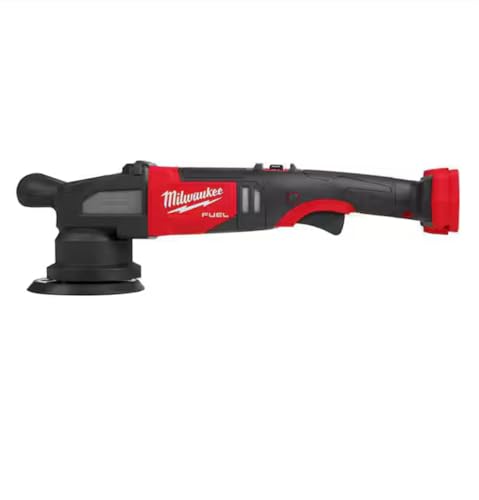
Milwaukee M18 FUEL 15 mm Random Orbital Polisher (2684-20)
Best Cordless DA
A cordless DA on M18 batteries with a 15 mm orbit, a 5″ backing plate in the box and an 8-position speed dial from 2,650 to 5,100 RPM, according to Milwaukee. No cord to drag across the paint is a real plus when you are working around a whole car. It is sold as a bare tool, so you need a battery and charger.
- ✅ No cord on the paint
- ✅ 8-position speed dial
- ❌ Battery and charger sold separately
- ❌ Top price tier
Makita 9237CX3 Variable-Speed Polisher

A Corded Polisher for Later
This is the kind of large, fixed-spindle polisher people usually mean by “rotary”, but Makita’s page does not use that word, so confirm the motion before you buy. What it does list: variable speed from 0 to 3,200 RPM, a 10 A motor, a 7 lb net weight, an 8″ round pad size, soft start to keep compound from flinging off, and constant speed control under load. It is a tool for after you have learned on a DA.
- ✅ Variable speed with soft start
- ✅ Constant speed control under load
- ❌ 7 lb net weight, tiring on vertical panels
- ❌ Not a first-timer’s machine
🏆 The Verdict
Buy a DA first. The Griot’s Garage G9 is my pick for a corded first machine and the Milwaukee 2684-20 for cordless. It cuts slower than a rotary, but it will not burn through your paint or leave the same holograms, and you can use the same machine to wax. Add a rotary only when you have the practice and the defects to justify it.
❓ Frequently Asked Questions
What’s better, a rotary or dual action polisher?+
Are dual action polishers better?+
Can you wax a car with an orbital polisher?+
How to use a rotary polisher?+
Is an orbital polisher the same as a DA polisher?+
Not sure which machine suits your car and your sanding marks? Describe the job in the comments and I’ll tell you which I’d start with.

